Section: Module 1: Lesson 3: Cycloalkanes | Organic Chemistry 1 | NextGenU.org
-
Upon completion of this lesson, you will be able to:Student Learning Outcomes:
- Correctly name cycloalkanes given their chemical formula or structural representation.
-
Identify, name, and draw cis and trans stereoisomers of di-substituted cycloalkanes.
- Compare the energies of cycloalkanes, and explain ring strain.
- Visualize the conformations of cyclohexanes using models.
- Illustrate and identify axial versus equatorial substituents on cyclohexane chairs, and predict the most stable conformations of di-substituted cases.
-
Students mustMark as done
Required Learning Resources and Activities
-
Students mustView
Read the content under the headings "The IUPAC Systematic Approach to Nomenclature" and "Cycloalkanes." (4 minutes)
Virtual Textbook of Organic Chemistry Michigan State University
-
Students mustView
Read the entire webpage. (6 minutes)
Kwantlen Polytechnic University
-
-
-
Students mustViewStart discussions: 1
General Instructions
In this activity, you will be given a series of questions. These questions will involve naming alkenes from their molecular structure, drawing structures from given names, examining energy diagrams of different conformations, and investigating stability based on conformation. The link to a chemistry drawing tool is provided; you should explore the features and familiarize yourself with the functions before starting the activity. Note that you are not required to share the structures or mechanisms you drew when sharing your responses.
Step 1 - Review
Review the material from this module, paying particular attention to the different representations used for alkanes and factors affecting stability.
Step 2 - Respond
Answer the following questions:
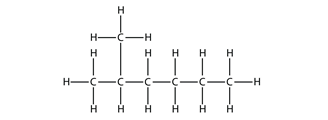
Explain the process of naming alkanes using the IUPAC rules for the structures below:
Using the chemistry tool, draw the structures for the alkanes below and explain the process you used in determining the structure:
2, 3 dimethyl-heptane
3-ethyl-2-methyl-heptane
1, 2-dimethylcyclohexane
Examine the information presented and discuss the points below:
What does this graph aim to represent?
Why is the eclipsed formation more stable?
Why is there rapid rotation at room temperature?
Cis/Trans nomenclature can be used to describe the relative positioning of substituents on molecules with more complex ring structures. Examine the molecular structure provided below:
Are the OH and the adjacent methyl group cis or trans to each other?
What can you deduce about the relative positions of the indicated hydrogens?
Which of these chair conformations are the most stable and why?
Step 3: Share
You are required to share your answers to Questions 1, 3, 4, and 5.
To share your work, click the “Add a new discussion topic” button under this post and paste your work into the “Message” box. Make sure to reference others’ intellectual property when necessary. All references should follow 7th Edition APA formatting. For further instructions, see the resource on the Himmelfarb Health Sciences Library: APA citation resource (N.B.: references are excluded from word counts).Step 4: Interact
To complete the activity, evaluate and categorize the work from one of your peers based on items A - E of the rubric below. Provide a rationale for your grade and comments or suggestions for improvement. To post a reply, click “Reply” on a particular discussion, write your feedback, and click “Post to forum.” You can use the list below as an example:
Item A is .…. because…. My suggestions for improvement are….
Item B is .…. because…. My suggestions for improvement are…
Item C is .…. because…. My suggestions for improvement are….
Item D is .…. because…. My suggestions for improvement are….
Item E is .…. because…. My suggestions for improvement are….OPTIONAL Step 5: Interact (10 minutes)
If you would like to, you can reply to your peers' posts in a respectful and professional manner. Ensure that your post engages your peers' ideas by including a reflection on their comments, sharing ideas of other potential difficulties and parties involved, or asking thought-provoking questions. If a peer comments on your posting, please reply. To post a reply, click “Reply” on a particular discussion, write your feedback and then click on “Post to forum.”
-
Quiz: Module 1
To access the quiz, click on the name of the quiz provided above. On the following screen, click the attempt quiz button to view the case studies and respond to the questions.
TO PASS THIS QUIZ YOU MUST OBTAIN A SCORE OF 80%.