Section: Module 3: Lesson 8: Bond Length and Strength | Organic Chemistry 1 | NextGenU.org
-
Upon completion of this lesson, you will be able to:Student Learning Outcomes:
- Determine bond order, bond length, and bond strength from Lewis structures.
-
Apply the periodic table trends to relate bond strength to bond order.
-
Students mustMark as done
Read the content under the heading "Bond Length." (4 minutes)
Chemistry Libre texts - 2014
-
Students mustViewStart discussions: 1
General Instructions
In this activity, you will be given a series of questions. These questions will involve identifying the placement of formal charges, discussing resonance, and discussing hybridization. The link to a chemistry drawing tool is provided; you should explore the features and familiarize yourself with the functions before starting the activity. Note that you are not required to share the structures or mechanisms you drew when sharing your responses.
Step 1 - Review
Review the material from this module, paying particular attention to formal charges, resonance structures, hybridization, and electron mechanisms.
Step 2 - Respond
Answer the following questions:
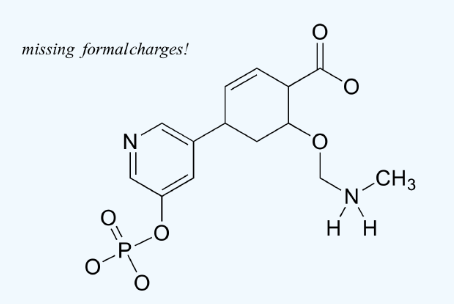
Examine the molecular structure below. The structure should have a net charge of -2. Where would you place the formal charges? Explain your reasoning.
Benzene is a common organic solvent previously used in gasoline; it is no longer used for this purpose, however, because it is now known to be a carcinogen. The benzene molecule (C6H6) consists of a regular hexagon of carbon atoms, each of which is also bonded to a hydrogen atom. Use the concept of resonance to describe the bonding in benzene. You can use the chemistry tool to draw and visualize the resonance structures to help you.
Based on resonance conformation, which structure is more stable?
Determine the hybridization (sp, sp2, sp3) of the indicated atom and indicate the atom's shape from the Lewis structures below:
The Carbon
The Oxygen
Step 3: Share
To share your work, click the “Add a new discussion topic” button under this post and paste your work into the “Message” box. Make sure to reference others’ intellectual property when necessary. All references should follow 7th Edition APA formatting. For further instructions, see the resource on the Himmelfarb Health Sciences Library: APA citation resource (N.B.: references are excluded from word counts). Note that you do not need to share your drawings done in the Chemistry tool, but you can discuss them if needed.
Step 4: Interact
To complete the activity, evaluate and categorize the work from one of your peers based on items A - E of the rubric below. Provide a rationale for your grade and comments or suggestions for improvement. To post a reply, click “Reply” on a particular discussion, write your feedback, then click “Post to forum.” You can use the list below as an example:
Item A is .…. because…. My suggestions for improvement are….
Item B is .…. because…. My suggestions for improvement are….
Item C is .…. because…. My suggestions for improvement are….
Item D is .…. because…. My suggestions for improvement are….
Item E is .…. because…. My suggestions for improvement are….OPTIONAL Step 5: Interact (10 minutes)
If you would like to, you can reply to your peers' posts in a respectful and professional manner. Ensure that your post engages your peers' ideas by including a reflection on their comments, sharing ideas of other potential difficulties and parties involved, or asking thought-provoking questions. If a peer comments on your posting, please reply. To post a reply, click “Reply” on a particular discussion, write your feedback and then click on “Post to forum.”
-
Quiz: Module 3
To access the quiz, click on the name of the quiz provided above. On the following screen, click the attempt quiz button to view the case studies and respond to the questions.
TO PASS THIS QUIZ YOU MUST OBTAIN A SCORE OF 80%.