

Section: Module 4: Lesson 2: Strengthening Collaboration in Public Health Response | Rural Health and Aging | NextGenU.org
-
Student Learning Outcomes:
Upon completion of this lesson, you will be able to:- Define interprofessional, interdisciplinary, and transdisciplinary relationships in the public health context.
- Analyze the implications of collaborative relationships in providing and delivering health services to older adults in a rural community.
- Discuss the significance of strengthening public health response for providing improved health care services.
- Review the role of collaborative relationships in strengthening practices, strategies, and priorities so that public health response can provide adequate health care services.
- Investigate how a given approach (such as a health preparedness program) can strengthen the public health response for providing health care services to older adults in rural communities.
-
Students mustMark as done
Required Learning Resources and Activities
-
Students mustView
Read the first section "Introduction." (1 minute)
Journal of Public Health-2014
-
Students mustView
Read the section "The Role of Interdisciplinary Teams in Physical and Rehabilitation Medicine (Types of Teams)." (4 minutes)
Journal of Rehabilitation Medicine-2018
-
Students mustView
Read "Key Concepts- Inter-Professional Education & Collaborative Practice" on page 13. (2 minutes)
World Health Organization-2010
-
Students mustView
Read the entire case report. (43 minutes)
Journal of Physical Therapy Education-2014
-
Students mustView
Read the content under the heading "Investments in Public Health Improve Health Outcomes and Reduce Health Care Spending," "Lack of Investment has led to a Dangerously Underfunded Public Health Infrastructure" on page 8, and "Substantially Increase Funding to Strengthen the Public Health Infrastructure and Workforce," and "Safeguard and Improve Americans’ Health" on pages 25 and 26. (13 minutes)
Trust for America's Health Organization-2020
-
Students mustView
Read the entire fact sheet. (8 minutes)
National Association of County and City Health Officials: The National Connection for Local Public Health-2017
-
Students mustView
Read Section 1 on pages 2-3 and Section 3 on pages 15 - 29. (34 minutes)
U.S. Department of Health and Human Services | Health Resources and Services Administration-2019
-
Students mustView
Read content under "Contextual Background: Configuration of Health-Care and Public Health Services" and "Catalyzing a virtuous cycle of collaboration until Guidance and Training" on pages 11 to 20. (35 minutes)
World Health Organization-2018
-
Students mustView
Read the entire article. (33 minutes)
Disaster Medicine and Public Health Preparedness Journal by Society for Disaster Medicine and Public Health (SDMPH)-2017
-
Students mustView
Read the entire article. (50 minutes)
Human Resources for Health-2021
-
Students mustView
Watch the entire webinar. (62 minutes)
-
Students mustViewStart discussions: 1
This assignment is a summative evaluation where you will demonstrate the knowledge, skills, and attitudes acquired during the course. You are going to make a proposal for a program that can strengthen public health response for providing health care services to rural older adults.
Learning Resources: Learning Resource 1, Learning Resource 2
Step 1. Review
Review all of the contents of Module 4 Lesson 2: Strengthening Collaboration in Public Health Response resource, especially Learning Resource 2 - the study on how a preparedness program is used to enhance personal Disaster and Emergency Support Networks of Older Adults in a Rural Community.
These resources are relevant for you to solve the given scenario below:
You have developed an idea to utilize an implemented emergency preparedness program for older adults from an external community and remodel it into an COVID-19 emergency preparedness and response program for older adults in your rural community consider other potential health issues present on the community.
- Prevalence of substance use disorders.
- HIV and other sexually transmitted diseases as social and psychological issues.
- Prevalence of communicable diseases such as tuberculosis, hepatitis.
To jump-start your idea, it needs to undergo a screening process to be led by the community’s head of Public Health Emergency Preparedness and Response Task Force. One of the requirements of the screening process is for you to submit a program proposal.
Step 2. Respond
Prepare a 750-1000 word program proposal, putting in all of the details of the COVID-19 emergency preparedness and response program for older adults in mind. Use the format below.
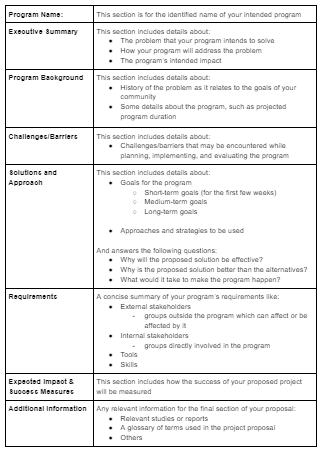
Step 3: Share
To share your work, click on the “Reply” button under this post and paste your work in the “Message” box. If your work is a google document, you may paste it as either an attachment or a “shareable link”. Make sure to reference others’ intellectual property when necessary. All references should follow 7th Edition APA formatting. For further instructions, see the resource on the Himmelfarb Health Sciences Library: APA citation resource (N.B. references are excluded from word counts).
Step 4: Interact
Evaluate and categorize the work from one of your peers based on items A - E of this rubric. Provide a rationale for the grade you provided, as well as, comments or suggestions for improvement. To post a reply, click “Reply” on a particular discussion, write your feedback and then click on “Post to forum.” You can use the list below as an example:
Item A is .…. because…. My suggestions for improvement are….
Item B is .…. because…. My suggestions for improvement are….
Item C is .…. because…. My suggestions for improvement are….
Item D is .…. because…. My suggestions for improvement are….
Item E is .…. because…. My suggestions for improvement are….OPTIONAL Step 5: Interact (10 minutes)
If you would like to, you can reply to your peers' posts in a respectful and professional manner. Ensure that your post engages your peers' ideas by including a reflection on their comments, sharing ideas of other potential difficulties and parties involved, or asking thought-provoking questions. If a peer comments on your posting, please reply. To post a reply, click “Reply” on a particular discussion, write your feedback and then click on “Post to forum.”
-
Quiz: Module 4To access the quiz, click on the name of the quiz provided above. On the following screen, click the "Preview quiz now" button to respond to the questions.
TO PASS THIS QUIZ YOU MUST OBTAIN A SCORE OF 21/26 -
Students mustMark as done
Additional Learning Options
-
Students mustView
Read the entire article. (50 minutes)
Human Resources for Health-2021
-
Students mustView
Read content under "Framework for Action" on pages 6-14. (28 minutes)
World Health Organization-2011
-
Students mustView
Read the entire article. (10 minutes)
The American Journal of Tropical Medicine and Hygiene-2020
-
Students mustView
Read the content under "2.1 Health Promotion and Well-Being Throughout Life" and "2.2 Universal and Equal Access to Health-Care Services" on pages 38 to 44. (24 minutes)
United Nations Population Fund and HelpAge International-2012