

Section: Module 1: Lesson 1: The Real Numbers | Intro to Algebra & Trigonometry | NextGenU.org
-
Student Learning Outcomes:
Upon completion of this lesson, you will be able to:- Describe the systems used to classify numbers.
- Explain, identify and work with mathematical expressions involving rational numbers.
- Explain and identify irrational numbers.
- Demonstrate the order of real numbers using the number line, the opposite of a real number, and the absolute value of a real number.
- Perform calculations using the order of operations.
- Define and use the properties of real numbers.
- Multiply and divide fractions.
- Add and subtract fractions.
- Perform all operations on fractions.
- Write fractions as decimals and decimals as fractions.
- Define and do operations with significant digits considerations.
- Demonstrate how decimals and fractions are used in real life.
-
Students mustView
Read the entire page - Section 1.1: Number Systems. (20 minutes)
LibreTexts, University of California, Davis - 2021
-
Students mustView
Read the entire page - Section 1.1: Real Numbers and the Number Line. (16 minutes)
LibreTexts, University of California, Davis - 2021
-
Students mustView
Read the entire page - Section 1.7: Order of Operations. (7 minutes)
LibreTexts, University of California, Davis - 2021
-
Students mustView
Read Section: Using the Properties of Real Numbers - Pages 19-23. (15 minutes)
OpenStax, Rice University - 2015
-
Students mustView
Read the entire web page. (14 minutes)
CK12 - 2014
-
Students mustView
Read the entire web page. (20 minutes)
CK12 - 2014
-
Students mustView
Read the entire page. (18 minutes)
Monterey Institute - 2021
-
Students mustView
Read the entire page. (10 minutes)
George Brown College, CA - 2020
-
Students mustView
Read the entire page. (10 minutes)
Extranet, University of Melbourne, Australia
-
Students mustViewStart discussions: 1
In this activity, you will study a case problem excerpt from Health Statistics and prove the origin of the equation without using actual mathematics
Step 1. Review
Review the learning resources for this lesson before studying the case problem.
Step 2. Analyze
Analyze the case problem below.
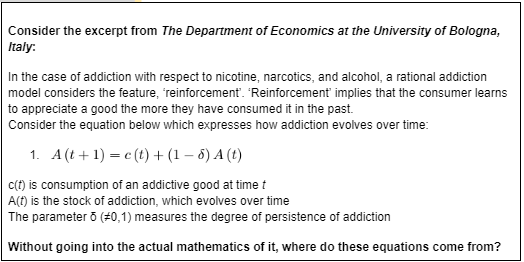
Step 3. Respond
Respond to the case problem by writing a 300-500 word discussion post with the following inclusions:
- Mathematical concepts and principles that can justify the equation.
- Explain how each variable responds to increases/decreases of the other variables.
Step 4. Share
To share your work, click on the “Reply” button under this post and paste your work in the “Message” box. Make sure to reference others’ intellectual property when necessary. All references should follow 7th Edition APA formatting. For further instructions, see the resource on the Himmelfarb Health Sciences Library: APA citation resource (N.B. references are excluded from word counts).
Step 5: Interact
To complete the activity, you will need to reply to at least two posts made by your peers in a respectful and professional manner. Ensure that your post engages your peers' ideas by including a reflection on their comments, sharing ideas of other potential difficulties and parties involved, or asking thought-provoking questions. If a peer comments on your posting, please reply. To post a reply, click “Reply” on a particular discussion, write your feedback and then click on “post to forum.”
OPTIONAL Step 6: Interact (10 minutes)
If you would like to, you can reply to your peers' posts in a respectful and professional manner. Ensure that your post engages your peers' ideas by including a reflection on their comments, sharing ideas of other potential difficulties and parties involved, or asking thought-provoking questions. If a peer comments on your posting, please reply. To post a reply, click “Reply” on a particular discussion, write your feedback and then click on “Post to forum.”
-
Students mustMark as done
Additional Resources for Optional Learning
-
Students mustView
Watch the four videos in the series, followed by the Practice Video. (45 minutes)