Section: Module 4: Lesson 1: Quadratic Expressions and Quadratic Equations | Intro to Algebra & Trigonometry | NextGenU.org
-
Student Learning Outcomes:
Upon completion of this lesson, you will be able to:- Solve quadratic equations by factoring and using the zero property.
- Solve quadratic equations by the square root property.
- Solve quadratic equations by completing the square.
- Solve quadratic equations by using the quadratic formula.
- Use the discriminant to find the nature of the solutions to a quadratic equation.
- Learn and identify characteristics of the graph of a quadratic function: the vertex, the x and y-intercepts, axis of symmetry, and translations.
- Solve equations with radicals.
- Apply the quadratic equation to problems in the medical field.
- Apply the quadratic equation to problems in other fields.
Click here to start this lesson-
Students mustView
Read Section 2.5: Quadratic Equations - Pages 172-184. (80 minutes)
OpenStax, Rice University - 2021
-
Students mustView
Read Section 10.2: Quadratic Functions and their Graphs. (15 minutes)
Lumen Learning - 2021
-
Students mustView
Read Section 9.2: Radical Equations and watch included videos. (15 minutes)
Lumen Learning - 2021
-
Students mustView
Read Section 10.3: Applicatioins of Quadratic functions and watch included videos. (12 minutes)
CUNY Hunter College - 2021
-
Students mustView
Watch the video. (6 minutes)
MathisPower4U - CUNY Hunter College - 2011
-
Students mustViewStart discussions: 1
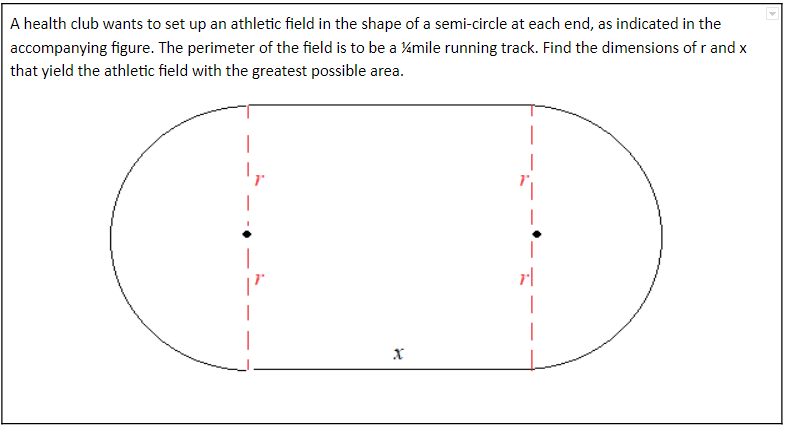
In this activity, you will solve a case problem that requires them to find the dimensions of r and x that yield the athletic field with the greatest possible area.
Step 1. Review
Review the learning resources for this lesson before studying the case problem.
Step 2. Analyze
Analyze the case problem below.
Step 3. Respond
Respond to the case problem by finding the dimensions of r and x that yield the athletic field with the greatest possible area. Include the following:
- Complete calculations
- Justifications such as theorems, properties, or laws
- Any other components you used that enabled you to move from one step to another.
Step 4. Share
To share your work, click on the “Add new discussion topic” button under this post and paste your work in the “Message” box. Make sure to reference others’ intellectual property when necessary. All references should follow 7th Edition APA formatting. For further instructions, see the resource on the Himmelfarb Health Sciences Library: APA citation resource (N.B. references are excluded from word counts).
Step 5: Interact
To complete the activity, you will need to reply to at least two posts made by your peers in a respectful and professional manner. Ensure that your post engages your peers' ideas by including a reflection on their comments, sharing ideas of other potential difficulties and parties involved, or asking thought-provoking questions. If peer comments on your posting, please reply. To post a reply, click “Reply” on a particular discussion, write your feedback and then click on “post to the forum.”OPTIONAL Step 6: Interact (10 minutes)
If you would like to, you can reply to your peers' posts in a respectful and professional manner. Ensure that your post engages your peers' ideas by including a reflection on their comments, sharing ideas of other potential difficulties and parties involved, or asking thought-provoking questions. If a peer comments on your posting, please reply. To post a reply, click “Reply” on a particular discussion, write your feedback and then click on “Post to forum.”
-
Students mustViewStart discussions: 1
In this activity, you will study and answer a series of given case problems on quadratic and rational expressions and equations.
Step 1. Review
Review the learning resources for this lesson before moving on to the series of case problems below.
Step 2. Analyze
Analyze the series of case problems below.
Case Problem A
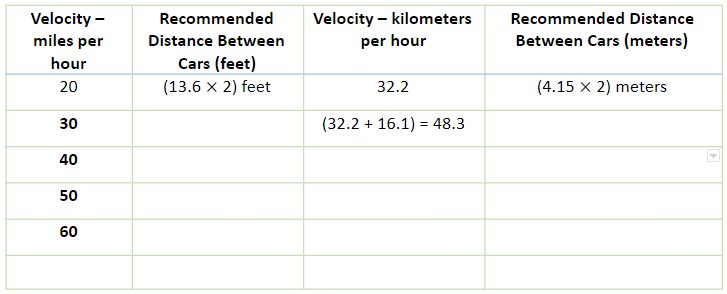
The faster a car is moving the more distance it will take to stop. Using mathematics, we can find a safe following distance for various speeds. The same concept is used by law enforcement and accident reconstructionists to gather evidence after an accident occurs.
One recommendation for a safe following distance is to allow one car length for every ten miles (approximately 16.1 kilometers) per hour. This means, if you were driving 50 miles per hour, you should have five car lengths between your car and the car in front of you.
Case Problem B
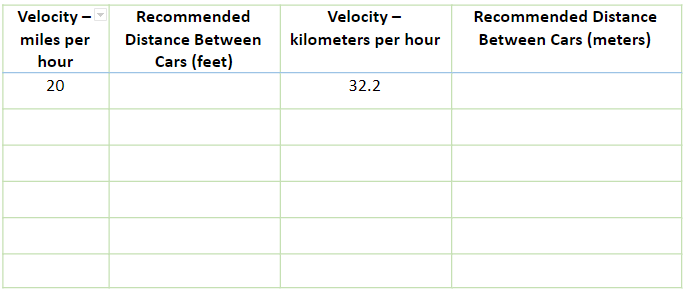
Most Department of Motor Vehicles recommend at least 3 seconds between your car and the car in front of you. How do you know if there is three seconds between your can and the car in front of you? You observe the car in front of you pass a point on the way, maybe a sign post. Then you begin to count “two thousand one, two thousand two”. If you pass the sign post before you finish your count, then you are too close. You slow down a little and try it again.
What is the following distance based on the three-second recommendation?
Fill in the table to find the following distance based on the three-second recommendation.
Case Problem C
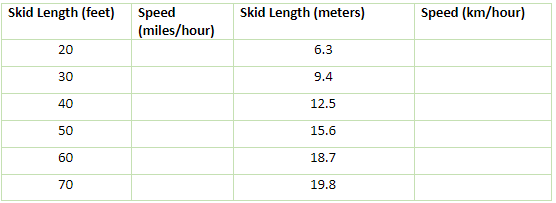
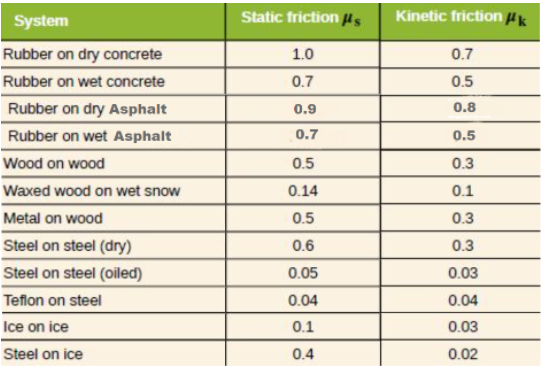
Frequently, when a collision accident happens, there are skid marks left on the roadway from a vehicle that has locked its brakes. Specialists measure the skid marks and apply the measurement to a formula that enables them to find the speed of the vehicle, prior to the collision. The speed a car was traveling at prior to the accident based on the skid distance is calculated using many different formulas, one of which is
Speed (s)= \( \sqrt[]{ \frac{60Df}{2.1} } \) where D is the skid distance, and f is the coefficient of friction for the particular road surface and elevation
For each measured skid distance given in the table below, calculate the speed at which the car was traveling when it created the skid mark. Choose a condition, either rubber on dry concrete, or rubber on wet concrete to find the coefficient of friction, and use that coefficient for the calculations.
Speed (miles per hour)= \( \sqrt[]{ \frac{60Df}{2.1} } \) Speed(km/hr)= 22.3\( \sqrt[]{Df} \)
Step 3. Respond
Respond to the case problems by fulfilling all the necessary requirements for each problem.
Step 4. Share
To share your work, click on the “Add a new discussion topic” button under this post and paste your work in the “Message” box. Make sure to reference others’ intellectual property when necessary. All references should follow 7th Edition APA formatting. For further instructions, see the resource on the Himmelfarb Health Sciences Library: APA citation resource (N.B. references are excluded from word counts).
Step 5: Interact
To complete the activity, you will need to reply to at least two posts made by your peers in a respectful and professional manner. Ensure that your post engages your peers' ideas by including a reflection on their comments, sharing ideas of other potential difficulties and parties involved, or asking thought-provoking questions. If peer comments on your posting, please reply. To post a reply, click “Reply” on a particular discussion, write your feedback and then click on “post to the forum.”OPTIONAL Step 6: Interact (10 minutes)
If you would like to, you can reply to your peers' posts in a respectful and professional manner. Ensure that your post engages your peers' ideas by including a reflection on their comments, sharing ideas of other potential difficulties and parties involved, or asking thought-provoking questions. If a peer comments on your posting, please reply. To post a reply, click “Reply” on a particular discussion, write your feedback and then click on “Post to forum.”
-
Students mustView
In this activity, you will explore a virtual quadratic function explorer and answer succeeding questions about its different features.
Step 1. Explore
Explore this virtual quadratic function explorer here http://www.mathopenref.com/quadraticexplorer.html
Step 2. Manipulate
Manipulate the function explorer by initially clicking the word “zero” under all three sliders. The “a”, “b”, and “c” correspond to the coefficients a, b, and c in a quadratic equation used in the quadratic formula. Then, follow these steps:
Move the slider “a” up and down. Observe what happens to the quadratic function when:
a. “a” is a positive number.
b. “a” gets larger in the positive direction.
c. “a” is a negative number.
d. “a” gets larger in the negative direction.
e. “a” is close to zero.
f. “a” is moved generally.Put the “a” slider at 1, the “c” slider at zero. We are now going to move the “b” slider. Observe what happens to the quadratic function when:
a. “b” is a positive number.
b. “b” is a negative number.
c. “b” gets larger in the positive direction.
d. “b” gets larger in the negative direction.
e. “a” on ‒1 and the “b” slider is moved.
f. “b” is moved generally.Put the “a” slider at 1, the “b” slider at zero. We are now going to move the “c” slider. Observe what happens to the quadratic function when:
a. “c” is a positive number.
b. “c” is a negative number.
c. “c” gets larger in the positive direction.
d. “c” gets larger in the negative direction.
e. “a” on ‒1 and try #a-d again.
f. “c” is moved generally.Now you are going to look at the function with a moving vertex. Click on the words “Quadratic Explorer – Standard Form”. This should change to the Vertex form.
a. Put all three sliders at zero.
b. Generalize what happens when you move the “a” slider.Put the “a” slider to a = 1, and the “k” slider to k = 0. We will move the “h” slider.
a. Describe what happens to the quadratic function when “h” is a positive number.
b. Describe what happens to the quadratic function when “h” is a negative number.
c. Generalize what happens when you move the “h” slider.Put the “a” slider to a = 1, and the “h” slider to h = 0. We will move the “k” slider.
a. Describe what happens to the quadratic function when “h” is a positive number.
b. Describe what happens to the quadratic function when “h” is a negative number.
c. Generalize what happens when you move the “k” slider.7. We are moving both the “h” and the “k” sliders.
Generalize what happens when you move both the “h” and the “k” sliders.
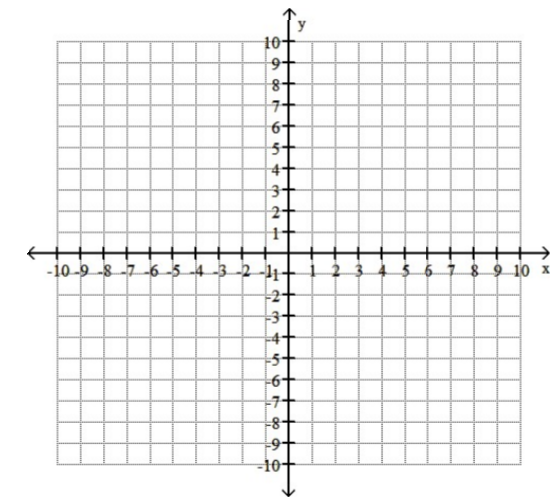
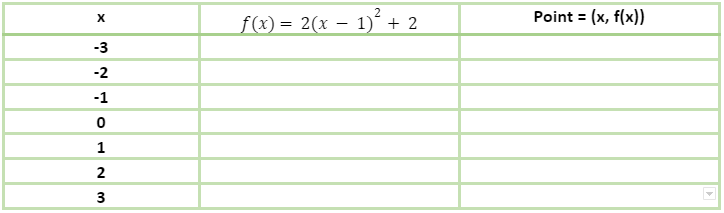
8. Graph a quadratic function with h and k.
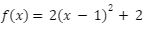
Fill out the table, plot the points and graph the function.
Step 3. Respond
Respond to this lab activity by putting all to writing all observations and descriptions from items #1-7. For item # 8, fill in the table, plot the points and finally graph the function.
Step 4. Share
To share your work, click on the “Add a new discussion topic” button under this post and paste your work in the “Message” box. Make sure to reference others’ intellectual property when necessary. All references should follow 7th Edition APA formatting. For further instructions, see the resource on the Himmelfarb Health Sciences Library: APA citation resource (N.B. references are excluded from word counts).
Step 5: Interact
To complete the activity, you will need to reply to at least two posts made by your peers in a respectful and professional manner. Ensure that your post engages your peers' ideas by including a reflection on their comments, sharing ideas of other potential difficulties and parties involved, or asking thought-provoking questions. If peer comments on your posting, please reply. To post a reply, click “Reply” on a particular discussion, write your feedback and then click on “post to the forum.”OPTIONAL Step 6: Interact (10 minutes)
If you would like to, you can reply to your peers' posts in a respectful and professional manner. Ensure that your post engages your peers' ideas by including a reflection on their comments, sharing ideas of other potential difficulties and parties involved, or asking thought-provoking questions. If a peer comments on your posting, please reply. To post a reply, click “Reply” on a particular discussion, write your feedback and then click on “Post to forum.”
-
Quiz: Module 4: Lesson 1
To access the quiz, click on the name of the quiz provided above. On the following screen, click the "Preview quiz now" button to respond to the questions.
TO PASS THIS QUIZ YOU MUST OBTAIN A SCORE OF 80%.
-
Students mustMark as done
Additional Resources for Optional Learning
-
Students mustView
Watch the video. (7 minutes)
Khan Academy-2022
-
-
Students mustView
Read Section: Graphs of Quadratic Equations. (20 minutes)
Lumen Learning- 2017
-
Students mustView
Watch the video. (6 minutes)
Khan Academy-2022