

Section: Module 4: Children's Emotional and Behavioral Problems | Mental Health Literacy | NextGenU.org
-
Upon completion of this module, learners should be able to: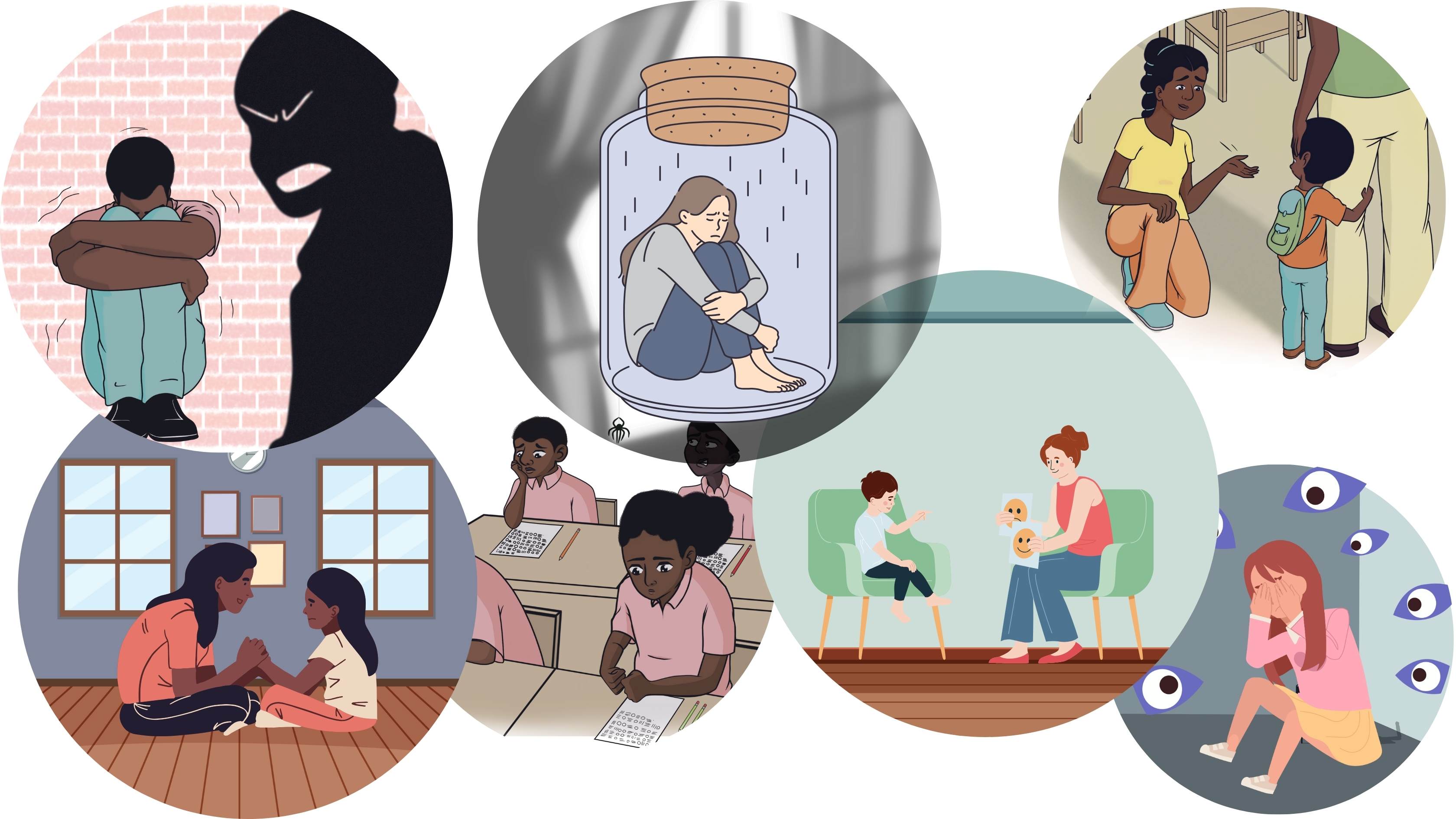 Student Learning Outcomes:
- Identify the main behavioral manifestations of common emotional and behavioral problems.
- Summarize age-appropriate fears and anxieties in children and adolescents.
- Recognize the role of educators in managing Anxiety Disorder in the classrooms.
- Describe the different types of Anxiety Disorders (Social Anxiety, Separation Anxiety, Specific phobias, Obsessive Compulsive Disorders, Post Traumatic Stress Disorder) and their specific symptoms.
- Discuss trauma-informed teaching and other strategies/tips for supporting anxiety, phobias, and stress.
- Describe common symptoms of mood disorders.
- Identify signs of suicidal thoughts and self-harm behaviors.
- Discuss the prevalence of suicidal thoughts and self-harm behaviors among children.
- Describe the role of educators in supporting students with mood disorders in the classroom.
- Describe the two common types of Mood disorders (Depressive Disorder, Disruptive Mood Dysregulation Disorder ) and their specific symptoms.
- Describe the classes of neurodevelopmental disorders [ASD, ADHD, Intellectual Disability] and their specific symptoms.
- Discuss how educators can support students with neurodevelopmental disorders within the classroom.
- Describe common symptoms of behavioral conditions, including Oppositional Defiant Disorder (ODD) and Conduct Disorder (CD).
- Discuss the role of educators in managing students with behavioral problems in the classroom (ODD/CD).
-
The module slides provide a concise and engaging overview of the course material, making it easier for you to grasp key concepts. The slides are a perfect companion to the handbook, ensuring you have a comprehensive learning experience.
-
To access the microlesson:
Step 1: Click on "Microlesson 4"
Step 2: Select "Enter"; the microlesson will open in a new window
Step 3: Click on "Start Course" to begin the microlesson.
If you need to exit the microlesson before it is completed, either click on "Exit Course" on the top right of the screen, or simply close the window. Your progress should be saved automatically.
There are activities and questions within the microlesson. These are not graded, but are intended to help you actively learn and practice the content. -
Students mustMark as done
To access the activity:
Step 1: Click on "Branching Logic Activity 4"
Step 2: Select "Enter"; the microlesson will open in a new window
Step 3: Click on the arrow at the bottom of the screen to begin the activity.This activity is not graded. It provides scenario-based practice to help you apply what you have just learned.
If you need to exit the microlesson before it is completed, either click on "Exit Course" on the top right of the screen, or simply close the window. Your progress should be saved automatically. -
General Instructions:
In this learning activity, you will analyze a case study detailing a student with an undisclosed social anxiety disorder who is a victim of cyberbullying initiated by his/her peers. Discuss the impact of this incident and strategies to address it and its associated challenges.
Step 1: Analyze [30 minutes]
Analyze the fictional case study below.
Case Study (13-year-old girl):
Ramona, 13 years old, is a newly transferred student at Albert's Primary School. She has been having difficulty interacting with the other students in class despite wanting to make friends. She has mostly kept to herself, often reading in her free time. In an attempt to be acquainted with the school community, she decided to join a sleepover party. While she was asleep, some of her classmates put funny makeup on her face. Their intent was simply to have some fun, but this private bit of fun turned into public ridicule and humiliation for Ramona when the picture was posted on Instagram. One offensive comment sparked a flood of insulting remarks that made fun of her intelligence, looks, and other attributes, shattering her confidence with each "like" those comments received. This has led her to become more withdrawn, quiet, alone, and extra sensitive. Her teachers have reported that she doesn't talk to anyone in the class, nor does she get involved in any class activities. Her seatmate has also observed that she trembles whenever her name is called and often looks like she is about to be sick whenever she is asked to participate in class. To make matters worse, her Maths teacher, who is completely unaware of the cyberbullying incident, has paired her with the perpetrator for a class activity. Right after that, she began cutting classes. Worried about their daughter's current state, her parents have arranged a dialogue with Ramona's teachers to disclose that Ramona has been diagnosed with a social anxiety disorder and discuss how it can be accommodated at the school.
Step 2: Respond [150 minutes]
After analyzing the case, respond by writing a 350-600 word post that discusses the following:
- Discuss how the bullying incident could have impacted the child.
- Discuss potential strategies to help minimize the harm of internet and social media use within and outside school settings. Extend your thinking to peer victimization and problems where there is a risk of physical violence.
- Identify common signs/symptoms associated with social anxiety disorder that teachers can be aware of.
- Discuss the important role of parents and teachers in collaborating on matters regarding children’s development and its associated challenges that need to be addressed.
- Cite a similar example you have experienced in your classroom and discuss potential strategies that can be used for supporting children with anxiety.
Step 3: Share [10 minutes]
To share your work, click on the “Add a new discussion topic” button under this post and paste your work into the “Message” box. Make sure to reference others’ intellectual property when necessary. All references should follow 7th Edition APA formatting. For further instructions, see the resource on the Himmelfarb Health Sciences Library: APA citation resource (N.B. references are excluded from word counts).
Step 4: Optional Peer Interaction
We highly encourage you to engage with your peers' posts in a respectful and professional manner. However, this interaction is not mandatory. If you choose to participate, consider reflecting on your peers' comments, sharing additional insights, or asking thought-provoking questions. This exchange of ideas can broaden your perspective and deepen your understanding of the topic. If you decide to respond, simply click "Reply" on a discussion, write your feedback, and then click "Post to forum." Remember, the goal is to foster a collaborative learning environment, so feel free to join the conversation if you're comfortable doing so.OPTIONAL Step 5: Interact (10 minutes)
If you would like to, you can reply to your peers' posts in a respectful and professional manner. Ensure that your post engages your peers' ideas by including a reflection on their comments, sharing ideas of other potential difficulties and parties involved, or asking thought-provoking questions. If a peer comments on your posting, please reply. To post a reply, click “Reply” on a particular discussion, write your feedback and then click on “Post to forum.”
-
General Instructions:
In this learning activity, you will analyze a case study about a student experiencing interparental conflicts and discuss how this experience influences his/her development and school success, the possibility for him/her to develop depression, as well as appropriate support strategies for the student.
Step 1: Analyze [30 minutes]
Analyze the fictional case study below.
Case Study:
Camille is a 17-year-old high school student whose parents are in the process of getting a divorce. Prior to the divorce, Camille had been a witness to endless, constant arguments between her parents that often led to verbal altercations. At one point, the personal differences between her parents almost ended in a physical fight. This has caused Camille to lose enthusiasm for schoolwork. Her teachers observed that Camille has been sleeping too much in class and is often found to be in low spirits. In fact, her Communications teacher has also observed her inability to form new questions and ideas, her lack of interest in comparing and debating opinions, and that she seems lost in thought. Her friends reported that she isn’t her usual self. Camille has been avoiding them and seems to be irritable and hot-headed. Camille has visited the school’s counselor and shared her feelings of being misunderstood and worthless, especially since she is unable to get her parents to reconcile. From their dialogue, the school counselor saw early signs of depressive disorder. At home, she is extra sensitive and chooses to retreat most of the time to her room, causing her mother to worry that she might be using drugs. Her mother decided to request a dialogue with the school’s counselor and teachers to ask for their help in looking out for her daughter.
Step 2: Respond [150 minutes]
After analyzing the case, respond by writing a 350-600 word post that discusses the following:
- What can this student be experiencing?
- How could parental conflicts and family separation impact the child?
- How would you engage the parents in approaching this?
- Is there a role for the school in supporting the distressed student due to family conflicts?
- What are potential strategies for managing these difficulties in the classroom? Discuss when you would require expert input. Discuss worries you may have as a resource person for this child.
- Discuss the important role of the parents and teachers in collaborating on matters regarding children’s development and its associated challenges that need to be addressed.
Step 3: Share [10 minutes]
To share your work, click on the “Add a new discussion topic” button under this post and paste your work into the “Message” box. Make sure to reference others’ intellectual property when necessary. All references should follow 7th Edition APA formatting. For further instructions, see the resource on the Himmelfarb Health Sciences Library: APA citation resource (N.B. references are excluded from word counts).
Step 4: Optional Peer Interaction
We highly encourage you to engage with your peers' posts in a respectful and professional manner. However, this interaction is not mandatory. If you choose to participate, consider reflecting on your peers' comments, sharing additional insights, or asking thought-provoking questions. This exchange of ideas can broaden your perspective and deepen your understanding of the topic. If you decide to respond, simply click "Reply" on a discussion, write your feedback, and then click "Post to forum." Remember, the goal is to foster a collaborative learning environment, so feel free to join the conversation if you're comfortable doing so.OPTIONAL Step 5: Interact (10 minutes)
If you would like to, you can reply to your peers' posts in a respectful and professional manner. Ensure that your post engages your peers' ideas by including a reflection on their comments, sharing ideas of other potential difficulties and parties involved, or asking thought-provoking questions. If a peer comments on your posting, please reply. To post a reply, click “Reply” on a particular discussion, write your feedback and then click on “Post to forum.”
-
General Instructions:
In this learning activity, you will analyze a case study detailing a student diagnosed with Oppositional Defiant Disorder (ODD) who has an alarming usage of the internet and social media. Also, discuss its impact on the child’s development and appropriate support strategies for the teacher to address the student's needs in the case study.
Step 1: Analyze [30 minutes]
Analyze the fictional case study below.
Case Study:
Garry is an only child and spends many hours on his laptop, averaging five hours a day in a school term, with up to 7 hours or more a day on weekends. Both of his parents are working and usually come home just in time for dinner. His internet activities include the usage of various social media, online war games, and YouTube videos. His mother describes him as "extremely good technically, very bright, and very good at computer programming. Unbeknownst to his parents, his school work has been increasingly suffering because of the time he spends on his computer. He lacks focus, has a short attention span, and lacks the use of formal logical operations in doing his schoolwork.
According to his classmates, Garry struggles socially. He often has an angry attitude towards his peers and is very reactive when he thinks he is at a disadvantage, causing him to be vindictive and seek revenge. His teachers are also facing challenges on how to manage his behavior in the classroom. He often questions school rules and refuses to follow these rules. At the same time, his general behavior at home worsened. He refused to do his normal household chores when requested and provoked confrontational situations between himself and his father, initiating his father to use corporal punishment to discipline him. His parents brought him to a psychiatrist, only to find out that he has an onset of Oppositional Defiant Disorder (ODD). The psychiatrist advised them to collaborate with Gary’s teachers in implementing the most appropriate management approach for their son’s condition.Step 2: Respond [150 minutes]
After analyzing the case, respond by writing a 350-600 word post that discusses the following:
- Discuss how excessive use of the internet and social media could impact the child’s development.
- Discuss your experiences managing such a child in your classroom.
- Identify which signs/symptoms this child exhibits that you would consider problematic to the normal functioning of your classroom.
- Discuss the role and limits of educators in managing students with behavioral problems.
- Discuss the important role of the parents and teachers in collaborating on matters regarding children’s development and its associated challenges that need to be addressed.
- Discuss how educators can help create a positive learning environment for students with ODD/CD.
Step 3: Share [10 minutes]
To share your work, click on the “Add a new discussion topic” button under this post and paste your work into the “Message” box. Make sure to reference others’ intellectual property when necessary. All references should follow 7th Edition APA formatting. For further instructions, see the resource on the Himmelfarb Health Sciences Library: APA citation resource (N.B. references are excluded from word counts).
Step 4: Optional Peer Interaction
We highly encourage you to engage with your peers' posts in a respectful and professional manner. However, this interaction is not mandatory. If you choose to participate, consider reflecting on your peers' comments, sharing additional insights, or asking thought-provoking questions. This exchange of ideas can broaden your perspective and deepen your understanding of the topic. If you decide to respond, simply click "Reply" on a discussion, write your feedback, and then click "Post to forum." Remember, the goal is to foster a collaborative learning environment, so feel free to join the conversation if you're comfortable doing so.
-
Quiz: Module 4
To access the quiz, click on the name of the quiz provided above. On the following screen, click the "Preview quiz now" button to respond to the questions.
TO PASS THIS QUIZ, YOU MUST OBTAIN A SCORE OF 80%