

Section: Module 1: Lesson 3: Literacy Narrative: Building Bridges, Bridging Gaps | Writing for Health Sciences | NextGenU.org
-
Student Learning Outcomes:
Upon completion of this lesson, you will be able to:
- Identify various types of literacy, discern identity in different contexts, and read a diverse range of texts, attending to relationships among ideas and patterns of organization.
- Developing flexible drafting, reviewing, collaborating, revising, rewriting, and editing strategies using language structures and various technologies.
- Reflect on the development of their composing processes and consider how those processes affect their work.
- Read and compose in multiple genres to understand how genre conventions shape and are shaped by readers' and writers' practices and purposes.
- Match the capacities of different environments to varying rhetorical situations.
- Read a diverse range of texts, attending to relationships among ideas, patterns of organization, and the interplay between verbal and nonverbal elements.
- Develop a writing project through multiple drafts and use composing for inquiry, learning, critical thinking, and communicating in various rhetorical, cultural, and language situations.
- Give and act on productive feedback to works in progress and benefit from writing processes' collaborative and social aspects.
- Identify how genre conventions for structure, paragraphing, tone, and mechanics vary.
- Use a variety of technologies to address a range of audiences.
- Reflect on the development of composing processes and consider how those processes affect your work.
-
Students mustMark as done
Required Learning Resources and Activities
-
-
Students mustView
Read the entire page. (8 minutes)
Rice University - 2021
-
Students mustView
Read the entire page. ( 7 minutes)
Rice University - 2021
-
Students mustViewStart discussions: 1
IMPORTANT
Make sure to carefully read and follow the instructions while completing the tasks. Once you have finished this activity, proceed to section 2.6 Evaluation: Antiracism and Inclusivity. This section provides rubric tools for self-evaluation and evaluating the work of your classmates. After completing the evaluation, move on to section 2.7 Spotlight on … Variations of English, where you will encounter new challenges to showcase your content. Finally, go to section 2.8 Portfolio: Decolonizing Self to find useful tools, recommendations, and reflections for creating your portfolio. Afterward, move on to the next Module.
Now, let's get started! Using the following template, share your tasks, taking into account the order of the different sections detailed chronologically.
Task 1:
Summary of Assignment: Cultural Artifact Part A
Choose an artifact that symbolizes something about a culture to which you belong. This might be a physical object that you have, or it may be a metaphorical object, such as Du Bois’s color line or veil, that represents something larger about your culture. Write approximately 350-700 words describing it, using sensory detail and explaining its meaning both to you personally and within your culture. To begin your thinking, watch the video below for a discussion on cultural artifacts and narratives led by artist David Bailey.
ANSWER PART A
_________________________________________________________________________________________________________________________________________________________
_________________________________________________________________________________________________________________________________________________________
_________________________________________________________________________________________________________________________________________________________
Summary of Assignment: Cultural Artifact Part B
Another Lens 1: Choose a space that is important to a cultural community to which you belong. While visiting this space, conduct an hour-long observation. Respond in writing to these items: Describe the space in detail. What do you see permanently affixed in the space? What activity is going on? How is the space currently used? What is the atmosphere? How do you feel while conducting your observation? Then, do some brief research on the space (using the Internet, the library, or campus archives), and answer these questions: What is the history of the space? When was it established, and under what circumstances? How has this space been used in the past? What is your response or reaction to this history? Then, write a passage in which you highlight a unique feature of the space and your cultural relationship to it.
ANSWER PART B
_________________________________________________________________________________________________________________________________________________________
_________________________________________________________________________________________________________________________________________________________
_________________________________________________________________________________________________________________________________________________________
Summary of Assignment: Cultural Artifact Part C
Another Lens 2. Considering Du Bois’s theory of double consciousness, explore the ways in which you may experience competing identities or competing cultures in your own life. What experiences have you had or witnessed where language clashed with or supported your identity or culture? What happened? How did others react? How did you react? What insight does your experience offer on this discussion of rhetoric and the power of language to define, shape, and change or give birth to identity or culture?
Summary of Assignment: Cultural Artifact Part CANSWER PART C
_________________________________________________________________________________________________________________________________________________________
_________________________________________________________________________________________________________________________________________________________
_________________________________________________________________________________________________________________________________________________________
+++++++++++++++++++++++++++++++++++++++++++++++++++++++++++++
-
Students mustView
Read the entire page. (7 minutes)
Rice University - 2021
-
Students mustView
Read the entire page. (21 minutes)
Rice University - 2021
-
Students mustViewStart discussions: 1
Instructions:
Read the questions carefully.Make sure you understand what the question is asking.
-
Gather your thoughts. What do you know about the topic of the question? What are your thoughts and opinions on the matter?
-
Write a brief outline of your response. This will help you to organize your thoughts and make sure you cover all of the important points.
-
Write your response. Be sure to answer the question directly and provide evidence to support your claims.
-
Proofread your response. Make sure there are no errors in grammar or spelling.
-
Be open to feedback. Ask your classmates for feedback on your responses. This will help you to improve your writing skills and learn from your mistakes.
Here are some additional tips for answering discussion questions:
-
Be clear and concise. Your response should be easy to understand and follow.
-
Use evidence to support your claims. This could include quotes from the text, statistics, or your own personal experiences.
-
Be respectful of other people's opinions. Even if you disagree with someone, you can still be respectful of their point of view.
Questions
-
What are some of the literacies that Westover learned while living at home? How might they conflict with the new ones learned away from home?
-
How might literacy learning have the potential to separate and unite individuals and their communities?
-
Do you think the Westovers with PhDs are more “literate” than the ones who remained at home? Explain your answer.
-
How are literacy and gaining new literacies related? Ambition? A desire for knowledge? Rebellion? Dissatisfaction? Explain your answer.
-
How do your childhood literacy experiences align with Westover’s? How do they differ?
-
At this point in your college experience, have you had any encounters with ideas that conflict with the value system(s) with which you were raised, as Westover did? How do you envision navigating those differences?
-
Students mustViewStart discussions: 1
Instructions:
Read the questions carefully. Make sure you understand what the question is asking.
Gather your thoughts. What do you know about the topic of the question? What are your thoughts and opinions on the matter?
Write a brief outline of your response. This will help you to organize your thoughts and make sure you cover all of the important points.
Write your response. Be sure to answer the question directly and provide evidence to support your claims.
Proofread your response. Make sure there are no errors in grammar or spelling.
Be open to feedback. Ask your classmates for feedback on your responses. This will help you to improve your writing skills and learn from your mistakes.
Here are some additional tips for answering discussion questions:
Be clear and concise. Your response should be easy to understand and follow.
Use evidence to support your claims. This could include quotes from the text, statistics, or your own personal experiences.
Be respectful of other people's opinions. Even if you disagree with someone, you can still be respectful of their point of view.
Questions
Based on what you have learned about literacy thus far, would you consider this excerpt from Frederick Douglass’s autobiography a literacy narrative? Explain your response by providing evidence from Douglass’s text.
How do Douglass’s descriptions of Mr. and Mrs. Auld make these characters come to life for the reader?
What do Douglass’s tone, use of language, and commentary reveal about him and why literacy was so important?
African American storytelling features a common trope (device) of a trickster character. The trickster is characterized by intellect or secret knowledge that they use to defy convention. How does Douglass play the role of the trickster in this excerpt from his narrative, and what impact does this rhetorical device have on the reading audience?
What elements of Douglass’s narrative might help you develop your own narrative about literacy?
-
Students mustViewStart discussions: 1
IMPORTANT
Make sure to carefully read and follow the instructions while completing the tasks. Once you have finished activities 3.5 and 3.6, proceed to section 3.7 Evaluation: Self-Evaluating. This section provides rubric tools for self-evaluation and evaluating the work of your classmates. After completing the evaluation, move on to section 3.8 Spotlight on … The Digital Archive of Literacy Narratives (DALN), where you will encounter new challenges to showcase your content. Finally, go to section 3.9 Portfolio: A Literacy Artifact to find useful tools, recommendations, and reflections for creating your portfolio. Afterward, move on to the next Module.
Now, let's get started! Using the following template, share your tasks, taking into account the order of the different sections detailed chronologically.
Drafting: Writing from Personal Experience and Observation
Now that you have planned your literacy narrative, you are ready to begin drafting. If you have been thoughtful in preparing to write, drafting usually proceeds quickly and smoothly. Use your notes to guide you in composing the first draft. As you write about specific events and scenes, create a rich picture for your readers by using concrete, sensory details, and specific, rather than general, noun, as shown in Table 3.2. You can use Frederick Douglass’s Text as a Drafting Model. To create a draft that draws on multiple elements of storytelling, as this selection from Douglass does, you may need to generate ideas for additional scenes, or you may need to revisit a particular place so that you can provide concrete and sensory details for your readers.
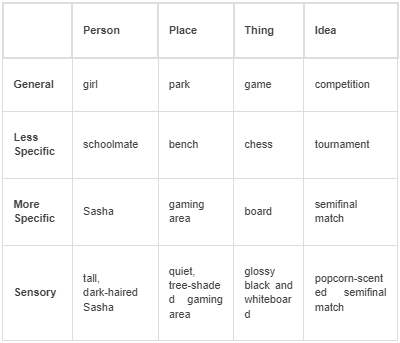
Table 3.2
ANSWER
_________________________________________________________________________________________________________________________________________________________
_________________________________________________________________________________________________________________________________________________________
_________________________________________________________________________________________________________________________________________________________
-
Students mustViewStart discussions: 1
Editing for More Effective Sentences
This paragraph from a student's first draft of a narrative contains sentences that need editing. Revise the sentences to eliminate “There are . . .,” “It is . . . ,” unclear you and this, and wordiness. For better flow, combine sentences that are repetitive or choppy.
It is now hours later. I think it is almost midnight, in fact. I have finally managed to get my paper started and studied for my exam. My eyes are very tired. I get up and leave my comfortable chair. Next, I walk out of the library. You have to walk through a glass door. I retrace the path that goes back to my apartment, where I came from earlier.
Revision:
_________________________________________________________________________________________________________________________________________________________
_________________________________________________________________________________________________________________________________________________________
_________________________________________________________________________________________________________________________________________________________
Since it is midnight, it is dark, and I nervously listen to footsteps. They are coming up behind me. Then, they get too close for comfort. This is really making me very, very nervous. I am really very scared, but I step over to the sidewalk’s edge. I am trying to be calm, and I let a man walk briskly past. Phew!
Revision:_________________________________________________________________________________________________________________________________________________________
_________________________________________________________________________________________________________________________________________________________
_________________________________________________________________________________________________________________________________________________________
When I am finally at my door to my apartment, I fumble for the key to the door. I insert the key in the lock. I open the door, put my hand on the switch to turn on the hall light and step inside the door to my apartment. There are two slices of pizza left in the box that is on the kitchen counter. They are really cold and very congealed.Revision:
_________________________________________________________________________________________________________________________________________________________
_________________________________________________________________________________________________________________________________________________________
_________________________________________________________________________________________________________________________________________________________
Review the possible edited versions at the end of this section after completing your task: https://openstax.org/books/writing-guide/pages/3-6-editing-focus-sentence-structure
+++++++++++++++++++++++++++++++++++++++++++++++++++++++++++++
-
Students mustView
Read the entire page. (48 minutes)
Rice University - 2021
-
Students mustView
Read the entire page. (13 minutes)
Rice University - 2021
-
Students mustView
Read the entire page. (4 minutes)
Rice University - 2021
-
Students mustView
Read the entire page. (4 minutes)
Rice University - 2021
-
Students mustView
Read the entire page. (2 minutes)
Rice University - 2021