

Section: Module 3: Lesson 5: Portfolio Reflection: Your Growth as a Writer | Writing for Health Sciences | NextGenU.org
-
Student Learning Outcomes:
Upon completion of this lesson, you will be able to:
- Identify and analyze an author's reflections and demonstrate critical thinking about them.
- Identify conventions of reflection and articulate how genre conventions are shaped by purpose, culture, and expectation.
- Analyze a reflective essay's elements and organizational patterns and demonstrate critical thinking about them.
- Apply composing processes and tools to discover and reconsider ideas and adapt them to different technologies and modalities.
- Demonstrate knowledge of linguistic structures, including grammar, and implement appropriate pronouns in written work.
- Articulate how genre conventions for structure, tone, and mechanics vary and evaluate a written work for critical language awareness, clarity and coherence, and rhetorical choices.
- Recognize and avoid gender bias in writing and language use, and use current terminology and gender-neutral pronouns where applicable.
Click here to start this lesson-
Students mustMark as done
Required Learning Resources and Activities
-
-
Students mustView
Read the entire page. ( 2 minutes)
Rice University - 2021
-
Students mustView
Read the entire page. ( 6 minutes)
Rice University - 2021
-
Students mustViewStart discussions: 1
Instructions:
Read the questions carefully. Make sure you understand what the question is asking.
Gather your thoughts. What do you know about the topic of the question? What are your thoughts and opinions on the matter?
Write a brief outline of your response. This will help you to organize your thoughts and make sure you cover all of the important points.
Write your response. Be sure to answer the question directly and provide evidence to support your claims.
Proofread your response. Make sure there are no errors in grammar or spelling.
Be open to feedback. Ask your classmates for feedback on your responses. This will help you to improve your writing skills and learn from your mistakes.
Here are some additional tips for answering discussion questions:
Be clear and concise. Your response should be easy to understand and follow.
Use evidence to support your claims. This could include quotes from the text, statistics, or your own personal experiences.
Be respectful of other people's opinions. Even if you disagree with someone, you can still be respectful of their point of view.
Questions
- In what ways did the realization that she was different from other students spur Sandra Cisneros’s journey as a writer?
- What is the purpose of reflection in Cisneros’s writing?
- What strategies does Cisneros use to generate reflective writing?
- What themes emerge when you think about your journey as a writer this semester? Do similarities exist between your themes and Cisneros’s? Explain.
- What dialogue might emerge between the writer you were at the beginning of the semester and the writer you are now? If applicable, describe an epiphany or sudden realization you might have had about your writing.
-
Students mustView
Read the entire page. ( 11 minutes)
Rice University - 2021
-
Students mustView
Read the entire page. (21 minutes)
Rice University - 2021
-
Students mustViewStart discussions: 1
Instructions:
Read the questions carefully. Make sure you understand what the question is asking.
Gather your thoughts. What do you know about the topic of the question? What are your thoughts and opinions on the matter?
Write a brief outline of your response. This will help you to organize your thoughts and make sure you cover all of the important points.
Write your response. Be sure to answer the question directly and provide evidence to support your claims.
Proofread your response. Make sure there are no errors in grammar or spelling.
Be open to feedback. Ask your classmates for feedback on your responses. This will help you to improve your writing skills and learn from your mistakes.
Here are some additional tips for answering discussion questions:
Be clear and concise. Your response should be easy to understand and follow.
Use evidence to support your claims. This could include quotes from the text, statistics, or your own personal experiences.
Be respectful of other people's opinions. Even if you disagree with someone, you can still be respectful of their point of view.
Questions
- What is the happening, and which parts of Dale Trumbore’s essay describe it?
- What parts of Trumbore’s essay show reflection?
- What parts of Trumbore’s essay describe an action that results from the reflection?
- How does Trumbore use her cat to make a reflective point? What effect might it have on readers?
- What might you do differently if you were Trumbore and wanted to focus on a similar topic?
-
Students mustView
Read the entire page. (16 minutes)
Rice University - 2021
-
Students mustViewStart discussions: 1
IMPORTANT
Make sure to carefully read and follow the instructions while completing the tasks. Once you have finished activity 20.5, proceed to section 20.6 and after to 20.7:20.7
Evaluation: Evaluating Self-Reflection. This section provides rubric tools for self-evaluation and evaluating the work of your classmates. After completing the evaluation, move on to section 20.8 Spotlight on … Pronouns in Context, where you will encounter new challenges to showcase your content. Finally, don't forget to move to the Handbook.
Now, let's get started! Using the following template, share your tasks, taking into account the order of the different sections detailed chronologically.
Summary of Assignment: Portfolio Reflection and Self-Evaluation
In the form of a letter (e.g., “Dear Reader”), respond to several questions and discuss various topics related to your writing development in this course. For example, you might be asked to identify and discuss your strongest piece of writing. For each claim you make about your strongest assignment, provide reasoning and evidence from your portfolio to support the statement. When you quote directly from your own writing, be sure to state which assignment or draft you are quoting. Within the context of your responses, include commentary on most of the following course topics as well as others that have been significant:
Writing processes (organizing graphically, outlining, drafting, conferencing, revising, editing, publishing, recursivity)
Rhetorical situation, rhetoric, and persuasion
Reasoning strategies, textual and rhetorical analysis
Evidentiary strategies: evaluation, research
Word choice, leads, transitions
Thesis statement, structure and organization, introductions, conclusions
Showing, not telling; descriptive writing
Voice; feelings, as hindsight or in the process
Depending on the nature of your portfolio, you may be able to create a digital or multimodal reflective letter, as mentioned in Glance at Genre: Purpose and Structure.
ANSWER
_________________________________________________________________________________________________________________________________________________________
_________________________________________________________________________________________________________________________________________________________
_________________________________________________________________________________________________________________________________________________________
_________________________________________________________________________________________________________________________________________________________
_________________________________________________________________________________________________________________________________________________________
_________________________________________________________________________________________________________________________________________________________
_________________________________________________________________________________________________________________________________________________________
_________________________________________________________________________________________________________________________________________________________
_________________________________________________________________________________________________________________________________________________________Quick Launch: Establishing Criteria for Growth
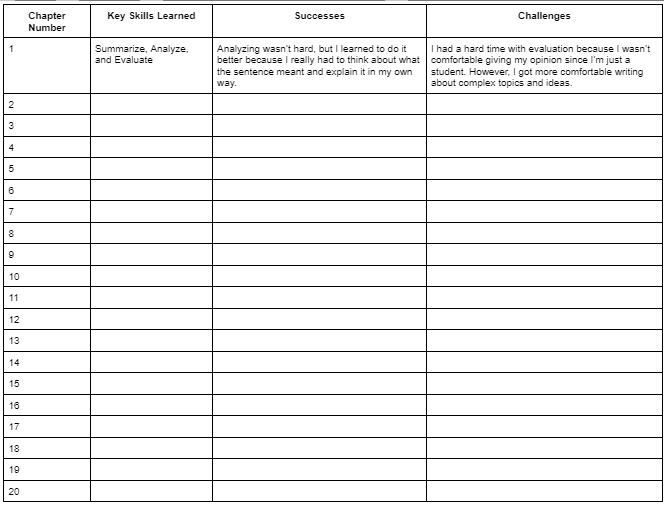
To get started, you will need to organize your thoughts. After you have reviewed each chapter and its related assignment, reflect on your successes and challenges. Use a graphic organizer similar to Table 20.1 to get started. If the information already filled in for Chapter 1 works for you, use it. If it doesn’t, change it accordingly. If you skipped the suggested review of your assignments, do it now. Otherwise, use your notes as you complete the chapter reflection table below. Skip any rows related to chapters that you did not cover in class.
++++++++++++++++++++++++++++++++++++++++++++++++++++++++++++++++++
-
Students mustView
Read the entire page. (12 minutes)
Rice University - 2021
-
Students mustView
Read the entire page. (5 minutes)
Rice University - 2021
-
Students mustView
Read the entire page. (6 minutes)
Rice University - 2021