
-
-
Students mustStudent must submit this questionnaire to complete it
-
Students mustMark as done
-
Students mustMark as done
-
Students mustView
Glossary from "Co ...
Students mustMark as doneWelcome to the < ...
Show More-


This Psychological Counselling introductory course provides a basic foundation of key skills for effective counseling. All parts of this training are free, including registration, learning, testing, and a certificate of completion. This course is intended for primary-care physicians, nurses, and allied health professionals in training and in practice.
This Psychological Counseling course is based on the Counselling Relationship (CR) manual, it was developed in partnership with the PREMIUM program funded by the Wellcome Trust, in association with the London School of Hygiene & Tropical Medicine, Sangath organization, and the Government of Goa's Directorate of Health Services. The course was developed by Arpita Anand, Sona Dimidjian and Richard Velleman with additional contributions from Angela Leocata, Sydney Church, Luanna Fernandes, Ajay Kumar, Medha Upadhye and Dielle Dsouza.
For a publication on this course’s efficacy, see “Building Public Health Capacity through Online Global Learning,” (2018), Open Praxis, to see more research related to NextGenU.org’s educational model, check out NextGenU.org’s publication page. Subscribe to our newsletter to be notified of future updates, new courses, and to be part of our community.
There are 17 modules which provide:
- An introduction to counseling and an effective counseling relationship
- The skills required to build a good counseling relationship, to prepare for a counseling session, and guidelines for sessions and home visits
- An overview of how to assess and manage suicide risk and how to involve family and friends
Approximate time for completion of this course is 6 hours at an average reading rate of 144 words/minute.
At the end of each lesson, there is a practice quiz. At the end of the course, after you’ve completed each lesson, quiz, and activity, you’ll have access to a final exam, and a chance to assess the training. Once you’ve passed that last test, you will be able to download a certificate of completion from NextGenU.org and our course’s co-sponsoring organizations (listed above). We keep all of your personal information confidential, never sell any of your information, and only use anonymized data for research purposes, and we are also happy to report your testing information and share your work with anyone (your school, employer, etc.) at your request. We hope that you will find this a rewarding learning experience, and we count on your feedback to help us improve this training for future students.
Engaging with this Course:
You may browse this course for free to learn for your personal enrichment; there are no requirements.
To obtain a certificate
- Show in the registration fields that you have the appropriate prerequisites to be certified. This course requires the learner to have already obtained a college-level degree.
- Complete all the reading requirements.
- Complete all quizzes and pass with a 70% with unlimited attempts..
- Successfully complete the final exam with a minimum of 70% and a maximum of 3 attempts.
- Complete the self and course evaluation forms.
To obtain credit
- Complete all requirements listed above for the certificate.
- Your learning institution or workplace should approve the partner-university-sponsored NextGenU.org course for educational credit, as they would for their learner taking a course anywhere.
- NextGenU.org is happy to provide your institution with:
- a link to and description of the course training, so they can see all its components, including the cosponsoring universities and other professional organization cosponsors
- your grade on the final exam
- your work products (e.g. peer and mentored activities), and any other required or optional shared materials that you produce and authorize to share with them
- your evaluations - course, and self-assessments.
- a copy of your certificate of completion, with the co-sponsoring universities and other organizations listed
To obtain a degree, NextGenU.org co-sponsors degree programs with institutional partners. To obtain a degree co-sponsored with NextGenU.org, registrants must be enrolled in a degree program as a student of a NextGenU.org institutional partner. If you think that your institution might be interested in offering a degree with NextGenU.org contact us.
We hope that you will find this a rewarding learning experience, and we count on your assessment and feedback to help us improve this training for future students.
Next Steps
- Complete the registration form.
- Begin the course with Module 1: Introduction To Counselling. In each lesson, read the description, complete all required readings and any required activity, and take the corresponding quizzes.
This course meets nationally approved standards of education developed for the addiction/substance use disorders counseling profession. This course's participants are assured that the continuing education (CE) credits provided will be accepted toward national credentialing by the NAADAC Certification Commission for Addiction Professionals (NCC AP), as well as by many of the individual state licensing/certification bodies in the addiction and other helping professions.
-
 Learning objectives:
- What is counselling?
- How counselling is different from a friendly chat.
-
 Congratulations on completing Module 1 on an Introduction to Counselling! You now know what counselling is and how it is different from a friendly chat.
In this module, you will learn about an effective counselling relationship, the key skills to develop one and the different styles of counselling.
-
For many patients, this is their first experience of counselling and they might be unclear about why they need to see the counsellor and what they are expected to do. The counsellor’s job is to develop trust and participation, and through that reduce any anxious thoughts or concerns.
Counsellors must show patients that they can be trusted, will take them seriously, will listen to and understand their problems, doubts, fears and hopes, and help them with their problems. This will make patients more likely to take part in the counselling process and get the most benefit from it. All the work should be done collaboratively, that is in a partnership with the patient.
-
Empathy is different from sympathy. Sympathy involves recognising the patient’s suffering and responding with pity, while empathy is actually sharing his or her suffering, if only briefly. It is often described as the ability to ‘put oneself into another’s shoes’.
Watch the role play video in the activities section below that shows empathy towards the patient
-
 Congratulations on completing Module 2 on An Effective Counselling Relationship! You now know what an effective relationship involves and some of the key skills to build one.
In this module, we will learn a few more skills to develop an effective counselling relationship. It involves understanding the role of genuineness in counselling and identifying the key skills for it.
-
A genuine person is one who is himself/herself and does not put on an act simply because one is a counsellor. But this does not mean that counsellors always show all their feelings. The aim is to only say things that might be helpful to the patient and to make certain that what we show or say is real and honest.
-

Congratulations on completing Module 3 on Genuineness! You now understand its role in an effective counselling relationship and how to identify its key skills.
In this module, you will learn how to identify and understand the various counselling approaches.
Watch the video lecture in the activities section below to understand the two different styles of counselling approaches.
SUMMARY
An effective counselling relationship includes:- Counsellor and patient working as a team
- Goals, activities and possible solutions are planned together
- The counsellor encourages the patient to actively take part in the treatment process
- The patient feels valued and understood by the counsellor
- The patient realises there are decisions he/she can make and is encouraged to take charge of his/her life
- Warmth, empathy and genuineness are very important qualities for effective counselling
- Other important skills include:
- Demonstrating acceptance
- Listening, and showing we are listening actively, and engaging with the patient
- Reflecting the verbal and emotional content of what has been said
- Allowing silences
- Providing affirmations or endorsing the patient’s understanding of their problem
- Summarising by expressing briefly and simply the difficulty the patient has described
- Asking for feedback
- Providing reassurance and hope
- The two different styles of counselling are Active & Discussion-based
-
 Congratulations on completing Module 4 on Counselling Approaches! You now know about active and discussion-based counselling approaches and how to identify them.
In this module you will learn how to prepare for a counselling session, how to greet the patient and introduce yourself.
-
To put patients at ease, particularly at the start of their first appointment:
- Greet the patient with a warm smile
- Offer the patient a comfortable seat
- Ask the patient his/her name and the language he/she is comfortable speaking in
With new patients, introduce yourself and explain your role at the clinic. For those who have a phone, ask if it is alright if you can call them in case a meeting in person is not possible.
-
 Congratulations on completing Module 5 on preparing for a counselling session! You now know how to prepare for a session, how to greet the patient and introduce yourself.
In this module you will learn how to talk about confidentiality, its importance and necessity.
Patients can be concerned that you will tell other people – such as family, friends, neighbours or employers – what has been discussed during counselling sessions. They need to be sure that the details will not be shared with anyone.
However, sometimes, patients will reveal information that is related to their own safety or that of other people, or breaking the law. For example, a school bus driver may have an alcohol problem and reveal that he is often drunk while on the job, or a patient might say that he/she is going to attempt suicide by having sleeping tablets hidden at home.
The basic rule in such situations is that issues like these must always be discussed within supervision. If it is urgent, speak to your supervisor on the phone. If the supervisor agrees that the situation must be shared with a family member (or significant other), it is ideal to get agreement from the patient first.
Note: A significant other (SO) can be any person in the patient’s life who plays an important role in his/her emotional health and is ready to participate in the treatment to help get over the patient’s problems.
When talking to patients about confidentiality, you must discuss the following:
- Patients should always know that you work as part of a study team and the work is supervised. So you may need to discuss what the patient has told you with your supervisors.
- There may be situations related to the safety of the patient or others. In such situations, we will discuss with the patient about speaking to other people concerned with the issue.
- Counsellors may be required by law to tell information to a court.
-
 Congratulations on completing Module 6 on Confidentiality! You now understand the importance and necessity of confidentiality in the counselling relationship.
In this module you will learn the need for recording the counselling sessions and how it can help.
Tape recording sessions
Using a digital recorder during sessions is important for supervision and to reflect upon to improve counselling skills. While the patient’s consent or permission for this is taken by the health assistant, it is important to ask whether you can switch the recorder on before every session. If the patient is not comfortable even though they are told they cannot be identified on the tape, or is still uneasy, do not force him/her, and turn off the recorder.
Make sure recordings are of good quality by keeping the recorder mid-way between you and the patient; holding the session in a quiet place; shutting doors and windows; asking other people nearby to speak softly; and pausing the recording until a disturbance – such as someone entering the room or a telephone ringing – has passed.
-
 Congratulations
on completing Module 7 on Recording Counselling Sessions! You now understand the scope and necessity to record the sessions.
Congratulations
on completing Module 7 on Recording Counselling Sessions! You now understand the scope and necessity to record the sessions.
In this module you will learn why home visits may be necessary and how to conduct them.
Home visits
If patients are unable to attend sessions in the clinic, you can conduct them in the patient’s home or some other place where they are happy for the session to take place, if the patient is willing.
Watch the video lecture in the activities section below to learn the guidelines for home visits.
-
 Congratulations on completing Module 8 on Home Visits! You now understand the usefulness, scope and conditions for home visits in counselling.
In this module you will learn why and how to use the telephone during counselling sessions.
Telephone Counselling
Not all patients have a personal phone, but if they do, it is important to get permission to call him/her in your first session itself.
SUMMARY
- Prepare yourself for the counselling session with a checklist of things you will need before the patient arrives
- Greet the patient warmly and introduce yourself
- Tell the patient that confidentiality will be maintained
- Discuss the options of home sessions, clinic sessions and telephone sessions and identify the most convenient one
- Follow the guidelines suggested for home visits
- The telephone can help check in with patients between sessions and after treatment ends, to remind patients of appointments and conduct sessions
-
 Congratulations on completing Module 9 on Telephone Counselling! You now know the usefulness, advantages and disadvantages of using the telephone in counselling, and how to conduct a session with it.
In this module you will learn how to conduct a suicide risk assessment, how to identify risk and protective factors, and plan a course of action.
-
Patients may sometimes be at risk of harming themselves during difficult times, and see death as the only solution. It is always important to ask if our patient has these thoughts so we can offer help. Suicide risk assessment is an essential part of our work and must be integrated into all counselling sessions.
-
Risk factors are those that increase the risk of suicide attempts or death by suicide. Protective factors are those linked to a decreased risk of suicide. Knowing these can provide a guide for which risk factors can be reduced, and which protective factors can be strengthened through counselling.
-
 Congratulations on completing Module 10 on Managing Suicide Risk! You now know how to conduct a suicide risk assessment, identify risk and protective factors, to assess suicide risk and plan action.
In this module you will learn how to manage patients with high suicide risk, and what steps to take in such situations.
Suicide risk is one of the situations where we are not required to maintain confidentiality. Watch the video lecture in the activities section below to learn step-by-step how to manage patients who have a high suicide risk
-
 Congratulations on completing Module 11 on Managing Patients with High Suicide Risk! You now know the various steps to be taken after identifying a patient with a high risk of suicide.
In this module you will learn how to counsel a patient who is at risk of suicide.
-
-
Keeping a record of the risk assessment and counselling plan regularly is very important. Watch the video lecture in the activities section below to learn what should be documented.
-
 Congratulations on completing Module 12 on Counselling Patients at Risk of Suicide! You now understand the counselling process for a person at risk of suicide and how to record it.
In this module you will learn the various kinds of personal crises - or emergencies - that might affect a patient, what steps can be taken to manage a patient dealing with these and how to help a patient in grief.
-
It may happen that a patient you are counselling may have been part of or seen a potentially stressful extreme event. Watch the video lecture in the activities section below to learn what these could be, what the patients’ reactions to them usually are, and what your goals should be to manage them.
-
 Congratulations on completing Module 13 on Managing a Patient with Personal Crises! You now know the various kinds of personal crises that might affect a patient, the steps to be taken to manage the patient, and how to help a patient in grief.
In this module you will learn about domestic violence, how to bring up the topic with patients and how to help a victim.
-
Domestic violence is a sensitive issue, so one could start by asking about the patient’s relationship, using simple questions such as ‘How are things at home?’ or ‘What is your relationship with your husband/wife like?’ If they say things are not good, then ask for further details of the issue and what happens during the fight. Remember to ask if the patient or spouse is violent during such quarrels/arguments. If it is denied strongly, do not push too hard as it could lead to an increase in violence.
The script shows how to handle a conversation about domestic violence.
Wife (to husband) You are telling him about your drinking, but you are not telling him that you hit me when you get drunk! Patient (Silence) Counsellor You are not saying anything Mr D’Silva. Would you like to reply to what your wife has said? Patient What is there to say? I do not like to talk about such private things here Counsellor I do understand that, Mr D’Silva. But this does sound like one of the effects of drinking, and we are trying to get a list here of some of these effects, so we can get clear what it is that you want to change. So tell me, Mr D’Silva, is this something that you agree happens, and that you’d like to change? Patient Yes, it does happen. And yes, I would like to not get so angry. But she makes me angry by being so argumentative! Counsellor OK, I can hear that: you feel that she gets argumentative when you come home drunk, you get very angry, and sometimes you then hit her – is that right? Patient (quietly) Yes Counsellor And is that how you see it, Mrs D’Silva? Wife No, I do not get argumentative – I am angry too, as he comes home drunk, he has spent lots of our money, and I am worried that we will not have enough to pay the bills. So of course I get angry and scold him. It is him that is wrong for hitting me! Instead he should not go drinking and spending all of our money! Counsellor OK, Mr and Mrs D’Silva – I can hear clearly what both of you are saying, and I can see that each of you is seeing things from your point of view – and from that point of view, you feel justified in saying and doing the things that you do. Can I please make a suggestion here?
(They nod)
This is a problem that we can sort out! I am sure that I can help you to stop having these arguments which turn into violence. But a problem like this can also be difficult, so I’d like us to start on something that is a bit easier to deal with – if we deal with easier problems to start with, we get success faster, and then we can all feel confident that we can make the changes we need to. Is that OK – we work on another area first and come back to this in a while? And if we manage to help you, Mr D’Silva, to stop getting drunk and therefore stop coming home drunk, then your wife will not feel the need to scold you and then you won’t get so angry – so maybe that will help, even before we start to work on that problem!
Patient and wife OK – we are happy to come back to this later Counsellor But one final thing before we move to another area – sometimes when things like this are said in counselling (and Mr D’Silva – you are not the first person that I have seen where someone, when they are drunk, becomes violent to his wife), the husband brings it up again with their wife after the session, and that also leads to anger and more violence. So can I ask you both to promise me that you will not bring up at home the fact that this issue has been raised here? -
Watch the video lecture in the activities section below to learn how to help a patient to stop being violent.
The warning signs a patient can look out for include:
- Typical situations such as arguments over money
- Physical signs such as finger pointing, pacing, etc
- Emotional signs such as feeling trapped, challenged, etc
- Mental signs including negative thoughts about the spouse or family member
SUMMARY
- It is essential to assess a patient for the presence of suicide risk
- If risk is present, it is important to ascertain the degree of risk since this will guide you about the appropriate course of action
- If you judge any patient to have high suicide risk, discuss this with your supervisor without delay
- Take urgent action for any patient at a high risk of suicide
- Crisis counselling may be needed for patients facing acute personal crises
- Respond positively to patients who are in bereavement - grieving from the loss of a close relative or friend
- People who experience domestic violence or who are themselves violent need help to deal with this. Speak about the violence in a non-judgemental manner and guide the patient to the help that he/she feels is most appropriate
-
 Congratulations on completing Module 13 on Managing Domestic Violence! You now know how to ask a patient about domestic violence, how to help a patient who is a victim and how to stop a patient from being violent.
In this module you will learn about including a patient’s significant other (SO) in the counselling process, the challenges and how to solve them
-
Read pages 46-48 of the manual and observe how the counsellor involves the SO in the counselling process and deals with challenges that come up
SUMMARY
- The SO in the patient’s life may add to the mental health problems that the patient faces. They, in turn, may also be negatively affected by these problems
- There are several advantages in involving the SO in counselling, both in understanding the patient’s problems better and in identifying and trying out solutions
- Be aware of the steps necessary in SO involvement – explaining their role, developing an effective counselling relationship with the SO, getting details of the patient’s problems and addressing the SO’s expectations from the treatment
- SO involvement is challenging, and addressing these is important to gain maximum benefit from their involvement
-
 Congratulations on completing Module 15 on Involving a Significant Other! You now know how to involve a significant other (SO) in the counselling process, the challenges and how to overcome them.
In this module you will learn how to become a more effective counsellor through supervision.
-
Watch the video lecture in the activities section below to understand how individual supervision takes place
-
When patients need help over what you provide, you can refer them to a community agency or to your supervisor for more specialised counselling or medical treatment
Whom to refer:
- Patients at high risk of suicide
- Patients with mental health problems other than depression or harmful drinking
- Patients we have been counselling who worsen or do not get better in spite of attending sessions
How to refer:
- For urgent referrals, telephone your clinical supervisor and get guidance on the next steps
- When it is not urgent, discuss the issue with your clinical supervisor at the next supervision session
- Inform the patient (and SO when appropriate) of the need for referral and the process involved
- Record the referral in your clinical notes, including the reason and result after it is complete
Referring to community agenciesWhom to refer
Patients with very difficult social problems can benefit from referral to community agencies.
How to refer
- Keep a list of local agencies and welfare schemes with you
- Call the agencies or send a referral letter when referring a patient
- Keep copies of related forms and help the patient when needed
- During follow-up, ask the patient about the results of the referral so further action may be taken if necessary
-
 Congratulations on completing Module 16 on Becoming A More Effective Counsellor! You now know what supervision is all about, how to go about peer group supervision and individual supervision, and how and when to refer patients to supervisors.
In this module you will learn about ending treatment, keeping in touch with patients after the sessions have been completed, keeping records, maintaining boundaries with patients and dealing with burn-out.
-
Treatment involves the patient:
- Attending sessions regularly as scheduled
- Performing tasks or exercises between sessions as planned with the counsellor
Problems that come up due to non-completion of treatment are not enough improvement and a risk of relapse. Patients are most likely to complete the treatment if it is within easy reach, acceptable or easy-to-follow and effective.
To ensure patients receive the complete treatment:
- Choose a setting/format, or mix of them, that the patient is comfortable with
- Opt for home visits as the preferred mode of treatment delivery if consent is given
- Fix appointments to suit the patient’s convenience and be flexible, if he/she is not willing for home visits
- Use other locations for sessions that are convenient
- Arrange visits when the patient is due to visit the PHC to meet the doctor
- Maintain a diary to schedule appointments
- Maintain a patient register
- Remind the patient before home visits or appointments and reschedule when necessary
- Send a text message if the patient does not answer the phone
- Visit the patient at home if he/she has given consent if unavailable on the phone
- Involve the SO to come with the patient to sessions, take care of people the patient cares for (such as children and old parents) or remind patients of appointments
- Continue the treatment after a long break
-
Barriers To Treatment Completion Possible Solutions Practical barriers Lack of time: Patients are daily wage earners and do not have the time to come back to meet the counsellor, or have caregiving responsibilities and cannot leave home Offer home visits as the preferred option and fix a time convenient for the patient.
Explain that an appointment is possible in the afternoon too and he/she can come at a convenient time before the clinic closes. Plan follow-up sessions according to the patient’s convenience.
Conduct telephone sessions.The patient forgets the date of the appointment Write the date clearly in the appointment card and relevant section of the patient booklet. Tell the patient to come on another convenient date if they cannot make it for some reason.
Call before the appointment date to remind the patient.Cultural/psychological barriers The patient feels their health concerns and social problems are not being taken care of Ask about the other physical health problems the patient is suffering from to make the patient feel you are concerned about all health aspects.
Be sensitive to his/her social problems, listen to them, advise him/her about what to do, write referral letters and follow up to improve engagementPatients drop out when they start feeling better During the first session, clearly explain the importance of following through with treatments even after the patient starts feeling better. Patients do not feel they have a ‘mental health problem’ NEVER use the term ‘mental’ because it is linked with shame and fear. Use ‘stress or tension related’ as it is something the patients can identify with easily and do not feel shame attached to. -
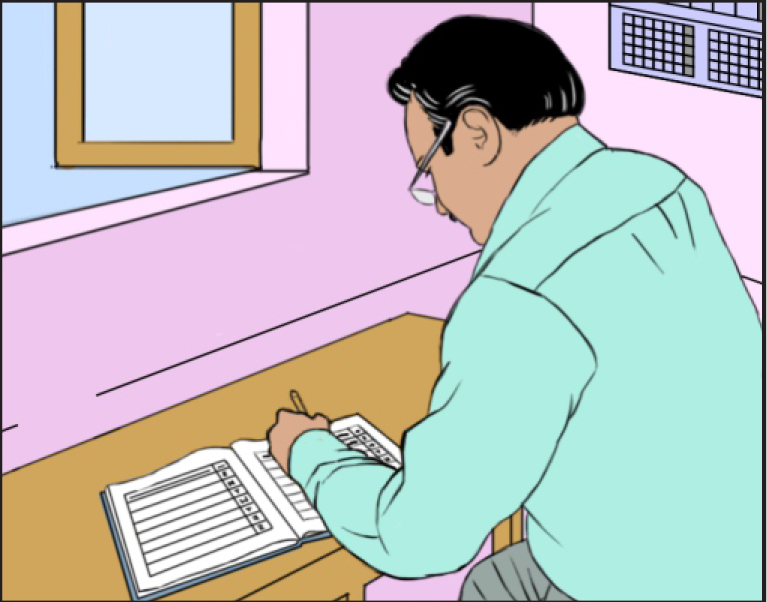
Use the Clinical Case Record for depression and alcohol problems to record necessary information. Documentation helps to keep track of the clinical process for each patient in the programme and make supervision effective.
The records you need to fill in at each session are:
- Clinical record form for depression and alcohol problems
- Patient registers for depression and alcohol problems
- Appointment diary
- End of treatment form for depression or alcohol problems, when the patient is discharged
Remember to fill in records as soon as the session is over and definitely by the end of the day; store the records in a safe and secure place; and go over them before your session with the patient.
-
Boundaries are limits within which the counselling relationship functions. It is your responsibility to maintain them.
Why do we need boundaries in counselling?
In a counselling relationship, there is a risk that the relationship may go beyond the professional one. Boundaries define counselling as a professional relationship between the counsellor and patient that is different from a conversation with a friend or family member. They help to ensure the safety of the counsellor and patient.
Types of boundaries to maintain:
- Sessions in places other than the clinic or planned home visit: Focus on discussing items on the agenda. Discuss how the patient would like you to respond if you meet the patient by accident in public.
- Receiving telephone calls: Give the patient your official number and clearly state the best times to call. But assure the patient that he/she may call in case of an emergency or personal crisis.
- Physical contact: In general, use other ways of showing care such as bending forward and softening one’s speaking tone.
- Exchanging gifts: Explain to the patient that because of the professional nature of the relationship, it is standard practice and applies to all patients that it is not appropriate to accept gifts. Ask your supervisor if you are uncertain about receiving a gift.
- Time-related boundaries: Setting time limits helps keep sessions in focus and allows for maximum results.
- Dealing with personal questions: The patient has the right to know all information related to the professional qualities of the counsellor such as training and experience. But any personal questions can be managed by explaining that they are not relevant.
- Counselling patients of the opposite sex: During home visits, take along a member of the same sex as the patient, such as the health assistant. You can make sure there are other members of the family at home when you plan the visit.
-
SUMMARY
- Regular supervision by a clinical supervisor or peers, individually or in a group, will support you and ensure good quality counselling
- Sometimes it is necessary to refer patients to supervisors, especially those with high suicide risk or who don’t improve with counselling. Patients in difficult social situations can be referred to community agencies
- Ensuring that patients complete treatment helps receive the best results of counselling. Telephone counselling, with prior consent, can be considered for those who are unable to follow up for subsequent sessions at home or in the clinic
- Documentation helps keep track of the clinical process and makes supervision effective
- Maintaining boundaries helps ensure that the professional nature of the relationship is maintained
- Be aware of the risk of burn out and take precautions to prevent it
-
 In this section, you can provide feedback about this course to help us make NextGenU.org better. Once evaluations are completed, you will be able to download your certificate of completion.
-
