loader image
Skip to main content
  • Preventing Non-Communicable Diseases
    0%

Focus Mode is ON. Click on the ‘collapse icon’ to close it.

  • Previous
  • Course data
    Introduction
    Course Registration
    Peer Corner
    Pre-Test
    Module 1: Size of the Problem (Burden of Illness, Macroeconomics)
    Resources Lesson 1: Burden of Illness
    Reflection Module 1
    Module 2: Causes (Risk Factors, including Individual, Population and Socio-cultural Determinants)
    Resources Lesson 1: Risk Factors
    Reflection Module 2
    Module 3: Appraising the Evidence that Underpins International Interventions and Prevention Programmes
    Resources Lesson 1: Evidence and International Initiatives
    Reflections Module 3
    Module 4: How Can We Make Health Policies to Reduce the Burden of NCD?
    Resources Lesson 1: How Can We Make Health Policies to Reduce the Burden of NCD?
    Drug Policies and Development: Conflict and Coexistence" - A Presentation for Southeast Asi
    Reflection: Module 4 (230 minutes)
    Module 5: Implementing Prevention Programmes (Plan Your Own)
    Resources Lesson 1: Planning and Implementing A Prevention Programme
    Exploring the Use of Electronic Health Records to Support Tobacco Cessation and Million Hearts
    Reflection: Module 5 (230 minutes)
    Final Exam
    Course and Self Evaluation & Certificate
  • Next
  • Categories
    • All categories
    • Public Health
    • Medicine Courses
    • Nursing
    • Professional Development Courses
    • Community Health Workers
    • Humanitarian Response
    • Health Sciences
    • Sciences
    • For our institutional partners: Full Programs/Graduate Medical Education
    • NIED Courses
  • Home
  • Calendar
  • About Us
    About Us FAQs The Frank Foundation Board Members Publications Quality Assurance
  • Guests
    Learners Mentors Universities
  • Courses
    All Courses Medicine Courses Public Health Courses Community Health Courses Professional Development Courses Nursing Courses Health Sciences Sciences
  • Programs
    Addiction Training for Health Professionals Public Health U - MPH Primary Education STEPS Humanitarian U
  • Connect
    Contact Us Volunteer Careers Join Our Network sign up for our newsletter
  • Donate
  • Blog
  • Recent
    Environmental Health SC
    Climate Change and Health - old
You are currently using guest access
Log in
Categories Collapse Expand
  • All categories
  • Public Health
  • Medicine Courses
  • Nursing
  • Professional Development Courses
  • Community Health Workers
  • Humanitarian Response
  • Health Sciences
  • Sciences
  • For our institutional partners: Full Programs/Graduate Medical Education
  • NIED Courses
Home Calendar About Us Collapse Expand
About Us FAQs The Frank Foundation Board Members Publications Quality Assurance
Guests Collapse Expand
Learners Mentors Universities
Courses Collapse Expand
All Courses Medicine Courses Public Health Courses Community Health Courses Professional Development Courses Nursing Courses Health Sciences Sciences
Programs Collapse Expand
Addiction Training for Health Professionals Public Health U - MPH Primary Education STEPS Humanitarian U
Connect Collapse Expand
Contact Us Volunteer Careers Join Our Network sign up for our newsletter
Donate Blog Recent Collapse Expand
Environmental Health SC
Climate Change and Health - old
Preventing Non-Communicable Diseases
Expand all Collapse all
Skip Activities

Activities

  • ForumForums
  • QuestionnaireQuestionnaires
  • QuizQuizzes
  • Resources
      Professional Development Courses

      Preventing Non-Communicable Diseases

      FE Felix Emeka
      • Course
      • Competencies
      • Professional Development Courses

        Preventing Non-Communicable Diseases

        FE Felix Emeka
        0% complete
        0% complete
        Resume

        Introduction


        Show More Show Less
        • questionnaire icon
          Course Registration Questionnaire
          Students must
          Student must submit this questionnaire to complete it
        • forum icon
          Peer Corner Forum
        • quiz icon
          Pre-Test Quiz
          Students must
          Mark as done
        Show More
      • How to create an account and enroll in the course?


      • Non-Communicable Diseases Homepage


        Introduction

        Despite a focus on the control of communicable diseases in developing countries in the past, it is now apparent that non-communicable diseases have crept up on populations and created a major threat. This course aims to help practitioners understand the size of this threat and its causes, and develop policies to reduce the growing burden on developing countries' populations. We cannot cover all non-communicable diseases in this module and have chosen to focus on Cardiovascular Disease (CVD) and Diabetes. We hope that the learning from this module will help students appreciate the evidence base required to plan interventions to reduce the threat from these conditions.

        The course is designed to help you: 

        1. Understand the size and causes of NCDs, and to develop policies to reduce the growing burden on developing countries’ populations (with a focus on CVD and Diabetes).
        2. Appreciate the evidence base required to plan interventions to reduce the threat from these conditions.

        This course is an Open Online Course (OOC) that has been adopted from Peoples-uni. It was further developed by NextGenU.org (NGU).

        There are five (5) modules to complete, which include:

        Module 1: Size of the Problem (Burden of Illness, Macroeconomics)
        Module 2: Causes (Risk Factors, including Individual, Population and Socio-cultural Determinants)
        Module 3: Appraising the Evidence that Underpins International Interventions and Prevention Programmes
        Module 4: How Can We Make Health Policies to Reduce the Burden of NCD?
        Module 5: Implementing Prevention Programmes (Plan Your Own)

        Approximate time for completion of this course is 18 hours and 30 minutes at an average reading rate of 144 words/minute.


        Engaging with this course

        • To register for this course, complete the registration form. Begin the course with Module 1. For each lesson, read the description. 
        • Each lesson comprises introductory remarks. You can click on the collections of resources in each module. 
        • There is a forum on each module for reflection, and you will be able to add a new topic or respond to a previous one. You may want to share your learning from this and other readings, comment on the topics from your own experience, comment on others' posts, or provide feedback on how we can improve the content and/or presentation.
        • There is a final quiz to assess your understanding of some important concepts. Click on the hyperlinks to take you to these items in each topic.

        Requirements to obtain the certificate 

        You may browse this course for free to learn for your personal enrichment. There are no requirements.

        To obtain a certificate, a learner must successfully complete:

        • All reading requirements
        • All quizzes, passing with 80%, having unlimited attempts (consider that some courses do not have quizzes)
        • All discussion forums
        • The final exam with a minimum of 80% and a maximum of 3 attempts, and
        • The self and course evaluation forms

        Subscribe to our newsletter to be notified of future updates, new courses, and to be part of our community.


      • Module 1: Size of the Problem (Burden of Illness, Macroeconomics)

        By the end of this Module, you should be able to understand the burden of disease from diabetes and cardiovascular disease from a public health perspective.

        See this short video from WHO: Global Noncommunicable Disease Network, as an introduction:

        • page icon
          Resources Lesson 1: Burden of Illness Page
          Students must
          View
        • forum icon
          Reflection Module 1 Forum
          Students must
          View

          Reflect on the global burden of cardiovascular disease and diabetes, and whether this first section of the course has given you an indication of the burden of illness that is relevant to your own setting?

      • Module 2: Causes (Risk Factors, including Individual, Population and Socio-cultural Determinants)

        By the end of this Module, you should have an understanding of the contribution of major risk factors, including socio-cultural factors, to the causes of diabetes and CVD.

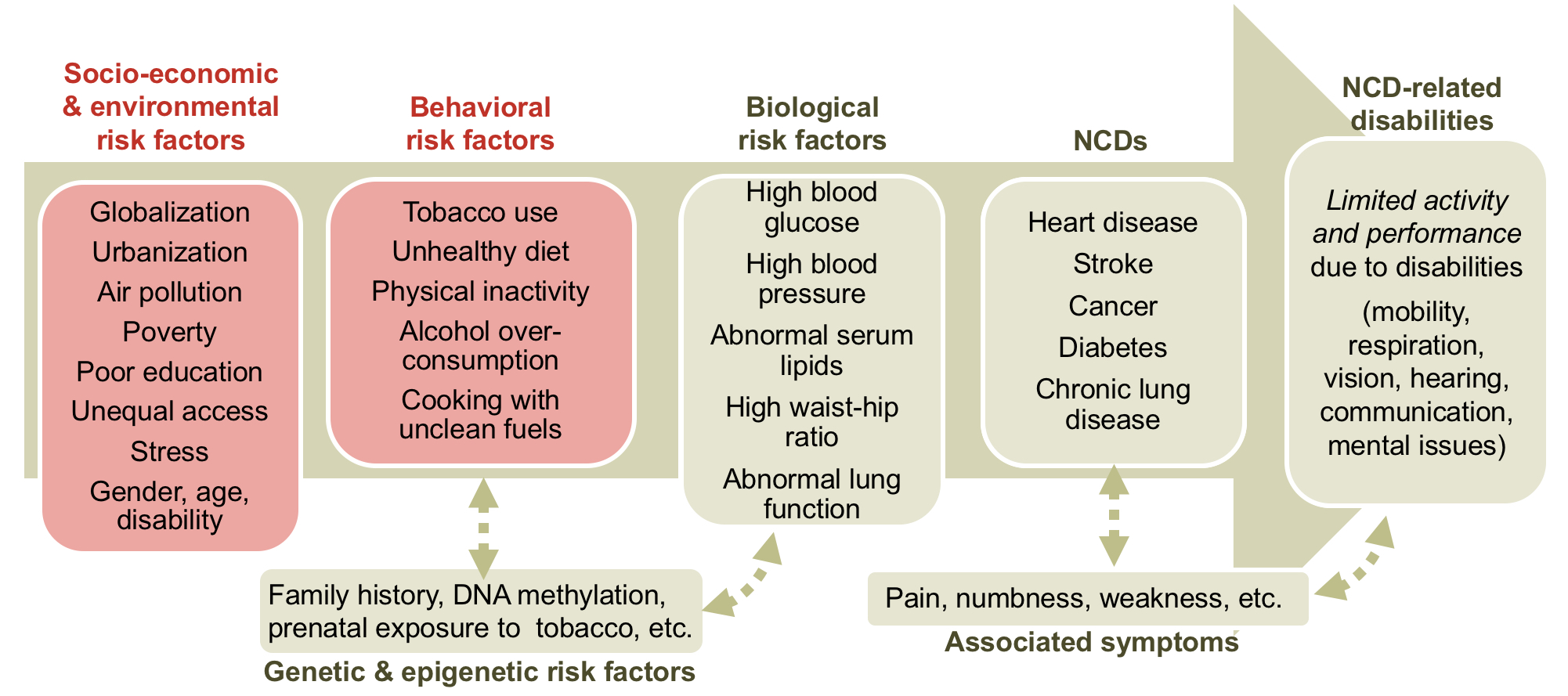
        This graphic Determinants and Chronic Conditions of NCDs (modified from Dans et al., 2011 by Medicus Mundi Switzerland) from Health Promotion and Health Literacy: Toward transformative action for non-communicable diseases is a nice summary of what you will find in the resources section below:
        753

        • page icon
          Resources Lesson 1: Risk Factors Page
          Students must
          View
        • forum icon
          Reflection Module 2 Forum
          Students must
          View

          Reflect on which of the risk factors for cardiovascular disease might be relevant in your own setting.

      • Module 3: Appraising the Evidence that Underpins International Interventions and Prevention Programmes

        By the end of this Module, you should be able to assess the evidence that underpins international initiatives in the prevention and provision of care for diabetes and cardiovascular diseases including primary and secondary prevention programmes and between population-based and individual-based interventions.

        • page icon
          Resources Lesson 1: Evidence and International Initiatives Page
          Students must
          View
        • forum icon
          Reflections Module 3 Forum
          Students must
          View

          How good do you think is the evidence underpinning interventions for NCD, and how relevant do you think is the evidence in your setting, since most of it comes from developed countries?

      • Module 4: How Can We Make Health Policies to Reduce the Burden of NCD?

        By the end of this Module, you should be able to discuss how diabetes and CVD might be incorporated in a policy agenda relevant to developing countries.                                         

        • page icon
          Resources Lesson 1: How Can We Make Health Policies to Reduce the Burden of NCD? Page
          Students must
          View
        • url icon
          Drug Policies and Development: Conflict and Coexistence" - A Presentation for Southeast Asi URL
          Students must
          View

          Watch the entire video

          An evidence-based discussion on the interactions between drug control and development, link them to the regional debates, and provide scientific findings on the history of drug eradication; on inclusive policies; and on the diverse impacts of drug policies in armed conflict situations. (73 minutes)

        • forum icon
          Reflection: Module 4 (230 minutes) Forum
          Students must
          View
          Start discussions: 1

          In this activity, discuss how Cardio Vascular Disease and addiction-related disorders might be incorporated into a policy agenda relevant to developing countries.        

          Step 1. Scan [30 minutes]

          Research an existing effective health policy in your country. Study the health issue or concern it aims to address and the provisions that accompany it.

          Step 2. Respond [180 minutes]

          Prepare a 300-600 word piece of writing that fully covers the following questions:

          • What is the relevance of the existing health policy in your country?
          • What provisions of the health policy are very much implemented in your country?
          • How adaptable is the existing health policy for developing a policy agenda for addiction-related disorders and CVD?                  
          • What are potential amendments to the policy in order to incorporate addiction-related disorders and CDV?    

          Step 3. Share [10 minutes]

          To share your work, click on the “Add a new discussion topic” button under this post and paste your work into the “Message” box. Make sure to reference others’ intellectual property when necessary. All references should follow 7th Edition APA formatting. For further instructions, see the resource on the Himmelfarb Health Sciences Library: APA citation resource (N.B. references are excluded from word counts).

          Step 4: Interact [10 minutes]

          To complete the activity, you will need to reply to at least two posts made by your peers in a respectful and professional manner. Ensure that your post engages your peers' ideas by including a reflection on their comments, sharing ideas of other potential difficulties and parties involved, or asking thought-provoking questions. Your response should respond to each of the three framework elements indicated in the table. If a peer comments on your posting, please reply. To post a reply, click “Reply” on a particular discussion, write your feedback and then click on “post to forum.”

          OPTIONAL Step 5: Interact (10 minutes)

          If you would like to, you can reply to your peers' posts in a respectful and professional manner. Ensure that your post engages your peers' ideas by including a reflection on their comments, sharing ideas of other potential difficulties and parties involved, or asking thought-provoking questions. If a peer comments on your posting, please reply. To post a reply, click “Reply” on a particular discussion, write your feedback and then click on “Post to forum.”

      • Module 5: Implementing Prevention Programmes (Plan Your Own)

        By the end of this Module you should be able to consider the implementation of a strategy to implement a successful intervention programme to reduce the burden of illness for CVD or diabetes in your own setting.

        • page icon
          Resources Lesson 1: Planning and Implementing A Prevention Programme Page
          Students must
          View
        • url icon
          Exploring the Use of Electronic Health Records to Support Tobacco Cessation and Million Hearts URL
          Students must
          View

          Watch the entire webinar.

          This webinar, co-hosted by ASTHO and NACCHO, explored and identified opportunities for using electronic health records (EHRs) to improve two of the ABCS of Million Hearts: smoking cessation efforts and improving blood pressure control. Furthermore, we provided a state and local example and available resources to support these efforts. (75 minutes)

        • forum icon
          Reflection: Module 5 (230 minutes) Forum
          Students must
          View
          Start discussions: 1

          In this activity, you will reflect on a policy/intervention you might implement in your setting and then identify any challenges or barriers to implementation and how they can be overcome.   

          Step 1. Scan [30 minutes]

          Research for existing health policies related to diabetes in a foreign country. Study the provisions of the policies you want to apply in your own setting.

          Step 2. Respond [180 minutes]

          Prepare a 300-600 word reflective piece of writing that fully addresses the following questions:

          • How can the provisions from the foreign policies be implemented in your own country?
          • What are the potential barriers and facilitators to the implementation of these policies in your country?
          • What strategies and practices will you employ to overcome the implementation barriers and challenges?
          • What are potential amendments to the policy in order to address the problem of substance use addiction in your country?

          Step 3. Share [10 minutes]

          To share your work, click on the “Add a new discussion topic” button under this post and paste your work into the “Message” box. Make sure to reference others’ intellectual property when necessary. All references should follow 7th Edition APA formatting. For further instructions, see the resource on the Himmelfarb Health Sciences Library: APA citation resource (N.B. references are excluded from word counts).

          Step 4: Interact [10 minutes]

          To complete the activity, you will need to reply to at least two posts made by your peers in a respectful and professional manner. Ensure that your post engages your peers' ideas by including a reflection on their comments, sharing ideas of other potential difficulties and parties involved, or asking thought-provoking questions. Your response should respond to each of the three framework elements indicated in the table. If a peer comments on your posting, please reply. To post a reply, click “Reply” on a particular discussion, write your feedback and then click on “post to forum.”

          OPTIONAL Step 5: Interact (10 minutes)

          If you would like to, you can reply to your peers' posts in a respectful and professional manner. Ensure that your post engages your peers' ideas by including a reflection on their comments, sharing ideas of other potential difficulties and parties involved, or asking thought-provoking questions. If a peer comments on your posting, please reply. To post a reply, click “Reply” on a particular discussion, write your feedback and then click on “Post to forum.”

      • Final Exam

        88
        Click here to start Final Examination
        • quiz icon
          Final Exam Quiz

          Take this quiz - A mark of 7/10 will qualify towards a certificate for the course.

          Not available unless any of: All of: ...
          Not available unless any of:
          • All of:
            • The activity Course Registration is marked complete
            • The activity Pre-Test is marked complete
            • The activity Reflection Module 1 is marked complete
            • The activity Reflection Module 2 is marked complete
            • The activity Reflections Module 3 is marked complete
            • The activity Reflection: Module 4 (230 minutes) is marked complete
            • The activity Reflection: Module 5 (230 minutes) is marked complete
          • You belong to Public Health U
          • You belong to Miami Med
      • Course and Self Evaluation & Certificate

        In this section, you can provide feedback about this course to help us make NextGenU.org better. Once evaluations are completed, you will be able to download your Certificate of Completion.

        Click here give your feedback

        • questionnaire icon
          Course Evaluations Questionnaire
          Not available unless: The activity Final Exam is marked complete
        • questionnaire icon
          Self Evaluation Questionnaire
          Not available unless: The activity Final Exam is marked complete
      Skip Rating and Review

      Rating and Review

      0

      0 Course Rating

      0%
      0%
      0%
      0%
      0%

      Reviews

      Contact site support
      You are currently using guest access (Log in)
      Powered by Moodle


      Copyright © 2025 NextGenU.org / All Rights Reserved


      Privacy Policy 


      Terms Of Use 


      Privacy Policy Terms & Conditions

      Copyrights Content