Rural Health and Aging
You do not have permission to view discussions in this forum.
-
Public HealthRural Health and AgingResume0% complete0% complete
-
Students mustStudent must submit this questionnaire to complete it
-
Students mustViewReceive a grade
Show More-
Rural Health and Aging Homepage
Highlighted

Welcome to Rural Health and Aging. This course provides an opportunity to develop practical skills and knowledge in social, economic, political, and cultural influences that impact the health of individuals and families in rural communities by focusing on improving health status and developing culturally appropriate interventions and services in rural settings.
This Rural Health and Aging course is sponsored by the University of the Incarnate Word (UIW). Like all NextGenU.org courses, it uses learning resources from accredited, world-class organizations such as the Pan American Health Organization, U.S. Centers for Disease Control and Prevention (CDC), and the U.S. National Institutes of Health. The course was developed in collaboration with UIW, and was designed by TimMarie Williams, PhD, MCG; Margaret Niles, PhD, MEd; Hugo Rojas, MD, MSc, DiplEd; Genikka Camille Gabral, B.ED, MSc; Pablo Baldiviezo, MD, DiplEd; and Carolina Bustillos, MD, DiplEd.
For publications on NextGenU.org’s courses’ efficacy, see “A Novel Integration of Online and Flipped Classroom Instructional Models in Public Health Higher Education,” (2014), BMC Medical Education, “Building Public Health Capacity through Online Global Learning,” (2018), Open Praxis, or on NextGenU.org’s publication page. Subscribe to our newsletter to be notified of future updates, new courses, and to be part of our community.There are 4 modules to complete, which provide an introduction to:
- Rural health and social sciences;
- Determinants of rural health;
- Healthcare delivery in rural communities; and
- Stakeholders and partnerships for rural health.
The completion time for this course is estimated at 122 hours and 44 minutes, 51 hours and 24 minutes of didactics and curated resources, and 71 hours and 20 minutes of work participating in activities and quizzes to assist the student in synthesis of the materials. This course is equivalent to three credit hours.
The course requires completion of all case studies, peer activities, and discussion fora. At the end of each lesson, there is a practice quiz. At the end of the course, after you’ve completed each lesson, quiz, and learning activity, you’ll have access to a final exam, and a chance to evaluate this course. Once you’ve passed that last test, you will be able to download a certificate of completion from NextGenU.org. We keep all of your personal information confidential, never sell any of your information, and only use anonymized data for research purposes, and we are also happy to report your testing information and share your work with anyone (your school, employer, etc.) at your request.
Engaging with this Course:
You may browse this course for free to learn for your personal enrichment; there are no requirements. To register in this course, it is required that learners have obtained a college-level/bachelor's degree.
To obtain a certificate a learner must successfully complete:
- All the reading requirements;
- All quizzes and pass with a 80% with unlimited attempts;
- All case studies;
- All peer activities;
- All discussion forums;
- The final exam with a minimum of 80% and a maximum of 3 attempts; and
- The self and course evaluation forms.
To obtain credit:- Complete all requirements listed above for the certificate; and
- Your learning institution or workplace should approve the partner-university-sponsored NextGenU.org course for educational credit, as they would for their learner taking a course anywhere.
NextGenU.org is happy to provide your institution with:
- A link to and description of the course training, so they can see all its components, including the cosponsoring universities and other professional organization cosponsors;
- Your grade on the final exam;
- Your work products (e.g. case study activities), and any other required or optional shared materials that you produce and authorize to share with them;
- Your evaluations -- course, and self-assessments;
- A copy of your certificate of completion, with the co-sponsoring universities and other organizations listed; and
- A collaboration to help your institution offer this course or other NextGenU.org courses to interested learners.
To obtain a degree, NextGenU.org co-sponsors degree programs with institutional partners. To obtain a full degree co-sponsored with NextGenU.org, registrants must be enrolled in a degree program as a student of a NextGenU.org institutional partner. If you think that your institution might be interested in offering a degree with NextGenU.org contact us.
We hope that you will find this a rewarding learning experience, and we count on your assessment and feedback to help us improve this training for future students.
Here are the next steps to take the course and earn a certificate.
- Complete the registration form.
- Take the pre-test.
- Begin the course with Module 1: Rural Health and Social Sciences. In each lesson, read the description, complete all required readings and any required activity, and take the corresponding quizzes.
-

Competency covered in this module:
- Examine the concept of "rurality" from a social sciences perspective.
- Synthesize theories, concepts, and models from social and behavioral sciences disciplines (e.g., anthropology, sociology, psychology, health education) that are used in public health research and practice.
-
Student Learning Outcomes:
Upon completion of this lesson, you will be able to:- Define rural and remote health.
- Differentiate between remote health and rural health.
- List some of the characteristic features of rural health populations and practices.
- Give examples of how the use of social sciences lenses can help to identify and address challenges for rural health.
- Using the example of aging, discuss how the social sciences approach can address challenges for rural and remote health.
-
Required Learning Resources and Activities
-
Students mustView
Read pages 16-18 under the heading "Definitions and characterization of rural health and remote health" and "Classification systems used overseas." (6 minutes)
Australian Rural Health Education Network-2019
-
Students mustView
Read the entire article. (3 minutes)
Healthcare Recruitment Specialists-2018
-
Students mustView
Read the entire content. (20 minutes)
Rural and Remote Health-2017
-
Students mustView
Read the content under the heading "Abstract" and "Challenges of Rural Health." (6 minutes)
Journal of Missouri State Medical Association-2017
-
Students mustView
Read "Summary" and "Health Status and Outcomes." (16 minutes)
Australian Institute of Health and Welfare-2019
-
Students mustView
Read pages the content under the headings: "Rural Populations and Health Inequality" and "Special Populations in Rural Health" pages 2-3. (6 minutes)
University of Washington-2020
-
Students mustView
Read the entire article. (33 minutes)
Humanities and social sciences communications-2019
-
Students mustView
Read the entire slide set. (17 minutes)
World Health Organization-2019
-
Students mustView
Read the content under the headings: "Abstract," "Sustainable Rural Health Care Services," and "Rural Health Workforce Supply." (8 minutes)
Annual Review of Public Health-2016
-
Students mustView
Read the entire article. (9 minutes)
International Journal For Equity in Health-2018
-
Students mustView
Read the following tabs on the left: "Summary," "Health status and outcomes," and "Access to Healthcare." (25 minutes)
Australian Institute Health and Welfare-2019
-
Students mustView
Read the entire article and click on the headings of "Health Communication," "Health Education," and "Policy, Systems, and Environmental Change." (13 minutes)
Rural Health Information Hub-2018
-
Students mustViewStart discussions: 1
In this activity, you will discuss how a social sciences approach can address the challenges for rural and remote health in the context of aging.
Reference Guide Links:
Step 1: Review
Study the given scenario below:
Imagine yourself as a medical social worker. Early in your career, you are deployed for a two-month medical mission to a rural “aging” community (residents are mainly 65 and older) in your country. As this is your first time receiving such an assignment, it is expected that you will encounter some challenges and social influences that may hinder the success of your medical deployment. As a medical social worker, how do you think a social sciences approach can address the challenges that you will encounter in the rural “aging” setting?
Step 2: Respond
Reflect on the given scenario by recalling some concepts covered previously, such as the social influences affecting rural health (see reference guide links above). After reflecting, study the “Rural Aging Community Assessment Table” and fill in the fourth column with the necessary details.
Note: Each box entry should be between 100 - 300 words (a total of 300-900 words for this table).
Step 3: Share
To share your work, click on the “Reply” button under this post and paste your work in the “Message” box. Make sure to reference others’ intellectual property when necessary. All references should follow 7th Edition APA formatting. For further instructions, see the resource on the Himmelfarb Health Sciences Library: APA citation resource (N.B. references are excluded from word counts).
Step 4: Interact
To complete the activity, you will need to reply to at least two posts made by your peers in a respectful and professional manner. Ensure that your post engages your peers' ideas by including a reflection on their comments, sharing ideas of other potential difficulties and parties involved, or asking thought-provoking questions. If a peer comments on your posting, please reply. To post a reply, click “Reply” on a particular discussion, write your feedback and then click on “post to forum.”
OPTIONAL Step 5: Interact (10 minutes)
If you would like to, you can reply to your peers' posts in a respectful and professional manner. Ensure that your post engages your peers' ideas by including a reflection on their comments, sharing ideas of other potential difficulties and parties involved, or asking thought-provoking questions. If a peer comments on your posting, please reply. To post a reply, click “Reply” on a particular discussion, write your feedback and then click on “Post to forum.”
-
Students mustMark as done
Additional Learning Options
-
Students mustView
Read the content under the heading "Introduction" and "Discussion." (7 minutes)
Rural and Remote Health-2017
-
Students mustView
Read the content under the heading " Challenges of Rural Health." (4 minutes)
Journal of Missouri State Medical Association-2017
-
Students mustView
Read the sections: "Rural Health Status," "Rural Cultures," and "Rural Health Services." (11 minutes)
Journal of Family Practice (Oxford)-2003
-
Students mustView
Read the entire article. (23 minutes)
Healio-2017
-
Student Learning Outcomes:
Upon completion of this lesson, you will be able to:- Recognize the core social sciences concepts and models relevant to public health.
- Identify the core behavioral sciences concepts and models relevant to public health.
- Analyze the potential benefits and challenges to improve rural health using concepts and models from social and behavioral sciences.
-
Required Learning Resources and Activities
-
Students mustView
Read the entire article. Click on the headings of "Ecological Models," "The Health Belief Model," "Stages of Change Model (Transtheoretical Model)," "Social Cognitive Theory," and "Theory of Reasoned Action/Planned Behavior." (9 minutes)
Rural Health Information Hub-2018
-
Students mustView
Read the content under the heading "Sociology and Public Health," "Anthropology and Public Health," "Economics and Public Health," "Geography and Public Health," "Demography and Public Health," "Political Science and Public Health," and "Conclusion" From pages 14 to 19. (19 minutes)
Research gate-2019
-
Students mustView
Read from: A Progression in Models/Theories of Health Behavior and Behavior Change. (19 minutes)
Journal of Clinical Interventions of Aging-2019
-
Students mustView
Read the entire article. (10 minutes)
UK Government.
-
Students mustViewStart discussions: 1
In this activity, you will reflect on the possible benefits and challenges of improving rural health in the context of social and behavioral sciences.
Reference Guide Links: https://www.ruralhealthinfo.org/topics/social-determinants-of-health
Step 1: Review
Select one of the four common issues present in rural health.
Rural Health Issues:
- Prevalence of substance use disorders.
- HIV and other sexually transmitted diseases as social and psychological issues.
- Prevalence of communicable diseases such as tuberculosis, hepatitis, and COVID-19.
- Resource distribution in rural health sectors.
- Access to health care centers and health facilities.
Step 2: Respond
After selecting one rural health issue, prepare a 500 - 900 word reflective piece of writing with the following inclusions:
-
Social and behavioral concepts/models that can be used to explain why the issue is considered a “rural health” problem,
-
e.g., cervical cancer illiteracy as a rural health problem can be explained by the Theory of Planned Behavior and Theory of Reasoned Action because:
- Briefly summarize the concepts/models of your choice.
- Provide a few examples of how it applies to your selected health issue.
-
Potential approaches to improve the response to the selected issue that becomes evident after analyzing it under the lenses of social and behavioral sciences,
-
e.g., incorporating the Theory of Planned Behavior entails an intervention approach or strategy that includes education and literacy through small group classes and teach-back methods.
Possible benefits and challenges of integrating/applying these concepts/models in addressing the issue
- e.g., Integrating the Theory of Planned Behavior provides reliability in the prediction of the behavior of individuals towards substance use/abuse, as it helps identify the biggest barriers to changing behavior, addressing the often-challenging gap between the “intention and behavior of the concerned individuals.
Step 3: Share
To share your work, click on the “Add a new discussion topic” button under this post and paste your work in the “Message” box. Make sure to reference others’ intellectual property when necessary. All references should follow 7th Edition APA formatting. For further instructions, see the resource on the Himmelfarb Health Sciences Library: APA citation resource (N.B. references are excluded from word counts).
Step 4: Interact
To complete the activity, you will need to reply to at least two posts made by your peers in a respectful and professional manner. Be sure that your post engages your peers' ideas by including a reflection on their comments, sharing ideas of other potential difficulties and parties involved, or asking thought-provoking questions. If a peer comments on your posting, please reply. To post a reply, click “Reply” on a particular discussion, write your feedback and then click on “post to forum.”
OPTIONAL Step 5: Interact (10 minutes)
If you would like to, you can reply to your peers' posts in a respectful and professional manner. Ensure that your post engages your peers' ideas by including a reflection on their comments, sharing ideas of other potential difficulties and parties involved, or asking thought-provoking questions. If a peer comments on your posting, please reply. To post a reply, click “Reply” on a particular discussion, write your feedback and then click on “Post to forum.”
-
Quiz: Module 1
To access the quiz, click on the name of the quiz provided above. On the following screen, click the "Preview quiz now" button to respond to the questions.
TO PASS THIS QUIZ YOU MUST OBTAIN A SCORE OF 28/35
Not available unless: The activity Course Registration is marked complete ...Not available unless:- The activity Course Registration is marked complete
- The activity Pre-Test is marked complete
-
 Competency covered in this module:
 - Analyze the social and behavioral determinants of health equity at all ecological levels (individual through policy) applied in rural settings.
- Assess the impact of power and privilege on health inequity at the local, national, and global levels.
-
Student Learning Outcomes:
Upon completion of this lesson, you will be able to:- Differentiate between the various social and behavioral determinants of rural health.
- Analyze the ecological model for health promotion programs.
- Exemplify how health outcomes can be influenced at all ecological levels.
- Describe what is health equity and how it is viewed by rural populations.
- Describe health equity from an aging population perspective.
- Analyze the burden of disease for aging populations in rural communities.
-
Required Learning Resources and Activities
-
Students mustView
Read the sections from "Introduction" to "Potential Rural Strategies." (22 minutes)
National Advisory Committee on Rural Health and Human Services-2017
-
Students mustView
Overview and FAQ's : 3, 4, 5, 6, 8, 10, 11, 15, and 18. (26 minutes)
Rural Health Information Hub-2020
-
Students mustView
Read the "Ecological Models" tab under Module 2: "Program Models" including examples of ecological models & considerations for implementations. View "PROJECT HEART" Model link for an actual ecological model on health promotion. (23 minutes)
Rural Health Information Hub-2018
-
Students mustView
Read content under "Discussion." (16 minutes)
PubMed Journal Article-2012
-
Students mustView
Read the content under the heading "Introduction" from page 1 to page 4. (10 minutes)
The National Academies Press-2018
-
Students mustView
Read the content under "Introduction" in Chapter 1.1.5. on pages 57-58. (3 minutes)
WONCA Rural Education Guidebook-2014
-
Students mustView
Read the content under "Abstract" and "Introduction." (7 minutes)
HHS Public Access-2011
-
Students mustView
Read the content under the heading "Identifying Public Health Goals and Benefits for Elderly Populations." (7 minutes)
The Oxford Handbook of Public Health Ethics-2019
-
Students mustView
Read the entire document. (18 minutes)
United Nations Department of Economic and Social Affairs-2018
-
Students mustView
Read instructions for the peer activity. (20 minutes)
National Institute on Minority Health and Health Disparities.
-
Students mustViewStart discussions: 1
In this activity, you will revamp a bar graph to any form of visual (chart, infographic, slideshow) and present the following:
- Analysis of the burden of disease in people aged 60 years and older.
- Examples of how living in rural communities present challenges and opportunities to address health issues among older adults.
- Demonstration of how a specific health issue can be influenced at different ecological levels.
Step 1: Analyze
Analyze the leading contributors to the burden of disease in people aged 60 years and older in 2010. Take note of the following key features of the figure:
- Most prominent disease burden contributors in both low-income and high-income countries.
- Least prominent disease burden contributors in both low-income and high-income countries.
- Potential explanations for the most significant differences of disease burden contributors among low-income and high-income countries.
Step 2: Respond
From the data, choose one disease contributor and reflect on how the prominence of the disease can be influenced at all ecological levels - For example: how the prominence of cardiovascular disease can be influenced at the individual, population, and community levels.
Your ideas for how to respond to your selected health issue at each ecological level should be contextualized for older adults in a rural health community.
Step 3: Design
Select your preferred digital/non-digital tool to revamp the given graph to your chosen visual representation. Ensure that you also include the key features from Step 1 and your ideas from Step 2. You can use chart features of PowerPoint or visual design apps like Canva and Visme. Choose a visual type that will enhance the clarity of the data based on “rank” or “prominence.”
Step 4: Present
Present your visual analysis highlighting the key features from Step 1 and the ideas from Step 2. Record yourself or your screen using the online tool, Loom. If you are using PowerPoint, you may embed an audio recording in your presentation. The presentation should be of 3 - 5 minutes duration only.
Step 5: Share
To share your work, click on the “Reply” button under this post and paste the shareable public link of your work in the “Message” box. Make sure to reference others’ intellectual property when necessary. All references should follow 7th Edition APA formatting. For further instructions, see the resource on the Himmelfarb Health Sciences Library: APA citation resource (N.B. references are excluded from word counts).
Step 6: Interact
Evaluate and categorize the work from one of your peers based on items A - E of this rubric. Provide a rationale for the grade you provided, as well as comments or suggestions for improvement. To post a reply, click “Reply” on a particular discussion, write your feedback and then click on “Post to forum.” You can use the list below as an example:
Item A is .…. because…. My suggestions for improvement are….
Item B is .…. because…. My suggestions for improvement are….
Item C is .…. because…. My suggestions for improvement are….
Item D is .…. because…. My suggestions for improvement are….
Item E is .…. because…. My suggestions for improvement are….OPTIONAL Step 5: Interact (10 minutes)
If you would like to, you can reply to your peers' posts in a respectful and professional manner. Ensure that your post engages your peers' ideas by including a reflection on their comments, sharing ideas of other potential difficulties and parties involved, or asking thought-provoking questions. If a peer comments on your posting, please reply. To post a reply, click “Reply” on a particular discussion, write your feedback and then click on “Post to forum.”
-
Additional Learning Options
-
Students mustView
Read the entire article. (29 minutes)
African Health Sciences-2011
-
Students mustView
Read the entire article. (19 minutes)
Wiley Public Health Emergency Collection-2020
-
Students mustView
Read the entire article. (3 minutes)
World Health Organization-2021
-
Students mustView
Read the entire document. (40 minutes)
United Nations Economic Commission for Europe-2017
-
Student Learning Outcomes:
Upon completion of this lesson, you will be able to:- Define health inequities.
- Explain the concepts of power and privilege within a public health context.
- Assess the relationship between power, privilege, and health inequities.
- Examine the application of ethics in rural health.
- Analyze the correlation between ethics and the health of the aging population.
-
Students mustMark as done
Required Learning Resources and Activities
-
Students mustView
Read 1.3 Health Equity. (3 minutes)
International Journal of Maternal and Child Health and AIDS
-
Students mustView
Read the first Frequently Asked Question (FAQ): What is the difference between health disparities and health inequities? (1 minute)
Rural Health Information Hub-2017
-
Students mustView
Read the entire article. (12 minutes)
Public Health Reports-2014
-
Students mustView
Read the content under the heading "How GH5050 Understands Power, Privilege & Priorities and Applies Them in This Report" on page 13. (2 minutes)
Editorial: Global Health
-
Students mustView
Read the entire article. (10 minutes)
Boston School of Public Health
-
Students mustView
Read the entire document. (11 minutes)
NHS Health Scotland-2016
-
Students mustView
Read: What is the Significance of Morality and Ethics to the Rural Professional? (8 minutes)
Dartmouth College Press-2009
-
Students mustView
Read pages 54-56, "Basic Ethical Principles as Essential Material for Your Peer Activity." (10 minutes)
Dartmouth College Press-2009
-
Students mustView
Read pages 45-49 under "Human Rights, Ethics, and Principles of Public Health." (15 minutes)
Caribbean Public Health Agency-2019
-
Students mustViewStart discussions: 1
In this activity, you will reflect on how ethical principles govern the health and well-being of older adults in a rural population.
Reference Guide Link: Ethical Challenges in Pursuing Public Health Goals https://geiselmed.dartmouth.edu/cfm/resources/ethics/chapter-03.pdf
Step 1: Review
Read and review the four topic questions below. Select one to reflect on.
In the context of ethics:
Topic Question 1: Why should vaccinating older adults for COVID-19 be a top priority?
Topic Question 2: Why can the age of older adults be a reasonable criterion for ICU admission in times of scarce ICU capacity?
Topic Question 3: Why should denying treatment for a life-threatening condition be acceptable if it is an aged patient’s personal choice?
Topic Question 4: How can the ban on visiting nursing homes for the aged be justifiable in times of COVID-19 crisis?
Step 2: Respond
After reflecting on your chosen topic question, prepare a 300 - 500 word reflective argument based on the following ethical principles:
- Autonomy
- Justice
- Beneficence
- Non-maleficence
Please see the reference guide links above for more information about these ethical principles.
Step 3: Share
To share your work, click on the “Reply” button under this post and paste your work in the “Message” box. Make sure to reference others’ intellectual property when necessary. All references should follow 7th Edition APA formatting. For further instructions, see the resource on the Himmelfarb Health Sciences Library: APA citation resource (N.B. references are excluded from word counts).
Step 4: Interact
To complete the activity, you will need to reply to at least two posts made by your peers in a respectful and professional manner. Ensure that your post engages your peers' ideas by including a reflection on their comments, sharing ideas of other potential difficulties and parties involved, or asking thought-provoking questions. If a peer comments on your posting, please reply. To post a reply, click “Reply” on a particular discussion, write your feedback and then click on “post to forum.”
OPTIONAL Step 5: Interact (10 minutes)
If you would like to, you can reply to your peers' posts in a respectful and professional manner. Ensure that your post engages your peers' ideas by including a reflection on their comments, sharing ideas of other potential difficulties and parties involved, or asking thought-provoking questions. If a peer comments on your posting, please reply. To post a reply, click “Reply” on a particular discussion, write your feedback and then click on “Post to forum.”
-
Quiz: Module 2
To access the quiz, click on the name of the quiz provided above. On the following screen, click the "Preview quiz now" button to respond to the questions.
TO PASS THIS QUIZ YOU MUST OBTAIN A SCORE OF 23/29.
Not available unless: The activity Quiz: Module 1 is marked complete -
Students mustMark as done
Additional Learning Options
-
Students mustView
Watch the entire video. (17 minutes)
PAHO TV-2018
-
Students mustView
Read the section titled "Ethical Challenges in Pursuing Public Health Goals" in the book as supplementary material for your peer activity. (12 minutes)
The Oxford Handbook of Public Health Ethics-2019
-
Students mustView
Read content from "Findings" and stop before "Methodological Considerations." (28 minutes)
International Journal of Qualitative Studies in Health and Well Being-2012
-
 Competency covered in this module:
 - Describe the benefits of having community health workers in rural health.
- Identify and discuss the barriers and solutions to a rural community's infrastructure (e.g., health IT and emergency medical services) and its impact on healthcare delivery.
-
Student Learning Outcomes:
Upon completion of this lesson, you will be able to:- Express the operational definition of community health workers and the alternative titles used to identify it.
- Examine the different functions that community health workers carry out and how the rural populations benefit from them.
- Differentiate rural healthcare from urban healthcare in terms of availability of health personnel and services.
- Reflect on the impact of community health workers in rural aging communities.
Click here to start this lesson-
Required Learning Resources and Activities
-
Students mustView
Read the abstract, discussion, and conclusion. (13 minutes)
Global Health Action-2017
-
Students mustView
Read the content from pages 1 to 2 under "Community Health Workers" and "Definition of Terms." (5 minutes)
Brigham and Women's Hospital-2018
-
Students mustView
Read the paragraphs before the Frequently Asked Questions. (2 minutes)
The Rural Health Information Hub-2019
-
Students mustView
Read entire page except "Resources to Learn More." (1 minute)
The Rural Health Information Hub-2020
-
Students mustView
Read entire page except "Resources to Learn More." (2 minutes)
The Rural Health Information Hub-2020
-
Students mustView
Read the content from pages 1 to 9. (28 minutes)
UNAIDS-2017
-
Students mustView
Read the content under the section titled Results: Approachability, Acceptability, Availability and Accommodation, Affordability, and Appropriateness; Discussion, and Conclusions. (27 minutes)
BMC Health Services Research-2019
-
Students mustView
Read the content under, "Central role of CHWs in the community," and "Multiple benefits for the elderly" (5 minutes)
Centers for Disease Prevention and Control-2013
-
Students mustViewStart discussions: 1
In this activity, you will reflect on the impact of community health workers as key players in a community-based intervention program for a rural aging community.
Step 1: Review
Study the given scenario below.
Find a health-related community-based intervention program in your community/region (or anywhere in the world) that targets a rural aging population. Imagine that you are the Lead Researcher and Educator for that intervention program in your community/region.
As the Lead Researcher and Educator, you are responsible for communicating the progress of the program to the Director. At the end of the program, the Director emails you to inquire about an initial outcomes report of the program. Your feedback is valuable as it will be a key determinant of the replication of the program elsewhere.
(If you are unable to find an appropriate intervention program in your community/region, you may use this one: StrongWomen–Healthy Hearts program)
Step 2: Respond
Prepare a 500-900 word email correspondence about:
1. Initial outcomes of the program
- Different roles carried out by facilitators and other collaborators
- How does each role/function contribute to the overall success of the program?
- What are the indicators that the participants have benefited from working with the facilitators?
- Impact of the intervention program on the participants
- What significant differences did the intervention program make in the community?
- How are the facilitators and other collaborators accountable for the success rate of the program?
- What modifications need to be made to increase the impact of the program in the event that it will be re-implemented or replicated?
- What new goals can be incorporated into the program related to substance use/abuse, and alcoholism?
- What additional roles/responsibilities can be explored to increase workforce participation in relation to achieving the new goals?
- How can the members of the community, including those who did not participate (e.g. teenage groups, younger adults), benefit from the “improved” program?
Step 3: Share
To share your work, click on the “Add a new discussion topic” button under this post and paste your work in the “Message” box. Make sure to reference others’ intellectual property when necessary. All references should follow 7th Edition APA formatting. For further instructions, see the resource on the Himmelfarb Health Sciences Library: APA citation resource (N.B. references are excluded from word counts).
Step 4: Interact
To complete the activity, you will need to reply to at least two posts made by your peers in a respectful and professional manner. Ensure that your post engages your peers' ideas by including a reflection on their comments, sharing ideas of other potential difficulties and parties involved, or asking thought-provoking questions. If a peer comments on your posting, please reply. To post a reply, click “Reply” on a particular discussion, write your feedback and then click on “Post to the forum.”
OPTIONAL Step 5: Interact (10 minutes)
If you would like to, you can reply to your peers' posts in a respectful and professional manner. Ensure that your post engages your peers' ideas by including a reflection on their comments, sharing ideas of other potential difficulties and parties involved, or asking thought-provoking questions. If a peer comments on your posting, please reply. To post a reply, click “Reply” on a particular discussion, write your feedback and then click on “Post to forum.”
-
Additional Learning Options
-
Students mustView
Read the content under "Discussion" (12 minutes)
BMC Health Services Research-2020
-
Student Learning Outcomes:
Upon completion of this lesson, you will be able to:- Discuss the challenges to healthcare delivery in rural communities.
- Explain how infrastructure is relevant to quality healthcare delivery for both public health and healthcare.
- Describe the concept of healthcare and public health infrastructure.
- Assess the key features of public health and healthcare infrastructure in rural United States.
- Examine healthcare models used in healthcare delivery in rural communities.
- Review a sample of recommendations on public health and healthcare infrastructure for improved healthcare delivery.
- Discuss possible ways in which healthcare models and recommendations can be implemented to improve healthcare delivery for older adults.
- Elaborate on the possible challenges in implementing models and recommendations for improved healthcare delivery in rural communities.
-
Students mustMark as done
Required Learning Resources and Activities
-
Students mustView
Read the following sections: (23 minutes)
1. What are barriers to healthcare access in rural areas?
2. What types of healthcare services are frequently difficult to access in rural areas?
3. How do rural healthcare facility and service closures impact access to care?The Rural Health Information Hub-2019
-
Students mustView
Read content under "Access to Healthcare." (4 minutes)
Europe PMC Funders Group-2018
-
Students mustView
Read the entire article. (5 minutes)
United Nations University Institute for Environment and Human Security-2020
-
Students mustView
Read the entire article. (14 minutes)
NCBI-2015
-
Students mustView
Read the following sections of the article: (2 minutes)
1. Overview.
2. Why is Public Health Structure Important?
3. Understanding Public Health Infrastructure.Office of Disease Prevention and Health Promotion, US Department of Health and Human Services-2021
-
Students mustView
Read the following section of the page: (4 minutes)
1. What infrastructure and governance exists in rural areas for public health agencies?Rural Health Information Hub-2020
-
Students mustView
Read the entire module introduction and all the links provided in the subsection program models. (9 minutes)
• Community Organization Model
• Community Readiness Model
• PRECEDE/PROCEED
• Clinical Model
• Workplace ModelRural Health Information Hub-2018
-
Students mustView
Read Chapter 4: Recommendations. (8 minutes)
Walsh Center for Rural Health Analysis-2012
-
Students mustView
Read the subsection: Implementation Considerations. (5 minutes)
Rural Health Information Hub-2017
-
Students mustView
Read the following sections of the module: (8 minutes)
• Implementation Challenges
• Staff Training and Education
• Financial Resources
• Technology
• PartnershipsRural Health Information Hub-2019
-
Students mustView
Read the section that aligns with your chosen model in the Peer Activity. (Estimated time to complete peer activity (540 minutes).
• Housing
• Legal Assistance
• Telehealth/Home Health
• Caregivers and Caregiver Well-Being
• Transportation Programs
• Community Integration
• Community Supports
• Designing Age-Friendly CommunitiesRural Health Information Hub-2019
-
Students mustView
Read the content under the heading "Challenges to Infrastructure Establishment" on pages 14-16. (6 minutes)
Walsh Center for Rural Health Analysis-2012
-
Students mustView
Watch the entire webinar. (83 minutes)
-
Students mustView
Watch the entire webinar The LTSS webinar introduces participants to the Opioid Response Network (STR-TA) and provides an overview of the intersection of aging and the opioid epidemic. Presenters discussed examples and implications for treatment and care in American Indian and Alaska Native (AI/AN) communities. (61 minutes)
-
Students mustViewStart discussions: 1
In this activity, you will discuss the process of implementing some recommendations and a rural health model to support rural aging in place.
Step 1: Review
Study the given scenario:
You have been invited to participate in a speaking engagement event titled “Rural Aging in Place: On Maintaining Independence, Autonomy, and Connection.” Prior to this event, you attended a stakeholder meeting to review some recommendations on public health and healthcare infrastructure to improve healthcare delivery.
As a speaker, you are requested to deliver a talk on how to improve and support rural aging in place by implementing the following:
- Recommendations on public health and healthcare infrastructures on rural healthcare delivery.
- One selected model from the eight models that support rural aging in place.
The eight models are as follows:
- Housing
- Legal Assistance
- Telehealth/Home Health
- Caregivers and Caregiver Well-Being
- Transportation Programs
- Community Integration
- Community Supports
- Designing Age-Friendly Communities
Note: As talk guides, review the following course readings again:
Establishing and Maintaining Public Health Infrastructure in Rural Communities.
(Read Chapter 4: Recommendations)Module 2: Evidence-Based and Promising Aging in Place Program Models.
(Read the section that aligns with your chosen model in the Peer Activity)Step 2: Respond
Prepare a 3-5 minute talk about the implementation of the recommendations on infrastructures and chosen health model to support rural aging in place, with the following highlights:
- Key features of the recommendations on infrastructures and health model.
- A real-life example of the health model anywhere in the world.
- Possible challenges when implementing both the recommendations on infrastructures and health model.
- Possible ways to effectively implement both the recommendations on infrastructures and health model in the rural aging community.
Step 3: Present
Present your talk by recording yourself using Loom or any video-recording/video curation tool that allows you to share your work through a link.
Step 4: Share
To share your work, click on the “Reply” button under this post and paste the shareable link of your talk in the “Message” box. Make sure to reference others’ intellectual property when necessary. All references should follow 7th Edition APA formatting. For further instructions, see the resource on the Himmelfarb Health Sciences Library: APA citation resource (N.B. references are excluded from word counts).
Step 5: Interact
Evaluate and categorize the work from one of your peers based on items A - E of this rubric. Provide a rationale for the grade you provided, as well as comments or suggestions for improvement. To post a reply, click “Reply” on a particular discussion, write your feedback and then click on “Post to forum.” You can use the list below as an example:
Item A is .…. because…. My suggestions for improvement are….
Item B is .…. because…. My suggestions for improvement are….
Item C is .…. because…. My suggestions for improvement are….
Item D is .…. because…. My suggestions for improvement are….
Item E is .…. because…. My suggestions for improvement are….OPTIONAL Step 6: Interact (10 minutes)
If you would like to, you can reply to your peers' posts in a respectful and professional manner. Ensure that your post engages your peers' ideas by including a reflection on their comments, sharing ideas of other potential difficulties and parties involved, or asking thought-provoking questions. If a peer comments on your posting, please reply. To post a reply, click “Reply” on a particular discussion, write your feedback and then click on “Post to forum.”
-
Quiz: Module 3To access the quiz, click on the name of the quiz provided above. On the following screen, click the "Preview quiz now" button to respond to the questions.TO PASS THIS QUIZ YOU MUST OBTAIN A SCORE OF 21/26Not available unless: The activity Quiz: Module 2 is complete and passed
-
Students mustMark as done
Additional Learning Options
-
Students mustView
Read the entire article. (23 minutes)
BMC Health Services Research-2008
-
Students mustView
Read the entire article. (12 minutes)
Indian Journal of Community Medicine-2016
-
Students mustView
Read entire article. (11 minutes)
The World Bank-2015
-
 Competency covered in this module:
 Explain the major political, economic, and social forces at work in rural communities and assess their impact on community and public health interventions. - Develop an understanding of, and explain interprofessional, interdisciplinary, and transdisciplinary relationships, to respond to public health problems applicable to rural settings.
-
Student Learning Outcomes:
Upon completion of this lesson, you will be able to:- Demonstrate understanding of the roles and functions of political, economic, and social forces at work in rural health.
- Recognize types of common partnerships or coalitions (political, economic, and social) between stakeholders and their shared responsibilities for the rural communities.
- Explain the need to form partnerships or coalitions for providing healthcare in a rural community.
- Assess how stakeholders in selected partnerships/coalitions impact community health and public health interventions in rural settings.
Click here to start this lesson-
Required Learning Resources and Activities
-
Students mustView
Read the following contents: (14 minutes)
1. All paragraphs under Rural Health Policy.
2. What types of issues does rural health policy address?
3. What role does the federal government play in the rural health policy process?
4. Which federal agencies participate in the rural health policy process?
5. How do researchers support rural health policy?
6. What role do membership organizations play in advocating for rural health issues?Rural Information Hub-2021
-
Students mustView
Read the content under the heading "Defining Rural Health Networks and Coalitions." (2 minutes)
Rural Health Information Hub-2017
-
Students mustView
Read the section: "Identify and Engage Possible Partners." (3 minutes)
Rural Health Information Hub-2017
-
Students mustView
Read the first two paragraphs on the page. (1 minute)
Center for Community Health and Development: University of Kansas-2018
-
Students mustView
Read "Section 1. Why Rural Health Care Provider Collaboration and Coordination is Important Today." (4 minutes)
U.S. Department of Health and Human Services | Health Resources and Services Administration-2019
-
Students mustView
Instructions for the use learning resources here are available in the activity plan. [7 minutes (for reading) and 540 minutes (for the Peer Activity)].
Rural Health Information Hub-2017
-
Students mustView
Read the content under "3.3 Synthesis" and "5 Conclusion and Implications." (17 minutes)
Health Expectations-2021
-
Students mustViewStart discussions: 1
In this activity, you will create a brochure to demonstrate your analysis of how various stakeholders in a coalition work together to impact community health and public health interventions in rural settings.
Step 1: Review
-
Review these four common models of rural health coalitions/partnerships.
-
Choose one model and click on the title to access the associated website. Review the information found on the website and select one (1) example of a real-life coalition that exemplifies the chosen model.
Example: For Collective Impact - Communities That Care.
-
Access the link of the real-life coalition and study its website, paying attention to:
- The coalition’s shared goal/s;
- The stakeholders involved in the coalition; and
- The functions of the stakeholders.
Step 2: Assess
-
After completing Step 1, you will assess how various stakeholders in a coalition work together to impact community health and public health interventions in rural settings, highlighting the following details:
- The common goal of the coalition.
- The rationale on the need for the coalition.
- Specific stakeholders of the coalition and their roles.
- A brief description of how the coalition works together.
- The impact of the community health and public health interventions on the rural settings that they serve (eg. success stories/data, testimonials).
Step 3: Design
Select your preferred digital/non-digital tool to create the assessment brochure. You can use features of Word or visual design apps like Canva , Visme and Venngage. To help you out on how to make a brochure, you may view this link for inspiration: https://www.canva.com/create/brochures/.
Step 4: Share
To share your work, click on the “Reply” button under this post and paste the shareable link of your work in the “Message” box. Make sure to reference others’ intellectual property when necessary. All references should follow 7th Edition APA formatting. For further instructions, see the resource on the Himmelfarb Health Sciences Library: APA citation resource (N.B. references are excluded from word counts).
Step 5: Interact
To complete the activity, you will need to reply to at least two posts made by your peers in a respectful and professional manner. Ensure that your post engages your peers' ideas by including a reflection on their comments, sharing ideas of other potential difficulties and parties involved, or asking thought-provoking questions. If a peer comments on your posting, please reply. To post a reply, click “Reply” on a particular discussion, write your feedback and then click on “Post to the forum.”
OPTIONAL Step 6: Interact (10 minutes)
If you would like to, you can reply to your peers' posts in a respectful and professional manner. Ensure that your post engages your peers' ideas by including a reflection on their comments, sharing ideas of other potential difficulties and parties involved, or asking thought-provoking questions. If a peer comments on your posting, please reply. To post a reply, click “Reply” on a particular discussion, write your feedback and then click on “Post to forum.”
-
-
Additional Learning Options
-
Students mustView
Read the entire article. (9 minutes)
Parliament of Australia-2019
-
Students mustView
Read the entire page. (8 minutes)
National Rural Health Association-2021
-
Students mustView
Read the entire document. (45 minutes)
The Partnership for Maternal, Newborn and Child Health-2013
-
Students mustView
Read the entire document. (39 minutes)
Journal of Integrated Care-2019
-
Students mustView
Read "Part 2: Profiles of Successful Partnerships" on pages 27 to 28. (5 minutes)
Development Organizations-2013
-
Students mustView
Read the content under the following headings: (19 minutes)
- "The Prominent Role of Partnerships in the Success of the AIDS Response," on page 95.
- "UNITAID: New Partnerships for Innovative Financing Mechanisms," on page 97.
- "Lessons from the AIDS Movement for Current and Future Partnerships," on page 99.
- "Strengthen Partnerships in Support of the Campaign to End Fistula," on page 106.
UN Department of Economic and Social Affairs-2009
-
Student Learning Outcomes:
Upon completion of this lesson, you will be able to:- Define interprofessional, interdisciplinary, and transdisciplinary relationships in the public health context.
- Analyze the implications of collaborative relationships in providing and delivering health services to older adults in a rural community.
- Discuss the significance of strengthening public health response for providing improved health care services.
- Review the role of collaborative relationships in strengthening practices, strategies, and priorities so that public health response can provide adequate health care services.
- Investigate how a given approach (such as a health preparedness program) can strengthen the public health response for providing health care services to older adults in rural communities.
-
Students mustMark as done
Required Learning Resources and Activities
-
Students mustView
Read the first section "Introduction." (1 minute)
Journal of Public Health-2014
-
Students mustView
Read the section "The Role of Interdisciplinary Teams in Physical and Rehabilitation Medicine (Types of Teams)." (4 minutes)
Journal of Rehabilitation Medicine-2018
-
Students mustView
Read "Key Concepts- Inter-Professional Education & Collaborative Practice" on page 13. (2 minutes)
World Health Organization-2010
-
Students mustView
Read the entire case report. (43 minutes)
Journal of Physical Therapy Education-2014
-
Students mustView
Read the content under the heading "Investments in Public Health Improve Health Outcomes and Reduce Health Care Spending," "Lack of Investment has led to a Dangerously Underfunded Public Health Infrastructure" on page 8, and "Substantially Increase Funding to Strengthen the Public Health Infrastructure and Workforce," and "Safeguard and Improve Americans’ Health" on pages 25 and 26. (13 minutes)
Trust for America's Health Organization-2020
-
Students mustView
Read the entire fact sheet. (8 minutes)
National Association of County and City Health Officials: The National Connection for Local Public Health-2017
-
Students mustView
Read Section 1 on pages 2-3 and Section 3 on pages 15 - 29. (34 minutes)
U.S. Department of Health and Human Services | Health Resources and Services Administration-2019
-
Students mustView
Read content under "Contextual Background: Configuration of Health-Care and Public Health Services" and "Catalyzing a virtuous cycle of collaboration until Guidance and Training" on pages 11 to 20. (35 minutes)
World Health Organization-2018
-
Students mustView
Read the entire article. (33 minutes)
Disaster Medicine and Public Health Preparedness Journal by Society for Disaster Medicine and Public Health (SDMPH)-2017
-
Students mustView
Read the entire article. (50 minutes)
Human Resources for Health-2021
-
Students mustView
Watch the entire webinar. (62 minutes)
-
Students mustViewStart discussions: 1
This assignment is a summative evaluation where you will demonstrate the knowledge, skills, and attitudes acquired during the course. You are going to make a proposal for a program that can strengthen public health response for providing health care services to rural older adults.
Learning Resources: Learning Resource 1, Learning Resource 2
Step 1. Review
Review all of the contents of Module 4 Lesson 2: Strengthening Collaboration in Public Health Response resource, especially Learning Resource 2 - the study on how a preparedness program is used to enhance personal Disaster and Emergency Support Networks of Older Adults in a Rural Community.
These resources are relevant for you to solve the given scenario below:
You have developed an idea to utilize an implemented emergency preparedness program for older adults from an external community and remodel it into an COVID-19 emergency preparedness and response program for older adults in your rural community consider other potential health issues present on the community.
- Prevalence of substance use disorders.
- HIV and other sexually transmitted diseases as social and psychological issues.
- Prevalence of communicable diseases such as tuberculosis, hepatitis.
To jump-start your idea, it needs to undergo a screening process to be led by the community’s head of Public Health Emergency Preparedness and Response Task Force. One of the requirements of the screening process is for you to submit a program proposal.
Step 2. Respond
Prepare a 750-1000 word program proposal, putting in all of the details of the COVID-19 emergency preparedness and response program for older adults in mind. Use the format below.
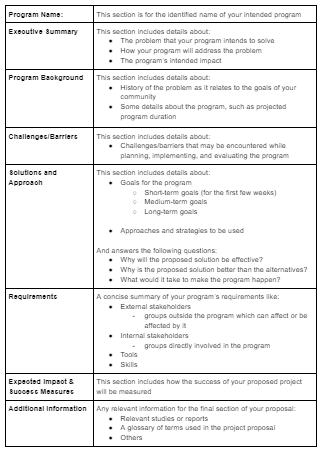
Step 3: Share
To share your work, click on the “Reply” button under this post and paste your work in the “Message” box. If your work is a google document, you may paste it as either an attachment or a “shareable link”. Make sure to reference others’ intellectual property when necessary. All references should follow 7th Edition APA formatting. For further instructions, see the resource on the Himmelfarb Health Sciences Library: APA citation resource (N.B. references are excluded from word counts).
Step 4: Interact
Evaluate and categorize the work from one of your peers based on items A - E of this rubric. Provide a rationale for the grade you provided, as well as, comments or suggestions for improvement. To post a reply, click “Reply” on a particular discussion, write your feedback and then click on “Post to forum.” You can use the list below as an example:
Item A is .…. because…. My suggestions for improvement are….
Item B is .…. because…. My suggestions for improvement are….
Item C is .…. because…. My suggestions for improvement are….
Item D is .…. because…. My suggestions for improvement are….
Item E is .…. because…. My suggestions for improvement are….OPTIONAL Step 5: Interact (10 minutes)
If you would like to, you can reply to your peers' posts in a respectful and professional manner. Ensure that your post engages your peers' ideas by including a reflection on their comments, sharing ideas of other potential difficulties and parties involved, or asking thought-provoking questions. If a peer comments on your posting, please reply. To post a reply, click “Reply” on a particular discussion, write your feedback and then click on “Post to forum.”
-
Quiz: Module 4To access the quiz, click on the name of the quiz provided above. On the following screen, click the "Preview quiz now" button to respond to the questions.
TO PASS THIS QUIZ YOU MUST OBTAIN A SCORE OF 21/26Not available unless: The activity Quiz: Module 3 is complete and passed -
Students mustMark as done
Additional Learning Options
-
Students mustView
Read the entire article. (50 minutes)
Human Resources for Health-2021
-
Students mustView
Read content under "Framework for Action" on pages 6-14. (28 minutes)
World Health Organization-2011
-
Students mustView
Read the entire article. (10 minutes)
The American Journal of Tropical Medicine and Hygiene-2020
-
Students mustView
Read the content under "2.1 Health Promotion and Well-Being Throughout Life" and "2.2 Universal and Equal Access to Health-Care Services" on pages 38 to 44. (24 minutes)
United Nations Population Fund and HelpAge International-2012
-
-
Final Exam. Quiz
To take the final exam, you must complete all quizzes and complete all the required activities. The final exam consists of 50 questions, and you will have 50 minutes to complete it. When the time is over, you will have two minutes to submit your attempt before it expires, and your progress is discarded. You will not be able to answer additional questions in the grace period.
To access the exam, click on the name of the exam provided above. On the following screen, click the Preview quiz now button to respond to the questions.
Not available unless any of: All of: ...Not available unless any of:-
All of:
- The activity Course Registration is marked complete
- The activity Pre-Test is marked complete
- The activity Peer Activity 1: The Role of Social and Behavioral Sciences in Improving Rural Health. (540 minutes) is marked complete
- The activity Quiz: Module 1 is complete and passed
- The activity Peer Activity 2: An Analysis of the Disease Burden in People Aged 60 Years and Older. (540 minutes) is marked complete
- The activity Quiz: Module 2 is complete and passed
- The activity Peer Activity 3: Implementing Recommendations and a Rural Health Model to Support Rural Aging in Place. (540 minutes) is marked complete
- The activity Quiz: Module 3 is complete and passed
- The activity Quiz: Module 4 is complete and passed
-
All of:
- The activity Discussion Forum 1: A Social Sciences Perspective on Addressing Challenges for Rural and Remote Health (480 mins). is marked complete
- The activity Discussion Forum 2: The role of ethics in the health of the aging population. (480 minutes) is marked complete
- The activity Discussion Forum 3: A reflection on the impact of a community health program in a rural aging community. (540 minutes) is marked complete
- The activity Discussion Forum 4: Community Health Impact of Interventions in Rural Settings (540 minutes). is marked complete
- You belong to Public Health U
-
All of:
-
-
 In this section, the student provide feedback about this course to help make NextGenU.org better. Once evaluations are completed, the certificate of completion will be available for download.
-
Course Evaluation QuestionnaireNot available unless: The activity Final Exam. is complete and passed
-
Self Evaluation QuestionnaireNot available unless: The activity Final Exam. is complete and passed
-
-
-
Students mustMark as done
-
Students mustMark as done
-
-