loader image
Skip to main content
  • Dismantling Structural Racism to Advance Health Equity
    0%

Focus Mode is ON. Click on the ‘collapse icon’ to close it.

  • Previous
  • Course data
    Introduction
    Course Registration
    Peer Corner
    Pre-Test
    Module 1: Lesson 1: Key Concepts and Definitions; Framing the Issue
    Addressing Health Equity and Social Determinants of Health Through Healthy People 2030
    Dismantling Structural Racism in Psychiatry: A Path to Mental Health Equity
    Advancing Health Equity by Addressing the Social Determinants of Health in Family Medicine (Position Paper)
    Communities in Action: Pathways to Health Equity.
    A Social-Ecological Model of Racism and Anti-Racism
    Discussion Forum 1 (70 minutes)
    Equitably Addressing Social Determinants of Health and Chronic Diseases
    Module 1: Lesson 2: Creating a Preparation Plan and Practicing Self-Reflection and Dialogue
    Cultural humility versus cultural competence: A critical distinction in defining physician training outcomes in multicultural education
    A Tool Kit for productive Conversations on Race
    Checklist for white allies against racism
    Cultural Competence Self Assessment Checklist
    Reflective Activity (110 minutes)
    Module 2: Lesson 1: The Historical Context of Structural Racism in the United States
    Systemic And Structural Racism: Definitions, Examples, Health Damages, And Approaches To Dismantling
    Structural Racism In Historical And Modern US Health Care Policy
    Module 2: Lesson 2: Current Issues on Structural Racism and Health Care
    How Structural Racism Works — Racist Policies as a Root Cause of U.S. Racial Health Inequities
    Structural Racism In Historical And Modern US Health Care Policy
    Discussion Forum 2 (45 minutes)
    Module 3: Lesson 1: Developing an Action Plan
    Systemic And Structural Racism: Definitions, Examples, Health Damages, And Approaches To Dismantling
    How Structural Racism Works — Racist Policies as a Root Cause of U.S. Racial Health Inequities
    Peer Activity (70 minutes)
    Module 3: Lesson 2: How to Create Sustainable Change
    Call to Action: Structural Racism as a Fundamental Driver of Health Disparities: A Presidential Advisory From the American Heart Association
    Healthcare can help make equity a reality
    Racial Equity Impact Assessment
    Final Exam
    Course and Self Evaluation & Certificate
    Course Activities
    All Discussion Forums
  • Next
  • Categories
    • All categories
    • Public Health
    • Medicine Courses
    • Nursing
    • Professional Development Courses
    • Community Health Workers
    • Humanitarian Response
    • Health Sciences
    • Sciences
    • For our institutional partners: Full Programs/Graduate Medical Education
    • NIED Courses
  • Home
  • Calendar
  • About Us
    About Us FAQs The Frank Foundation Board Members Publications Quality Assurance
  • Guests
    Learners Mentors Universities
  • Courses
    All Courses Medicine Courses Public Health Courses Community Health Courses Professional Development Courses Nursing Courses Health Sciences Sciences
  • Programs
    Addiction Training for Health Professionals Public Health U - MPH Primary Education STEPS Humanitarian U
  • Connect
    Contact Us Volunteer Careers Join Our Network sign up for our newsletter
  • Donate
  • Blog
  • Recent
    Environmental Health SC
    Climate Change and Health - old
You are currently using guest access
Log in
Categories Collapse Expand
  • All categories
  • Public Health
  • Medicine Courses
  • Nursing
  • Professional Development Courses
  • Community Health Workers
  • Humanitarian Response
  • Health Sciences
  • Sciences
  • For our institutional partners: Full Programs/Graduate Medical Education
  • NIED Courses
Home Calendar About Us Collapse Expand
About Us FAQs The Frank Foundation Board Members Publications Quality Assurance
Guests Collapse Expand
Learners Mentors Universities
Courses Collapse Expand
All Courses Medicine Courses Public Health Courses Community Health Courses Professional Development Courses Nursing Courses Health Sciences Sciences
Programs Collapse Expand
Addiction Training for Health Professionals Public Health U - MPH Primary Education STEPS Humanitarian U
Connect Collapse Expand
Contact Us Volunteer Careers Join Our Network sign up for our newsletter
Donate Blog Recent Collapse Expand
Environmental Health SC
Climate Change and Health - old
Dismantling Structural Racism to Advance Health Equity
Expand all Collapse all
Skip Course Activities and Resources

Course Activities and Resources

  • Syllabus
  • Resources
  • Discussion Forums

      1. Professional Development Courses

        Dismantling Structural Racism to Advance Health Equity

        • Course
        • Competencies
        You do not have permission to view discussions in this forum.
        • Professional Development Courses

          Dismantling Structural Racism to Advance Health Equity

          0% complete
          0% complete
          Resume

          Introduction


          Show More Show Less
          • questionnaire icon
            Course Registration Questionnaire
            Students must
            Student must submit this questionnaire to complete it
          • forum icon
            Peer Corner Forum
          • quiz icon
            Pre-Test Quiz
            Students must
            View
            Receive a grade
          Show More
        • How to create an account and enroll in the course?


        • Homepage


          This course, Dismantling Structural Racism to Advance Health Equity, provides an introductory exploration of the key concepts related to health equity, including structural racism, health inequities, and social determinants of health. Participants will develop a practice of self-reflection and learn how structurally racist policies have adversely impacted health. They will also identify strategies to begin dismantling these policies in healthcare organizations and develop an action plan to implement these strategies.

          This course emphasizes practical applications and solutions and provides participants with the knowledge and resources to make a positive impact and promote health equity in their own communities and beyond. It is ideal for healthcare executives and may also be useful to healthcare professionals, policymakers, community leaders, and health professional students who are passionate about advancing health equity and dismantling structural racism. Enroll now to make a difference and join a community of change-makers.

          The course was designed by Gold Course Directors, Ruth S. Shim, MD, MPH, and Karinn Glover, MD, MPH, in collaboration with the NextGenU.org team, including Pablo Baldiviezo, M.D, M.Sc., DiplEd.; Sherian Bachan, M.Sc., B.Sc.; Reisha Narine, M.Sc., B.Sc.; and Anthony Schlaff, M.D, MPH. and sponsored by, The Arnold P. Gold Foundation.


          Ruth Shim, MD, MPH, is the Luke & Grace Kim Professor in Cultural Psychiatry, Professor of Clinical Psychiatry in the Department of Psychiatry and Behavioral Sciences at the University of California, Davis, and Associate Dean of Diverse and Inclusive Education at the UC Davis School of Medicine. Dr. Shim is a member of the Board of Trustees of the Robert Wood Johnson Foundation and serves on the Editorial Boards of Psychiatric Services, JAMA Psychiatry, Community Mental Health Journal, and American Psychiatric Publishing, and is co-editor of the books, The Social Determinants of Mental Health, and Social (In)Justice and Mental Health. She is an expert on mental health equity, structural racism in medicine, and diversity, equity, and inclusion in academic medicine.

          After graduating from Howard University with a BA in History, Karinn Glover, MD, MPH worked at Essence Magazine and as an Account Executive for Verizon. She followed her curiosity about medicine and ultimately attended SUNY Downstate College of Medicine and obtained an MPH from Columbia University's Mailman School of Public Health. Currently Assistant Professor of Psychiatry at the Albert Einstein College of Medicine, Dr. Glover teaches psychopharmacology and psychotherapy to Psychiatry and Family Medicine residents. Her career as a consultant and educator has informed her expertise in the fields of health equity, workplace mental health, and organizational success.

          For publications on NextGenU.org’s courses’ efficacy, see NextGenU.org’s publication page. Subscribe to our newsletter to be notified of future updates and new courses and to be part of our community. 

          There are three (3) modules to complete, which include:

          1. Module 1: Introduction to Structural Racism and Health Equity
          2. Module 2: Structural Racism in Health Care and the United States
          3. Module 3: Dismantling Structural Racism in Health Care Settings

          The course requires the completion of all activities. After you’ve completed each module’s learning activity, you will have access to a final exam with multiple-choice questions and a chance to evaluate this course. You will have up to three opportunities to take the final exam and achieve the required score of >=80%.

          Once you have passed that last test, you will be able to download a Certificate of Completion from NextGenU.org and our course’s co-sponsoring organizations. We keep all of your personal information confidential, never sell any of your information, and only use anonymized data for research purposes. We are also happy to report your testing information and share your work with anyone (your school, employer, etc.) at your request. We hope you will find this a rewarding learning experience, and we count on your feedback to help us improve this training for future students.

          Time estimation for the course:

          The completion time for this course is estimated at 18 hours at an average rate of 144 words/minute, comprising 5 hours of learning resources, 8 hours to study the content and assimilation, and 5 hours of participating in learning activities and quizzes, to assist the learners in the synthesis of learning materials.

          Engaging with this course:

          You may browse this course for free to learn for personal enrichment; there are no requirements. This free course is primarily intended for healthcare executives.

          To obtain a certificate, a learner must first register for the course and then successfully complete:

          • Complete all the reading requirements;
          • Complete all activities and associated certification quizzes;
          • Successfully complete the final exam with a minimum of 80% and a maximum of 3 attempts; and
          • Complete the self and course evaluation forms.

          To obtain credit:

          • Complete all requirements listed above for the certificate; and
          • Your learning institution or workplace should approve the partner-university-sponsored NextGenU.org course for educational credit, as they would for their learner taking a course anywhere.  

          NextGenU.org is happy to provide your institution with:

          • A link to and description of the course training, so they can see all its components, including the co-sponsoring universities and other professional organization co-sponsors; 
          • Your grade on the final exam;
          • Your work products (e.g., peer and mentored activities) and any other required or optional shared materials that you produce and authorize to share with them;  
          • Your evaluations - course, self, peer, and mentor assessments; and
          • A copy of your certificate of completion, with the co-sponsoring universities and other organizations listed.

          To obtain a degree, NextGenU.org co-sponsors degree programs with institutional partners. To obtain a full degree co-sponsored with NextGenU.org, registrants must be enrolled in a degree program as a student of a NextGenU.org institutional partner. If you think that your institution might be interested in offering a degree with NextGenU.org, contact us.

          We hope that you will find this a rewarding learning experience, and we count on your assessment and feedback to help us improve this training for future students.

          Next steps:

          • Complete the registration form; and 
          • Begin the course with Module 1: Introduction to Structural Racism and Health Equity. In each lesson, read the description, complete all required readings and any required activity, and take the corresponding quizzes.
        • Module 1: Introduction to Structural Racism and Health Equity

          Competencies covered in this module: 

          • Discuss how social inequities, oppression, and structural racism impact health and impede progress toward achieving health equity at organizational, community, and societal levels.
          • Develop a practice of humility, self-reflection, and dialogue in regards to structural racism and its impact on health outcomes.
        • Module 1: Lesson 1: Key Concepts and Definitions; Framing the Issue

          Student Learning Outcomes:
          Upon completion of this lesson, you will be able to:
          • Discuss key concepts such as health equity, oppression, structural racism, and social determinants of health.
          • Exemplify health inequities due to racist actions/policies that affect health at levels of the socioecological model.
          Approximate time required for the readings for this lesson (at 144 words/minute): 2 hours and 17 minutes. 

          Click here to start this lesson
          • Module 1 Introduction and key Concepts - Dr. Ruth S Shim, MD, MPH.
          • Students must
            Mark as done


            Watch the entire video to better understand the module’s content. (18 minutes)

          • Required Learning Resources and Activities
          • url icon
            Addressing Health Equity and Social Determinants of Health Through Healthy People 2030 URL
            Students must
            View

            Read the sections on Health Equity: Key Concepts and Related Definitions. (2 minutes)

            Journal of Public Health Management and Practice (JPHMP) - 2021

          • url icon
            Dismantling Structural Racism in Psychiatry: A Path to Mental Health Equity URL

            Read the section on "KEY CONCEPTS Conceptualizing Race and Structural Racism". (2 minutes)

            The American Journal of Psychiatry - 2021

          • url icon
            Advancing Health Equity by Addressing the Social Determinants of Health in Family Medicine (Position Paper) URL

            Read the sections on Introduction, Definitions, and Health Inequities. (3 minutes)

            American Academy of Family Physicians - 2019

          • url icon
            Communities in Action: Pathways to Health Equity. URL

            Read the sections titled "The Root Causes of Health Inequity" until "Structural Inequities". (8 minutes)

            National Library of Medicine - 2017

          • url icon
            A Social-Ecological Model of Racism and Anti-Racism URL

            Read the entire section on Response. (5 minutes)

            Center for the Study of Social Policy - 2021

          • forum icon
            Discussion Forum 1 (70 minutes)
            Students must
            View
            Start discussions: 1

            In this activity, you will analyze key concepts that influence health equity at different levels of the socio-ecological model.

            Step 1: Identify

            Research and identify an example of a health equity issue that affects the type of health care you would receive or access in your country or region.

            Step 2: Respond 

            Based on the learning materials provided and the example you have identified, prepare a 300 - 350 word discussion illustrating how social inequities, oppression, and structural racism affect health equity and determinants of health impact your selected health issue. 

            Step 3: Share 

            To share your work, click on the “Add a new discussion topic” button under this post and paste your work into the “Message” box. Make sure to reference others’ intellectual property when necessary. All references should follow 7th Edition APA formatting. For further instructions, see the resource on the Himmelfarb Health Sciences Library: APA citation resource (N.B. references are excluded from word counts).

            OPTIONAL Step 4: Interact (10 minutes)

            If you would like to, you can reply to your peers' posts in a respectful and professional manner. Ensure that your post engages your peers' ideas by including a reflection on their comments, sharing ideas of other potential difficulties and parties involved, or asking thought-provoking questions. If a peer comments on your posting, please reply. To post a reply, click “Reply” on a particular discussion, write your feedback and then click on “Post to forum.”

          • Students must
            Mark as done
            Recommended Additional Readings
          • url icon
            Equitably Addressing Social Determinants of Health and Chronic Diseases URL
            Students must
            View

            Read the reactions "Achieving Health Equity by Addressing the Social Determinants of Health" and "Our Framework". (3 minutes)

            CDC -  2022

        • Module 1: Lesson 2: Creating a Preparation Plan and Practicing Self-Reflection and Dialogue

          Student Learning Outcomes:
          Upon completion of this lesson, you will be able to:
          • Define the concepts of cultural humility and competence, self-reflection, and dialogue in the context of racism.
          • Describe recommendations to develop self-reflection skills and cultural humility.
          • Demonstrate structural and cultural humility by practicing self-reflection and dialogue regarding structural racism.
          Approximate time required for the readings for this lesson (at 144 words/minute): 4 hours and 55 minutes. 

          Click here to start this lesson
          • Required Learning Resources and Activities
          • url icon
            Cultural humility versus cultural competence: A critical distinction in defining physician training outcomes in multicultural education URL
            Students must
            View

            Read the entire article. (19 minutes)

            Journal of Health Care for the Poor and Underserved - 1998

          • url icon
            A Tool Kit for productive Conversations on Race URL
            Students must
            View

            Read the entire toolkit. (25 minutes)

            2020

          • url icon
            Checklist for white allies against racism URL
            Students must
            View

            Read the entire webpage. (3 minutes)

            SUNY Cortland - 2001

          • url icon
            Cultural Competence Self Assessment Checklist URL
            Students must
            View

            Read the entire webpage. (4 minutes)

            The University of Edinburgh - 2019

          • forum icon
            Reflective Activity (110 minutes) Forum
            Students must
            View
            Start discussions: 1

            In this activity, you will apply essential concepts and recommendations regarding cultural humility, self-reflection, and dialogue in the context of racism and health.

            Step 1: Review and Reflect

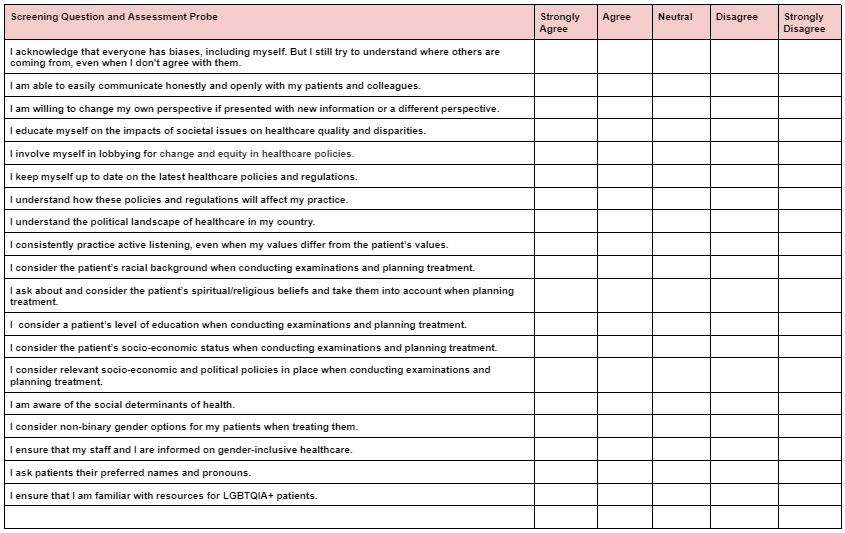
            Review the relevant learning materials for this lesson and complete the structural competence self-assessment checklist included below.

            42


            Step 2: Respond

            Based on the self-assessment results, prepare a reflection piece of 300 - 350 words identifying any personal strengths and weaknesses. Discuss how you plan to continue developing your structural humility, dialogue or communication skills, self-reflection skills, and skills to respond and relate to others of different ethnicities, cultures, and socio-economic backgrounds. You will discuss the importance of developing these skills for your practice and/or professional development to ensure health equity.

            Step 3: Share 

            To share your work, click on the “Add a new discussion topic” button under this post and paste your work into the “Message” box. Make sure to reference others’ intellectual property when necessary. All references should follow 7th Edition APA formatting. For further instructions, see the resource on the Himmelfarb Health Sciences Library: APA citation resource (N.B. references are excluded from word counts).

            OPTIONAL Step 4: Interact (10 minutes)

            If you would like to, you can reply to your peers' posts in a respectful and professional manner. Ensure that your post engages your peers' ideas by including a reflection on their comments, sharing ideas of other potential difficulties and parties involved, or asking thought-provoking questions. If a peer comments on your posting, please reply. To post a reply, click “Reply” on a particular discussion, write your feedback and then click on “Post to forum.”

        • Module 2: Structural Racism in Health Care and the United States

          Competency covered in this module: 

          • Discuss how social inequities, oppression, and structural racism impact health and impede progress toward achieving health equity at organizational, community, and societal levels.
        • Module 2: Lesson 1: The Historical Context of Structural Racism in the United States

          Student Learning Outcomes:
          Upon completion of this lesson, you will be able to:
          • Describe the concept of structural racism.
          • Explain the historical context of structural racism by considering three examples of structurally racist health policies.
          • Summarize how historical facts on race have accumulated to create and maintain structural racism observed in the present.
          Approximate time required for the readings for this lesson (at 144 words/minute): 33 minutes. 

          Click here to start this lesson
          • Module 2 The Historical Context of Structural Racism in the United States - Dr. Karinn Glover, MD MPH.
          • Students must
            Mark as done

            Watch the entire video to better understand the module’s content. (21 minutes)

          • Required Learning Resources and Activities
          • url icon
            Systemic And Structural Racism: Definitions, Examples, Health Damages, And Approaches To Dismantling URL
            Students must
            View

            Read the content under the heading "Definitions". (6 minutes)

            Health Affairs - 2022

          • url icon
            Structural Racism In Historical And Modern US Health Care Policy URL
            Students must
            View

            Read the section on "Structural Racism In Early US Health Care Policy". (5 minutes)

            Health Affairs - 2022

        • Module 2: Lesson 2: Current Issues on Structural Racism and Health Care

          Student Learning Outcomes:
          Upon completion of this lesson, you will be able to:
          • Identify current examples of structurally racist policies and their impact on healthcare.
          • Discuss how structurally racist policies impact modern healthcare.
          Approximate time required for the readings for this lesson (at 144 words/minute): 2 hours and 6 minutes. 

          Click here to start this lesson
          • Students must
            Mark as done
            Required Learning Resources and Activities
          • url icon
            How Structural Racism Works — Racist Policies as a Root Cause of U.S. Racial Health Inequities URL
            Students must
            View

            Read the entire article. (18 minutes)

            The New England Journal of Medicine - 2022

          • url icon
            Structural Racism In Historical And Modern US Health Care Policy URL
            Students must
            View

            Read from the content under the heading "Structural Racism In Modern US Health Care Policy" to the end of the article. (7 minutes)

            Health Affairs - 2022

          • forum icon
            Discussion Forum 2 (45 minutes)
            Students must
            View
            Start discussions: 1

            In this activity, you will identify current examples of structurally racist policies and their impact on healthcare and discuss how structurally racist policies impact modern healthcare.

            Step 1: Identify

            Identify three (3) examples of structurally racist policies in your specialty or area of focus. 

            Step 2: Respond

            Based on the examples you have identified, prepare a 300 - 500 word written piece discussing how the structurally racist policies have resulted in adverse health implications and outcomes and suggest how these policies could be modified to improve health outcomes. 

            Step 3: Share 

            To share your work, click on the “Add a new discussion topic” button under this post and paste your work into the “Message” box. Make sure to reference others’ intellectual property when necessary. All references should follow 7th Edition APA formatting. For further instructions, see the resource on the Himmelfarb Health Sciences Library: APA citation resource (N.B. references are excluded from word counts).

            OPTIONAL Step 4: Interact (10 minutes)

            If you would like to, you can reply to your peers' posts in a respectful and professional manner. Ensure that your post engages your peers' ideas by including a reflection on their comments, sharing ideas of other potential difficulties and parties involved, or asking thought-provoking questions. If a peer comments on your posting, please reply. To post a reply, click “Reply” on a particular discussion, write your feedback and then click on “Post to forum.”

        • Module 3: Dismantling Structural Racism in Health Care Settings

          Competency covered in this module: 

          • Create a sustainable action plan to dismantle structurally racist policies in healthcare organizations.
        • Module 3: Lesson 1: Developing an Action Plan

          Student Learning Outcomes:
          Upon completion of this lesson, you will be able to:
          • Identify strategies to begin dismantling structurally racist policies in healthcare organizations.
          • Develop an action plan for dismantling structurally racist policies in your healthcare settings.
          Approximate time required for the readings for this lesson (at 144 words/minute): 1 hour and 37 minutes. 

          Click here to start this lesson
          • Module 3 Developing an Action Plan - Dr. Ruth S. Shim, MD, MPH and Dr. Karinn Glover, MD, MPH.
          • Students must
            Mark as done

            Watch the entire video to better understand the module’s content. (15 minutes)

          • Required Learning Resources and Activities
          • url icon
            Systemic And Structural Racism: Definitions, Examples, Health Damages, And Approaches To Dismantling URL
            Students must
            View

            Read the following sections: (9 minutes)
            -Dismantling Systemic Racism: Examples Of Approaches
            -Addressing Systemic Racism: General Considerations

            Health Affairs - 2022

          • Students must
            Mark as done
            Recommended Additional Readings
          • url icon
            How Structural Racism Works — Racist Policies as a Root Cause of U.S. Racial Health Inequities URL
            Students must
            View

            Read the section on "Our Role in Dismantling Structural Racism". (4 minutes)

            The New England Journal of Medicine -  2021

          • forum icon
            Peer Activity (70 minutes) Forum
            Students must
            View
            Start discussions: 1

            In this activity, you will create an action plan in order to dismantle a structurally racist policy in a healthcare setting of your choice.

            Step 1: Identify

            Identify a structurally racist policy that has affected your healthcare setting.

            Step 2: Respond 

            Prepare a 500 - 600 word written piece that discusses how the policy you have identified has impacted the healthcare setting. 

            Ensure that your action plan includes the following:

            • A problem statement that identifies the structurally racist policy
            • A brief overview/analysis of the policy 
            • A plan to address the structural inequities
            • A plan which details the implementation process, including financial resources, personnel, and a timeline
            • Identify possible sustainability measures

            Step 3: Share 

            To share your work, click on the “Add a new discussion topic” button under this post and paste your work into the “Message” box. Make sure to reference others’ intellectual property when necessary. All references should follow 7th Edition APA formatting. For further instructions, see the resource on the Himmelfarb Health Sciences Library: APA citation resource (N.B. references are excluded from word counts).

            OPTIONAL Step 4: Interact (10 minutes)

            If you would like to, you can reply to your peers' posts in a respectful and professional manner. Ensure that your post engages your peers' ideas by including a reflection on their comments, sharing ideas of other potential difficulties and parties involved, or asking thought-provoking questions. If a peer comments on your posting, please reply. To post a reply, click “Reply” on a particular discussion, write your feedback and then click on “Post to forum.”

        • Module 3: Lesson 2: How to Create Sustainable Change

          Student Learning Outcomes:
          Upon completion of this lesson, you will be able to:
          • Explain the resources needed to create sustainable change on structurally racist policies in your healthcare settings.
          Approximate time required for the readings for this lesson (at 144 words/minute): 56 minutes. 

          Click here to start this lesson
          • Students must
            Mark as done
            Required Learning Resources and Activities
          • url icon
            Call to Action: Structural Racism as a Fundamental Driver of Health Disparities: A Presidential Advisory From the American Heart Association URL
            Students must
            View

            Read the following sections: "Future State" and "Call to Action". (18 minutes)

            AHA Journals. (2022)

          • Students must
            Mark as done
            Recommended Additional Readings
          • url icon
            Healthcare can help make equity a reality URL
            Students must
            View

            Read the webpage and watch the video. (4 minutes)

            Raising the Bar Healthcare's Transforming Role

          • url icon
            Racial Equity Impact Assessment URL
            Students must
            View

            Read the entire PDF of the toolkit. (5 minutes)

            Race Forward: The Center for Racial Justice Innovation - 2009

        • Final Exam

          Click here to start Final Examination

          • quiz icon
            Final Exam Quiz

            To take the final exam, you must complete all quizzes and complete all the required activities. The final exam consists of 20 questions, and you will have 40 minutes to complete it. When the time is over, you will have two minutes to submit your attempt before it expires, and your progress is discarded. You will not be able to answer additional questions in the grace period.

            To access the exam, click on the name of the exam provided above. On the following screen, click the attempt quiz button to respond to the questions.


            Not available unless: All of: ...
            Not available unless:
            • All of:
              • The activity Course Registration is marked complete
              • The activity Pre-Test is marked complete
            • All of:
              • The activity Discussion Forum 1 (70 minutes) is marked complete
              • The activity Reflective Activity (110 minutes) is marked complete
              • The activity Discussion Forum 2 (45 minutes) is marked complete
              • The activity Peer Activity (70 minutes) is marked complete
        • Course and Self Evaluation & Certificate

          In this section, you can provide feedback about this course to help us make NextGenU.org better. Once evaluations are completed, you will be able to download your certificate of completion.

          Click here give your feedback

          • questionnaire icon
            Course Evaluation Questionnaire
            Not available unless: The activity Final Exam is marked complete
          • questionnaire icon
            Self Evaluation Questionnaire
            Not available unless: The activity Final Exam is marked complete
        • Course Activities

          • page icon
            All Discussion Forums Page
            Students must
            Mark as done
        Skip Rating and Review

        Rating and Review

        0

        0 Course Rating

        0%
        0%
        0%
        0%
        0%

        Reviews

        Contact site support
        You are currently using guest access (Log in)
        Powered by Moodle


        Copyright © 2025 NextGenU.org / All Rights Reserved


        Privacy Policy 


        Terms Of Use 


        Privacy Policy Terms & Conditions

        Copyrights Content