Tobacco Control Legislation (with examples from the Caribbean)
-
Public HealthTobacco Control Legislation (with examples from the Caribbean)Resume0% complete0% complete
-
Students mustStudent must submit this questionnaire to complete it
-
Students mustViewReceive a grade
Show More-


Tobacco use is a common risk factor for six of the eight leading causes of death, which account for almost two-thirds of the total worldwide deaths. Furthermore, it is a common risk factor for the four main non-communicable diseases (NCDs): cardiovascular, chronic respiratory, cancer, and diabetes. Globally, these diseases account for 70% of the total deaths per year, of which 38% occur prematurely. The World Health Organization’s Framework Convention on Tobacco Control (WHO FCTC) describes the scientifically-based strategies and measures to combat this, but the implementation of effective tobacco control measures requires committed work across sectors to realize appropriate implementation of these strategies that will lead to significant improvements in morbidity and mortality from tobacco use.
This course is sponsored by the Pan American Health Organisation (PAHO) in collaboration with the Caribbean Court of Justice Academy for Law and was developed to enhance capacity for the development and implementation of effective, WHO FCTC-compliant tobacco control legislation in the Caribbean. This course was originally delivered on PAHO’s Virtual Campus for Public Health (VCPH) platform for a chosen cohort of Government officials from the English-speaking Caribbean who are actively involved in the process of developing and implementing legislation, notably tobacco control legislation. The course is an important resource for the Caribbean and maybe contextualized for other world regions.
PAHO and CAFL members developed and reviewed the technical contents of this course with the participation of Elisa Prieto, Advisor, Non Communicable diseases, Subregional Program Coordination; Eduardo Bianco, Technical Director of the International Center for Tobacco Control Cooperation; Kavita Singh, Regional Data Coordinator, Tobacco Control; Irene Melamed, Consultant, and Coordinator, Virtual Campus of Public Health; Kimberley Benjamin, Part-time Consultant, Caribbean Court of Justice Academy for Law; and Luciana Severini, International Consultant, Department Noncommunicable Diseases and Mental Health, Risk Factors and Nutrition Unit, WHO Regional Office for the Americas. NextGenU.org’s staff adapted the technical content and collaborated in developing assessments and other didactic materials.NextGenU.org members participating in the creation of this course include Margaret Niles, PhD, MEd, DipID; Hugo Rojas, MD, MSc, DiplEd; Stephanie Sankar, LLB, L.E.C.; Pablo Baldiviezo, MD, DiplEd.
The course is largely based on the Pan American Health Organization’s “Manual for developing Tobacco Control Legislation in the Caribbean” and draws on international case studies, as well as Caribbean experiences and legislative contexts. It uses learning resources from accredited, world-class organizations such as the Pan American Health Organization and the World Health Organization. It includes 8 interactive modules that combine self-directed, peer-to-peer, and tutoring-based approaches, as well as didactic, experiential, and practice-based methodologies. Learning activities on the various topics of study include webinars, assignments, and quizzes.
There are 8 modules to complete, which include:
- Module 1: The tobacco epidemic and status of tobacco control
- Module 2: Developing tobacco control legislation
- Module 3: Protection from exposure to tobacco smoke
- Module 4: Packaging and labeling of tobacco products
- Module 5: Tobacco advertising, promotion, and sponsorship
- Module 6: Other measures
- Module 7: Novel and emerging nicotine and tobacco products
- Module 8: Protecting tobacco control policies from the commercial and other vested interests of the tobacco industry
The completion time for this course is estimated at 50 hours, comprising 14 hours of learning resources that include webinars of live course version, 14 hours for time to study content and assimilation, and 22 hours of participating in learning activities and quizzes, to assist the learners in the synthesis of learning materials. This course is equivalent to 1 credit hour.
Requirements for completion of course:
The course requires the completion of all activities (i.e. discussion forums and quizzes.) At the end of each module, there is a practice quiz of ten (10) multiple-choice questions and a discussion forum. After you’ve completed each module, quiz, and discussion forum, you’ll have access to a final exam consisting of forty (40) multiple-choice questions, a final discussion forum, and a chance to evaluate this course. The required score of 70% or higher is needed to successfully complete the course. Once you’ve successfully completed the course, you will be able to download a certificate of completion from NextGenU.org and endorsed by PAHO and CAFL. We keep all of your personal information confidential, never sell any of your information, and only use anonymized data for research purposes. Also, we are happy to report your testing information and share your work with anyone (your school, employer, etc.) at your request.
Engaging with this course:
You may browse this course for free to learn for your personal enrichment; there are no requirements.
To PASS and Obtain a Certificate
● All reading requirements,
● All quizzes and pass with a 80% with unlimited attempts,
● All discussion forums,
● The final quiz with a minimum of 80%,
● The self and course evaluation forms.To obtain credit:
- Complete all requirements listed above for the certificate, and
- Your learning institution or workplace should approve the course for educational credit, as they would for their learner taking a course anywhere.
To obtain a degree, NextGenU.org co-sponsors degree programs with institutional partners. To obtain a full degree co-sponsored with NextGenU.org, registrants must be enrolled in a degree program as a student of a NextGenU.org institutional partner. If you think that your institution might be interested in offering a degree with NextGenU.org contact us.
We hope that you will find this a rewarding learning experience, and we count on your assessment and feedback to help us improve this training for future students.
Here are the next steps to take the course and earn a certificate.
- Complete the registration form
- Take the pre-test
- Begin the course with Module 1: The tobacco epidemic and status of tobacco control. In each lesson, read the description, complete all required readings and any required activity, as well as take the corresponding quizzes and discussion forums.
This course meets nationally approved standards of education developed for the addiction/substance use disorders counseling profession. This course's participants are assured that the continuing education (CE) credits provided will be accepted toward national credentialing by the NAADAC Certification Commission for Addiction Professionals (NCC AP), as well as by many of the individual state licensing/certification bodies in the addiction and other helping professions.
We hope that you will find this a rewarding learning experience, and we count on your assessment and feedback to help us improve this training for future students.
Disclaimer: This course is Caribbean-focused and requires contextualization for other regions. The course has been produced with the help of a grant managed by the International Union Against Tuberculosis and Lung Disease (The Union) and funded by Bloomberg Philanthropies. The content of this course is the sole responsibility of the authors and can under no circumstances be regarded as reflecting the position of The Union or the Bloomberg Philanthropies.
Subscribe to our newsletter to be notified of future updates, new courses, and to be part of our community.
-
 By the end of this module and upon completion of the required readings and activities, participants will be able to:
- Discuss the health, economic, social, and environmental impacts of the tobacco epidemic;
- Assess the importance of and difficulties surrounding tobacco control in light of key emerging challenges;
- Identify the international, regional, and Caribbean legal frameworks, mandates, and accountability mechanisms; and
- Describe the monitoring and status of implementation of tobacco control measures in the Caribbean.
-
Students mustMark as done
Live Session
-
This video is a recording of a webinar session that was delivered to a cohort of students from the Caribbean. Watch the entire video to better understand the module’s content. (56 minutes)
-
Read the entire Slideset. (4 minutes)
13.7 MB -
Required readings and activities
-
Module Introduction
-
-
Students mustView
Watch the entire video. (3 minutes)
-
Students mustMark as done
1.1 Overview of the tobacco epidemic, including its economic, social and environmental impact
-
Students mustView
Read the entire document. (8 minutes)
-
Students mustMark as done
1.2 Emerging challenges
-
-
Students mustMark as done
1.3 Overview of international, regional, and Caribbean legal frameworks, mandates, and accountability mechanisms
-
Students mustView
Read the entire document. (25 minutes)
-
Students mustMark as done
1.4 Monitoring and status of implementation
-
Students mustView
Read the entire document. (3 minutes)
-
Students mustMark as done
Module 1: Key Messages
-
Students mustView
Read the entire document. (5 minutes)
-
Students mustMark as done
Activity
-
Students mustViewStart discussions: 1
You have been invited to provide opening words in a forum about Tobacco Control Legislation in your country. You will have only a few minutes to speak. Your aim is to communicate the need to implement tobacco control measures while specifically highlighting areas of implementation that need the most attention in your region.
Step 1: Review
Review the content of segments 1.1 and 1.4 of the course readings. Pay attention to:
- Specific facts about the status of the tobacco epidemic along with its impact on health, society, and the environment;
- The areas where the implementation of tobacco control measures need the most attention in your region.
Step 2: Respond
Based on your review of segments 1.1 and 1.4 in Step 1, select the facts and areas of implementation that you think have the most relevance for your region. Use that information to write a 100-250 word script for your presentation that includes:
The current tobacco situation in your country or region with a few highly impactful statistics
The importance of implementing tobacco control measures by mentioning 2-4 bullet points about the impact of tobacco on health, society, or the environment
Explain briefly how working on MPOWER measures can help with the statistics and bullet points you developed in response to Items 1 and 2 of this list.
Step 3: Share
To share your work, click on the “Add a new discussion topic” button under the post and paste your work in the “Message” box. Make sure to reference others’ intellectual property when necessary. All references should follow 7th Edition APA formatting. For further instructions, see the resource on the Himmelfarb Health Sciences Library: APA citation resource (N.B. references are excluded from word counts).
Step 4: Interact
To complete this activity, you will need to reply respectfully and professionally to at least one post made by your peers. To post a reply, click “Reply” on a particular discussion, write your feedback and then click on “Post to forum.” If your peer(s) comment(s) on your post(s), please reply. Feel free to interact with the work done by other peers as well!
OPTIONAL Step 5: Interact (10 minutes)
If you would like to, you can reply to your peers' posts in a respectful and professional manner. Ensure that your post engages your peers' ideas by including a reflection on their comments, sharing ideas of other potential difficulties and parties involved, or asking thought-provoking questions. If a peer comments on your posting, please reply. To post a reply, click “Reply” on a particular discussion, write your feedback and then click on “Post to forum.”
-
Students mustMark as done
Quiz
-
Module 1: Quiz
To access the quiz, click on the name of the quiz provided above. On the following screen, click the attempt quiz button to respond to the questions.
Not available unless: The activity Course Registration is marked complete ...Not available unless:- The activity Course Registration is marked complete
- The activity Pre-Test is marked complete
-
Students mustMark as done
Recommended Readings
-
Students mustView
Review the recommended reading of your interest. (53 minutes)
- Discuss the health, economic, social, and environmental impacts of the tobacco epidemic;
-

By the end of this module and upon completion of the required readings and activities, participants will be able to:
- Assess the vital role of law in addressing NCDs and advancing the tobacco control agenda;
- Identify possible routes for effective WHO FCTC implementation;
- Assess the considerations that come into play when choosing between the possible routes for effective WHO FCTC implementation and the content of measures;
- Describe the key components that should be included in effective tobacco control legislation;
- Assess the intersection of trade and tobacco control; and
- Outline the typical policy and legislative processes involved in developing tobacco control legislation in the Caribbean.
-
Students mustMark as done
Required readings and activities
-
Module Introduction
-
-
2.1 The central role of law in advancing the tobacco control agenda
-
Students mustView
Read the entire document. (4 minutes)
-
Students mustView
Watch the entire video. (11 minutes)
-
Students mustMark as done
2.2 Different routes to effective implementation of the WHO FCTC
-
Students mustView
Read the entire document. (16 minutes)
-
Students mustView
Watch the entire video. (6 minutes)
-
Students mustMark as done
2.3 Key components of tobacco control legislation and cross-cutting topics
-
Students mustView
Read the entire document. (9 minutes)
-
Students mustView
Watch the entire video. (3 minutes)
-
Students mustMark as done
2.4 Legislation and litigation
-
Students mustView
Read the entire document. (5 minutes)
-
Students mustView
Watch the entire video. (3 minutes)
-
Students mustView
Watch the entire video. (5 minutes)
-
Students mustMark as done
2.5 Tobacco and trade
-
-
-
Students mustMark as done
2.6 Developing tobacco control legislation in the Caribbean: an overview of the process
-
Students mustView
Read the entire document. (2 minutes)
-
Students mustView
Watch the entire video. (7 minutes)
-
Students mustMark as done
Module 2: Key Messages
-
Students mustView
Read the entire document. (1 minute)
-
Students mustMark as done
Activity
-
Students mustViewStart discussions: 1
Segment 2.6 provided an overview of the typical process used to develop tobacco control legislation in the English-speaking Caribbean. In this activity, you will reflect on how you could contribute to this process considering your background and/or current job position.
Step 1: Review
Review the content of segment 2.6 of the course readings. Reflect on how your experiences and goals relate to the different steps involved in developing tobacco control legislation in the Caribbean.
Step 2: Summarize
Prepare a 200-350 word discussion post that includes the following:
A very brief description of your current job position.
Having the typical process for developing tobacco legislation as a reference:
- How have you been/are involved? What was/is your role?
- What have been/are the main challenges and what are your suggestions to confront them?
- What have been/are the main opportunities and contributing factors?
- How do you see yourself contributing to the tobacco control agenda in the future?
Note: Some participants may have not yet been involved in tobacco legislation. Others, instead of being directly involved in the process at a domestic level, are involved at the regional or civil society level. If such is the case, share your experiences in the area that is relevant to you or focus on how you would like to get involved in the future.
Step 3: Share
To share your work, click on the “Add a new discussion topic” button under the post and paste your work in the “Message” box. Make sure to reference others’ intellectual property when necessary. All references should follow 7th Edition APA formatting. For further instructions, see the resource on the Himmelfarb Health Sciences Library: APA citation resource (N.B. references are excluded from word counts).
Step 4: Interact
To complete this activity, you will need to reply respectfully and professionally to at least one post made by your peers. To post a reply, click “Reply” on a particular discussion, write your feedback and then click on “Post to forum.” If your peer(s) comment(s) on your post(s), please reply. Feel free to interact with the work done by other peers as well!
OPTIONAL Step 5: Interact (10 minutes)
If you would like to, you can reply to your peers' posts in a respectful and professional manner. Ensure that your post engages your peers' ideas by including a reflection on their comments, sharing ideas of other potential difficulties and parties involved, or asking thought-provoking questions. If a peer comments on your posting, please reply. To post a reply, click “Reply” on a particular discussion, write your feedback and then click on “Post to forum.”
-
Students mustMark as done
Quiz
-
Students mustViewReceive a gradeReceive a passing grade
To access the quiz, click on the name of the quiz provided above. On the following screen, click the attempt quiz button to respond to the questions.
-

By the end of this module and upon completion of the required readings and activities, participants will be able to:
- Discuss the rationale and summarize the evidence regarding exposure to second-hand smoke and smoke-free measures;
- Describe the status of implementation of Article 8 of the WHO FCTC in the Caribbean;
- Identify the key elements of smoke-free measures necessary to effectively protect people from exposure to tobacco smoke;
- Assess the common arguments of the tobacco industry and provide effective counter-arguments;
- Analyze the key legal arguments used to try to challenge comprehensive smoke-free measures; and
- Design and draft effective smoke-free measures.
-
Students mustMark as done
Live Session
-
This video is a recording of a webinar session that was delivered to a cohort of students from the Caribbean. Watch the entire video to better understand the module’s content. (58 minutes)
-
Read the entire Slideset. (17 minutes)
1.8 MB -
Students mustMark as done
Required readings and activities
-
Students mustMark as done
Module Introduction
-
-
Students mustMark as done
3.1 Rationale and evidence, including that relevant to novel and emerging nicotine and tobacco products
-
Students mustView
Read the entire document. (11 minutes)
-
Students mustMark as done
3.2 Status of implementation of WHO FCTC compliant smoke-free measures in the Caribbean
-
Students mustView
Read the entire document. (3 minutes)
-
Students mustMark as done
3.3 Implementing WHO FCTC Article 8: Drafting effective smoke-free measures
-
Students mustView
Read the entire document. (29 minutes)
-
Students mustView
Watch the entire video. (3 minutes)
-
Students mustMark as done
3.4 Countering tobacco industry arguments
-
Students mustView
Read the entire document. (4 minutes)
-
Students mustView
Watch the entire video. (8 minutes)
-
Students mustMark as done
3.5 Experiences with legal challenges to comprehensive smoke-free legislation
-
Students mustView
Read the entire document. (4 minutes)
-
Students mustView
Watch the entire video. (8 minutes)
-
Students mustMark as done
Module 3: Key Messages
-
Students mustView
Read the entire document. (3 minutes)
-
Students mustMark as done
Activity
-
Students mustViewStart discussions: 1
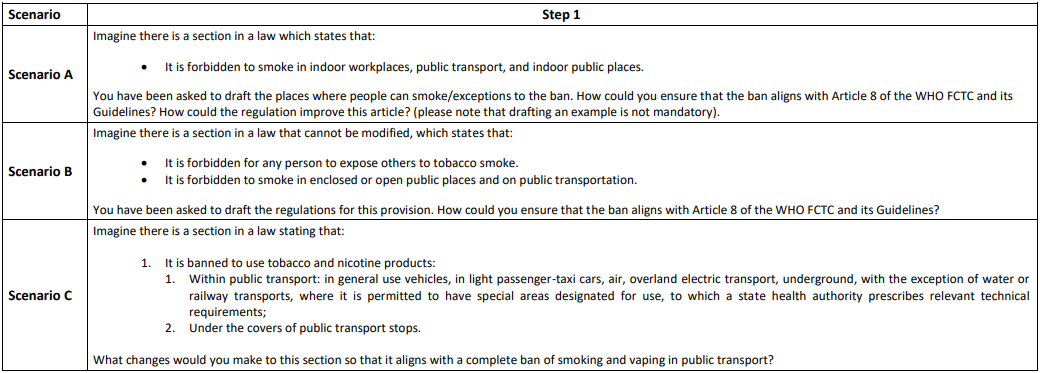
In this activity, you will analyze how smoke-free legislation aligns with the nine-component framework for designing effective tobacco control legislation and with the World Health Organization (WHO) Framework Convention on Tobacco Control (FCTC) Article 8 Guidelines. To complete this activity you will need to reply to at least one post made by your peers.
Step 1: Analyze
Review the content in Segment 3.3. Select ONE scenario from below and analyze how you would address the question(s) raised in the chosen scenario:
Step 2: Write
Write a 150-300 word discussion post that answers the question(s) raised in Step 1.
Step 3: Share
To share your work, click on the “Add a new discussion topic” button under the post and paste your work in the “Message” box. Make sure to reference others’ intellectual property when necessary. All references should follow 7th Edition APA formatting. For further instructions, see the resource on the Himmelfarb Health Sciences Library: APA citation resource (N.B. references are excluded from word counts).
Step 4: Interact
To complete this activity, you will need to reply respectfully and professionally to at least one post made by your peers. To post a reply, click “Reply” on a particular discussion, write your feedback and then click on “Post to forum.” If your peer(s) comment(s) on your post(s), please reply. Feel free to interact with the work done by other peers as well!
OPTIONAL Step 5: Interact (10 minutes)
If you would like to, you can reply to your peers' posts in a respectful and professional manner. Ensure that your post engages your peers' ideas by including a reflection on their comments, sharing ideas of other potential difficulties and parties involved, or asking thought-provoking questions. If a peer comments on your posting, please reply. To post a reply, click “Reply” on a particular discussion, write your feedback and then click on “Post to forum.”
-
Students mustMark as done
Quiz
-
Students mustViewReceive a gradeReceive a passing grade
To access the quiz, click on the name of the quiz provided above. On the following screen, click the attempt quiz button to respond to the questions.
-
By the end of this module and upon completion of the required readings, participants will be able to:
- Discuss the rationale and evidence for the implementation of effective tobacco packaging and labelling measures;
- Describe the status of implementation of tobacco control measures in the Caribbean;
- Identify and analyse the key elements of effective tobacco packaging and labelling measures;
- Assess the common arguments of the tobacco industry and its allies against effective packaging and labelling measures and provide robust counter-arguments;
- Analyse the key legal arguments from prominent cases on packaging and labelling of tobacco products;
- Discuss the additional benefits of plain packaging; and
- Design and draft effective tobacco packaging and labelling measures.
Click here to start this module-
Students mustMark as done
Live Session
-
This video is a recording of a webinar session that was delivered to a cohort of students from the Caribbean. Watch the entire video to better understand the module’s content. (57 minutes)
-
Students mustMark as done
Required readings and activities
-
Students mustMark as done
Module Introduction
-
-
Students mustMark as done
4.1 Rationale and evidence for implementing effective tobacco packaging and labelling measures
-
Students mustView
Read the entire document. (4 minutes)
-
Students mustView
Watch the entire video. (8 minutes)
-
Students mustMark as done
4.2 Status of implementation of effective packaging and Labelling of Tobacco products
-
Students mustView
Read the entire document. (5 minutes)
-
Students mustMark as done
4.3 Implementing WHO FCTC Article 11 at the domestic level: Drafting effective packaging and labelling measures
-
Students mustView
Read the entire document. (33 minutes)
-
Students mustMark as done
4.4 Overview of plain packaging
-
Students mustView
Read the entire document. (4 minutes)
-
Students mustView
Watch the entire video. (17 minutes)
-
Students mustView
Watch the entire video. (18 minutes)
-
Students mustMark as done
4.5 Tobacco industry arguments against effective packaging and labelling of tobacco products and counterarguments
-
Students mustView
Read the entire document. (5 minutes)
-
Students mustMark as done
4.6 Experiences with legal challenges to packaging and labelling legislation Australian cases – investment law, constitutional law, and World Trade Organization law
-
Students mustView
Read the entire document. (5 minutes)
-
Students mustMark as done
Module 4: Key Messages
-
Students mustView
Read the entire document. (3 minutes)
-
Students mustMark as done
Activity
-
Students mustViewStart discussions: 1
In this activity, you will create a discussion post analyzing the key elements of effective tobacco packaging and labeling measures. To complete this activity you will need to reply to at least one post made by your peers.
Step 1: Analyze
Based on the readings and videos of this module, choose ONE of the following scenarios: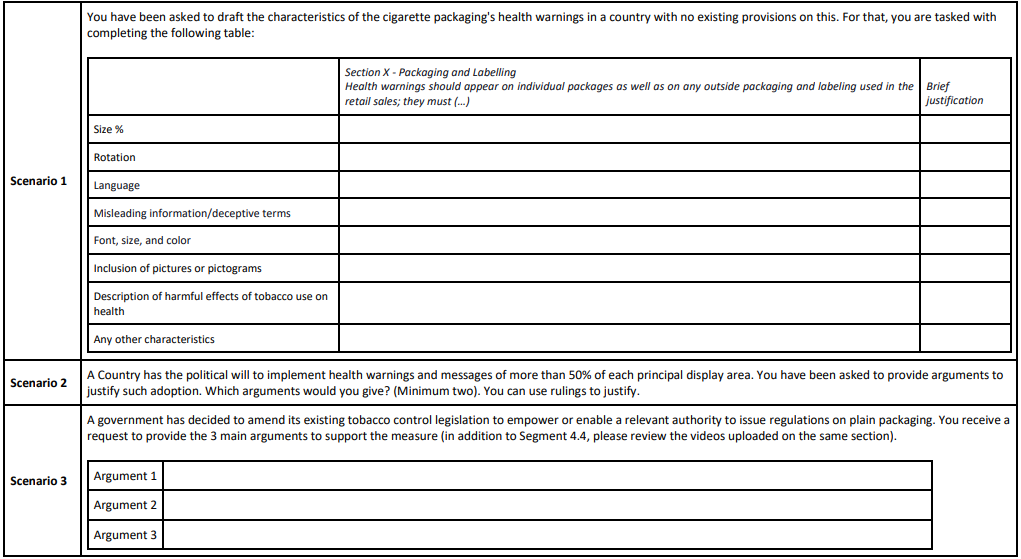
Step 2: Write
Solve the task assigned to you in Step 1. Then, write a 100-200 reflective post explaining what you learned from this exercise.
Step 3: Share
To share your work, click on the “Add a new discussion topic” button under the post and paste your work in the “Message” box. Make sure to reference others’ intellectual property when necessary. All references should follow 7th Edition APA formatting. For further instructions, see the resource on the Himmelfarb Health Sciences Library: APA citation resource (N.B. references are excluded from word counts).
Step 4: Interact
To complete this activity, you will need to reply respectfully and professionally to at least one post made by your peers. To post a reply, click “Reply” on a particular discussion, write your feedback and then click on “Post to forum.” If your peer(s) comment(s) on your post(s), please reply. Feel free to interact with the work done by other peers as well!
OPTIONAL Step 5: Interact (10 minutes)
If you would like to, you can reply to your peers' posts in a respectful and professional manner. Ensure that your post engages your peers' ideas by including a reflection on their comments, sharing ideas of other potential difficulties and parties involved, or asking thought-provoking questions. If a peer comments on your posting, please reply. To post a reply, click “Reply” on a particular discussion, write your feedback and then click on “Post to forum.”
-
Students mustMark as done
Quiz
-
Students mustViewReceive a gradeReceive a passing grade
To access the quiz, click on the name of the quiz provided above. On the following screen, click the attempt quiz button to respond to the questions.
-
 By the end of this module and upon completion of the required readings, participants will be able to:
- Discuss the rationale and evidence for the implementation of effective tobacco advertising, promotion and sponsorship measures;
- Describe the monitoring and status of implementation of tobacco advertising, promotion and sponsorship measures in the Caribbean;
- Identify and analyze the key elements of effective tobacco advertising, promotion and sponsorship measures;
- Assess the common arguments of the tobacco industry and its allies against effective tobacco advertising, promotion and sponsorship measures and provide robust counter-arguments;
- Analyze the key legal arguments from prominent cases on tobacco advertising, promotion, and sponsorship measures; and
- Design and draft effective tobacco advertising, promotion, and sponsorship measures.
-
Students mustMark as done
Live Session
-
Watch the entire video. (60 minutes)
-
Students mustMark as done
Required readings and activities
-
Module Introduction
-
-
5.1 Rationale and Evidence, Including that Relevant to Novel and Emerging Nicotine and Tobacco Products
-
Students mustView
Read the entire document. (19 minutes)
-
Students mustView
Watch the entire video. (3 minutes)
-
Students mustMark as done
5.2 Status of Implementation of Tobacco Advertising, Promotion and Sponsorship Measures in the Caribbean
-
Students mustView
Read the entire document. (2 minutes)
-
Students mustMark as done
5.3 Implementing WHO FCTC Article 13: Drafting Effective Measures on Tobacco Advertising, Promotion, and Sponsorship
-
Students mustView
Read the entire document. (26 minutes)
-
Students mustView
Watch the entire video. (3 minutes)
-
Students mustMark as done
5.4 Tobacco Industry Arguments Against Strong and Comprehensive TAPS Bans and Counterarguments
-
Students mustView
Read the entire document. (6 minutes)
-
Students mustMark as done
5.5 Legal Challenges Advanced by the Tobacco Industry Against TAPS Bans
-
Students mustView
Read the entire document. (8 minutes)
-
Students mustView
Watch the entire video. (5 minutes)
-
Students mustMark as done
Module 5: Key Messages
-
Students mustView
Read the entire document. (2 minutes)
-
Students mustMark as done
Activity
-
Students mustViewStart discussions: 1
This activity will have two main stages. First, you will analyze a hypothetical provision regarding tobacco advertising, promotion, and sponsorship (TAPS), and then, you will share examples of advertisements in your country. To complete this activity you will need to reply to at least one post made by your peers.
Step 1: Analyze
Review the content in segment 5.3 and analyze how you would address the question raised below:
Question: What changes would you make to the following hypothetical provision regarding tobacco advertising, promotion, and sponsorship (TAPS) so that it aligns with Article 13 of the World Health Organization Framework Convention on Tobacco Control (WHO FCTC) and the Guidelines for implementation of Article 13 of the WHO FCTC?
“The advertising, promotion, and sponsorship of tobacco products is banned, whether directly or indirectly, with the exception of advertising or promotion done inside points of sale, and direct communication to those over the age of (18) eighteen.”
Step 2: Find Examples
Select ONE of the following, and provide the examples.

Step 3: Write
Write a 300-500 word post that:
- Answers the question raised in Step 1
- Provides context and introduces the examples identified in Step 2
Step 4: Share
To share your work, click on the “Add a new discussion topic” button under the post and paste your work in the “Message” box. Make sure to reference others’ intellectual property when necessary. All references should follow 7th Edition APA formatting. For further instructions, see the resource on the Himmelfarb Health Sciences Library: APA citation resource (N.B. references are excluded from word counts).
Step 5: Interact
To complete this activity, you will need to reply respectfully and professionally to at least one post made by your peers. To post a reply, click “Reply” on a particular discussion, write your feedback and then click on “Post to forum.” If your peer(s) comment(s) on your post(s), please reply. Feel free to interact with the work done by other peers as well!
OPTIONAL Step 6: Interact (10 minutes)
If you would like to, you can reply to your peers' posts in a respectful and professional manner. Ensure that your post engages your peers' ideas by including a reflection on their comments, sharing ideas of other potential difficulties and parties involved, or asking thought-provoking questions. If a peer comments on your posting, please reply. To post a reply, click “Reply” on a particular discussion, write your feedback and then click on “Post to forum.”
-
Students mustMark as done
Quiz
-
Students mustViewReceive a gradeReceive a passing grade
To access the quiz, click on the name of the quiz provided above. On the following screen, click the attempt quiz button to respond to the questions.
-

By the end of this module and upon completion of the required readings, participants will be able to:
- Discuss the importance of regulating the contents of tobacco products and the reporting of constituents and emissions;
- Discuss the importance of education, communication, training, and public awareness; and
- Identify the key components of the Protocol to Eliminate Illicit Trade in Tobacco Products.
-
Students mustMark as done
Live Session
-
This video is a recording of a webinar session that was delivered to a cohort of students from the Caribbean. Watch the entire video to better understand the module’s content. (60 minutes)
-
Students mustMark as done
Required readings and activities
-
Students mustMark as done
Module Introduction
-
-
Students mustMark as done
6.1 Regulation of the Contents of Tobacco Products and the Reporting of Constituents and Emissions
-
Students mustView
Read the entire document. (18 minutes)
-
Students mustMark as done
6.2 Education, Communication, Training and Public Awareness (WHO FCTC Article 12) and Demand Reduction Measures Concerning Tobacco Dependence and Cessation (WHO FCTC Article 14) as Components of an Integrated Multisectoral Tobacco Control Strategy
-
Students mustView
Read the entire document. (15 minutes)
-
Students mustView
Watch the entire video. (5 minutes)
-
Students mustMark as done
6.3 Tobacco Products Taxation
-
-
-
Students mustMark as done
6.4 Overview of the Protocol to Eliminate Illicit Trade in Tobacco Products
-
Students mustView
Read the entire document. (6 minutes)
-
Students mustView
Watch the entire video. (15 minutes)
-
Students mustMark as done
Module 6: Key Messages
-
-
Students mustMark as done
Activity
-
Students mustViewStart discussions: 1
This activity will have two main stages. Firstly, you will complete the following table to reflect on the rationale for including content regulation and disclosures measures. Secondly, you will share some examples and justifications about the other measures in tobacco control legislation. To complete this activity you will need to reply to at least one post made by your peers.
Step 1: Justify
Review the content in segment 6.1 and analyze how you would address the questions raised below:
You have been asked to produce drafting instructions for comprehensive tobacco control legislation in your country. In preparation for this, complete the following table to reflect on the rationale for including content regulation and disclosures measures:

Step 2: Analyze
Select ONE of the segments below and focus on the accompanying question(s).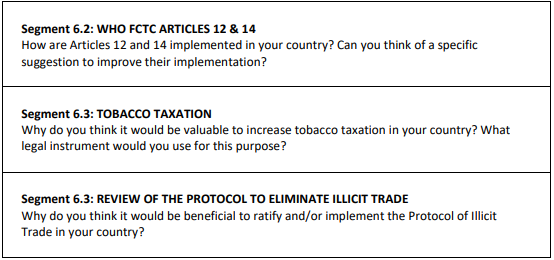
Step 3: Write
Fill in the table presented in Step 1 and answer the question(s) raised in Step 2. The recommended word count for this assignment is 300-500 words.
Step 4: Share
To share your work, click on the “Add a new discussion topic” button under the post and paste your work in the “Message” box. Make sure to reference others’ intellectual property when necessary. All references should follow 7th Edition APA formatting. For further instructions, see the resource on the Himmelfarb Health Sciences Library: APA citation resource (N.B. references are excluded from word counts).
Step 5: Interact
To complete this activity, you will need to reply respectfully and professionally to at least one post made by your peers. To post a reply, click “Reply” on a particular discussion, write your feedback and then click on “Post to forum.” If your peer(s) comment(s) on your post(s), please reply. Feel free to interact with the work done by other peers as well!
OPTIONAL Step 6: Interact (10 minutes)
If you would like to, you can reply to your peers' posts in a respectful and professional manner. Ensure that your post engages your peers' ideas by including a reflection on their comments, sharing ideas of other potential difficulties and parties involved, or asking thought-provoking questions. If a peer comments on your posting, please reply. To post a reply, click “Reply” on a particular discussion, write your feedback and then click on “Post to forum.”
-
Students mustMark as done
Quiz
-
Students mustViewReceive a gradeReceive a passing grade
To access the quiz, click on the name of the quiz provided above. On the following screen, click the attempt quiz button to respond to the questions.
-
By the end of this module and upon completion of the required readings, participants will be able to:
- Discuss the rationale and the evidence for regulating novel and emerging nicotine and tobacco products (HTPs, ENDS, and ENNDS); and
- Identify the key policy options to address novel and emerging nicotine and tobacco products (HTPs, ENDS, and ENNDS).
Click here to start this module-
Students mustMark as done
Live Session
-
This video is a recording of a webinar session that was delivered to a cohort of students from the Caribbean. Watch the entire video to better understand the module’s content. (54 minutes)
-
Read the entire Slideset. (22 minutes)
31.5 MB -
Students mustMark as done
Required readings and activities
-
Students mustMark as done
Module Introduction
-
-
Students mustMark as done
7.1 Definitions, Rationale, and Evidence of Novel and Emerging Nicotine and Tobacco Products
-
Students mustView
Read the entire document. (33 minutes)
-
Students mustView
Watch the entire video. (12 minutes)
-
Students mustMark as done
7.2 Legal Obligations and Policy Options to Address Novel and Emerging Nicotine and Tobacco Products
-
Students mustView
Read the entire document. (19 minutes)
-
Students mustView
Watch the entire video. (11 minutes)
-
Students mustMark as done
Module 7: Key Messages
-
Students mustView
Read the entire document. (3 minutes)
-
Students mustMark as done
Activity
-
Students mustViewStart discussions: 1
This activity will have two main stages. First, you will select and analyze a case scenario regarding key policy options addressing novel and emerging nicotine and tobacco products. Then, you will share pictures of different forms (if possible) of advertisement, promotion, or sponsorship of novel and emerging nicotine and tobacco products in your area. To complete this activity you will need to reply to at least one post made by your peers.
Step 1: Analyze
Review the content in Segments 7.1 and 7.2 Select ONE of the case scenarios below and analyze how you would address it.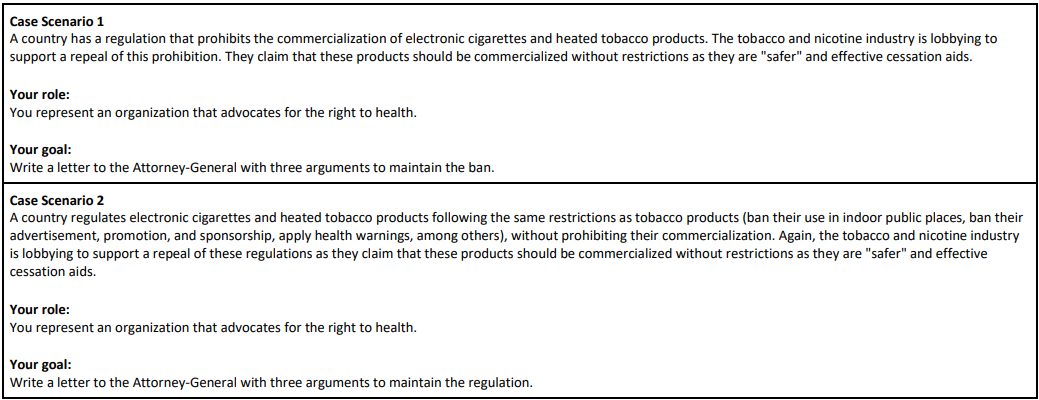
Step 2. Find Examples
Find Examples: Take three pictures of different forms (if possible) of advertisement, promotion, or sponsorship of novel and emerging nicotine and tobacco products in your area (i.e., magazines, festivals, social media). If you cannot locate any in your area, you may use internet images.
Answer: Who do you think the intended audience is (e.g., youth or women)?
Step 3: Write
Write a 300-500 word post that:
- Answers the chosen case scenario raised in Step 1;
- Provides context and introduces the example pictures identified in Step 2; and
- Answers the question raised in Step 2.
Step 4: Share
To share your work, click on the “Add a new discussion topic” button under the post and paste your work in the “Message” box. Make sure to reference others’ intellectual property when necessary. All references should follow 7th Edition APA formatting. For further instructions, see the resource on the Himmelfarb Health Sciences Library: APA citation resource (N.B. references are excluded from word counts).
Step 5: Interact
To complete this activity, you will need to reply respectfully and professionally to at least one post made by your peers. To post a reply, click “Reply” on a particular discussion, write your feedback and then click on “Post to forum.” If your peer(s) comment(s) on your post(s), please reply. Feel free to interact with the work done by other peers as well!
OPTIONAL Step 6: Interact (10 minutes)
If you would like to, you can reply to your peers' posts in a respectful and professional manner. Ensure that your post engages your peers' ideas by including a reflection on their comments, sharing ideas of other potential difficulties and parties involved, or asking thought-provoking questions. If a peer comments on your posting, please reply. To post a reply, click “Reply” on a particular discussion, write your feedback and then click on “Post to forum.”
-
Students mustMark as done
Quiz
-
Students mustViewReceive a gradeReceive a passing grade
To access the quiz, click on the name of the quiz provided above. On the following screen, click the attempt quiz button to respond to the questions.
-
 By the end of this module and upon
completion of the required readings, participants will be able to:
By the end of this module and upon
completion of the required readings, participants will be able to:- Discuss the rationale and summarize the evidence for protecting tobacco control policies from the commercial and other vested interests of the tobacco industry;
- Describe the current status of implementation of Article 5.3 of the WHO FCTC in the Caribbean;
- Identify the key elements which need to be tailored for implementation of WHO FCTC Article 5.3; and
- Design and draft effective measures to protect tobacco control policies from the commercial and other vested interests of the tobacco industry.
-
Students mustMark as done
Required readings and activities
-
Students mustMark as done
Module Introduction
-
-
Students mustMark as done
8.1 Rationale, and Evidence for Protecting Tobacco Control Policies from the Commercial and Other Vested Interests of the Tobacco Industry
-
Students mustView
Read the entire document. (12 minutes)
-
Students mustView
Watch the entire video. (14 minutes)
-
Students mustMark as done
8.2 Implementing WHO FCTC Article 5.3: Drafting Effective Measures to Prevent Tobacco Industry Interference
-
Students mustView
Read the entire document. (39 minutes)
-
-
Students mustMark as done
Module 8: Key Messages
-
Students mustView
Read the entire document. (2 minutes)
-
Students mustMark as done
Activity
-
Students mustViewStart discussions: 1
You will analyze a general scenario regarding the protection of tobacco control policies from the commercial and other vested interests of the tobacco industry. To complete this activity, you will need to reply to at least one post made by your peers.
Step 1: Analyze
Review the content in Segments 8.1 and 8.2 and analyze how you would address this scenario:

Step 2: Write
Write a 300-500 word post that justifies:
- Three (3) main arguments to support your position whether the offer (from the case scenario) should be accepted.
- Any recommendations to address the scenario.
Step 3: Share
To share your work, click on the “Add a new discussion topic” button under the post and paste your work in the “Message” box. Make sure to reference others’ intellectual property when necessary. All references should follow 7th Edition APA formatting. For further instructions, see the resource on the Himmelfarb Health Sciences Library: APA citation resource (N.B. references are excluded from word counts).
Step 4: Interact
To complete this activity, you will need to reply respectfully and professionally to at least one post made by your peers. To post a reply, click “Reply” on a particular discussion, write your feedback and then click on “Post to forum.” If your peer(s) comment(s) on your post(s), please reply. Feel free to interact with the work done by other peers as well!
OPTIONAL Step 5: Interact (10 minutes)
If you would like to, you can reply to your peers' posts in a respectful and professional manner. Ensure that your post engages your peers' ideas by including a reflection on their comments, sharing ideas of other potential difficulties and parties involved, or asking thought-provoking questions. If a peer comments on your posting, please reply. To post a reply, click “Reply” on a particular discussion, write your feedback and then click on “Post to forum.”
-
Students mustMark as done
Quiz
-
Students mustViewReceive a gradeReceive a passing grade
To access the quiz, click on the name of the quiz provided above. On the following screen, click the attempt quiz button to respond to the questions.
-
To complete this assignment, you are required to reflect on the progress your country has made in implementing tobacco control measures. If your country has started to implement control measures, you must select Track 1. However, if your country has not implemented tobacco control measures, you must select Track 2.
-
Students mustViewStart discussions: 1
-
Students mustViewStart discussions: 1
-
-
-
Final Exam Quiz
To take the final exam, you must complete all quizzes and complete all the required activities. The final exam consists of 40 questions, and you will have 80 minutes to complete it. When the time is over, you will have two minutes to submit your attempt before it expires, and your progress is discarded. You will not be able to answer additional questions in the grace period.
To access the exam, click on the name of the exam provided above. On the following screen, click the attempt quiz button to respond to the questions.
Not available unless: All of: ...Not available unless:-
All of:
- The activity Course Registration is marked complete
- The activity Pre-Test is marked complete
- The activity Module 1: Quiz is marked complete
- The activity Module 2: Quiz is marked complete
- The activity Module 3: Quiz is marked complete
- The activity Module 4: Quiz is marked complete
- The activity Module 5: Quiz is marked complete
- The activity Module 6: Quiz is marked complete
- The activity Module 7: Quiz is marked complete
- The activity Module 8: Quiz is marked complete
-
All of:
- The activity Discussion Forum #1: Importance of Implementing Tobacco Control Measures in the Caribbean (90 mins.) is marked complete
- The activity Discussion Forum #2: The Process to Develop Tobacco Control Legislation in the Caribbean (90 mins) is marked complete
- The activity Discussion Forum #3: Protection from exposure to tobacco smoke (90 Mins.) is marked complete
- The activity Discussion Forum #4 Packaging and labeling of tobacco products (90 Mins.) is marked complete
- The activity Discussion Forum #5: Tobacco advertising, promotion, and sponsorship (90 Mins.) is marked complete
- The activity Discussion Forum #6: Content regulation and disclosure measures in tobacco control legislation (90 Mins.) is marked complete
- The activity Discussion Forum #7: Critiquing Key Policy Options Addressing Novel and Emerging Nicotine and Tobacco Products (90 Mins.) is marked complete
- The activity Discussion Forum #8: Protecting tobacco control policies from the commercial and other vested interests of the tobacco industry (90 Mins.) is marked complete
-
Any of:
- The activity Track 1: Countries with tobacco control measures in place is marked complete
- The activity Track 2: Countries with no legislation with tobacco control measures is marked complete
-
All of:
-
-
 In this section, you can provide feedback about this course to help us make NextGenU.org better. Once evaluations are completed, you will be able to download your certificate of completion.
-
Course Evaluation QuestionnaireNot available unless: The activity Final Exam is complete and passed
-
Self Evaluation QuestionnaireNot available unless: The activity Final Exam is complete and passed
-
-