Social and Behavioral Health
-
Public HealthSocial and Behavioral HealthResume0% complete0% complete
Introduction
Show More Show LessThis course is a comprehensive introduction to theories, concepts, and models of Social and Behavioral Sciences and provides an opportunity to develop practical skills and knowledge in the topic. This Social and Behavioral Health course is sponsored by the University of the Incarnate Word and was developed in partnership with the Association for Prevention Teaching and Research, and the U.S. Centers for Disease Control and Prevention (CDC), with special thanks to the volunteers at Public Health U (formerly Peoples-Uni) for their important contributions.
-
Students mustMark as done
-
Students mustViewReceive a grade
Show More-


This course is a comprehensive introduction to theories, concepts, and models of Social and Behavioral Sciences and provides an opportunity to develop practical skills and knowledge in the topic. This Social and Behavioral Health course is sponsored by the University of the Incarnate Word and was developed in partnership with the Association for Prevention Teaching and Research, and the U.S. Centers for Disease Control and Prevention (CDC), with special thanks to the volunteers at Public Health U (formerly Peoples-Uni) for their important contributions.
Like all NextGenU.org courses, this course is competency-based, using competencies from the ASPPH: MPH Core Competency Model, and CEPH, and uses learning resources from accredited, world-class organizations such as the Pan American Health Organization, U.S. Centers for Disease Control and Prevention (CDC), the U.S. National Institutes of Health, and the World Health Organization. The course designers include Aalia Chatur, MPH; Andrea Ramirez, MD; Ashley Shaw, Ph.D.; Ellina Lytvyak; Karah Koleszar; Jamila Conliffe MPH; Hugo Andres Rojas Aldieri MD, MSc; Leohrandra Graham, MSc.; Madison Cox MSN, RN; Pablo Baldiviezo Rodriguez, MD; Sergio Arancibia, MD; and Valeria Reynolds, MD.
For publications on NextGenU.org’s courses’ efficacy, see “A Novel Integration of Online and Flipped Classroom Instructional Models in Public Health Higher Education,” (2014), BMC Medical Education, “Building Public Health Capacity through Online Global Learning,” (2018), Open Praxis, or on NextGenU.org’s publication page. Subscribe to our newsletter to be notified of future updates, new courses, and to be part of our community.
There are 5 modules to complete, which provide an introduction to:
- Introduction to Social and Behavioral Sciences
- Social and Behavioral Factors Affecting Health
- Public Health Ethics
- Social Behavioral Science Interventions
- Planning, Implementation & Evaluation of Public Health Programs, Policies, and Interventions
The completion time for this course is estimated at 87 hours, comprising 14 hours of learning resources, 28 hours for study and assimilation, and 45 hours of participating in learning activities and quizzes, to assist the learners in the synthesis of learning materials. This course is equivalent to 2 credit hours.
The course requires the completion of all case studies, peer activities, and discussion forums. At the end of each lesson, there is a practice quiz. At the end of the course, after you’ve completed each lesson, quiz, and learning activity, you’ll have access to a final exam, and a chance to evaluate this course. Once you’ve passed that last test, you will be able to download a certificate of completion from NextGenU.org and our course’s co-sponsoring organizations (listed above). We keep all of your personal information confidential, never sell any of your information, and only use anonymized data for research purposes, and we are also happy to report your testing information and share your work with anyone (your school, employer, etc.) at your request.
Engaging with this Course:
You may browse this course for free to learn for your personal enrichment; there are no requirements. To register for this course, learners should have a college-level/bachelor's degree.
To PASS and Obtain a Certificate
- all the reading requirements,
- Complete all quizzes and pass with a 80% with unlimited attempts.
- all case studies,
- all peer activities,
- final assignment,
- The final exam with a minimum of 80% and a maximum of 3 attempts.
- The self and course evaluation forms.
To obtain credit
- complete all requirements listed above for the certificate, and
- your learning institution or workplace should approve the partner-university-sponsored NextGenU.org course for educational credit, as they would for their learner taking a course anywhere.
NextGenU.org is happy to provide your institution with
- a link to and description of the course training, so they can see all its components, including the cosponsoring universities and other professional organization cosponsors;
- your grade on the final exam;
- your work products (e.g. case study activities), and any other required or optional shared materials that you produce and authorize to share with them;
- your evaluations -- course, and self-assessments;
- a copy of your certificate of completion, with the co-sponsoring universities and other organizations listed.
To obtain a degree, NextGenU.org co-sponsors degree programs with institutional partners. To obtain a full degree co-sponsored with NextGenU.org, registrants must be enrolled in a degree program as a student of a NextGenU.org institutional partner. If you think that your institution might be interested in offering a degree with NextGenU.org contact us.
We hope that you will find this a rewarding learning experience, and we count on your assessment and feedback to help us improve this training for future students.
Next Steps include:
- Complete the registration form.
- Take the pre-test.
- Begin the course with Module 1: Introduction to Social and Behavioral Sciences. In each lesson, read the description, complete all required readings and any required activity, and take the corresponding quizzes.
-

Competencies covered in this module:
- Identify the basic theories, concepts, and models from a range of social and behavioral disciplines that are used in public health research and practice.
-
Student Learning Outcomes:
- Describe the concept of social and behavioral sciences and the disciplines involved.
- Summarize the fundamental theories and models used in public health practice and research.
- Explain how essential theories, concepts, and models used in public health research and practice are linked to a variety of social and behavioral disciplines.
-
Required Learning Resources and Activities
-
Students mustView
Read the entire article. (14 minutes)
Ohio University - 2020
-
Students mustView
Read content under Chapter 4 What are behavioural and social sciences? What key frameworks do they offer public health practitioners? (19 minutes)
Public Health England - 2018
-
Students mustView
Read the entire document. (15 minutes)
Purdue Extension Health and Human Sciences - 2015
-
Students mustView
Read the entire resource. (31 minutes)
NIH - 2008
-
Students mustView
Read the content on the section “Part 1” on pages 4-7, and “Part 3” on pages 36-46. (15 minutes)
National Cancer Institute - 2012
-
Students mustViewReceive a grade
Read the following scenario and answer the questions based on your understanding of social and behavioral practice models.
-
Quiz: Module 1
To access the quiz, click on the name of the quiz provided above. On the following screen, click the "Preview quiz now" button to respond to the questions.
TO PASS THIS QUIZ YOU MUST OBTAIN A SCORE OF 80%.
Not available unless: The activity Course Registration is marked complete ...Not available unless:- The activity Course Registration is marked complete
- The activity Pre-Test is marked complete
-
Recommended Additional Readings
-
Students mustViewRead the Introduction. (11 minutes)
The National Academies Press - 2011
-
Competencies covered in this module:

- Identify the causes of social and behavioral factors that affect the health of individuals and populations.
- Describe the role of social and community factors in both the onset and solution of public health problems.
-
Student Learning Outcomes:
- Explain how social factors and individual behaviors contribute to the health of an individual.
- Explain the social and behavioral factors that affect population health.
-
Students mustMark as done
Required Learning Resources and Activities
-
Students mustView
Read the entire article. (16 minutes)
NCBI - 2015
-
Students mustView
Read the entire page. (10 minutes)
HealthyPeople - 2020
-
Students mustView
Read the content under "The Impacts of Socioeconomic and Other Social Factors on Most Health Outcomes" And "Multiple Mechanisms Explain Impacts of Socioeconomic and Other Social Factors on Health" (16 minutes)
Public Health Reports - 2014
-
Students mustView
Read the entire article. (37 minutes)
PNAS - 2020
-
Students mustViewStart discussions: 1
Using the example of substance use disorders, discuss how social and behavioral factors affect individual and population health.
Instructions: Using the content covered in this lesson thus far, discuss the role of social and behavioral factors in the increased difficulty of detection and treatment of substance use disorders.
Step 1: Review
Review the learning resources in the outcomes you completed for this lesson. Pay attention to social and behavioral factors that affect treatment of substance use disorders.
Step 2: Apply & Respond
Contemplate the issue of substance use disorders and the difficulties of detecting and treating them. Now, think about social and behavioral factors which can be linked to worsening the detection and treatment of these disorders.
Write a 400-500 word discussion based on this, it should include:- At least one example on the effects of social factors on the detection and treatment of substance use disorders; and
- At least one example on the effects of behavioral factors on the detection and treatment of substance use disorders.
Step 3: Share
Submit your discussion for peer review. To share your work, click on the button at the bottom of the screen “Add a new discussion topic.” Include a title for your discussion and paste your work in the “Message” box. Make sure to reference others’ intellectual property when necessary. All references should follow 7th Edition APA formatting; see the resource on the Himmelfarb Health Sciences Library for instructions: APA citation resource (references are excluded from word counts).
Step 4: InteractTo complete the activity, you will need to reply to at least one post made by your peers in a respectful and professional manner. Ensure that your post engages your peers' ideas by including a reflection on their comments, sharing ideas of other potential difficulties and parties involved, or asking thought-provoking questions. If a peer comments on your posting, please reply. To post a reply, click “Reply” on a particular discussion, write your feedback and then click on “Post to the forum.”
OPTIONAL Step 5: Interact (10 minutes)
If you would like to, you can reply to your peers' posts in a respectful and professional manner. Ensure that your post engages your peers' ideas by including a reflection on their comments, sharing ideas of other potential difficulties and parties involved, or asking thought-provoking questions. If a peer comments on your posting, please reply. To post a reply, click “Reply” on a particular discussion, write your feedback and then click on “Post to forum.”
- Explain how social factors and individual behaviors contribute to the health of an individual.
-
Student Learning Outcomes:
- Define an ecological model as it applies to social and behavioral health.
- Describe the linkages between social and behavioral determinants of health at different levels of the ecological framework.
- Identify community factors that influence public health.
- Discuss how social, behavioral, environmental, and biological factors contribute to public health issues.
- Understand the role and importance of social & community factors in addressing Public Health issues.
- Explore strategies to solve public health problems that make use of social and community factors.
-
Required Learning Resources and Activities
-
Students mustView
Read content on the section “Part 2” on pages 10-33. (20 minutes)
National Cancer Institute - 2012
-
Students mustView
Read the entire article. (31 minutes)
SagePub Journal - 2012
-
Students mustView
Read the entire article. (37 minutes)
National Research Council - 2013
-
Read the entire article. (5 minutes)
American Hospital Association - 2020
-
Read from the title "Abstract" to the title "Community", ¨Society¨ and ¨Conclusion¨(9 minutes)
Springer Science - 2020
-
Read the entire flyer. (10 minutes)
NIH - 2020
-
Students mustView
Read the entire article (6 minutes)
AJMC - 2016
-
Read content from "A Framework for Healthy Communities" to end. (11 minutes)
Journal Article - 2018
-
Read content from "Why Address Social Determinants of Health and Development" to "Summary". (34 minutes)
Community Tool Box - 2013
-
Watch the enitre video This lecture reviewed some of Professor Everitt and his group’s research on the behavioural neuroscience of addiction in experimental animals that seeks to understand the neural and psychological mechanisms of addictive behaviour, including the nature of vulnerability as well as the possibility of developing new treatments. (53 minutes)
-
Students mustViewStart discussions: 1
Instructions: Based on the material covered so far, pick the two (2) strategies that you think are the best/most effective at solving public health problems. Write a discussion (250 -300 words) on why you chose those strategies.
Step 1: Review
Review learning resources for Module 2. Based on the factors that affect the health of individuals and the strategies explored, select two strategies that you think are the most effective.
Step 2: Apply
Think about a specific public health problem related to your area of expertise. Reflect on how the strategies you chose are applied to solving the problem you identified.
Step 3. Respond
Write a 350-500 word report discussing your selected strategies with the following inclusions.
Why did you choose those strategies?
Discuss why the chosen strategies are effective.
Do you think the strategies can be further improved?
Step 4: Share
Submit your discussion. To share your work, click on the button at the bottom of the screen, “Add a new discussion topic.” Include the title of your report and paste your work in the “Message” box. Click “Post to forum.” Make sure to reference others’ intellectual property when necessary. All references should follow 7th Edition APA formatting; see the resource on the Himmelfarb Health Sciences Library for instructions: APA citation resource (references are excluded from word counts).OPTIONAL Step 5: Interact (10 minutes)
If you would like to, you can reply to your peers' posts in a respectful and professional manner. Ensure that your post engages your peers' ideas by including a reflection on their comments, sharing ideas of other potential difficulties and parties involved, or asking thought-provoking questions. If a peer comments on your posting, please reply. To post a reply, click “Reply” on a particular discussion, write your feedback and then click on “Post to forum.”
-
Students mustViewStart discussions: 1
In this activity, you will use some statistical data to analyze social and behavioral determinants of individual health within an ecological framework.
Step 1. Review
Review the learning resources for this module. Focus on social and behavioral determinants of health and ecological models.
Step 2. Study
Study this statistical record.
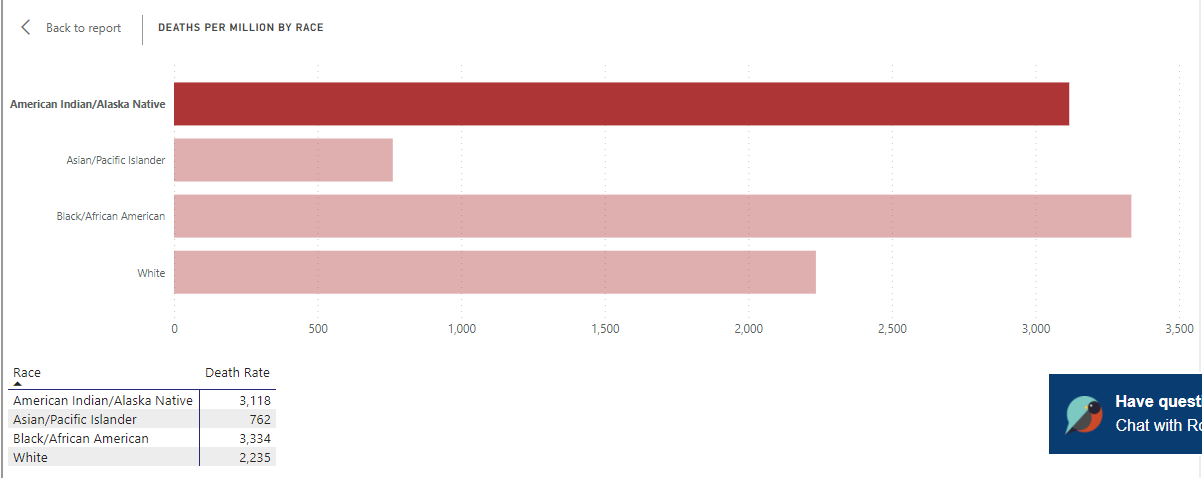
African Americans comprise approximately 14% of Michigan’s population, yet 40% of the state’s COVID-19-related deaths were among African Americans as reported by the state’s official website. Additionally, American Indians and Alaskan Natives who are also state residents fall second in that category. https://www.michigan.gov/coronavirus/0,9753,7-406-98163_98173---,00.html
Step 3: Reflect
Using the data above, reflect on the following questions:
- What social and behavioral determinants of health can be attributed as to why African Americans and Alaskan Natives have more mortality cases?
- How do social and behavioral factors at the individual level affect this health outcome?
- How can an ecological framework be used to understand the effects of social and behavioral factors on the risks of COVID-19 mortality cases for these populations?
Step 4: Respond
Respond by writing a 300-600 word reflective piece of writing covering the questions introduced in step 3.
Step 5: Share
To share your work, click on the “Add a new discussion topic” button under this post and paste your work in the “Message” box. Make sure to reference others’ intellectual property when necessary. All references should follow 7th Edition APA formatting. For further instructions, see the resource on the Himmelfarb Health Sciences Library: APA citation resource (N.B. references are excluded from word counts).
Step 6: Interact
To complete the activity, you will need to reply to at least one post made by your peers in a respectful and professional manner. Ensure that your post engages your peers' ideas by including a reflection on their comments, sharing ideas of other potential difficulties and parties involved, or asking thought-provoking questions. If a peer comments on your posting, please reply. To post a reply, click “Reply” on a particular discussion, write your feedback and then click on “Post to the forum.”
OPTIONAL Step 7: Interact (10 minutes)
If you would like to, you can reply to your peers' posts in a respectful and professional manner. Ensure that your post engages your peers' ideas by including a reflection on their comments, sharing ideas of other potential difficulties and parties involved, or asking thought-provoking questions. If a peer comments on your posting, please reply. To post a reply, click “Reply” on a particular discussion, write your feedback and then click on “Post to forum.”
-
Quiz: Module 2
To access the quiz, click on the name of the quiz provided above. On the following screen, click the "Preview quiz now" button to respond to the questions.
TO PASS THIS QUIZ YOU MUST OBTAIN A SCORE OF 80%.
Not available unless: The activity Quiz: Module 1 is marked complete -
Recommended Additional Readings
-
Read content under the following headings: "Social Networks, Social Support, and Health" and "Aspects of Health Influenced by the Social Environment". (13 minutes)
Institute of Medicine (US) - 2006
- Define an ecological model as it applies to social and behavioral health.
-
Competencies covered in this module:

- Apply ethical principles to public health program planning, implementation, and evaluation.
-
Student Learning Outcomes:
- Discuss the principles of the Ethical Practice of Public Health as they relate to SBS interventions.
- Examine the key issues in global health ethics relate to SBS.
- State the role of the government in personal risk management.
- Explain the role of human rights in public health.
- Explain what is meant by personal freedom and the collective good.
- Assess the tension between personal freedom and the collective good using ethical principles as a framework.
-
Required Learning Resources and Activities
-
Students mustView
Read the content on Section "A. Introduction to health ethics key concepts" on pages 10-11. (9 minutes)
WHO - 2015
-
Students mustView
Read the content under Section 2 on pages 5-6. (4 minutes)
APHA - 2019
-
Students mustView
Read entire page. Click on the cases at the end of the page and read. (30 minutes)
UW Medicine - 2018
-
Read Section under "An Ethics Framework for Public Health" (31 minutes)
NIH - 2001
-
Students mustView
Read the content under the heading "What are key ethical issues in public health?"on the pages 14-20. (7 minutes)
WHO - 2015
-
Students mustView
Read the summarised points under "Eight key principles guiding governments on how to deal with risk" (2 minutes)
Elsevier - 2018
-
Students mustView
Read the content under "Policy Instruments to Stimulate Behavior Change" (3 minutes)
Public Administration Review - 2019
-
Students mustView
Read from the title "Developing health-related human rights" to the title "A critical time for human rights in public health". (12 minutes)
PMC National Institues of Health - 2018
-
Students mustView
Read the entire article. (6 minutes)
The Network for Public Health Law - 2021
-
Students mustView
Read the entire article. (11 minutes)
Journal of Public Health Research - 2016
-
Students mustViewStart discussions: 1
Students will discuss points both for and against personal freedom and collective good as it applies to the topic of vaccination.
Step 1: Review
Review the learning resources in Module 4 with particular attention to ethical principles in public health.
Step 2: Apply
Reflect and think about the effect of personal freedom and collective good as it relates to vaccination. Establish the role of each on vaccination in a pandemic environment.
Step 3: Respond
Briefly discuss both sides of personal freedom and collective good. You should cover the following:
Arguments for personal freedom being of most importance with respect to vaccination.
Arguments for collective good being of most importance with respect to vaccination.
Each argument for the points above should be supported by an ethical principle. For example: Personal freedom is of most importance with respect to vaccination because of [X]. The [X] ethical principle supports this argument because [X].
To share your work, click on the button at the bottom of the screen “Add a new discussion topic.” Include a title and paste your work in the “Message” box. Then click “Post to forum.” Make sure to reference others’ intellectual property when necessary. All references should follow 7th Edition APA formatting; see the resource on the Himmelfarb Health Sciences Library for instructions: APA citation resource (references are excluded from word counts).OPTIONAL Step 5: Interact (10 minutes)
If you would like to, you can reply to your peers' posts in a respectful and professional manner. Ensure that your post engages your peers' ideas by including a reflection on their comments, sharing ideas of other potential difficulties and parties involved, or asking thought-provoking questions. If a peer comments on your posting, please reply. To post a reply, click “Reply” on a particular discussion, write your feedback and then click on “Post to forum.”
-
Quiz: Module 3
To access the quiz, click on the name of the quiz provided above. On the following screen, click the "Preview quiz now" button to respond to the questions.
TO PASS THIS QUIZ YOU MUST OBTAIN A SCORE OF 80%.
Not available unless: The activity Quiz: Module 2 is marked complete -
Students mustMark as done
Recommended Additional Readings
-
Students mustView
Read the entire article. (12 minutes)
Davidson - 2020
- Discuss the principles of the Ethical Practice of Public Health as they relate to SBS interventions.
-
Competencies covered in this module:

- Describe the merits of social and behavioral science interventions and policies.
- Identify multiple targets and levels of intervention for social and behavioral science programs and/or policies.
-
Student Learning Outcomes:
- Define and defferentiate between Policy and Intervention.
- Provide examples of how social and behavioural sciences are incorporated in Public Health interventions and responses.
- Explain the role of social and behavioral science interventions in individuals, households, and communities to improve health outcomes.
- Explain the levels of public health intervention practice.
- Explore interventions or policies in social and behavioral science programs at the individual, household, and community levels.
-
Required Learning Resources and Activities
-
Students mustView
Read the section "Public health interventions, defined" (4 minutes)
Minnesota Department of Health Center for Public Health Practice - 2019
-
Read the entire article. (4 minutes)
Columbia University - 2021
-
Students mustView
Read the content under the sections "Social Context", and "Aligning individual and collective interests" (22 minutes)
Nature Human Behaviour - 2020
-
Students mustView
Read the content under the headings "The Impact of these Conditions on Parents", "The Impact of Disadvantage on Children", and "A Wealth of Evidence-Based Family and School Interventions" (16 minutes)
Clinical Child and Family Psychology Review - 2020
-
Students mustView
Read the content under the heading "Community as a Whole" (4 minutes)
Oslo and Akershus University College of Applied Sciences - 2017
-
Students mustView
Read the section 'Public health practice levels'. (2 minutes)
Minnesota Department of Health Center for Public Health Practice - 2019
-
Students mustView
Read the entire article. (19 minutes)
Issues in Science and Technology - 2013
-
Students mustView
Watch the entire webinar
This webinar will review the CBT model of substance use, as well as practical treatment strategies and tools in order to best help individuals affected by SUDs. (92 minutes)
-
Students mustViewStart discussions: 1
Step 1: Study
Review learning resources for Module 3 about the role of social and behavioral sciences in interventions and programs. Then read the Introduction, Results, and Discussion sections of the following publication: https://www.nature.com/articles/ijo201475#Sec14
Step 2: Respond
Prepare a 300-500 piece of writing discuss the following:
How does each intervention level compare with the others?
What qualities of each intervention worked?
What qualities did not work?
Why is social and behavioral science important to these interventions?
To share your work, click on the button at the bottom of the screen “Add a new discussion topic.” Include a title and paste your work in the “Message” box. Then click “Submit to forum.” Make sure to reference others’ intellectual property when necessary. All references should follow 7th Edition APA formatting; see the resource on the Himmelfarb Health Sciences Library for instructions: APA citation resource (references are excluded from word counts).OPTIONAL Step 4: Interact (10 minutes)
If you would like to, you can reply to your peers' posts in a respectful and professional manner. Ensure that your post engages your peers' ideas by including a reflection on their comments, sharing ideas of other potential difficulties and parties involved, or asking thought-provoking questions. If a peer comments on your posting, please reply. To post a reply, click “Reply” on a particular discussion, write your feedback and then click on “Post to forum.”
-
Quiz: Module 4
To access the quiz, click on the name of the quiz provided above. On the following screen, click the "Preview quiz now" button to respond to the questions.
TO PASS THIS QUIZ YOU MUST OBTAIN A SCORE OF 80%.
Not available unless: The activity Quiz: Module 3 is marked complete
- Define and defferentiate between Policy and Intervention.
-
Competencies covered in this module:
- Identify the individual, organizational and community concerns, assets, resources, and deficits for social and behavioral science interventions.
- Identify critical stakeholders for the planning, implementation, and evaluation of public health programs, policies, and interventions.
- Describe steps and procedures for the planning, implementation, and evaluation of public health programs, policies, and interventions.
- Apply evidence-based approaches in the development of social and behavioral science interventions.
-
Student Learning Outcomes:
- Summarize important individual, organizational and community concerns, assets, resources, and deficits, and strategies for identifying these components.
- Recognize the importance of considering individual, organization, and community levels as related to the development of social and behavioral science public health interventions.
- Identify key stakeholders and partnerships in an example of a public health program.
- Describe the Planning Health Promotion Programs steps 1-4.
- Explain how evidence-based SBS interventions and policies can be applied to public health programs.
- Summarize the key procedures for implementing public-health programs, policies, and interventions.
- Explain the special considerations and approaches for implementing SBS interventions in diverse communities.
- Identify the challenges faced when developing and implementing SBS interventions.
-
Required Learning Resources and Activities
-
Students mustView
Read the content under "Case study" and "Social Ecology of health Model" on pages 12-15 (11 minutes)
SagePub - 2009
-
Students mustView
Read the content under the heading "Abstract", "Introduction". (3 minutes)
American Journal of Community Psychology - 2009
-
Students mustView
Read content under Chapter 3 "What can behavioural and social
sciences contribute to public health?" page 16. (13 minutes)Public Health England - 2018
-
Students mustView
Read the content for Step 1: Engage Stakeholders. (11 minutes)
CDC - 2015
-
Students mustView
Read from page 1 to page 6. (10 minutes)
Public Health Ontario - 2015
-
Students mustView
Read from 3.3.4. Build Synchronization across Levels to the end of the Conclusion. (16 minutes)
NIH - 2016
-
Students mustView
Read the entire article. (28 minutes)
PMC National Institutes of Health - 2014
-
Students mustView
Read the steps 1-6. (16 minutes)
Journal of Epidemiology & Community Health - 2016
-
Students mustView
Read the entire article. (11 minutes)
MDPI - 2017
-
Students mustView
Watch the entire video.
The video describes a translational research program that explores the application of basic behavioral findings on delay discounting, decision science, and the neural underpinnings of these processes to the development of interventions for alcohol and drug abuse, obesity, and other behavioral risk factors. (60 minutes)
-
Students mustMark as done
Recommended Additional Readings
-
Students mustView
Read content from beginning until "National Interventions". (44 minutes)
National Academies Press - 2004
-
Students mustView
Read the entire page. (5 minutes)
Public Health Ontario - 2015
-
Students mustView
Read the content under "Barriers to Behavioral Change". (6 minutes)
South American Journal of Public Health - 2014
-
Student Learning Outcomes:
- Identify common types of evaluations for public health interventions.
- Compare and contrast evaluation types and methods.
- List the steps to prepare an evaluation plan.
- Discuss suitable criteria to evaluate partnerships among stakeholders.
- Identify special considerations and approaches for evaluating SBS interventions in diverse communities.
- Explain the potential challenges of evaluating SBS interventions in diverse communities.
- Outline the benefits of evidence-based approaches and their efficacy in the development of social and behavioral science interventions.
-
Students mustMark as done
Required Learning Resources and Activities
-
Students mustView
Read content under "What is evaluation?" and "What type of evaluation should I conduct?". (5 minutes)
Centers for Disease Control and Prevention - 2011
-
Click on the tab at the top of the webpage titled "Evaluation". Read the content of that web page. Then, click on the links at the bottom of the web page titled "Evaluation Types and Methods", "Preparing and Evaluation Plan", and "Evaluating your Partnership". Read the content of those links as well. (13 minutes)
Missouri Department of Health - 2011
-
Read the entire page. (3 minutes)
NIH - 2016
-
Read the content on pages 7 to 10. (12 minutes)
CDC - 2008
-
Read content under "Reviews of Theory use in Interventions" Pages 5 to 12. (28 minutes)
Annual Review of Public Health - 2010
-
Students mustView
Read the content under "The Role of Culture and Cultural Competence in Quality Evaluation". (16 minutes)
AEA - 2011
-
Students mustView
Read the entire article. (29 minutes)
CDC - 2012
-
Students mustView
Read the entire article. (6 minutes)
University of Canberra - 2021
-
Students mustViewStart discussions: 1
In this activity, you will research health promotion programs in your region and develop an evaluation plan for their health promotion initiative.
Step 1: Research
Research the information provided about two types of intervention from the following resources: https://www.thecommunityguide.org/findings/physical-activity-community-wide-campaigns
https://www.thecommunityguide.org/findings/physical-activity-stand-alone-mass-media-campaignsStep 2: Analyze
Based on the information gathered from your research, analyze the following key points, keeping in mind the content you have learnt based on intervention evaluation and assessment:
Which intervention showed higher efficacy?
Why was one intervention better than the other?
How can the inferior intervention be improved so that it may be used in the future?
Step 3: Discuss
Submit your work. To share your work, click on the button at the bottom of the screen, “Add a new discussion topic.” Include a title and paste your work in the “Message” box. Then click “Post to forum.” Make sure to reference others’ intellectual property when necessary. All references should follow 7th Edition APA formatting; see the resource on the Himmelfarb Health Sciences Library for instructions: APA citation resource (references are excluded from word counts).OPTIONAL Step 4: Interact (10 minutes)
If you would like to, you can reply to your peers' posts in a respectful and professional manner. Ensure that your post engages your peers' ideas by including a reflection on their comments, sharing ideas of other potential difficulties and parties involved, or asking thought-provoking questions. If a peer comments on your posting, please reply. To post a reply, click “Reply” on a particular discussion, write your feedback and then click on “Post to forum.”
-
Quiz: Module 5
To access the quiz, click on the name of the quiz provided above. On the following screen, click the "Preview quiz now" button to respond to the questions.
TO PASS THIS QUIZ YOU MUST OBTAIN A SCORE OF 80%.
Not available unless: The activity Quiz: Module 4 is marked complete
- Identify common types of evaluations for public health interventions.
-
Competencies covered in this Assignment:
- Apply awareness of cultural values and practices to the design or implementation of public health policies or programs.
- Apply evidence-based approaches in the development and evaluation of social and behavioral science interventions.
-
Students mustMark as done
Required Learning Resources and Activities
-
Students mustView
Read the entire article. (52 minutes)
Center for Community Health and Development, University of Kansas - 2021
-
Students mustView
Read the entire article before attempting the assignment. (30 minutes)
Fronteirs in Public Health - 2019
-
Students mustViewStart discussions: 1
Instructions: Using the skills and content covered throughout the course, you will design a social and behavioral intervention.
Step 1: Review
Provide a brief review of the learning resources from the course which may be key to helping you complete this final assessment. Resources from the following may be especially useful for you:
- Module 2, Lesson 2
- Module 4, Lesson 1
- Module 5
Read the article: Intervention Mapping: Theory- and Evidence-Based Health Promotion Program Planning: Perspective and Examples
Step 2: Research & Reflect
- Identify a health issue you would like to focus on, and establish a population/community to target. Aim to select an issue and population that would be benefited from a social and behavioral science intervention.
- Research the population, look at the culture, values, and practices specific to the population, this is important in shaping your intervention. Think on how these factors relate to the health issue of your choice.
- Additionally, research other interventions for your selected health issue, both successful and unsuccessful. This will provide you with knowledge on what strategies are most likely to be effective in your intervention. If many options are available, try to find the interventions that target a population similar to the one of your choice. Don’t forget that the same intervention may not have the same performance when the population and context is different.
- Make sure to take notes when doing your research. Once you are satisfied with your research results, look at your notes and reflect on what interventions you would like to propose for your selected health issue and population.
Step 3: Respond
Propose your designed intervention, in 700-1000 words.
In your intervention proposal, you should include:
- A definition of the chosen health issue and a rationale of the need for a social and behavioral science intervention
- An indication of your target population and a justification on why this is your target
- A brief report on the population’s cultural values and practices as they relate to the health issue
- An overview of your proposed intervention
- A rationale that justifies every aspect of your proposed intervention using published scientific evidence. The justification should clarify if similar interventions have been done in the past, the advantages and disadvantages of such interventions, and their target populations.
- A brief justification on the cultural appropriateness of your intervention as it relates to the target population.
Step 4: Share
Submit your discussion for peer review. To share your work, click on the button at the bottom of the screen “Add a new discussion topic.” Include a title for your discussion and paste your work in the “Message” box. Make sure to reference others’ intellectual property when necessary. All references should follow 7th Edition APA formatting; see the resource on the Himmelfarb Health Sciences Library for instructions: APA citation resource (references are excluded from word counts).
Step 5: Evaluate the work of one of your peers based on items A to D of this rubric.
Step 6: Interact
To complete the activity, you will need to reply to at least one post made by your peers in a respectful and professional manner. Ensure that your post engages your peers' ideas by including a reflection on their comments, sharing ideas of other potential difficulties and parties involved, or asking thought-provoking questions. If a peer comments on your posting, please reply. To post a reply, click “Reply” on a particular discussion, write your feedback and then click on “Post to the forum.” You can use the list below as a guide:
Item A is .…. because…. My suggestions for improvement are….
Item B is .…. because…. My suggestions for improvement are….
Item C is .…. because…. My suggestions for improvement are….
Item D is .…. because…. My suggestions for improvement are….OPTIONAL Step 7: Interact (10 minutes)
If you would like to, you can reply to your peers' posts in a respectful and professional manner. Ensure that your post engages your peers' ideas by including a reflection on their comments, sharing ideas of other potential difficulties and parties involved, or asking thought-provoking questions. If a peer comments on your posting, please reply. To post a reply, click “Reply” on a particular discussion, write your feedback and then click on “Post to forum.”
- Apply awareness of cultural values and practices to the design or implementation of public health policies or programs.
-
-
Final Exam Quiz
To take the final exam, you must complete all quizzes and complete all the required activities. The final exam consists of 50 questions, and you will have 100 minutes to complete it. When the time is over, you will have two minutes to submit your attempt before it expires, and your progress is discarded. You will not be able to answer additional questions in the grace period.
To access the exam, click on the name of the exam provided above. On the following screen, click the Preview quiz now button to respond to the questions.
Not available unless: All of: ...Not available unless:-
All of:
- The activity Course Registration is marked complete
- The activity Pre-Test is marked complete
- The activity Quiz: Module 1 is marked complete
- The activity Quiz: Module 2 is marked complete
- The activity Quiz: Module 3 is marked complete
- The activity Quiz: Module 4 is marked complete
- The activity Quiz: Module 5 is marked complete
-
All of:
- The activity Case Study 1: Social and Behavioral practices models (60 mins) is marked complete
- The activity Discussion Forum: Identifying Social and Community Factors that Affect Health (120 minutes) is marked complete
- The activity Activity 1: Analyzing strategies for solving public health problems. (120 minutes) is marked complete
- The activity Activity 2 : Personal freedom, Collective good and vaccination in a pandemic. (120 minutes) is marked complete
- The activity Activity 3: Social and Behavioral Sciences involved in Interventions (120 miuten) is marked complete
- The activity Activity 4: Evaluation of promotion program. (180 minutes) is marked complete
- The activity Final Assignment: Intervention Design (1380 minutes) is marked complete
-
All of:
-
-

In this section, you can provide feedback about this course to help us make NextGenU.org better. Once evaluations are completed, you will be able to download your certificate of completion.
Click here give your feedback
-
Course Evaluation QuestionnaireNot available unless: The activity Final Exam is marked complete
-
Self Evaluations QuestionnaireNot available unless: The activity Final Exam is marked complete
-
-
-
Students mustMark as done
-
Students mustMark as done
-
Students mustMark as done
-
-