Research Methods for Health Sciences
You do not have permission to view discussions in this forum.
-
-
Students mustStudent must submit this questionnaire to complete it
-
Students mustViewReceive a grade
Show More-
Research Methods Homepage
Highlighted

Welcome to the Research Methods for Health Sciences course. This course provides students with the knowledge and skills necessary to design a research project and present it in the form of a research proposal.
The Research Methods for Health Sciences course is sponsored by the University of the Incarnate Word. Like all NextGenU.org courses, the Research Methods for Health Sciences course is competency-based, referencing competencies from the Health Services Research Doctoral Core Competencies (2018), Development of the Learning Health System Researcher Core Competencies, and WHO-ASPHER 2020. It uses learning resources from accredited, world-class organizations such as the U.S. Centers for Disease Control and Prevention (CDC), the U.S. National Institutes of Health, and the World Health Organization.
The Research Methods for Health Sciences course was developed in collaboration with the University of the Incarnate Word and was designed by Hugo Rojas, MD, MSc, DiplEd; Pablo Baldiviezo, MD, DiplEd; Carolina Bustillos, MD, DiplEd; Felix Emeka Anyiam MPH, MScPH, DataSc., Ph.D.; Jean Pierre Musabyimana MSc; Genikka Camille Gabral, B.ED, MSc; Glenda Niles PhD.
For publications on NextGenU.org’s courses’ efficacy, see “A Novel Integration of Online and Flipped Classroom Instructional Models in Public Health Higher Education” (2014), BMC Medical Education, “Building Public Health Capacity through Online Global Learning,” (2018), Open Praxis, or on NextGenU.org’s publication page. Subscribe to our newsletter to be notified of future updates, new courses, and to be part of our community.
There are 6 modules to complete, which provide an introduction to:
- Module 1: Introduction to Research Methods
- Module 2: Research Questions, Research Objectives, and Hypotheses
- Module 3: Quantitative Studies
- Module 4: Qualitative and Mixed Studies
- Module 5: Literature Reviews and Critical Appraisals of Research
- Module 6: Scientific Skills
The completion time for this course is estimated at 143 hours, consisting of 27 hours of learning resources, 55 hours for time to study content and assimilation, and 61 hours of participating in learning activities and quizzes, to assist the learners in the synthesis of learning materials. This course is equivalent to 3 credit hours.
The course requires the completion of all activities i.e., quizzes, peer activities, discussion forums, and a final assignment that are needed to complete the course. At the end of each module, there is a practice quiz of ten (15) multiple-choice questions. After you’ve completed each lesson, quiz, peer activity, and learning activity, you will have access to a final exam consisting of fifty (50) multiple-choice questions and a chance to evaluate this course. The final exam will be designed so that participants can have multiple opportunities to answer correctly until the required score of 70% or higher is obtained. Once you’ve passed that last test, you will be able to download a certificate of completion from NextGenU.org and our course’s co-sponsoring organizations (listed above). We keep all of your personal information confidential, never sell any of your information, and only use anonymized data for research purposes. Also, we are happy to report your testing information and share your work with anyone (your school, employer, etc.) at your request.
Engaging with this course:
You may browse this course for free to learn for your personal enrichment; there are no requirements. To register in this course, it is required that learners have obtained a college-level/bachelor's degree.
To PASS and Obtain a Certificate, a learner must first register for the course and then successfully complete:
- All reading requirements,
- All quizzes and pass with a score of 80% with unlimited attempts,
- All peer activities,
- All discussion forums,
- Final assignment,
- The final exam with a minimum score of 80% and a maximum of 3 attempts, and
- The self and course evaluation forms.
To obtain credit:
- Complete all requirements listed above for the certificate, and
- Your learning institution or workplace should approve the partner-university-sponsored NextGenU.org course for educational credit, as they would for their learner taking a course anywhere.
NextGenU.org is happy to provide your institution with:
- A link to and description of the course training, so they can see all its components, including the co-sponsoring universities and other professional organization co-sponsors;
- Your grade on the final exam;
- Your work products (e.g., case study activities) and any other required or optional shared materials that you produce and authorize to share with them;
- Your evaluations -- course, and self-assessments;
- A copy of your certificate of completion, with the co-sponsoring universities and other organizations listed.
To obtain a degree, NextGenU.org co-sponsors degree programs with institutional partners. To obtain a full degree co-sponsored with NextGenU.org, registrants must be enrolled in a degree program as a student of a NextGenU.org institutional partner. If you think that your institution might be interested in offering a degree with NextGenU.org, contact us.
We hope that you will find this a rewarding learning experience, and we count on your assessment and feedback to help us improve this training for future students.
Here are the next steps to take the course and earn a certificate.
- Complete the registration form.
- Take the pre-test.
- Begin the course with Module 1: Introduction to Research Methods. In each lesson, read the description, complete all required readings and any required activities, as well as take the corresponding quizzes.
-
 Instructional Goals covered in this module:
- Understand research terminologies and the scientific method.
- Analyze the theoretical basis of research paradigms and health models.
- Describe the ethical principles of research, ethical challenges, and informed consent.
- Understand research terminologies and the scientific method.
-
Student Learning Outcomes:
- Describe terms such as epistemology, empirical research, variables, units of analysis, and others.
- Describe the concept and process of the scientific method.
- Give specific examples of how the scientific method has contributed to the development of modern society.
-
Students mustMark as done
Required Learning Resources and Activities
-
Students mustView
Read the entire page. (28 minutes)
University of Southern California - 2020
-
Students mustView
Read the entire page except for the "References" section. (35 minutes)
PLOS Computational Biology - 2019
-
Students mustView
Read the key takeaway titles under Roots of the Scientific Method. (11 minutes)
Stanford Encyclopedia of Philosophy - 2015
-
Students mustView
Read the following sections: 8. Technological Revolution” and 9. Sustainability Revolution. (33 minutes)
University of Southampton, United Kingdom - 2021
-
Students mustView
Read the entire webpage and watch the entire video The video explores how science leads to new developments of addiction medicines. (60 minutes)
-
Students mustViewStart discussions: 1
In this activity, you will select a date or an event in the given “development of modern society” timeline and will analyze how the scientific method has contributed to the selected date/event.
Step 1: Review
Review this timeline of human conditions: milestones in evolution and history. Select one date or event under sections “8. Technological Revolution” and “9. Sustainability Revolution.”
Step 2: Analyze
Analyze the role of the scientific method in the emergence and development of the selected event/date. Focus on the following key questions:
- What is the most prominent or distinctive feature/ element of the selected event/ date?
Example: 2019 - first case of COVID-19 coronavirus (Wuhan, China, 1/12/2019) → pandemic, triggering unprecedented lockdowns of nations and societies worldwide.
- Is the event deemed to be a positive event or a negative event?
- How is the scientific method utilized or related to this event? Give specific examples.
- Does the use of scientific methods have a positive impact on the event? Give specific examples.
Step 3: Respond
Write a 300-500 word discussion post that answers all the questions in Step 2.
Step 4: Share
To share your work, click on the “Reply” button under this post and paste your work in the “Message” box. Make sure to reference others’ intellectual property when necessary. All references should follow 7th Edition APA formatting. For further instructions, see the resource on the Himmelfarb Health Sciences Library: APA citation resource (N.B. references are excluded from word counts).
OPTIONAL Step 5: Interact (10 minutes)
If you would like to, you can reply to your peers' posts in a respectful and professional manner. Ensure that your post engages your peers' ideas by including a reflection on their comments, sharing ideas of other potential difficulties and parties involved, or asking thought-provoking questions. If a peer comments on your posting, please reply. To post a reply, click “Reply” on a particular discussion, write your feedback and then click on “Post to forum.”
- What is the most prominent or distinctive feature/ element of the selected event/ date?
-
Students mustMark as done
Recommended Additional Readings
-
Students mustView
Read the information under the headings "Scientific Method" and "Discourse on scientific method". (16 minutes)
Stanford Encyclopedia of Philosophy - 2021
- Describe terms such as epistemology, empirical research, variables, units of analysis, and others.
-
Student Learning Outcomes:
- Differentiate the concepts of paradigm, method, and design in research theory.
- Identify the most significant characteristics of the positivist, post-positivist, constructivist, and critical research paradigms.
- Discuss the strengths and weaknesses of the positivist, post-positivist, constructivist, and critical research paradigms.
- Examine the most significant aspects of ontology, epistemology, and methodology according to different research paradigms.
-
Students mustMark as done
Required Learning Resources and Activities
-
Students mustView
Read the content under the heading "Introduction" and "Research Paradigms" until the end of the article. (64 minutes)
The Qualitative Report. - 2017
-
Students mustView
Read the entire article. (34 minutes)
Life Science Journal - 2013
-
Students mustView
Read content under the following headings: "Abstract, Introduction, Paradigm, Post-Positivist Paradigm, Social Constructivist Paradigm, Critical Theory Paradigm". (21 minutes)
British Journal of Social Work - 2015
-
Students mustView
Read the content under Section 2 on page 26: "What Are the Essential Elements of a Research Paradigm? Pertinent Literature". (14 minutes)
International Journal of Higher Education - 2017
-
Students mustViewStart discussions: 1
In this activity, you will select a research problem. You will create a video presentation explaining the different approaches to study the problem from different paradigms, including how ontology, epistemology, and methodology differ. For each paradigm, you will make a comment on the strengths and weaknesses of each.
Step 1: Review
Review the components of Module 1 Lesson 2, especially the four common research paradigms in medical education: positivist, post-positivist, constructivist, and critical research. After reviewing, select a particular health issue of your interest.
Example:
Health issue: Assessing COVID-19 Vaccine Hesitancy in the US population.
Step 2: Analyze
2.1: Select four research paradigms and think of examples about how each of them can help you discover different aspects of a health issue of your choice.
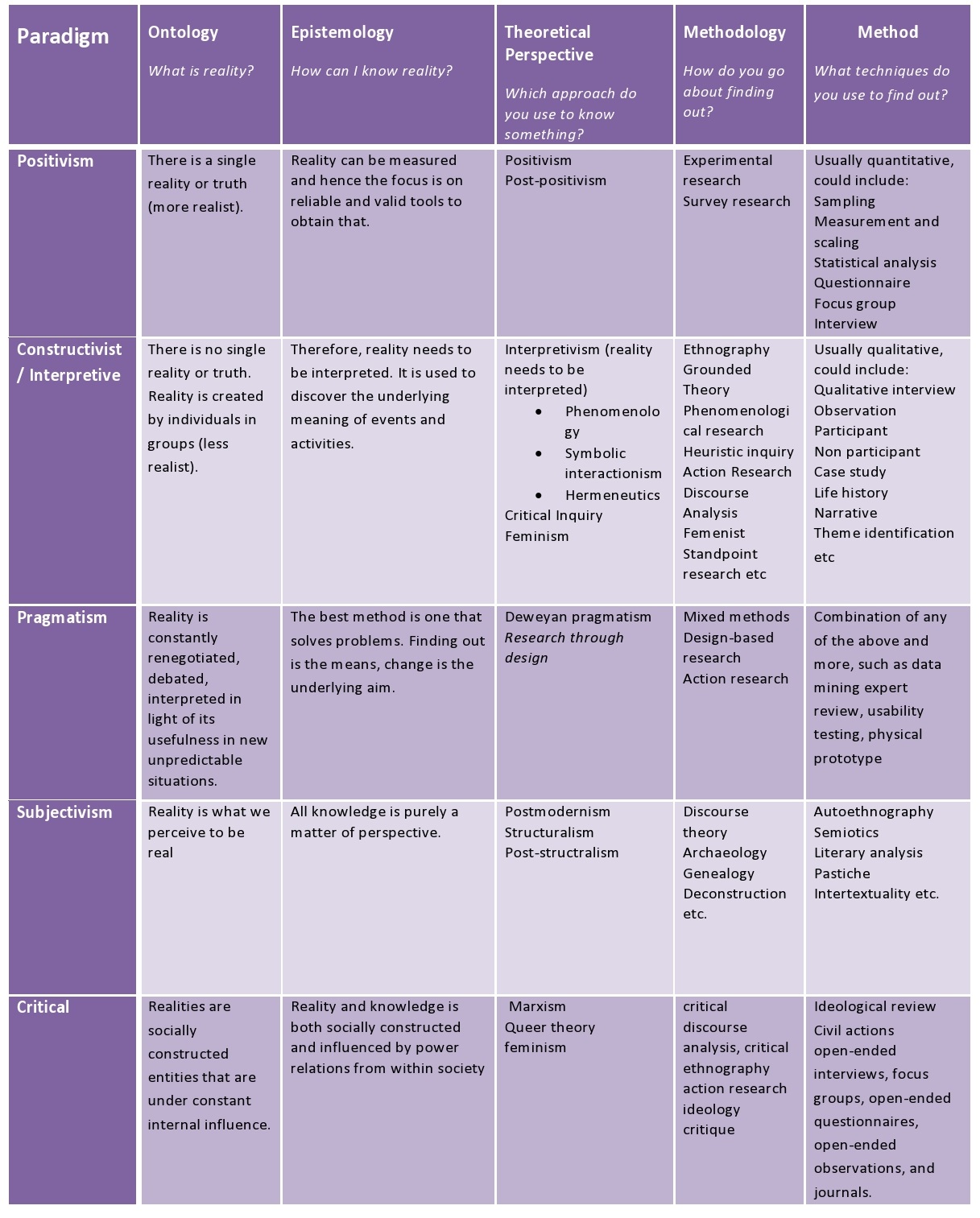
2.2: Now, select one paradigm and reflect on how ontology, epistemology, and methodology differ according to your selected paradigm. The table in this link and the following questions will help you to complete this task:
Ontology: What is out there to know? / What is reality?
Epistemology: How can I know reality?
Methodology: How do I acquire knowledge?
Step 3: Create
Create a 5-minute video presentation that includes:
Your examples on how each research paradigm would help you discover different aspects of the health issue of your choice.
How ontology, epistemology, and methodology differ for a selected paradigm. Use examples related to your selected health issue to illustrate your arguments.
Feel free to use slides for the presentation. You can use the free version of Loom to record and share your video.
Step 4: Self-Analysis and Enhancement
Before you submit, engage in an introspective self-analysis by systematically reviewing each component of your work. Reflect on what aspects of your work were executed well and what could be enhanced. Proceed to refine these elements in your work.
Step 5: Submit
Post a shareable link to your presentation in the forum. To share your work, click on the “Reply” button under this post and paste your link in the “Message” box. Make sure to reference others’ intellectual property when necessary. All references should follow 7th Edition APA formatting. For further instructions, see the resource on the Himmelfarb Health Sciences Library: APA citation resource (N.B. references are excluded from word counts).
OPTIONAL Step 6: Interact (10 minutes)
If you would like to, you can reply to your peers' posts in a respectful and professional manner. Ensure that your post engages your peers' ideas by including a reflection on their comments, sharing ideas of other potential difficulties and parties involved, or asking thought-provoking questions. If a peer comments on your posting, please reply. To post a reply, click “Reply” on a particular discussion, write your feedback and then click on “Post to forum.”
- Differentiate the concepts of paradigm, method, and design in research theory.
-
Student Learning Outcomes:
- Discuss the importance of informed consent in public health research.
- Explain the ethical principles in public health research and their importance.
- Describe the core values of integrity in research.
- Summarize the history of research ethics, the Nuremberg Code, and the Belmont Report.
- Using the example of substance abuse research, discuss ethical challenges in research with potentially vulnerable participants.
-
Students mustMark as done
Required Learning Resources and Activities
-
Students mustView
Read the entire article. (8 minutes)
International Journal of Occupational Safety and Health - 2020
-
Students mustView
Read from page 1 to page 5. (11 minutes)
National Institute of Environmental Health Sciences - 2013
-
Students mustView
Read the entire page. (5 minutes)
National Institutes of Health - 2016
-
Students mustView
Read the entire article. (35 minutes)
National Academy of Sciences - 2017
-
Students mustView
Read entire page. (46 minutes)
National Institute of Environmental Health Sciences - 2021
-
Students mustView
Read the entire article. (10 minutes)
JAMA Network American Medical Association - 2017
-
Students mustView
Read all sections except for Acknowledgment and References. (16 minutes)
American Public Health Association - 2018
-
Students mustView
Read the entire article. (21 minutes)
Journal of Medical Ethics and History of Medicine - 2014
-
Students mustView
Read the entire article. (22 minutes)
NCBI - 2018
-
Students mustView
Read the entire article. (20 minutes)
Therapeutic Innovation & Regulatory Science - 2018
-
Students mustViewStart discussions: 1
For this activity, you will reflect about the unique risks that arise in research with individuals with substance use disorder and link them with the ethical principles of research.
Step 1: Reflect
Review the readings listed below and reflect on how unique risks in research with individuals with substance use disorders are related to specific principles of ethical research and core values and guiding norms of integrity research.
- Guiding Principles for Ethical Research
- Foundations of Integrity in Research: Core Values and Guiding Norms
- Ethical Issues in Research Involving Participants With Opioid Use Disorder
Step 2: Respond
Write a 250-450 word post in which you:
- Select one or two unique risks that arise in research with individuals with substance use disorders
- Explain how these unique risks are related to the guiding principles for ethical research and the core values and guiding norms of integrity research
- Discuss how these principles, values, and norms, can reduce risks when working with these potentially vulnerable populations
Step 3: Share
To share your work, click on the “Reply” button under this post and paste your work in the “Message” box. Make sure to reference others’ intellectual property when necessary. All references should follow 7th Edition APA formatting. For further instructions, see the resource on the Himmelfarb Health Sciences Library: APA citation resource (N.B. references are excluded from word counts).
OPTIONAL Step 4: Interact (10 minutes)
If you would like to, you can reply to your peers' posts in a respectful and professional manner. Ensure that your post engages your peers' ideas by including a reflection on their comments, sharing ideas of other potential difficulties and parties involved, or asking thought-provoking questions. If a peer comments on your posting, please reply. To post a reply, click “Reply” on a particular discussion, write your feedback and then click on “Post to forum.”
-
Quiz: Module 1
To access the quiz, click on the name of the quiz provided above. On the following screen, click the "Preview quiz now" button to respond to the questions.
TO PASS THIS QUIZ, YOU MUST OBTAIN A SCORE OF 12/15
Not available unless: The activity Course Registration is marked complete ...Not available unless:- The activity Course Registration is marked complete
- The activity Pre-Test is marked complete
- Discuss the importance of informed consent in public health research.
-

Instructional Goals covered in this module:
- Formulate research problems, questions, aims, objectives, and hypotheses that are clear and practicable.
-
Student Learning Outcomes:
- Define a research problem and a research question.
- Describe the characteristics of clear and practicable research problems and research questions for quantitative, qualitative, and mixed methods research.
- Formulate clear and practicable quantitative and qualitative research problems and research questions.
-
Students mustMark as done
Required Learning Resources and Activities
-
Students mustView
Read the entire page. (2 minutes)
University of London - 2014
-
Students mustView
Read the entire article. (17 minutes)
International Journal of Research (IJR)-2014
-
Students mustView
Read the entire article. (18 minutes)
Stanford University - 2016
-
Students mustView
Read the entire article. (19 minutes)
Journal of Indian Association of Pediatric Surgeons - 2019
-
Students mustView
Read the entire Document except the "References" part. (19 minutes)
American Scientific Research Journal for Engineering, Technology, and Sciences (ASRJETS) - 2021
-
Students mustView
Read the entire page and the next page for qualitative research questions. (16 minutes)
Mavs Open Press Open Educational Resources from the University of Texas at Arlington - 2018
-
Students mustViewStart discussions: 1
In this activity, you will write a research problem statement keeping in mind that it will be used to work on the activities in the entire course, including the final assignment. Then, you will write qualitative and quantitative research questions for your identified problem.
Step 1: Review
Review this Learning Resource.
Step 2: Respond
Think about a health issue that you might be interested in studying and complete the following:
- Write a problem statement that:
- Reflects a need
- Is based on factual evidence
- Is meaningful; has testable hypotheses
- Has a relevant and manageable problem
- Using this to guide you, write between 3 and 5 research questions to guide your study of the problem. Ensure that you have a combination of qualitative and quantitative questions.
Before you submit, engage in an introspective self-analysis by systematically reviewing each component of your work. Reflect on what aspects of your work were executed well and what could be enhanced. Proceed to refine these elements in your work.
Step 4: Submit
To submit your work, click on the “Reply” button under this post and paste your work in the “Message” box. Make sure to reference others’ intellectual property when necessary. All references should follow 7th Edition APA formatting. For further instructions, see the resource on the Himmelfarb Health Sciences Library: APA citation resource (N.B. references are excluded from word counts).OPTIONAL Step 5: Interact (10 minutes)
If you would like to, you can reply to your peers' posts in a respectful and professional manner. Ensure that your post engages your peers' ideas by including a reflection on their comments, sharing ideas of other potential difficulties and parties involved, or asking thought-provoking questions. If a peer comments on your posting, please reply. To post a reply, click “Reply” on a particular discussion, write your feedback and then click on “Post to forum.”
- Define a research problem and a research question.
-
Student Learning Outcomes:
- Define a research aim and research objective.
- Differentiate research aims and research objectives.
- Give examples of research objectives and research aims that are clear and practicable for qualitative and quantitative research.
- Write research aims and objectives that are clear and practicable.
-
Students mustMark as done
Required Learning Resources and Activities
-
Students mustView
Read the following sections: Aims, Objectives, and Conclusion. (10 minutes)
Nurse Researcher - 2016
-
Students mustView
Read the entire journal article. (26 minutes)
Sage - 2013
-
Students mustViewStart discussions: 1
Based on the research problems and questions developed in M2 L1, you will write qualitative and quantitative research aims and objectives.
Step 1: Review
Review the learning resources for Lesson 2.
Step 2: Respond
- Write the aim(s) of your research. Ensure that it clearly states what you want to achieve by the end of the research project.
- List your research objectives:
- Write between 3-5 research objectives
- Make sure to have a combination of qualitative and quantitative objectives
- Remember that they should be SMART (specific, measurable, achievable, realistic, and time-constrained)
Step 3: Self-Analysis and Enhancement
Before you submit, engage in an introspective self-analysis by systematically reviewing each component of your work. Reflect on what aspects of your work were executed well and what could be enhanced. Proceed to refine these elements in your work.
Step 4: Submit
To submit your work, click on the “Reply” button under this post and paste your work in the “Message” box. Make sure to reference others’ intellectual property when necessary. All references should follow 7th Edition APA formatting. For further instructions, see the resource on the Himmelfarb Health Sciences Library: APA citation resource (N.B. references are excluded from word counts).
OPTIONAL Step 5: Interact (10 minutes)
If you would like to, you can reply to your peers' posts in a respectful and professional manner. Ensure that your post engages your peers' ideas by including a reflection on their comments, sharing ideas of other potential difficulties and parties involved, or asking thought-provoking questions. If a peer comments on your posting, please reply. To post a reply, click “Reply” on a particular discussion, write your feedback and then click on “Post to forum.”
- Define a research aim and research objective.
-
Student Learning Outcomes:
- Describe the common types of research hypotheses for health research.
- Differentiate qualitative and quantitative research hypotheses.
- Formulate clear and practicable quantitative and qualitative research hypotheses.
-
Students mustMark as done
Required Learning Resources and Activities
-
Students mustView
Read the entire page. (1 minute)
Austin Peay State University - 2021
-
Students mustView
Read the content under the heading "Quantitative Research Questions and Hypotheses" on pages 132 to 136, and "Mixed Methods Research Questions and Hypotheses" on pages 138 to 143. (30 minutes)
Sage Publishing. - 2008
-
Students mustView
Read the following sections:
Abstract
3.3.What Is a Research Hypothesis?
3.4. Analogical Arguments in Support of Using Hypotheses
3.5. Can a Hypothesis Be “Tested” in Qualitative Research?
4. The Process of Developing and Using Hypotheses in Qualitative Research. (15 minutes)MDPI or Multidisciplinary Digital Publishing Institute - 2019
-
Students mustView
Read the content under the sections: "Formulating Hypotheses" and "Variables of Interest". (7 minutes)
University of Central Arkansas - 2013
-
Students mustViewStart discussions: 1
In this activity, you will build on previous work and write quantitative and qualitative research hypotheses for your research proposal.
Step 1: Review
Review the Section on Formulating Hypotheses.
Step 2: Respond
Recalling your research problem, which you formulated in Module 2 Lesson 1:
- Write at least two hypotheses to predict the result of your research. Make sure to have at least one qualitative and quantitative hypothesis.
- For each hypothesis, write a 50-150 word paragraph explaining the rationale for the prediction.
Step 3: Self-Analysis and Enhancement
Before you submit, engage in an introspective self-analysis by systematically reviewing each component of your work. Reflect on what aspects of your work were executed well and what could be enhanced. Proceed to refine these elements in your work.
Step 4: Submit
To submit your work, click on the “Reply” button under this post and paste your work in the “Message” box. Make sure to reference others’ intellectual property when necessary. All references should follow 7th Edition APA formatting. For further instructions, see the resource on the Himmelfarb Health Sciences Library: APA citation resource (N.B. references are excluded from word counts).
OPTIONAL Step 5: Interact (10 minutes)
If you would like to, you can reply to your peers' posts in a respectful and professional manner. Ensure that your post engages your peers' ideas by including a reflection on their comments, sharing ideas of other potential difficulties and parties involved, or asking thought-provoking questions. If a peer comments on your posting, please reply. To post a reply, click “Reply” on a particular discussion, write your feedback and then click on “Post to forum.”
-
Quiz: Module 2
To access the quiz, click on the name of the quiz provided above. On the following screen, click the "Preview quiz now" button to respond to the questions.
TO PASS THIS QUIZ, YOU MUST OBTAIN A SCORE OF 12/15
Not available unless: The activity Quiz: Module 1 is complete and passed -
Students mustMark as done
Recommended Additional Readings
-
Students mustView
Read entire table. (2 minutes)
Xavier University - 2012
- Describe the common types of research hypotheses for health research.
-
 Instructional Goals covered in this module:
- Develop a quantitative study design, including a strategy for sampling and data collection, hypothesis testing, and data analysis.
-
Student Learning Outcomes:
- Understand the hierarchies of quantitative study designs.
- Understand the levels of evidence based on study designs.
- Describe the concept and classification of descriptive study designs.
- Discuss the strengths and weaknesses of descriptive study designs such as cross-sectional studies, case reports, and case series.
- Select a descriptive study design to address a given research question.
- Describe the concept and classification of analytic study designs, including observational and experimental studies.
- Break down the different observational study designs (cross-sectional, case-control, and cohort studies).
- Describe the concept of quasi-experimental studies.
- Describe the concepts of randomization and experimental study designs.
- Examine the different types of clinical trials.
- Discuss the strengths and weaknesses of common observational and analytical study designs.
- Select a quantitative study design to address a given research question.
-
Students mustMark as done
Required Learning Resources and Activities
-
Students mustView
Read the entire document. (16 minutes)
Australian Journal of Advanced Nursing - 2016
-
Students mustView
Read the entire document. (8 minutes)
Walden University - 2021
-
Students mustView
Read the section under overview of the design tree. (8 minutes)
University of Oxford - 2009
-
Students mustView
Read the entire article. (15 minutes)
Journal of Health Specialties - 2015
-
Students mustView
Read the entire article. (12 minutes)
Perspectives in Clinical Research - 2019
-
Students mustView
Read the entire article EXCEPT for these sections: Standards of research and reporting and Conclusion. (35 minutes)
Biochemia Medica - 2014
-
Students mustView
Read the content under cross-sectional, case-control design and cohort stduy design. (32 minutes)
HealthKnowledge - 2018
-
Students mustView
Read the following components of the Review section: Cross-sectional, Case-control, and cohort studies. (6 minutes)
Cureus Journal of Medical Science - 2020
-
Students mustView
Read pages 6-11 of the manuscript. (19 minutes)
Journal of Clinical Epidemiology - 2017
-
Students mustView
Read entire page including the hyperlinked page: Random Assignment. (8 minutes)
Office of Research Integrity by U.S. Department of Health and Human Services - 2017
-
Students mustView
Read the entire page. (17 minutes)
American Cancer Society - 2021
-
Students mustViewStart discussions: 1
In this activity, you will analyse a given set of research questions and will discuss the strengths and weaknesses of studying one of the questions with at least 2 types of descriptive and analytical study designs.
Step 1: Review
Review the learning resources for this lesson.
Step 2: Analyze
Analyze the following research questions:
- Is there a correlation between diet and stomach cancer survival in people aged 50-65?
- How effective is immunotherapy in the fight against breast cancer?
- What are the perceptions of residents in rural communities about vaccinations?
- Are middle/low-income countries more likely to have low rates of COVID vaccine uptake?
- Was there an increase in mental health disorders as a result of lockdown measures imposed in Italy between March and May 2020?
Step 3: Respond
- Select one question from the list above.
- Write a post of 250-350 words in which you:
- Choose at least 2 types of study designs (descriptive and/or analytical) that can be used to answer this question.
- Discuss the strengths and weaknesses of utilizing each study design to answer the research question.
Step 4: Share
To share your work, click on the “Reply” button under this post and paste your work in the “Message” box. Make sure to reference others’ intellectual property when necessary. All references should follow 7th Edition APA formatting. For further instructions, see the resource on the Himmelfarb Health Sciences Library: APA citation resource (N.B. references are excluded from word counts).
OPTIONAL Step 5: Interact (10 minutes)
If you would like to, you can reply to your peers' posts in a respectful and professional manner. Ensure that your post engages your peers' ideas by including a reflection on their comments, sharing ideas of other potential difficulties and parties involved, or asking thought-provoking questions. If a peer comments on your posting, please reply. To post a reply, click “Reply” on a particular discussion, write your feedback and then click on “Post to forum.”
-
Students mustViewStart discussions: 1
In this activity, you will continue to build upon previous work by selecting a study design for the quantitative component of your research proposal.
Step 1: Review
Review the research questions which you wrote in Module 2 Lesson 1. Select the quantitative question(s).
Step 2: Respond
Choose the best quantitative study design which will help you to answer the question(s). Write a 200-350 word post in which you:
- Summarize the selected design for the chosen questions
- Give a rationale for its selection
Step 3: Self-Analysis and Enhancement
Before you submit, engage in an introspective self-analysis by systematically reviewing each component of your work. Reflect on what aspects of your work were executed well and what could be enhanced. Proceed to refine these elements in your work.
Step 4: Submit
To submit your work, click on the “Reply” button under this post and paste your work in the “Message” box. Make sure to reference others’ intellectual property when necessary. All references should follow 7th Edition APA formatting. For further instructions, see the resource on the Himmelfarb Health Sciences Library: APA citation resource (N.B. references are excluded from word counts).
OPTIONAL Step 5: Interact (10 minutes)
If you would like to, you can reply to your peers' posts in a respectful and professional manner. Ensure that your post engages your peers' ideas by including a reflection on their comments, sharing ideas of other potential difficulties and parties involved, or asking thought-provoking questions. If a peer comments on your posting, please reply. To post a reply, click “Reply” on a particular discussion, write your feedback and then click on “Post to forum.”
- Understand the hierarchies of quantitative study designs.
-
Student Learning Outcomes:
- Understand the uses of probability and non-probability sampling methods.
- Give examples of probability and non-probability sampling methods.
- Determine a sampling strategy and sample size for a quantitative study.
- Describe the data collection methods in quantitative research.
- Determine a data collection method for a quantitative study.
-
Students mustMark as done
Required Learning Resources and Activities
-
Students mustView
Read the entire document. (51 minutes)
People's University - 2016
-
Students mustView
Read the entire article. (21 minutes)
International Journal of Academic Research in Management - 2016
-
Students mustView
Read the entire article. (23 minutes)
Indian Journal of Continuing Nursing Education - 2017
-
Students mustView
Read the entire document. (5 minutes)
CDC - 2014
-
Students mustViewStart discussions: 1
For this activity, you will determine a sampling strategy, sample size, and data collection strategy for the quantitative component of your research proposal.
Step 1: Review
Review the learning resources for this lesson.
Step 2: Respond
Recalling the quantitative research questions, design, and objectives already designed, write a post of 200-350 words in which you explain:
- Sampling strategy with a description of the study population
- Sample size along with:
- Justification for the calculation strategy
- Margin of error and confidence level
- Data collection strategy
Step 3: Self-Analysis and Enhancement
Before you submit, engage in an introspective self-analysis by systematically reviewing each component of your work. Reflect on what aspects of your work were executed well and what could be enhanced. Proceed to refine these elements in your work.
Step 4: Submit
To submit your work, click on the “Reply” button under this post and paste your work in the “Message” box. Make sure to reference others’ intellectual property when necessary. All references should follow 7th Edition APA formatting. For further instructions, see the resource on the Himmelfarb Health Sciences Library: APA citation resource (N.B. references are excluded from word counts).
OPTIONAL Step 5: Interact (10 minutes)
If you would like to, you can reply to your peers' posts in a respectful and professional manner. Ensure that your post engages your peers' ideas by including a reflection on their comments, sharing ideas of other potential difficulties and parties involved, or asking thought-provoking questions. If a peer comments on your posting, please reply. To post a reply, click “Reply” on a particular discussion, write your feedback and then click on “Post to forum.”
-
Student Learning Outcomes:
- Describe the process of quantitative data analysis.
- Explain the different data measurement scales (nominal, ordinal, interval, ratio).
- Differentiate between continuous and discrete data.
- Explain the purpose of hypothesis testing.
- Explain the components of hypothesis testing (null hypothesis, alternative hypothesis, Type I Error, Type II Error, and power).
- Describe the meaning of a test of significance.
- Define the different tests of significance (Chi-Square, T-Test, ANOVA, F-Statistic, etc).
- Differentiate the different tests of significance (Chi-Square, T-Test, ANOVA, F-Statistic, etc).
- Define probability value (P-value).
- Give examples of the use of P-value in a research context.
- Determine a data analysis strategy for a given research question.
-
Students mustMark as done
Required Learning Resources and Activities
-
Students mustView
Read the entire page. (17 minutes)
University of Southern California - 2021
-
Students mustView
Read the entire page. (9 minutes)
CDC - 2018
-
Students mustView
Read the entire page. (16 minutes)
Annals of Cardiac Anaesthesia - 2018
-
Students mustView
Read the following sections:
-Introduction
-Nominal
-Ordinal
-Ratio
-Interval and watch the videos that accompany each. (11 minutes)University of Nottingham School of Health Sciences - 2016
-
Students mustView
Read the entire document. (11 minutes)
NextGenu.org - 2019
-
Students mustView
Read the entire document. (4 minutes)
NextGenu.org - 2019
-
Students mustView
Read the entire document. (24 minutes)
University of Dallas
-
Students mustView
Read the entire document. (20 minutes)
University of West Georgia
-
Students mustView
Read the entire document. (45 minutes)
UCLA - 2021
-
Students mustView
Read the entire page. (40 minutes)
Food and Agriculture Organization of the United Nations
-
Students mustView
Read the entire page. (6 minutes)
Boston University School of Public Health - 2019
-
Students mustView
Read the entire article. (5 minutes)
Sociedade Brasileira de Pneumologia e Tisiologia: Continuing Education: Scientific Methodology - 2015
-
Students mustViewStart discussions: 1
In this activity, you will write the first part of the "Data Analysis" section of your research proposal. It will include a description of the type of data you expect to collect in the quantitative component and the analysis strategy(ies) you plan to utilize.
Step 1: Review
Review the following resources from the lesson’s readings:
- Analyzing Quantitative Data for Evaluation
- Quantitative Methods - Organizing Your Social Sciences Research Paper
- Scales of Measurement and Presentation of Statistical Data
Step 2: Respond
Write the first few paragraphs of the Data Analysis section of your proposal. Your post should be 200-350 words long. Ensure that you include:
- Type of data to be collected
- Appropriate data analysis strategy(ies) to be used for each type of data
Step 3: Self-Analysis and Enhancement
Before you submit, engage in an introspective self-analysis by systematically reviewing each component of your work. Reflect on what aspects of your work were executed well and what could be enhanced. Proceed to refine these elements in your work.
Step 4: Submit
To submit your work, click on the “Reply” button under this post and paste your work in the “Message” box. Make sure to reference others’ intellectual property when necessary. All references should follow 7th Edition APA formatting. For further instructions, see the resource on the Himmelfarb Health Sciences Library: APA citation resource (N.B. references are excluded from word counts).
OPTIONAL Step 5: Interact (10 minutes)
If you would like to, you can reply to your peers' posts in a respectful and professional manner. Ensure that your post engages your peers' ideas by including a reflection on their comments, sharing ideas of other potential difficulties and parties involved, or asking thought-provoking questions. If a peer comments on your posting, please reply. To post a reply, click “Reply” on a particular discussion, write your feedback and then click on “Post to forum.”
-
Quiz: Module 3
To access the quiz, click on the name of the quiz provided above. On the following screen, click the "Preview quiz now" button to respond to the questions.
TO PASS THIS QUIZ, YOU MUST OBTAIN A SCORE OF 12/15
Not available unless: The activity Quiz: Module 2 is complete and passed -
Students mustMark as done
Recommended Additional Readings
-
Students mustView
Read the content under the heading Introduction, The Meaning of Significance Tests, Z-M's Criticism of Significance Tests to page 265. (19 minutes)
Econ Journal Watch - 2012
- Describe the process of quantitative data analysis.
-
 Instructional Goals covered in this module:
- Develop a qualitative study design, including a strategy for sampling, data collection, and data analysis.
- Develop a qualitative study design, including a strategy for sampling, data collection, and data analysis.
-
Student Learning Outcomes:
- Describe the concept and defining characteristics of qualitative research.
- Categorize the different qualitative study designs (grounded theory, ethnography, phenomenology, participatory action research, case study, and historical studies).
- Discuss the strengths and weaknesses of qualitative research.
- Determine an appropriate qualitative design to address a given research question.
-
Students mustMark as done
Required Learning Resources and Activities
-
Students mustView
Read the entire document. (21 minutes)
Public Health U - 2020
-
Students mustView
Read the entire article. (21 minutes)
Geriatrics, Gerontology and Aging - 2017
-
Students mustView
Read section: Types of Qualitative Research Designs. (10 minutes)
International Journal of Preventive Medicine - 2021
-
Students mustView
Read entire page. (12 minutes)
Australian Institute of Family Services - 2015
-
Students mustView
Read Section: 3. Qualitative Research Approaches and Methods. (12 minutes)
Journal of Education and Learning: Canadian Center of Science and Education - 2016
-
Students mustViewStart discussions: 1
For this activity, you will analyse a given set of research questions, discussing the strengths and weaknesses of studying the question with at least 2 types of qualitative research designs.
Step 1: Review
Review the learning resources for this lesson.
Step 2: Analyze
Analyze the following research questions:
- How do cancer survivors perceive their quality of life after chemotherapy and radiation treatment?
- Does early intervention in obese children result in healthy body weight as adults?
- Is vaccine hesitancy more prevalent among immigrant populations in rural areas?
- Do mental health disorders increase with substance abuse?
Step 3: Respond
- Select one question from the list above.
- Write a post of 250-350 words in which you:
- Choose at least 2 types of qualitative study designs (phenomenology, grounded theory, case study, ethnography, participant action research, historical study) that can be used to answer this question.
- Discuss the strengths and weaknesses of utilizing each study design to answer the research question.
Step 4: Share
To share your work, click on the “Reply” button under this post and paste your work in the “Message” box. Make sure to reference others’ intellectual property when necessary. All references should follow 7th Edition APA formatting. For further instructions, see the resource on the Himmelfarb Health Sciences Library: APA citation resource (N.B. references are excluded from word counts).
OPTIONAL Step 5: Interact (10 minutes)
If you would like to, you can reply to your peers' posts in a respectful and professional manner. Ensure that your post engages your peers' ideas by including a reflection on their comments, sharing ideas of other potential difficulties and parties involved, or asking thought-provoking questions. If a peer comments on your posting, please reply. To post a reply, click “Reply” on a particular discussion, write your feedback and then click on “Post to forum.”
-
Students mustViewStart discussions: 1
In this activity, you will start working on the qualitative component of your research proposal. You will select a study design from the ones addressed in this lesson to study your qualitative research questions.
Step 1: Review
Review the research questions which you wrote in Module 2 Lesson 1. Select the qualitative question(s).
Step 2: Respond
Choose the best qualitative study design which will help you to answer the question(s). Write a 200-350 word post in which you:
- Summarize the selected design
- Give a rationale for its selection
Step 3: Self-Analysis and Enhancement
Before you submit, engage in an introspective self-analysis by systematically reviewing each component of your work. Reflect on what aspects of your work were executed well and what could be enhanced. Proceed to refine these elements in your work.
Step 4: Submit
To submit your work, click on the “Reply” button under this post and paste your work in the “Message” box. Make sure to reference others’ intellectual property when necessary. All references should follow 7th Edition APA formatting. For further instructions, see the resource on the Himmelfarb Health Sciences Library: APA citation resource (N.B. references are excluded from word counts).
OPTIONAL Step 5: Interact (10 minutes)
If you would like to, you can reply to your peers' posts in a respectful and professional manner. Ensure that your post engages your peers' ideas by including a reflection on their comments, sharing ideas of other potential difficulties and parties involved, or asking thought-provoking questions. If a peer comments on your posting, please reply. To post a reply, click “Reply” on a particular discussion, write your feedback and then click on “Post to forum.”
- Describe the concept and defining characteristics of qualitative research.
-
Student Learning Outcomes:
- Describe the common sampling strategies for qualitative research (purposeful, convenience, snowballing, quota).
- Explain the common qualitative research methods (interviews, focus groups, observation, document reviews, and visual methods).
- Determine the sampling and data collection methods to address a given research question.
-
Students mustMark as done
Required Learning Resources and Activities
-
Students mustView
Read pages 1-3 from "Introduction" to "Purposive Sampling Methods". (14 minutes)
American Journal of Theoretical and Applied Statistics - 2015
-
Students mustView
Read content under "Introduction" and "On Snowball Sampling". (10 minutes)
PLoS One - 2018
-
Students mustView
Read content under Non-probability Sampling and Types of Non-probability sampling. (12 minutes)
Radford University - 2021
-
Students mustView
Watch the entire video. (12 minutes)
Center for Research Quality - 2015
-
Students mustViewStart discussions: 1
In this activity, you will continue working on the qualitative component of your proposal by defining a sampling and data collection method that matches your preferred study design.
Step 1: Review
Review the learning resources for this lesson.
Step 2: Respond
Recalling the qualitative research questions and objectives already designed, write a post of 150-250 words, in which you explain:
- Sampling strategy
- Sample size and justification
- Data collection method
Step 3: Self-Analysis and Enhancement
Before you submit, engage in an introspective self-analysis by systematically reviewing each component of your work. Reflect on what aspects of your work were executed well and what could be enhanced. Proceed to refine these elements in your work.
Step 4: Submit
To submit your work, click on the “Reply” button under this post and paste your work in the “Message” box. Make sure to reference others’ intellectual property when necessary. All references should follow 7th Edition APA formatting. For further instructions, see the resource on the Himmelfarb Health Sciences Library: APA citation resource (N.B. references are excluded from word counts).
OPTIONAL Step 5: Interact (10 minutes)
If you would like to, you can reply to your peers' posts in a respectful and professional manner. Ensure that your post engages your peers' ideas by including a reflection on their comments, sharing ideas of other potential difficulties and parties involved, or asking thought-provoking questions. If a peer comments on your posting, please reply. To post a reply, click “Reply” on a particular discussion, write your feedback and then click on “Post to forum.”
- Describe the common sampling strategies for qualitative research (purposeful, convenience, snowballing, quota).
-
Student Learning Outcomes:
- Describe the concept and defining characteristics of qualitative data analysis.
- Describe the main approaches to qualitative data analysis (deductive, inductive, thematic, and content analysis).
- Determine a qualitative data analysis strategy to address a given research question.
-
Students mustMark as done
Required Learning Resources and Activities
-
Students mustView
Read from the content under the heading "Research Designs" on page 365 to the heading "Mixed Methods" on page 369. (22 minutes)
Sage Publishing - 2014
-
Students mustView
Read the entire page. (4 minutes)
NSW government website - 2020
-
Students mustView
Read content under "Data Analysis". (11 minutes)
Qualitative Research Journal - 2018
-
Students mustView
Read from "Introduction" to "When to use thematic analysis". (12 minutes)
Medical Teacher - 2020
-
Students mustView
Read the entire page. (14 minutes)
Columbia Public Health - 2021
-
Students mustViewStart discussions: 1
For this activity, you will select a data analysis strategy for the qualitative component of your proposal and provide a justification/rationale.
Step 1: Review
Review the learning resources for this lesson.
Step 2: Respond
Based on your qualitative research questions, select the most appropriate data analysis strategy/strategies and write a 200-350 word post in which you include:
- The type of data to be collected
- The strategy/strategies you will use to analyse it
- A justification for your selection.
Step 3: Self-Analysis and Enhancement
Before you submit, engage in an introspective self-analysis by systematically reviewing each component of your work. Reflect on what aspects of your work were executed well and what could be enhanced. Proceed to refine these elements in your work.
Step 4: Submit
To submit your work, click on the “Reply” button under this post and paste your work in the “Message” box. Make sure to reference others’ intellectual property when necessary. All references should follow 7th Edition APA formatting. For further instructions, see the resource on the Himmelfarb Health Sciences Library: APA citation resource (N.B. references are excluded from word counts).}
OPTIONAL Step 5: Interact (10 minutes)
If you would like to, you can reply to your peers' posts in a respectful and professional manner. Ensure that your post engages your peers' ideas by including a reflection on their comments, sharing ideas of other potential difficulties and parties involved, or asking thought-provoking questions. If a peer comments on your posting, please reply. To post a reply, click “Reply” on a particular discussion, write your feedback and then click on “Post to forum.”
- Describe the concept and defining characteristics of qualitative data analysis.
-
Student Learning Outcomes:
- Describe what is meant by mixed research methods.
- Identify the characteristics of common mixed research designs (convergent, sequential, triangulation, explanatory, exploratory, embedded).
- Outline the advantages and shortcomings of employing mixed method designs.
-
Students mustMark as done
Required Learning Resources and Activities
-
Students mustView
Read Section 2: Mixed Method Research Defined. (5 minutes)
International Journal of Science and Research (IJSR) - 2013
-
Students mustView
Read the entire document. (22 minutes)
Public Health U - 2020
-
Students mustView
Read Sections 4,5,6 of the paper. (8 minutes)
Journal of Literature, Languages and Linguistics - 2019
-
Students mustViewStart discussions: 1
Based on your experience working on the peer activities so far, for this activity, you will provide 3 advantages and 3 disadvantages of using a mixed methods approach.
Step 1: Review
Review the resources from this lesson, particularly this article.
Step 2: Respond
Write a post of 150-250 words in which you discuss:
- 3 advantages of using a mixed method approach
- 3 disadvantages of using a mixed method approach
Step 3: Share
To share your work, click on the “Reply” button under this post and paste your work in the “Message” box. Make sure to reference others’ intellectual property when necessary. All references should follow 7th Edition APA formatting. For further instructions, see the resource on the Himmelfarb Health Sciences Library: APA citation resource (N.B. references are excluded from word counts).
OPTIONAL Step 4: Interact (10 minutes)
If you would like to, you can reply to your peers' posts in a respectful and professional manner. Ensure that your post engages your peers' ideas by including a reflection on their comments, sharing ideas of other potential difficulties and parties involved, or asking thought-provoking questions. If a peer comments on your posting, please reply. To post a reply, click “Reply” on a particular discussion, write your feedback and then click on “Post to forum.”
-
Quiz: Module 4
To access the quiz, click on the name of the quiz provided above. On the following screen, click the "Preview quiz now" button to respond to the questions.
TO PASS THIS QUIZ, YOU MUST OBTAIN A SCORE OF 12/15
Not available unless: The activity Quiz: Module 3 is complete and passed
- Describe what is meant by mixed research methods.
-
 Instructional Goals covered in this module:
- Appraise the importance and application of literature reviews for health sciences research.
- Conduct a systematic search and critical appraisal of research.
- Appraise the importance and application of literature reviews for health sciences research.
-
Student Learning Outcomes:
- Explain the narrative, scoping, and systematic reviews of literature and meta-analysis.
- Differentiate the types of systematic reviews and their importance (Rapid review, Narrative review, Meta-analysis, Mixed methods/mixed studies)
- Explain the steps to conduct a systematic review and meta-analysis.
- Reflect on the contributions of each type of review for the advancement of health sciences research.
-
Students mustMark as done
Required Learning Resources and Activities
-
Students mustView
Watch the entire video. (10 minutes)
National Collaborating Centre for Methods and Tools - 2016
-
Students mustView
Read whole article. (31 minutes)
BMC Medical Research - 2018
-
Students mustView
Read the entire document. (16 minutes)
Public Health U - 2020
-
Students mustView
Read the entire page. (7 minutes)
Duke University: Medical City Library
-
Students mustView
Read the entire document. (10 minutes)
Canadian Academy of Child and Adolescent Psychiatry - 2011
-
Students mustView
Read the entire article. (14 minutes)
Temple University - 2021
-
Students mustViewStart discussions: 1
For this activity, you will use one of the quantitative and qualitative research questions developed in your previous peer activities. For each question, you will write a short reflective paragraph on how each type of literature review addressed in the module could help answer the research question (narrative, scoping, systematic review, meta-analysis).
Step 1: Review
Review the learning resources for this lesson.
Step 2: Respond
For each of your research questions, write a paragraph of between 100-200 words in which you reflect on how each of the types of literature reviews can help you to answer the research question.
Step 3: Share
To share your work, click on the “Reply” button under this post and paste your work in the “Message” box. Make sure to reference others’ intellectual property when necessary. All references should follow 7th Edition APA formatting. For further instructions, see the resource on the Himmelfarb Health Sciences Library: APA citation resource (N.B. references are excluded from word counts).
OPTIONAL Step 4: Interact (10 minutes)
If you would like to, you can reply to your peers' posts in a respectful and professional manner. Ensure that your post engages your peers' ideas by including a reflection on their comments, sharing ideas of other potential difficulties and parties involved, or asking thought-provoking questions. If a peer comments on your posting, please reply. To post a reply, click “Reply” on a particular discussion, write your feedback and then click on “Post to forum.”
- Explain the narrative, scoping, and systematic reviews of literature and meta-analysis.
-
Student Learning Outcomes:
- Understand the concept and defining characteristics of systematic searches.
- Explain the steps and best practices to conduct a systematic search.
- Apply the techniques for a systematic search for the research question of interest.
- Describe the importance of critical appraisal of research.
- Describe the commonly used tools for critical appraisal of research (CASP and JAMA).
- Reporting a critical appraisal and systematic review in general.
- Apply the tools to critically appraise a research paper.
-
Students mustMark as done
Required Learning Resources and Activities
-
Students mustView
Read this section of the document: CREATING A SYSTEMATIC SEARCH STRATEGY. (26 minutes)
Journal of the Medical Library Association - 2018
-
Students mustView
Read the section: Why is critical appraisal needed? (2 minutes)
The Royal College of Surgeons of England - 2017
-
Students mustView
Read the entire page. (20 minutes)
University of South Australia
-
Students mustViewStart discussions: 1
For this activity, you will conduct a systematic search based on one of your research questions and share the results within the platform (process and databases employed, search terms, number of results).
After completing the systematic search, you will then select a research paper from the results. Based on the tools studied in the module, you will identify an appropriate tool to assess the paper and provide a rationale for using that particular tool.
Step 1: Review
Review the learning resources for this module.
Step 2: Search
Assume you are doing a systematic review as part of your thesis:
- Select a research question of your preference and design search terms to conduct a systematic search. Make sure that the terms make good use of operators such as (), AND, OR, “”, and others.
- Select at least two databases of your preference. You can use open databases such as ERIC, PubMed, or Google Scholar.
- Insert your search terms, assess the results, and make adjustments to the terms until you feel satisfied with the number and quality of results obtained.
Step 3: Assess
From your results, select any research paper of your preference and get ready to make a critical appraisal.
- Choose a tool/checklist to assess the paper. Feel free to use the tools mentioned in the course readings or identify any other of your preference.
- Use your selected tool to assess the paper.
Step 4: Report
Prepare a 400-700 word report in which you include details under the following headings:
- Systematic Search
- Research Question
- Search Process utilized (logical and clear)
- Database(s) used
- Search Terms used
- Number of results obtained in each database
- Critical Appraisal
- Write a rationale for your tool selection and the main observations you have made about the paper. Make sure to include positive and negative aspects.
Step 5: Self-Analysis and Enhancement
Before you submit, engage in an introspective self-analysis by systematically reviewing each component of your work. Reflect on what aspects of your work were executed well and what could be enhanced. Proceed to refine these elements in your work.
Step 6: Submit
To submit your work, click on the “Reply” button under this post and paste your work in the “Message” box. Make sure to reference others’ intellectual property when necessary. All references should follow 7th Edition APA formatting. For further instructions, see the resource on the Himmelfarb Health Sciences Library: APA citation resource (N.B. references are excluded from word counts).
OPTIONAL Step 7: Interact (10 minutes)
If you would like to, you can reply to your peers' posts in a respectful and professional manner. Ensure that your post engages your peers' ideas by including a reflection on their comments, sharing ideas of other potential difficulties and parties involved, or asking thought-provoking questions. If a peer comments on your posting, please reply. To post a reply, click “Reply” on a particular discussion, write your feedback and then click on “Post to forum.”
-
Quiz: Module 5
To access the quiz, click on the name of the quiz provided above. On the following screen, click the "Preview quiz now" button to respond to the questions.
TO PASS THIS QUIZ, YOU MUST OBTAIN A SCORE OF 12/15
Not available unless: The activity Quiz: Module 4 is complete and passed
- Understand the concept and defining characteristics of systematic searches.
-

Instructional Goals covered in this module:
- Write and present scientific research, following appropriate style and referencing standards.
-
Student Learning Outcomes:
- Distinguish between scientific and regular writing.
- Implement scientific writing principles in research products.
- Describe the strategies for effective oral communication.
- Demonstrate oral communication skills in presenting research products.
-
Students mustMark as done
Required Learning Resources and Activities
-
Students mustView
Read the entire article. (56 minutes)
The Pennsylvania State University-2018
-
Students mustView
Read the entire article. (11 minutes)
PLOS Computational Biology - 2015
-
Students mustView
Read the entire page. (7 minutes)
University of Nebraska-Lincoln - 2016
-
Students mustView
Read entire document. (14 minutes)
University of Leeds - 2015
-
Students mustView
Read entire document. (10 minutes)
University of Colorado Denverr - 2014
-
Students mustView
Read the entire page. (10 minutes)
University of Waterloo - 2013
-
Students mustView
Read the entire page. (5 minutes)
Harvard Division of Continuing Education - 2020
- Distinguish between scientific and regular writing.
-
Student Learning Outcomes:
- Describe the concepts of intellectual property and plagiarism.
- Explain the common recommendations to avoid plagiarism in academic writing.
- Identify the different referencing styles and their uses.
- Apply a referencing style to cite and reference research studies.
-
Students mustMark as done
Required Learning Resources and Activities
-
Students mustView
Read entire document. (30 minutes)
World Intellectual Property Organization - 2020
-
Students mustView
Read the entire page. (8 minutes)
University of Michigan - 2020
-
Students mustView
Read entire page. (15 minutes)
Trent University - 2021
-
Students mustView
Read the entire document. (4 minutes)
Memorial University of Newfoundland - 2012
-
Students mustView
Read the entire page. (15 minutes)
University of California - 2021
-
Students mustViewStart discussions: 1
In this activity, you will write a few introductory paragraphs for your research proposal that will follow scientific writing principles and a referencing style of your preference.
Step 1: Review
Review the learning resources for this module.
Step 2: Respond
Using the following as a guide, write the introductory paragraphs to your Research Proposal. Include the following:
- Problem statement and the background
- The relevance and contribution of your planned project
- Reference list, stating the referencing style used
Step 3: Self-Analysis and Enhancement
Before you submit, engage in an introspective self-analysis by systematically reviewing each component of your work. Reflect on what aspects of your work were executed well and what could be enhanced. Proceed to refine these elements in your work.
Step 4: Submit
To submit your work, click on the “Reply” button under this post and paste your work in the “Message” box. Make sure to reference others’ intellectual property when necessary. All references should follow 7th Edition APA formatting. For further instructions, see the resource on the Himmelfarb Health Sciences Library: APA citation resource (N.B. references are excluded from word counts).
OPTIONAL Step 5: Interact (10 minutes)
If you would like to, you can reply to your peers' posts in a respectful and professional manner. Ensure that your post engages your peers' ideas by including a reflection on their comments, sharing ideas of other potential difficulties and parties involved, or asking thought-provoking questions. If a peer comments on your posting, please reply. To post a reply, click “Reply” on a particular discussion, write your feedback and then click on “Post to forum.”
-
Students mustViewReceive a gradeReceive a passing grade
To access the quiz, click on the name of the quiz provided above. On the following screen, click the "Preview quiz now" button to respond to the questions.
TO PASS THIS QUIZ. YOU MUST OBTAIN A SCORE OF 12/15
-
Students mustMark as done
Recommended Additional Readings
-
Students mustView
Watch the entire video. (4 minutes)
University of Reading - 2019
- Describe the concepts of intellectual property and plagiarism.
-
-
Students mustViewStart discussions: 1
For the Final Assignment, you will add to the work that you have already completed to prepare your research proposal. You will then create a 10-minute video presentation of your research proposal.
Step 1: Review
Review your submissions for the previous activities in the course. Pay close attention to any feedback suggested by your peers.
Step 2: Create
Create your thesis proposal using the materials developed for the peer activities in this course. You can decide to propose a mixed methods approach or to use only a quantitative or qualitative approach. The proposal should have an extension of 3-4 pages and use the following outline:
- Title
- Introduction (background, relevance, contribution)
- Research Problem
- Research Questions
- Research Aim and Objectives
- Hypothesis
- Methods (specify the qualitative and quantitative components in each category if the study follows a mixed methods approach)
Study design, including a justification for the proposed design
Population
Sampling
Inclusion and Exclusion Criteria
Data collection and analysis
References
Use the following as a formatting guide:
- Font: Arial or Calibri
- Font Size: 11-point
- Spacing: 1.5
- Headings: bold, flush left (Methods will have level 2 headings: flush left, bold, italics)
Step 3: Present
Prepare a 10-minute video presentation of your research proposal. You are free to use slides to present the information. You can use the free version of Loom or any other screen recording software to record and share your video.
Step 4: Share
To share your work, click on the “Reply” button under this post, then upload your written research proposal and paste a shareable link to your video in the “Message” box. Make sure to reference others’ intellectual property when necessary. All references should follow 7th Edition APA formatting. For further instructions, see the resource on the Himmelfarb Health Sciences Library: APA citation resource (N.B. references are excluded from word counts).
OPTIONAL Step 5: Interact (10 minutes)
If you would like to, you can reply to your peers' posts in a respectful and professional manner. Ensure that your post engages your peers' ideas by including a reflection on their comments, sharing ideas of other potential difficulties and parties involved, or asking thought-provoking questions. If a peer comments on your posting, please reply. To post a reply, click “Reply” on a particular discussion, write your feedback and then click on “Post to forum.”
Item A is .…. because…. My suggestions for improvement are….
Item B is .…. because…. My suggestions for improvement are….
Item C is .…. because…. My suggestions for improvement are….
Item D is .…. because…. My suggestions for improvement are….
Item E is .…. because…. My suggestions for improvement are….
Item F is .…. because…. My suggestions for improvement are….
Item G is .…. because…. My suggestions for improvement are….
Item H is .…. because…. My suggestions for improvement are….
-
-
-
Final Exam Quiz
To take the final exam, you must complete all quizzes and complete all the required activities. The final exam consists of 50 questions, and you will have 100 minutes to complete it. When the time is over, you will have two minutes to submit your attempt before it expires, and your progress is discarded. You will not be able to answer additional questions in the grace period.
To access the exam, click on the name of the exam provided above. On the following screen, click the attempt quiz button to respond to the questions.
Not available unless any of: All of: ...Not available unless any of:-
All of:
-
All of:
- The activity Course Registration is marked complete
- The activity Pre-Test is marked complete
- The activity Quiz: Module 1 is marked complete
- The activity Quiz: Module 2 is marked complete
- The activity Quiz: Module 3 is marked complete
- The activity Quiz: Module 4 is marked complete
- The activity Quiz: Module 5 is marked complete
- The activity Quiz: Module 6 is marked complete
-
All of:
- The activity Discussion Forum 1: Scientific Method and the Development of Modern Society (200 minutes). is marked complete
- The activity Asynchronous Learning Activity 1: A video presentation explaining the approaches to studying a research problem using different paradigms and their strengths and weaknesses (200 minutes). is marked complete
- The activity Discussion Forum 2: Informed Consent (210 minutes). is marked complete
- The activity Asynchronous Learning Activity 2: Research Problem Statement and Questions (120 minutes). is marked complete
- The activity Asynchronous Learning Activity 3: Research Aims and Objectives (120 minutes). is marked complete
- The activity Asynchronous Learning Activity 4: Research Hypotheses (120 minutes). is marked complete
- The activity Discussion Forum 3: Selecting Appropriate Study Designs (180 minutes) is marked complete
- The activity Asynchronous Learning Activity 5: Quantitative Study Design Selection (120 minutes). is marked complete
- The activity Asynchronous Learning Activity 6: Quantitative Data Collection (120 minutes). is marked complete
- The activity Asynchronous Learning Activity 7: Quantitative Data Analysis (200 minutes). is marked complete
- The activity Discussion Forum 4: Qualitative Study Designs (180 minutes) is marked complete
- The activity Asynchronous Learning Review 8: Qualitative Research Design (120 minutes). is marked complete
- The activity Asynchronous Learning Activity 9: Qualitative Data Collection (120 minutes) is marked complete
- The activity Asynchronous Learning Activity 10: Qualitative Data Analysis (200 minutes) is marked complete
- The activity Discussion Forum 5: Mixed Methods (120 minutes). is marked complete
- The activity Discussion Forum 6: Literature Reviews (200 minutes). is marked complete
- The activity Asynchronous Learning Activity 11: Systematic Search and Assessment (200 minutes). is marked complete
- The activity Asynchronous Learning Activity 12: Introduction of Research Proposal (180 minutes). is marked complete
- The activity Final Assignment (480 minutes) is marked complete
-
All of:
- You belong to Public Health U
-
All of:
-
-

In this section, you can provide feedback about this course to help us make NextGenU.org better. Once evaluations are completed, you will be able to download your certificate of completion.
Click here give your feedback
-
Course Evaluation QuestionnaireNot available unless: The activity Final Exam is complete and passed
-
Self Evaluation QuestionnaireNot available unless: The activity Final Exam is complete and passed
-
-
-
Students mustMark as done
-
Students mustMark as done
-
-