Wellness in the Workplace
-
Professional Development CoursesWellness in the WorkplaceResume0% complete0% complete
-
Students mustStudent must submit this questionnaire to complete it
-
Students mustViewReceive a grade
Show More-


Welcome to the Wellness in the Workplace course. This course is designed to provide students with an understanding of the context surrounding workplace wellness promotion. It provides an opportunity for participants to gain knowledge regarding wellness program needs, the theories behind changes in health behaviors, and the planning, implementation, and evaluation of wellness programs. The course is intended for health professionals, community health workers, primary care workers, and laypeople involved in occupational health.
The Wellness in the Workplace course is based on competencies from the Update on Validity of Required Competencies for Worksite Health Professionals. American Journal of Health Education. It uses learning resources from accredited, world-class organizations such as the World Health Organization, Public Health Agency of Canada, Centers for Disease Control and Prevention, Institute for Health and Productivity Studies Johns Hopkins Bloomberg School of Public Health In collaboration with Transamerica Center for Health Studies, Harvard University. The Wellness in the Workplace course was created with the efforts of Cirisse Stephen, MD and was designed by the NextGenU.org team: Pablo Baldiviezo, MD, DiplEd.; Genikka Camille Gabral, B.ED, MSc; and Hugo Rojas, MD, MSc, DiplEd;
For publications on NextGenU.org’s courses’ efficacy, see the NextGenU.org’s publication page. Subscribe to our newsletter to be notified of future updates, new courses, and to be part of our community.
There are 4 modules to complete, which provide an introduction to:
- Module 1: Introduction to Workplace Wellness Promotion
- Module 2: Needs Assessment and Program Planning
- Module 3: Implementation and Evaluation of Workplace Wellness Programs
- Module 4: Mental Health and Substance Use Disorders
The completion time for this course is estimated at 87.8 hours, comprising 15.8 hours of learning resources, 31.5 hours for time to study content and assimilation, and 40.5 hours of participating in learning activities and quizzes, to assist the learners in the synthesis of learning materials. This course is equivalent to 2 credit hours.
The course requires completion of all discussion forums. At the end of each module, there is a practice quiz of ten (10) multiple-choice questions. After you’ve completed each module, quiz, and learning activity, at the end of the course, you’ll have access to a final exam consisting of twenty (20) multiple-choice questions, and a chance to evaluate this course. Participants have up to three opportunities to take the final exam and achieve the required score of >=70%.
Once you’ve passed that last test, you will be able to download a certificate of completion from NextGenU.org and our course’s co-sponsoring organizations. We keep all of your personal information confidential, never sell any of your information, and only use anonymized data for research purposes. Also, we are happy to report your testing information and share your work with anyone (your school, employer, etc.) at your request.
Engaging with this Course:
You may browse this course for free to learn for your personal enrichment; there are no requirements.
To obtain a certificate, a learner must first register for the course and then successfully complete:
- All the reading requirements,
- All quizzes and pass with a 80% with unlimited attempts,
- All discussion forums,
- The final exam with a minimum of 80% and a maximum of 3 attempts, and
- The self and course evaluation forms.
To obtain credit:
- Complete all requirements listed above for the certificate, and
- Your learning institution or workplace should approve the partner-university-sponsored NextGenU.org course for educational credit, as they would for their learner taking a course anywhere.
NextGenU.org is happy to provide your institution with:
- A link to and description of the course training, so they can see all its components, including the cosponsoring universities and other professional organization cosponsors;
- Your grade on the final exam;
- Your work products (e.g. case study activities), and any other required or optional shared materials that you produce and authorize to share with them;
- Your evaluations -- course, and self-assessments;
- A copy of your certificate of completion, with the co-sponsoring universities and other organizations listed.
To obtain a degree, NextGenU.org co-sponsors degree programs with institutional partners. To obtain a full degree co-sponsored with NextGenU.org, registrants must be enrolled in a degree program as a student of a NextGenU.org institutional partner. If you think that your institution might be interested in offering a degree with NextGenU.org contact us.
We hope that you will find this a rewarding learning experience, and we count on your assessment and feedback to help us improve this training for future students.
Here are the next steps to take the course and earn a certificate.
- Complete the registration form.
- Take the pre-test.
- Begin the course with Module 1: Introduction to Workplace Wellness Promotion. In each lesson, read the description, complete all required readings and any required activity, as well as take the corresponding quizzes.
This course meets nationally approved standards of education developed for the addiction/substance use disorders counseling profession. This course's participants are assured that the continuing education (CE) credits provided will be accepted toward national credentialing by the NAADAC Certification Commission for Addiction Professionals (NCC AP), as well as by many of the individual state licensing/certification bodies in the addiction and other helping professions.
-
 Competencies covered in this module:
- Explain the purpose and benefits of workplace wellness promotion in the context of the determinants of health and the population health approach.
- Interpret theories related to health behaviour change and their relationship with workplace factors and concepts that influence the health and wellbeing of employees.
-
Student Learning Outcomes:
Upon completion of this lesson, you will be able to:
- Describe the determinants of health recognized by the WHO.
- Identify the evidence that supports the underlying premises of each of the key determinants of health.
- Identify key aspects of the Population Health Approach and its role in workplace wellness.
- Describe the purpose of a workplace wellness program, and the main benefits for employers, individuals, and organizations.
- Discuss the factors that must be addressed to create a comprehensive workplace wellness program.
-
Required Learning Resources and Activities
-
Students mustView
Read the entire page including the collapsable headings (i.e., What are the determinants of health?). (6 minutes)
World Health Organization - 2016
-
Students mustView
Read the entire webpage (NOT including the hyperlinks). (32 minutes)
Public Health Agency of Canada - 2013
-
Students mustView
Read the entire webpage (NOT including the hyperlinks to more extended descriptions of the 12 key determinants of health). (11 minutes)
Public Health Agency of Canada - 2013
-
Students mustView
Read the entire webpage (NOT including the hyperlinks). (4 minutes)
Centers for Disease Control and Prevention - 2015
-
Students mustView
Read from "The Employee Health Problem" to "Benefits to Employees." (11 minutes)
Closing the Gap Healthcare Group - 2019
-
Students mustView
Read the following pages: 4-7, 13-17, 21-23, 61-64, 66-68, 70-71, 74-76, and 79-82. (89 minutes)
Institute for Health and Productivity Studies Johns Hopkins Bloomberg School of Public Health In collaboration with Transamerica Center for Health Studies® - 2015
-
Students mustViewStart discussions: 1
In this activity, you will analyze the factors that should be considered to enhance the workplace wellness programs of two case scenarios.
Step 1. Review
Review these two case scenarios:
ACE employs more than 200 full-time, year-round employees and contracts with thousands of seasonal employees to harvest and package carrots. It has been a repeated observation that most workers do not practice proper handwashing and sanitation before eating meals. As such, the company decided to launch a “Hygiene in the Workplace'' wellness program in partnership with a local health institute to ensure the employees adopt proper handwashing and sanitation. The hygiene in the workplace wellness program faced some challenges due to cultural and religious practices. Some believed that soap should not be used to cleanse their hands as it is composed of animal fat. To address this, the workplace wellness program applied educational strategies that included focus groups to allow employees to raise their concerns openly regarding the use of alcohol-based hand rubs, help them to understand the scientific evidence underlying this recommendation, and identify possible solutions to overcome obstacles together.
- .Due to the increased prevalence of overweight and obesity in the transportation industry and the risks that accompany obesity, a health and wellness (H&W) program at a leading car service was initiated to reduce obesity and its associated risks such as hypertension, diabetes, etc. The local health system and gym worked with the company to offer health and wellness programs, ergonomic and injury prevention services, on-site physical therapy and health screens, and overall wellness coaching every Saturday morning to approximately 20,000 company-insured employees. Some of the challenges faced by the wellness program were disengaged employees who primarily did not feel the need to lose weight anymore and time-schedule conflicts as the employees were working in different shifts, thus making it hard to collaborate together as a “community” program.
Step 2. Analyze
Analyze the goal of the two workplace wellness programs, and provide your thoughts on:
How appropriate the measures to accomplish the program’s goals are
Your recommendations for adjustments or additions to the strategy to achieve a comprehensive workplace wellness program
How the actions taken are related to the determinants of health and the population health promotion model
Step 3. Respond
Respond by writing a 200-400 word discussion post that articulates the factors that affect the success and outcome of the two workplace wellness programs. Make sure to include the focus areas in Step 2 in your discussion.
Step 4: Share
To share your work, click on the “Add a new discussion topic” button under this post and paste your work in the “Message” box. Make sure to reference others’ intellectual property when necessary. All references should follow 7th Edition APA formatting. For further instructions, see the resource on the Himmelfarb Health Sciences Library: APA citation resource (N.B. references are excluded from word counts).
Step 5: Interact
To complete the activity, you will need to reply to at least two posts made by your peers in a respectful and professional manner. Ensure that your post engages your peers' ideas by including a reflection on their comments, sharing ideas of other potential difficulties and parties involved, or asking thought-provoking questions. If a peer comments on your posting, please reply. To post a reply, click “Reply” on a particular discussion, write your feedback and then click on “Post to the forum.”
OPTIONAL Step 6: Interact (10 minutes)
If you would like to, you can reply to your peers' posts in a respectful and professional manner. Ensure that your post engages your peers' ideas by including a reflection on their comments, sharing ideas of other potential difficulties and parties involved, or asking thought-provoking questions. If a peer comments on your posting, please reply. To post a reply, click “Reply” on a particular discussion, write your feedback and then click on “Post to forum.”
-
Student Learning Outcomes:
Upon completion of this lesson, you will be able to:- Describe how different factors influence health outcomes based on the ecological model in public health and workplace health promotion networks.
- Explain the meaning of "built environment" and how it influences people's health.
- Summarize evidence of different workplace wellness interventions and their associated health outcomes.
- Describe the concept of active design and its guiding principles.
-
Required Learning Resources and Activities
-
Students mustView
Watch the entire video. (10 minutes)
The Women's and Children's Health Policy Center (WCHPC) at the Johns Hopkins Bloomberg School of Public Health - 2013
-
Students mustView
Read the entire article, skipping the "Next Steps for Research and Policy" section. (31 minutes)
Annual Review of Public Health - 2014
-
Students mustView
Read from the "Introduction" to the "Conclusion." (22 minutes)
Montclair State University - 2015
-
Students mustView
Read the entire page. (6 minutes)
University of Alberta - 2021
-
Students mustView
Read more on any topic which interests you.
Centers for Disease Control and Prevention - 2015
-
Students mustView
Read the content under the headings "Abstract," "Introduction," "Results," and "Discussion." (40 minutes)
Food & Nutrition Research - 2018
-
Students mustView
Read the entire document, including the checklists. (24 minutes)
City of North Vancouver - 2015
-
Students mustView
Read the sections "Nature" and "Social Connection" from pages 58-63. (7 minutes)
Urban Land Institute - 2015
-
Students mustViewStart discussions: 1
In this activity, you will reflect on the best practices to promote workplace wellness, focusing on the concept of “built environment.”
Step 1. Review
Review the learning resources for this lesson, specifically how a “built environment” is designed.
Step 2. Draw and Describe
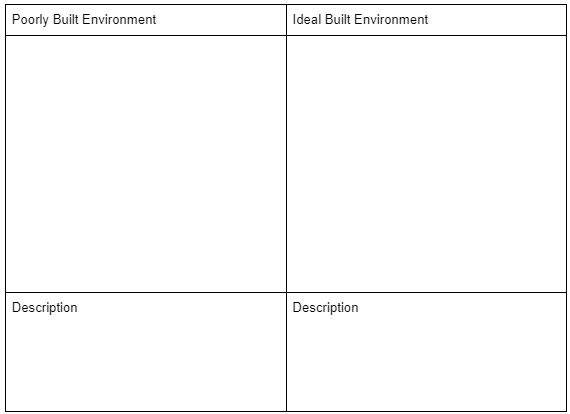
Using the knowledge gained about the built environment, draw two models of the built environment: an ideal built environment workplace and a poorly built environment workplace in the boxes provided below. Describe each of your drawings.
Step 3. Explain
Based on your drawings, discuss in 200-600 words how the built environment affects the workplace and the people within the workplace, highlighting the following points:
- How the built environment influences an employee’s level of physical activity
- How the built environment leads to sedentary habits and behavior
- How the built environment contributes to poor health outcomes
Step 4: Share
To share your work, click on the “Add a new discussion topic” button under this post and paste your work in the “Message” box. Make sure to reference others’ intellectual property when necessary. All references should follow 7th Edition APA formatting. For further instructions, see the resource on the Himmelfarb Health Sciences Library: APA citation resource (N.B. references are excluded from word counts).
Step 5: Interact
To complete the activity, you will need to reply to at least two posts made by your peers in a respectful and professional manner. Ensure that your post engages your peers' ideas by including a reflection on their comments, sharing ideas of other potential difficulties and parties involved, or asking thought-provoking questions. If a peer comments on your posting, please reply. To post a reply, click “Reply” on a particular discussion, write your feedback and then click on “Post to the forum.”
OPTIONAL Step 6: Interact (10 minutes)
If you would like to, you can reply to your peers' posts in a respectful and professional manner. Ensure that your post engages your peers' ideas by including a reflection on their comments, sharing ideas of other potential difficulties and parties involved, or asking thought-provoking questions. If a peer comments on your posting, please reply. To post a reply, click “Reply” on a particular discussion, write your feedback and then click on “Post to forum.”
-
Quiz: Module 1
To access the quiz, click on the name of the quiz provided above. On the following screen, click the attempt quiz button to view the case studies and respond to the questions.
TO PASS THIS QUIZ YOU MUST OBTAIN A SCORE OF 80%.
Not available unless: The activity Course Registration is marked complete ...Not available unless:- The activity Course Registration is marked complete
- The activity Pre-Test is marked complete
-

Competency covered in this module:
- Assess the characteristics and needs of specific workforces and organizations for the planning of workplace wellness programs.
- Examine recommendations for developing a workplace wellness program plan, including establishing program policies, procedures, and budgeting.
- Assess the characteristics and needs of specific workforces and organizations for the planning of workplace wellness programs.
-
Student Learning Outcomes:
Upon completion of this lesson, you will be able to:- Describe multiple workplace wellness programs that demonstrate the importance of tailoring programs to different workers' needs.
- Analyze the demographics and characteristics of specific workforces and organizations to identify wellness program needs.
- Describe common aspects explored in survey-based needs assessments, with examples.
-
Required Learning Resources and Activities
-
Students mustView
Watch the entire video. (11 minutes)
Institute for Health and Productivity Studies, Johns Hopkins Bloomberg School of Public Health, & Transamaerica Center for Health Studies - 2015
-
Students mustView
Read pages 85-87 and the "Employer Interviews" section from pages 105-123. (43 minutes)
Institute for Health and Productivity Studies Johns Hopkins Bloomberg School of Public Health In collaboration with Transamerica Center for Health Studies® - 2015
-
Students mustView
Read through this webpage and each of the three hyperlinked sections listed at the top: Site Visit Interviews; Environmental Assessment; Data Collection. (25 minutes)
Centers for Disease Control and Prevention - 2016
-
Students mustView
Read through this webpage and each of the six hyperlinked pages: Designing Surveys; Administering Surveys; Analyzing Surveys; On-the-Job Injuries Data; Employee Time and Attendance; and Job Satisfaction. (38 minutes)
Centers for Disease Control and Prevention - 2016
-
Students mustView
Read pages 8-14 (Research and Identify Needs). (6 minutes)
Tufts Health Plan - 2012
-
Students mustView
Read the entire page, including the file attachment. (12 minutes)
Government of Canada - 2019
-
Students mustViewStart discussions: 1
In this activity, you will explore the characteristics of a specific workforce or organization and discuss the need for workplace wellness.
Step 1. Reflect
Think of your current institution (either your university or work environment) or any institution you have access to. Examine the demographic and characteristic components of your selected institution. Reflect on the following:
- Population
- Age
- Education levels
- Ethnicity
- Others
Step 2. Fill-in
Use this needs assessment template or any other template of your preference. Then, fill it in with necessary information based on your current knowledge about your institution. For this assignment, you can fill in the template yourself. Optionally, you can ask one or more staff members to fill it in for you.
This is not a comprehensive exercise, but it will help you practice how to perform a needs assessment.
Step 3. Respond
Write a 300-600 word post that explains the results of your needs assessment as well as other recommendations and potential solutions to address the needs of your institution based on its current demographics.
Step 4: Share
To share your work, click on the “Add a new discussion topic” button under this post and paste your work in the “Message” box. Make sure to reference others’ intellectual property when necessary. All references should follow 7th Edition APA formatting. For further instructions, see the resource on the Himmelfarb Health Sciences Library: APA citation resource (N.B. references are excluded from word counts).
Step 5: Interact
To complete the activity, you will need to reply to at least two posts made by your peers in a respectful and professional manner. Ensure that your post engages your peers' ideas by including a reflection on their comments, sharing ideas of other potential difficulties and parties involved, or asking thought-provoking questions. If a peer comments on your posting, please reply. To post a reply, click “Reply” on a particular discussion, write your feedback and then click on “Post to the forum.”
OPTIONAL Step 6: Interact (10 minutes)
If you would like to, you can reply to your peers' posts in a respectful and professional manner. Ensure that your post engages your peers' ideas by including a reflection on their comments, sharing ideas of other potential difficulties and parties involved, or asking thought-provoking questions. If a peer comments on your posting, please reply. To post a reply, click “Reply” on a particular discussion, write your feedback and then click on “Post to forum.”
-
Student Learning Outcomes:
Upon completion of this lesson, you will be able to:- Summarize common steps and components of a workplace wellness plan.
- Describe the characteristics of clear and reachable goals.
- Reflect on the best practices to promote workplace wellness and their importance for program planning.
-
Students mustMark as done
Required Learning Resources and Activities
-
Students mustView
Read the entire page. Then, access and read the content of the following links on the side menu: (37 minutes)
- Leadership Support
- Governance Structure & Management
- Workplace Health Improvement Plan
- Dedicated Resources
- Communications
- Workplace Health InformaticsCDC - 2013
-
Students mustView
Read pages 2-9, 14, 15. (20 minutes)
Health Alliance Plan of Michigan - 2013
-
Students mustView
Read the entire document. (16 minutes)
Alberta Blue Cross - 2013
-
Students mustView
Read the entire page. (10 minutes)
WellSource - 2012
-
Students mustView
Read the entire webpage. (10 minutes)
Mind Tools - 2016
-
Students mustView
Read the entire article. (34 minutes)
JOEM - 2021
-
Students mustViewStart discussions: 1
In this activity, you will reflect on the best practices to promote workplace wellness to address workplace conflict.
Step 1. Review
Review the learning resources for this lesson, especially some of the best practices used to promote workplace wellness.
Step 2. Study
Study the case scenario below:
For the last quarter, the middle-management managers of different divisions of an advertising company have reported cases of disruptive behavior observed from some of the employees. This disruptive behavior includes unnecessary shouting and unreasonable offensive and demeaning remarks. One reported incident was an employee demanding rudely in a loud voice that they drop whatever they were working on and help him with his project. Another report involves employees asking a female supervisor for advice on a topic in her area of expertise, where she responded quite rudely, telling them to use their common sense. As the learning and development manager, you are asked to design a training program to address workplace conflict.
Step 3. Reflect
Reflect on some of the best practices that can be adopted in designing a training program tailored to fit the needs of the workplace described in the scenario. Reflect on their significance to program planning.
Step 4. Respond
Respond by writing a 200-600 word reflective essay that addresses the following questions:
- Which best practices from other successful programs can be adopted to solve the workplace problem?
- How can these practices be adapted to the specific workplace dynamics described in the scenario?
- Aside from the existing practices, what other strategies and opportunities can be implemented in designing a training program to address the problem?
- How significant are these practices in planning the training program?
Step 5: Share
To share your work, click on the “Add a new discussion topic” button under this post and paste your work in the “Message” box. Make sure to reference others’ intellectual property when necessary. All references should follow 7th Edition APA formatting. For further instructions, see the resource on the Himmelfarb Health Sciences Library: APA citation resource (N.B. references are excluded from word counts).
Step 6: Interact
To complete the activity, you will need to reply to at least two posts made by your peers in a respectful and professional manner. Ensure that your post engages your peers' ideas by including a reflection on their comments, sharing ideas of other potential difficulties and parties involved, or asking thought-provoking questions. If a peer comments on your posting, please reply. To post a reply, click “Reply” on a particular discussion, write your feedback and then click on “Post to the forum.”
OPTIONAL Step 7: Interact (10 minutes)
If you would like to, you can reply to your peers' posts in a respectful and professional manner. Ensure that your post engages your peers' ideas by including a reflection on their comments, sharing ideas of other potential difficulties and parties involved, or asking thought-provoking questions. If a peer comments on your posting, please reply. To post a reply, click “Reply” on a particular discussion, write your feedback and then click on “Post to forum.”
-
Quiz: Module 2
To access the quiz, click on the name of the quiz provided above. On the following screen, click the attempt quiz button to view the case studies and respond to the questions.
TO PASS THIS QUIZ YOU MUST OBTAIN A SCORE OF 7/9
Not available unless: The activity Quiz: Module 1 is marked complete
-
Competency covered in this module:
- Examine the steps and recommendations to implement a workplace wellness program using appropriate marketing and communication resources to foster employer engagement.
- Assess different frameworks for the evaluation of workplace wellness and promotion programs, paying particular attention to the types of evaluations and outcomes of interest along with tools and methods available to report and apply evaluation findings.
-
Student Learning Outcomes:
Upon completion of this lesson, you will be able to:- Examine workplace wellness implementation strategies and processes along with lessons learned from implementation case studies.
- Explain the importance of branding and communication strategies to improve program engagement along with best practices for their implementation.
-
Required Learning Resources and Activities
-
Students mustView
Read through the webpage and the following four hyperlinked webpages: Health-related Programs; Health-related Policies; Health Benefits; and Environmental Support. (11 minutes)
Centers for Disease Control and Prevention - 2015
-
Students mustView
Read Chapter 4 "Integrated Implementation," from pages 50-66. (35 minutes)
Harvard - 2017
-
Students mustView
Read pages 93-104. (20 minutes)
Rand Corporation - 2013
-
Students mustView
Read pages 16-19. (9 minutes)
Health Alliance Plan of Michigan - 2013
-
Students mustView
Read the entire document. (4 minutes)
CDC - 2013
-
Students mustViewStart discussions: 1
In this activity, you will study the different types of workplace wellness programs and explain how branding and communication strategies can be applied for each.
Step 1. Examine
Examine these different types of workplace wellness programs:
- Smoking cessation program - consists of lifestyle coaching, as well as pharmacological assistance, to their team members to help employees quit smoking.
- Healthy eating program - this includes extended fitness lunch to team members - enough time to play a sport, hit the gym, or head home for a healthy homemade lunch.
- Transit program - encouraging alternative methods of transportation, such as bike-sharing or public transit incentives, by reimbursing employees for their transit passes.
- Wellness adventure program - optional wellness adventures for employees with the goal of getting away from their desks for a little while. This includes a one-hour golf lesson or even laser tag. The wellness adventures are kept broad to appeal to a wide range of people and, most importantly, are focused on having fun.
Step 2. Reflect
Reflect on branding and communication strategies that can be used to improve engagement for each workplace wellness program in Step 1. More specifically, reflect on the following aspects:
- The type of branding and communication strategies suitable for the workplace wellness program
- The importance of branding and communication strategies to improve the outcome for each of the workplace wellness programs
- Best practices to implement these strategies to improve each workplace wellness program
Step 3. Respond
Respond by writing a 200-600 word discussion post that addresses all of the bulleted points in Step 2.
Step 4: Share
To share your work, click on the “Add a new discussion topic” button under this post and paste your work in the “Message” box. Make sure to reference others’ intellectual property when necessary. All references should follow 7th Edition APA formatting. For further instructions, see the resource on the Himmelfarb Health Sciences Library: APA citation resource (N.B. references are excluded from word counts).
Step 5: Interact
To complete the activity, you will need to reply to at least two posts made by your peers in a respectful and professional manner. Ensure that your post engages your peers' ideas by including a reflection on their comments, sharing ideas of other potential difficulties and parties involved, or asking thought-provoking questions. If a peer comments on your posting, please reply. To post a reply, click “Reply” on a particular discussion, write your feedback and then click on “Post to the forum.”
OPTIONAL Step 6: Interact (10 minutes)
If you would like to, you can reply to your peers' posts in a respectful and professional manner. Ensure that your post engages your peers' ideas by including a reflection on their comments, sharing ideas of other potential difficulties and parties involved, or asking thought-provoking questions. If a peer comments on your posting, please reply. To post a reply, click “Reply” on a particular discussion, write your feedback and then click on “Post to forum.”
-
Student Learning Outcomes:
Upon completion of this lesson, you will be able to:- Examine the definition, types, and steps to perform a program evaluation according to different frameworks along with common outcomes of interest of evaluation programs.
- Discuss the available tools used to evaluate a program's success and to effectively report evaluation findings.
-
Students mustMark as done
Required Learning Resources and Activities
-
Students mustView
Read the entire page, including the content of the links: (18 minutes)
- Worker Productivity Measures
- Health Care Costs Measures
- Health Outcomes Measures
- Organizational Change MeasuresCDC - 2015
-
Students mustView
Read the entire document. (4 minutes)
Centers for Disease Control. - 2016
-
Students mustView
Read pages 1-66. (132 minutes)
Public Health Ontario - 2016
-
Students mustView
Read pages 5-9. (10 minutes)
Centers for Disease Control and Prevention - 2014
-
Students mustViewStart discussions: 1
In this activity, you will select a workplace wellness program and discuss how available tools can be used to evaluate its success.
Step 1. Review
Review the learning resources for this lesson.
Step 2. Research and Analyze
Research a sample workplace wellness program. Gather as much information as possible for the selected program, i.e., type of audience, target goals, intervention and strategies used, and outcomes. Analyze all the data collected.
Step 3. Select
After analyzing the data collected, select the appropriate tool from those described in this lesson’s learning resources that can be used to evaluate the program’s success and report the evaluation findings.
Step 4. Discuss
Discuss how the selected evaluation tool can be used to:
- Provide a clear and meaningful picture of participation and engagement
- Identify the quality of the program, the participant’s experience, what aspects of the program were effective and possible areas for improvement
- Assess for change in attitudes and intent to change behavior
- Report specific evaluation findings
Step 5. Respond
Respond by writing a 300-700 word discussion post that addresses all the bulleted points in Step 4.
Step 6: Share
To share your work, click on the “Add a new discussion topic” button under this post and paste your work in the “Message” box. Make sure to reference others’ intellectual property when necessary. All references should follow 7th Edition APA formatting. For further instructions, see the resource on the Himmelfarb Health Sciences Library: APA citation resource (N.B. references are excluded from word counts).
Step 7: Interact
To complete the activity, you will need to reply to at least two posts made by your peers in a respectful and professional manner. Ensure that your post engages your peers' ideas by including a reflection on their comments, sharing ideas of other potential difficulties and parties involved, or asking thought-provoking questions. If a peer comments on your posting, please reply. To post a reply, click “Reply” on a particular discussion, write your feedback and then click on “Post to the forum.”
OPTIONAL Step 8: Interact (10 minutes)
If you would like to, you can reply to your peers' posts in a respectful and professional manner. Ensure that your post engages your peers' ideas by including a reflection on their comments, sharing ideas of other potential difficulties and parties involved, or asking thought-provoking questions. If a peer comments on your posting, please reply. To post a reply, click “Reply” on a particular discussion, write your feedback and then click on “Post to forum.”
-
Quiz: Module 3
To access the quiz, click on the name of the quiz provided above. On the following screen, click the attempt quiz button to view the case studies and respond to the questions.
TO PASS THIS QUIZ YOU MUST OBTAIN A SCORE OF 80%.
Not available unless: The activity Quiz: Module 2 is marked complete -
Students mustMark as done
Additional Learning Options
-
Students mustView
Read the entire PDF. (6 minutes)
Dairy Council of California - 2013
-
 Competency
covered in this module:
Competency
covered in this module: Understand the different types of substances commonly used in the workplace, their effects, methods of use, signs and symptoms of substance use disorder, and how they can affect the workplace. - Understand mental health in the workplace, its common problems, illnesses, disorders and how significant its impact in the workplace is.
-
Student Learning Outcomes:
Upon completion of this lesson, you will be able to:- Explain what is substance use disorder, the types of commonly used substances, and the implications of substance use for the workplace.
- Discuss strategies, interventions, and policies that can be applied to manage substance use in the workplace.
-
Required Learning Resources and Activities
-
Students mustView
Read the sections: (5 minutes)
- Why should a workplace look at problematic substance use issues?
- In general, what are the effects of various types of substances?
- What are the costs to a business?
- Are there elements of work that may contribute to the use of substances?Canadian Center for Occupational Health and Safety - 2017
-
Students mustView
Read pages 3-8 of the toolkit. (18 minutes)
State of Alaska: Department of Health and Social Sciences - 2022
-
Students mustView
Read the following sections: (3 minutes)
- What the workplace can do?
- What elements should be in a substance use or impairment in the workplace policy?Canadian Center for Occupational Health and Safety - 2017
-
Students mustView
Read the section "Policies to build a culture of support and protect the workplace" from pages 9-17. (29 minutes)
State of Alaska: Department of Health and Social Sciences - 2022
-
Student Learning Outcomes:
Upon completion of this lesson, you will be able to:- Explain common mental health issues and the importance of promoting mental health in the workplace.
- Discuss the strategies, actions, and policies that can be done to manage mental health in the workplace.
-
Students mustMark as done
Required Learning Resources and Activities
-
Students mustView
Read pages 1-2 of the document. (2 minutes)
CDC - 2018
-
Students mustView
Read pages 5-11, and the first paragraph of page 12. (24 minutes)
CAMH - 2020
-
Students mustView
Read pages 3-6 of the document. (8 minutes)
CDC - 2018
-
Students mustView
Read pages 12-20 of the document. (25 minutes)
CAMH - 2020
-
Students mustViewStart discussions: 1
In this activity, you will propose a workplace wellness plan for an individual based on the case scenario.
Step 1. Study
Examine and study this case scenario:
Joey is an architect in a large architectural firm. Not long after he was recruited, he became unwell, suffering from depression, anxiety, and panic attacks, particularly when he was asked to work at locations other than the office. His performance was unsatisfactory. He was noticed to have strange and inconsistent behavior. His assistant eventually reported to management that Joey had been regularly drinking coffee spiked with alcohol. Joey’s supervisor and the HR manager decided to have a dialogue with Joey, to which Joey confessed that this was his coping mechanism for his anxiety. The supervisor and the HR manager have become aware of the situation but are unsure how to handle it. As such, they’ve allowed Joey to continue with this working pattern. They are seeking your help as a medical professional.
Step 2. Analyze
Analyze the case scenario above. Reflect on the potential strategies, actions, and policies that can be applied to manage Joey’s situation.
Step 3. Respond
Write a 200-500 word workplace wellness plan for Joey. Include the following points in your plan:
- The problem/s
- Target goals that are aligned with the SMART criteria (Specific, Measurable, Attainable, Relevant, Time-limited)
- Interventions, strategies, policies that are applicable to the company, the employee, and the employee’s support networks
- Possible challenges that may impede the achievement of the target goals
- Other recommendations
Step 4: Share
To share your work, click on the “Add a new discussion topic” button under this post and paste your work in the “Message” box. Make sure to reference others’ intellectual property when necessary. All references should follow 7th Edition APA formatting. For further instructions, see the resource on the Himmelfarb Health Sciences Library: APA citation resource (N.B. references are excluded from word counts).
Step 5: Interact
To complete the activity, you will need to reply to at least two posts made by your peers in a respectful and professional manner. Ensure that your post engages your peers' ideas by including a reflection on their comments, sharing ideas of other potential difficulties and parties involved, or asking thought-provoking questions. If a peer comments on your posting, please reply. To post a reply, click “Reply” on a particular discussion, write your feedback and then click on “Post to the forum.”
OPTIONAL Step 6: Interact (10 minutes)
If you would like to, you can reply to your peers' posts in a respectful and professional manner. Ensure that your post engages your peers' ideas by including a reflection on their comments, sharing ideas of other potential difficulties and parties involved, or asking thought-provoking questions. If a peer comments on your posting, please reply. To post a reply, click “Reply” on a particular discussion, write your feedback and then click on “Post to forum.”
-
Quiz: Module 4
To access the quiz, click on the name of the quiz provided above. On the following screen, click the attempt quiz button to view the case studies and respond to the questions.
TO PASS THIS QUIZ YOU MUST OBTAIN A SCORE OF 80%.
Not available unless: The activity Quiz: Module 3 is marked complete
-
-
Final Exam Quiz
To take the final exam, you must complete all quizzes and complete all the required activities. The final exam consists of 20 questions, and you will have 40 minutes to complete it. When the time is over, you will have two minutes to submit your attempt before it expires, and your progress is discarded. You will not be able to answer additional questions in the grace period.
To access the exam, click on the name of the exam provided above. On the following screen, click the attempt quiz button to respond to the questions.
Not available unless: All of: ...Not available unless:-
All of:
- The activity Course Registration is marked complete
- The activity Pre-Test is marked complete
- The activity Quiz: Module 1 is marked complete
- The activity Quiz: Module 2 is marked complete
- The activity Quiz: Module 3 is marked complete
- The activity Quiz: Module 4 is marked complete
-
All of:
- The activity Discussion Forum 1: Factors that Influence the Success of a Comprehensive Workplace Wellness Program. (300 minutes) is marked complete
- The activity Discussion Forum 2: Health and the Built Environment. (300 minutes) is marked complete
- The activity Discussion Forum 3: A Workforce Demographic Analysis Using a Needs Assessment Tool. (300 minutes) is marked complete
- The activity Discussion Forum 4: Promoting Workplace Wellness. (300 minutes) is marked complete
- The activity Discussion Forum 5: Branding and Communication Strategies for Workplace Wellness Programs. (300 minutes) is marked complete
- The activity Discussion Forum 6: Evaluating a Program’s Success. (420 minutes) is marked complete
- The activity Discussion Forum 7: Promoting a Safe and Healthy Workplace. (420 minutes) is marked complete
-
All of:
-
-
 In this section, you can provide feedback about this course to help us make NextGenU.org better. Once evaluations are completed, you will be able to download your certificate of completion.
-
Course Evaluation QuestionnaireNot available unless: The activity Final Exam is marked complete
-
Self Evaluation QuestionnaireNot available unless: The activity Final Exam is marked complete
-
-