Introduction to Mental Health Professions
You do not have permission to view discussions in this forum.
You do not have permission to view discussions in this forum.
-
Health SciencesIntroduction to Mental Health ProfessionsResume0% complete0% complete
-
Students mustStudent must submit this questionnaire to complete it
-
Students mustViewReceive a grade
Show More-


Welcome to the Introduction to Mental Health Professions course. This course, designed for undergraduate students, provides an understanding of the fundamental principles of psychology in the Mental Health Professions. It focuses on the key themes and concepts of psychology as well as their application to psychological research and the ethical and social responsibility considerations that may arise.
The Introduction to Mental Health Professions course, like all NextGenU.org courses, is competency-based, using competencies from the American Psychological Association. It uses learning resources from accredited, world-class organizations such as the British Columbia Campus Open Education, Rice University, American Psychological Association, University of Southern California Libraries, University of Central Florida, and University of Minnesota.
The Introduction to Mental Health Professions course was developed by: Gabriel Young, Ph.D., LMFT; William Livingston; Prof. Nahid Fattahi, M.A.; Prof. Jay Scolio, PhD; Prof. Andrew Kami; Ruby Escatel, MFTT, M.A. Candidate; Jose Luis Gonzalez, M.A., AMFT; Aime Plantillas Veaz, MFTT, M.A. Candidate, from the Pacific Oaks College; and was designed by the NextGenU.org team: Alixandria Ali, BSc; Pablo Baldiviezo, MD, DiplEd; Genikka Camille Gabral, B.ED, MSc; Reisha Narine, MSc, BSc; Rhonda Prudent, BSc; Hugo Rojas, MD, MSc, DiplE.
For publications on NextGenU.org’s courses’ efficacy, see NextGenU.org’s publication page. Subscribe to our newsletter to be notified of future updates, new courses, and to be part of our community.
There are 5 modules to complete, which provide an introduction to:
Module 1: Knowledge Base in Psychology
Module 2: Scientific Inquiry and Critical Thinking
Module 3: Ethical and Social Responsibility in a Diverse World
Module 4: Communication
Module 5: Professional DevelopmentThe completion time for this course is estimated at 109 hours, comprising 17 hours of learning resources, 33 hours of time to study and assimilate content, and 59 hours of participating in learning activities and quizzes, to assist the learners in the synthesis of learning materials. This course is equivalent to 2 credit hours.
The Introduction to Mental Health Professions course requires the completion of discussion forums, peer activities, and quizzes to receive a course certificate. At the end of each module, there is a practice quiz of 10 multiple-choice questions. After you’ve completed each module, quiz, and learning activity, at the end of the course, you’ll have access to a final exam consisting of 50 multiple-choice questions and a chance to evaluate this course. Participants have up to three opportunities to take the final exam and achieve the required passing score of >=80%. Once you’ve passed the final exam and completed the evaluations, you will be able to download a certificate of completion from NextGenU.org and our course’s co-sponsoring organizations.
We keep all of your personal information confidential, never sell any of your information, and only use anonymized data for research purposes. Also, we are happy to report your testing information and share your work with anyone (your school, employer, etc.) at your request.
Engaging with this Course:
You may browse this course for free to learn for your personal enrichment; there are no requirements.
To obtain a certificate, a learner must first register for the course and then successfully complete:
- Pre-test,
- All reading requirements,
- All quizzes and pass with a 80% with unlimited attempts,
- All case studies,
- All discussion forums,
- The final exam with a minimum of 80% and a maximum of 3 attempts, and
- The self and course evaluation forms.
To obtain credit:
- Complete all requirements listed above for the certificate, and
- Your learning institution or workplace should approve the partner-university-sponsored NextGenU.org course for educational credit, as they would for their learner taking a course anywhere.
NextGenU.org is happy to provide your institution with:
- A link to and description of the course training so they can see all its components, including the co-sponsoring institutions,
- Your work products (e.g., discussion forum responses) and any other required or optional shared materials that you produce and authorize to share with them,
- Your evaluations -- course, and self-assessments, and
- A copy of your certificate of completion, with the co-sponsoring universities and other organizations listed.
To obtain a degree, NextGenU.org co-sponsors degree programs with institutional partners. To obtain a full degree co-sponsored with NextGenU.org, registrants must be enrolled in a degree program as a student of a NextGenU.org institutional partner. If you think that your institution might be interested in offering a degree with NextGenU.org, contact us.
We hope that you will find this a rewarding learning experience, and we count on your assessment and feedback to help us improve this training for future students.
Here are the next steps to take the course and earn a certificate:
- Complete the registration form,
- Take the pre-test, and
- Begin the course with Module 1: Knowledge Base in Psychology. In each lesson, read the description, complete all required readings and any required activity, as well as take the corresponding quizzes.
This course meets nationally approved standards of education developed for the addiction/substance use disorders counseling profession. This course's participants are assured that the continuing education (CE) credits provided will be accepted toward national credentialing by the NAADAC Certification Commission for Addiction Professionals (NCC AP), as well as by many of the individual state licensing/certification bodies in the addiction and other helping professions.
-

Competencies covered in this module:
- Describe key concepts, principles, and overarching themes in psychology.
- Develop a working knowledge of psychology’s content domains.
- Describe applications of psychology.
-
Student Learning Outcomes:
Upon completion of this lesson, you will be able to:
- Define the term "psychology".
- Recognize why psychology is a science.
- Explain the evolution of psychology into a science.
- Describe major perspectives of psychology.
- Describe the major branches of psychology.
-
Students mustMark as done
Required Learning Resources and Activities
-
-
Students mustView
Read from the heading "What is Science?" to the green box "Key Takeaways." (13 minutes)
-
-
Students mustView
Read the entire webpage. (28 minutes)
-
Students mustView
Read the entire webpage. (58 minutes)
-
-
-
-
-
Students mustView
Read the entire webpage. (30 minutes)
-
Students mustView
In this activity, you will select any (2) psychological perspectives covered and explain how they can be applied to understanding behavior and mental processes. You will identify their main takeaways; then, discuss how they might relate to human behavior and mental processes.
Instructions:
Step 1: Identify
Select any (2) psychological perspectives - Biological, Psychodynamic, Behaviorist, Humanist, Cognitive or Evolutionary Psychology.
Step 2: Respond
Analyze and prepare a discussion piece of 250-350 words that explains how the chosen perspectives can help to better understand or analyze human behavior and mental processes.
Step 3: Share
To share your work, click on the “Add a new discussion topic” button under this post and paste your work in the “Message” box. Make sure to reference others’ intellectual property when necessary. All references should follow 7th Edition APA formatting. For further instructions, see the resource on the Himmelfarb Health Sciences Library: APA citation resource (N.B. references are excluded from word counts).
Step 4: Interact
To complete the activity, you will need to reply to at least two posts made by your peers in a respectful and professional manner. Be sure that your post engages your peers' ideas by including a reflection on their comments, sharing ideas on other potential difficulties and parties involved, or asking thought-provoking questions. If a peer comments on your posting, please reply. To post a reply, click “Reply” on a particular discussion, write your feedback and then click on “Post to forum.” You can use the following questions as a guide for your response:
- Which other perspective can be applied to your peer’s post?
- Do you notice any weaknesses/strengths of the particular perspective applied in your peer’s post?
- Do you have a particular example that can help build on your peer’s post?
OPTIONAL Step 5: Interact (10 minutes)
If you would like to, you can reply to your peers' posts in a respectful and professional manner. Ensure that your post engages your peers' ideas by including a reflection on their comments, sharing ideas of other potential difficulties and parties involved, or asking thought-provoking questions. If a peer comments on your posting, please reply. To post a reply, click “Reply” on a particular discussion, write your feedback and then click on “Post to forum.”
-
Student Learning Outcomes:
Upon completion of this lesson, you will be able to:
- Recognize that the five domains act as pillars of psychology.
- Explain the biological domain in psychology.
- Explain the cognitive domain in psychology.
- Explain the developmental domain in psychology.
- Explain the social and personality domain in psychology.
- Explain the mental and physical health domain in psychology.
- Define industrial-organizational psychology, sport and exercise psychology, and forensic psychology.
-
Students mustMark as done
Required Learning Resources and Activities
-
Students mustView
Read from the heading "Introduction to Contemporary Psychology" to the blue box "Helpful Hints." (6 minutes)
-
Students mustView
Read from "Learning Objectives" to "Sensation and Perception." (6 minutes)
-
-
Students mustView
Read from the heading "Learning Objectives" to "Biological Psychology." (4 minutes)
-
Students mustView
Read the entire webpage. (12 minutes)
-
-
Students mustView
Read from the heading "Learning Objectives" to "Link to Learning." (3 minutes)
-
Students mustView
In this activity, you will compare at least (3) domains in psychology and discuss the main viewpoints/core assumptions of each domain in analyzing human behavior.
Instructions:
Step 1: Identify
Review the lesson’s readings and select at least (3) domains in psychology.
Step 2: Respond
Write a 250-500 word essay. Discuss the main viewpoints/core assumptions of each domain. Make sure to include how each domain identified analyzes human behavior.
Step 3: Share
To share your work, click on the “Add a new discussion topic” button under this post and paste your work in the “Message” box. Make sure to reference others’ intellectual property when necessary. All references should follow 7th Edition APA formatting. For further instructions, see the resource on the Himmelfarb Health Sciences Library: APA citation resource (N.B. references are excluded from word counts).
Step 4: Interact
To complete the activity, you will need to reply to at least two posts made by your peers in a respectful and professional manner. Ensure that your post engages your peers' ideas by including a reflection on their comments, sharing ideas of other potential difficulties and parties involved, or asking thought-provoking questions. If a peer comments on your posting, please reply. To post a reply, click “Reply” on a particular discussion, write your feedback and then click on “Post to forum.” You can use the following as a guide:
- Do you agree or disagree with the identified domains and its analysis of human behavior?
OPTIONAL Step 5: Interact (10 minutes)
If you would like to, you can reply to your peers' posts in a respectful and professional manner. Ensure that your post engages your peers' ideas by including a reflection on their comments, sharing ideas of other potential difficulties and parties involved, or asking thought-provoking questions. If a peer comments on your posting, please reply. To post a reply, click “Reply” on a particular discussion, write your feedback and then click on “Post to forum.”
-
Student Learning Outcomes:
Upon completion of this lesson, you will be able to:
- Explain that psychology influences our social lives.
- Describe how psychology can help understand everyday behaviour.
- Discuss how psychological differences can determine beliefs and social interactions.
-
Students mustMark as done
Required Learning Resources and Activities
-
-
Students mustView
Read the entire webpage. (36 minutes)
-
Students mustView
Read the entire webpage. (38 minutes)
-
Students mustView
Using (3) key principles of social cognition, discuss how attitudes may influence a person's behavior and vice versa.
Instructions:
Step 1: Analyze
Review key principles of social cognition: cognitive dissonance, fundamental attribution error, and self-fulfilling prophecy.
Step 2: Respond
Prepare a 250-500 word piece of writing that explains how the identified principles influence our attitudes and behaviors.
Step 3: Share
To share your work, click on the “Reply” button under this post and paste your work in the “Message” box. Make sure to reference others’ intellectual property when necessary. All references should follow 7th Edition APA formatting. For further instructions, see the resource on the Himmelfarb Health Sciences Library: APA citation resource (N.B. references are excluded from word counts).
Step 4: Interact
To complete the activity, you will need to reply to at least two posts made by your peers in a respectful and professional manner. Ensure that your post engages your peers' ideas by including a reflection on their comments, sharing ideas of other potential difficulties and parties involved, or asking thought-provoking questions. If a peer comments on your posting, please reply. To post a reply, click “Reply” on a particular discussion, write your feedback and then click on “Post to forum.”
OPTIONAL Step 5: Interact (10 minutes)
If you would like to, you can reply to your peers' posts in a respectful and professional manner. Ensure that your post engages your peers' ideas by including a reflection on their comments, sharing ideas of other potential difficulties and parties involved, or asking thought-provoking questions. If a peer comments on your posting, please reply. To post a reply, click “Reply” on a particular discussion, write your feedback and then click on “Post to forum.”
-
Quiz: Module 1
To access the quiz, click on the name of the quiz provided above. On the following screen, click the attempt quiz button to view the case studies and respond to the questions.
TO PASS THIS QUIZ YOU MUST OBTAIN A SCORE OF 80%.
Not available unless: The activity Course Registration is marked complete ...Not available unless:- The activity Course Registration is marked complete
- The activity Pre-Test is marked complete
-

Competency covered in this module:
- Use scientific reasoning to interpret psychological phenomena.
- Demonstrate psychology information literacy.
- Engage in innovative and integrative thinking and problem-solving.
- Interpret, design, and conduct basic psychological research.
- Incorporate sociocultural factors in scientific inquiry.
- Use scientific reasoning to interpret psychological phenomena.
-
Student Learning Outcomes:
Upon completion of this lesson, you will be able to:
- Identify the difference between phenomena and theories.
- Describe the three dimensions of psychological theories.
- Discuss how theories are tested and evaluated in psychology.
- Recognize how hypotheses are developed.
- Describe how a research study is designed.
- Discuss effective ways for data analysis.
- Describe the method of drawing conclusions and preparing reports.
- Identify and navigate psychology databases and other legitimate sources of psychology information.
- Describe what kinds of additional information beyond personal experience is acceptable in developing behavioral explanations.
- Interpret simple graphs and statistical findings.
-
Students mustMark as done
Required Learning Resources and Activities
-
-
Students mustView
Read the entire webpage. (13 minutes)
-
Students mustView
Read from "Learning Objectives" to "Key Takeaways." (22 minutes)
-
Students mustView
Read from "Learning Objectives" to "Key Takeaways." (15 minutes)
-
-
-
Students mustView
Read the entire webpage. (6 minutes)
-
Students mustView
Read from "Learning Objectives" to "Key Takeaways." (21 minutes)
-
-
Students mustView
Read the entire webpage. (11 minutes)
-
Students mustView
Read the entire webpage. (10 minutes)
-
-
Students mustView
Read the entire webpage. (8 minutes)
-
-
-
-
-
Students mustView
In this learning activity, you will select any one of the psychology articles mentioned below. You will identify the study’s hypothesis, research methods, and conclusions drawn and will discuss why the selected research method was appropriate.
- The Effects of Instagram Use, Social Comparison, and Self-Esteem on Social Anxiety: A Survey Study in Singapore.
- Self-esteem, Social comparison, and Facebook Use.
You can use this as a guideline to help you navigate through the research articles.
Instructions:
Step 1: Select
Select one of the two journal articles identified.
Step 2: Identify
Identify the study’s hypothesis, research methods and conclusions drawn.
Step 3: Respond
Write a 250-500 piece of writing explaining why you believe that the chosen methodology was appropriate for the study based on the results presented and conclusions drawn. Ensure that you include the following information in your answer:
- What is the researcher’s main hypothesis?
- What methodology/research design did the researcher undertake?
- What conclusions can be drawn from the research findings?
- Do you agree/disagree with the methodology selected?
- What are the main advantages and disadvantages of using the selected research method?
Step 4: Share
To share your work, click on the “Reply” button under this post and paste your work in the “Message” box. Make sure to reference others’ intellectual property when necessary. All references should follow 7th Edition APA formatting. For further instructions, see the resource on the Himmelfarb Health Sciences Library: APA citation resource (N.B. references are excluded from word counts).
Step 5: Interact
To complete the activity, you will need to reply to at least two posts made by your peers in a respectful and professional manner. Be sure that your post engages your peers' ideas by including a reflection on their comments, sharing ideas on other potential difficulties and parties involved, or asking thought-provoking questions. If a peer comments on your posting, please reply. To post a reply, click “Reply” on a particular discussion, write your feedback and then click on “Post to forum.” You can use the following as a guide:
- Did you observe anything different in terms of the study’s hypothesis, research methods or conclusions drawn?
- Do you agree or disagree with the rationale provided for the selected research method?
OPTIONAL Step 6: Interact (10 minutes)
If you would like to, you can reply to your peers' posts in a respectful and professional manner. Ensure that your post engages your peers' ideas by including a reflection on their comments, sharing ideas of other potential difficulties and parties involved, or asking thought-provoking questions. If a peer comments on your posting, please reply. To post a reply, click “Reply” on a particular discussion, write your feedback and then click on “Post to forum.”
-
Students mustViewStart discussions: 1
In this activity you will review a case study and interpret the statistical findings.
Step 1: Review
Data
The following dataset is based on the famous study “Internet Paradox. A social technology that reduces social involvement and psychological well-being?” Kraut R, Patterson M, Lundmark V, Kiesler S, Mukopadhyay T, and Scherlis W. Am Psychol. 1998 Sep; 53(9): 101731.
STUDY:
The September 1998 issue of the American Psychologist published an article by Kraut et al. that reported on an experiment examining “the social and psychological impact of the internet of 169 people in 73 households during their first few years online.” In the experiment, 73 households were offered free internet access for 1 or 2 years in return for allowing their time and activity online to be tracked. The members of the households who participated in the study were also given a battery of tests at the beginning and again at the end of the study. The conclusion of the study made news headlines: Those who spent more time online tended to be more depressed at the end of the experiment.
The news reports about this study clearly concluded that using the internet causes depression. Is such a conclusion warranted?
DATASET
The original dataset consisted of 169 observations (cases) that were measured across 8 variables: Internet Use, Depression Before, Depression After, Gender, Race, Age Group, Household Income, and Household Size.
The given dataset is 12 observations based on the original.
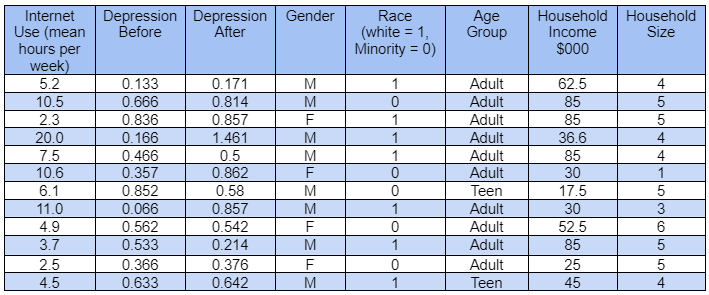
Questions
Graphing (Visualization)
- What type of graph should be used to represent the data of Variable 1 (Internet Use), a bar graph, a scatter plot, or a stem-and-leaf plot?
- What type of graph should be used to represent the data of Variable 8 (Household Size), a histogram or a scatter plot?
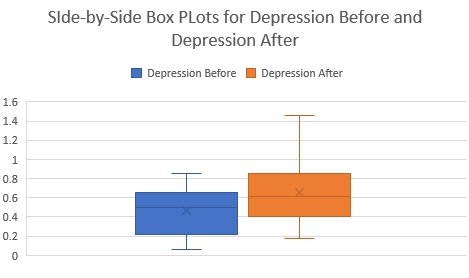
- Presented below is a graph with side-by-side boxplots for the Depression Before, and Depression After variables.
a. How do the ranges of the two variables differ?
b. Are there any potential outliers?
c. Compare the skewness of the graphs in terms of their being either Positively or Negatively skewed, or roughly symmetrical.
d. Compare the boxplots in terms of their variability as shown in the plots.
e. Compare the Interquartile Ranges of the two plots.
f. Which variable has the higher median depression level?Correlational Analysis
Now we will consider the scatterplot of the variables Internet Use (x-axis) and Depression After (y-axis). This graph is shown below.
- From the scatterplot shown above, what type of correlation does it suggest: positive, negative, little, or none?
- Calculate a Pearson’s r to determine analytically the type and strength of the relationship between Internet use and Depression After.
- How much of the variability in Depression After is accounted for by the number of hours of internet use per week?
- Calculate Cohen’s d for the variables Internet Use and Depression After, and give a brief explanation of what this statistic tells us.
Step 2: Interpret
Analyze and prepare a discussion piece of 250-300 words that respond all the points stated below.
Step 3: Share
To share your work, click on the “Add a new discussion topic” button under this post and paste your work in the “Message” box. Make sure to reference others’ intellectual property when necessary. All references should follow 7th Edition APA formatting. For further instructions, see the resource on the Himmelfarb Health Sciences Library: APA citation resource (N.B. references are excluded from word counts).
Step 4: Interact
To complete the activity, you will need to reply to at least two posts made by your peers in a respectful and professional manner. Be sure that your post engages your peers' ideas by including a reflection on their comments, sharing ideas on other potential difficulties and parties involved, or asking thought-provoking questions. If a peer comments on your posting, please reply. To post a reply, click “Reply” on a particular discussion, write your feedback and then click on “Post to forum.”
OPTIONAL Step 5: Interact (10 minutes)
If you would like to, you can reply to your peers' posts in a respectful and professional manner. Ensure that your post engages your peers' ideas by including a reflection on their comments, sharing ideas of other potential difficulties and parties involved, or asking thought-provoking questions. If a peer comments on your posting, please reply. To post a reply, click “Reply” on a particular discussion, write your feedback and then click on “Post to forum.”
-
Student Learning Outcomes:
Upon completion of this lesson, you will be able to:
- Describe problem-solving strategies.
- Discuss issues that can prevent effective problem-solving.
- Explain key concepts that characterize psychological research.
- Explain research design in psychology.
- Describe research methods used by psychologists, including their respective advantages and disadvantages.
- Explain how researcher’s biases can influence the development of scientific inquiry on psychological research.
- Explain potential challenges related to sociocultural factors in a given research study.
- Discuss how socio-cultural differences can influence the applicability/generalizability of research findings.
-
Students mustMark as done
Required Learning Resources and Activities
-
-
Students mustView
Read from "Learning Objectives" to "Key Takeaways." (10 minutes)
-
Students mustView
Read from "Learning Objectives" to "Key Takeaways." (13 minutes)
-
-
Students mustView
Read the content under the headings "Introduction" "Experimental", " Descriptive", "Causal", "Mixed-method" and " Observational." (13 minutes)
-
-
Students mustView
Read the content under the heading "body." (5 minutes)
-
Students mustView
Read the entire webpage. (8 minutes)
-
-
-
Students mustView
In this learning activity, you will review the hypothetical scenario and answer the following questions as it relates to sampling and measurement in research.
Instructions:
Step 1: Review
Read all the required material for this activity here and reflect on the following scenario:
As a researcher, you are required to conduct a study on the impact of substance abuse on adolescents. Using key psychological research concepts of measurement and sampling, explain what factors must be considered before conducting your research.
Step 2: Respond
Analyze and prepare a 300-400 word discussion piece addressing the following key points:
- Identify your sample population.
- Discuss the different types of sampling methods in research.
- Explain which sampling method may be best suited for your research and how it will allow for the generalizability of your findings.
Step 3: Share
To share your work, click on the “Add a new discussion topic” button under this post and paste your work in the “Message” box. Make sure to reference others’ intellectual property when necessary. All references should follow 7th Edition APA formatting. For further instructions, see the resource on the Himmelfarb Health Sciences Library: APA citation resource (N.B. references are excluded from word counts).
Step 4: Interact
To complete the activity, you will need to reply to at least two posts made by your peers in a respectful and professional manner. Ensure that your post engages your peers' ideas by including a reflection on their comments, sharing ideas of other potential difficulties and parties involved, or asking thought-provoking questions. If a peer comments on your posting, please reply. To post a reply, click “Reply” on a particular discussion, write your feedback and then click on “Post to forum.”
OPTIONAL Step 5: Interact (10 minutes)
If you would like to, you can reply to your peers' posts in a respectful and professional manner. Ensure that your post engages your peers' ideas by including a reflection on their comments, sharing ideas of other potential difficulties and parties involved, or asking thought-provoking questions. If a peer comments on your posting, please reply. To post a reply, click “Reply” on a particular discussion, write your feedback and then click on “Post to forum.”
-
Students mustView
In this learning activity, you will read the abstract and methodology sections of the two research articles from the Open Access Journal mentioned below. You will identify the research methods used and discuss the strengths and weaknesses of each.
Instructions:
Step 1: Review
Read the abstract and methodology sections of the two research articles you identified.
Step 2: Respond
Write a 200-500 word discussion post. Ensure your answers cover the following key areas:
- Identify the research methods used by the researchers.
- Discuss the strengths and weaknesses of each method identified.
- Did the researcher fulfill the research objective through the selected method? What could have been done differently?
Step 3: Share
To share your work, click on the “Add a new discussion topic” button under this post and paste your work in the “Message” box. Make sure to reference others’ intellectual property when necessary. All references should follow 7th Edition APA formatting. For further instructions, see the resource on the Himmelfarb Health Sciences Library: APA citation resource (N.B. references are excluded from word counts).
Step 4: Interact
To complete the activity, you will need to reply to at least two posts made by your peers in a respectful and professional manner. Be sure that your post engages your peers' ideas by including a reflection on their comments, sharing ideas on other potential difficulties and parties involved, or asking thought-provoking questions. If a peer comments on your posting, please reply. To post a reply, click “Reply” on a particular discussion, write your feedback and then click on “Post to forum.”
OPTIONAL Step 5: Interact (10 minutes)
If you would like to, you can reply to your peers' posts in a respectful and professional manner. Ensure that your post engages your peers' ideas by including a reflection on their comments, sharing ideas of other potential difficulties and parties involved, or asking thought-provoking questions. If a peer comments on your posting, please reply. To post a reply, click “Reply” on a particular discussion, write your feedback and then click on “Post to forum.”
-
Students mustView
In this activity, you will analyze the hypothetical scenario and discuss the (4) different types of validities that must be considered when designing your experiment.
Instructions:
Step 1: Review
Read all the required material here and reflect on the scenario below:
A researcher is studying how social media impacts self-esteem among teenagers. The independent variable is social media usage, while the dependent variable is the self-esteem of the teenagers, which is affected by social media usage.
Discuss the (4) different types of validities that must be considered when designing your experiment.
Step 2: Respond
Prepare a 250-500 word discussion piece that covers the following key points:
- Identify the four (4) different types of validities that must be considered
- Explain each type of validity and its importance in undertaking psychological research
- How can this affect a study’s generalizability or reliability?
Step 3: Share
To share your work, click on the “Add a new discussion topic” button under this post and paste your work in the “Message” box. Make sure to reference others’ intellectual property when necessary. All references should follow 7th Edition APA formatting. For further instructions, see the resource on the Himmelfarb Health Sciences Library: APA citation resource (N.B. references are excluded from word counts).
Step 4: Interact
To complete the activity, you will need to reply to at least two posts made by your peers in a respectful and professional manner. Ensure that your post engages your peers' ideas by including a reflection on their comments, sharing ideas of other potential difficulties and parties involved, or asking thought-provoking questions. If a peer comments on your posting, please reply. To post a reply, click “Reply” on a particular discussion, write your feedback and then click on “Post to forum.”
OPTIONAL Step 5: Interact (10 minutes)
If you would like to, you can reply to your peers' posts in a respectful and professional manner. Ensure that your post engages your peers' ideas by including a reflection on their comments, sharing ideas of other potential difficulties and parties involved, or asking thought-provoking questions. If a peer comments on your posting, please reply. To post a reply, click “Reply” on a particular discussion, write your feedback and then click on “Post to forum.”
-
Quiz: Module 2
To access the quiz, click on the name of the quiz provided above. On the following screen, click the attempt quiz button to view the case studies and respond to the questions.
TO PASS THIS QUIZ YOU MUST OBTAIN A SCORE OF 80%.
Not available unless: The activity Quiz: Module 1 is marked complete
-
 Competencies covered in this module
- Apply ethical standards to evaluate psychological science and practice.
- Build and enhance interpersonal relationships.
- Adopt values that build community at local, national, and global levels.
- Apply ethical standards to evaluate psychological science and practice.
-
Student Learning Outcomes:
Upon completion of this lesson, you will be able to:
- Describe a foundational framework for ethical issues in psychological research.
- Summarize the American Psychological Association's Ethics Code.
- Define the role of the institutional review board.
- Discuss strategies for identifying and minimizing risks and deception in psychological research.
-
Students mustMark as done
Required Learning Resources and Activities
-
Students mustView
Read the entire webpage. (12 minutes)
-
Students mustView
Read the entire webpage. (20 minutes)
-
-
Students mustView
You are to watch the Stanley Milgram Experiment video. Following the American Psychological Association Ethics Code (APA), you are to identify any ethical issues that arose in the experiment. You are to discuss how the Code was breached and examine how such risks/deceptions can be minimized.
Instructions:
Step 1: Watch
Watch this short 6-minute video:
Step 2: Analyze
Analyze the video. Focus on the following key points:
- Consider what ethical guidelines a psychologist should follow while conducting research?
- Assess how the Milgram Experiment has breached these ethical codes of conducting research?
- Discuss how such risks/deceptions can be minimized when conducting psychological research?
Step 3: Respond
Write a 300-500 word discussion post that answers the questions in Step 2.
Step 4: Share
To share your work, click on the “Add a new discussion topic” button under this post and paste your work in the “Message” box. Make sure to reference others’ intellectual property when necessary. All references should follow 7th Edition APA formatting. For further instructions, see the resource on the Himmelfarb Health Sciences Library: APA citation resource (N.B. references are excluded from word counts).
Step 5: Interact
To complete the activity, you will need to reply to at least two posts made by your peers in a respectful and professional manner. Be sure that your post engages your peers' ideas by including a reflection on their comments, sharing ideas on other potential difficulties and parties involved, or asking thought-provoking questions. If a peer comments on your posting, please reply. To post a reply, click “Reply” on a particular discussion, write your feedback and then click on “Post to forum.”
OPTIONAL Step 6: Interact (10 minutes)
If you would like to, you can reply to your peers' posts in a respectful and professional manner. Ensure that your post engages your peers' ideas by including a reflection on their comments, sharing ideas of other potential difficulties and parties involved, or asking thought-provoking questions. If a peer comments on your posting, please reply. To post a reply, click “Reply” on a particular discussion, write your feedback and then click on “Post to forum.”
-
Student Learning Outcomes:
Upon completion of this lesson, you will be able to:
- Recognize the need to treat others with civility.
- Describe the need for positive personal values (e.g., integrity, benevolence, honesty, respect for human integrity, respect for human dignity) in building strong relationships with others.
- Identify aspects of individual and cultural diversity and the interpersonal challenges that often result from diversity and context.
- Recognize the potential for prejudice and discrimination in oneself and others.
- Describe psychology-related issues of global concern (e.g., poverty, health, migration, human rights, rights of children, international conflict, sustainability).
- Explain how psychology can promote civic, social, and global outcomes that benefit others.
-
Students mustMark as done
Required Learning Resources and Activities
-
-
Students mustView
Read the entire webpage. (38 minutes)
-
Students mustView
Read the entire webpage. (16 minutes)
-
-
-
Students mustView
Read the entire webpage. (5 minutes)
-
-
Students mustView
Read the entire webpage. (21 minutes)
-
Students mustView
Read the entire webpage. (2 minutes)
-
Students mustView
In this learning activity, think about and reflect on the personal relationships that you have experienced. You will be required to write on one of your most positive relationships and one of your relationships that has faced difficulties.
Instructions:
Step 1: Review
Read all the required material and reflect on the following:
- One of your most positive relationships and one of your relationships that has faced difficulties.
Step 2: Respond
Write a 300-400 discussion post. Ensure that your discussion post covers the following points:
- Discuss how positive personal values have played a role in each of the relationships chosen
- Explain the importance of benevolence, honesty, and integrity in building strong relationships with others
Step 3: Share
To share your work, click on the “Add a new discussion topic” button under this post and paste your work in the “Message” box. Make sure to reference others’ intellectual property when necessary. All references should follow 7th Edition APA formatting. For further instructions, see the resource on the Himmelfarb Health Sciences Library: APA citation resource (N.B. references are excluded from word counts).
Step 4: Interact
To complete the activity, you will need to reply to at least two posts made by your peers in a respectful and professional manner. Be sure that your post engages your peers' ideas by including a reflection on their comments, sharing ideas on other potential difficulties and parties involved, or asking thought-provoking questions. If a peer comments on your posting, please reply. To post a reply, click “Reply” on a particular discussion, write your feedback and then click on “Post to forum.”
OPTIONAL Step 5: Interact (10 minutes)
If you would like to, you can reply to your peers' posts in a respectful and professional manner. Ensure that your post engages your peers' ideas by including a reflection on their comments, sharing ideas of other potential difficulties and parties involved, or asking thought-provoking questions. If a peer comments on your posting, please reply. To post a reply, click “Reply” on a particular discussion, write your feedback and then click on “Post to forum.”
-
Students mustViewStart discussions: 1
In this learning activity, you will discuss, from a social psychological perspective, the underlying factors that motivate individuals to help others by studying the following excerpt.
Leonardo DiCaprio has been an avid supporter of climate action and environmental justice. The DiCaprio Foundation has funded and supported numerous projects geared towards environmental conservation. He sits on the board for several environmental organizations and has been honored and recognized for his philanthropic work on many occasions. From a social psychological perspective, explain the underlying factors that motivate individuals to help others.
Adapted from: https://www.un.org/en/messengers-peace/leonardo-dicaprio
Instructions:
Step 1: Analyze
Reflect on the information about Leonardo DiCaprio and his climate change activism.
Step 2: Respond
Discuss what underlying factors/human motivations are responsible for individuals helping others or demonstrating altruistic behavior.
Step 3: Personal Reflection
Relate this topic to your personal life. Include what factors are responsible for determining whether you help someone or not.
Step 4: Respond
Present this information as a commentary (250-500 words in length).
Step 5: Share
To share your work, click on the “Add a new discussion topic” button under this post and paste your work in the “Message” box. Make sure to reference others’ intellectual property when necessary. All references should follow 7th Edition APA formatting. For further instructions, see the resource on the Himmelfarb Health Sciences Library: APA citation resource (N.B. references are excluded from word counts).
Step 6: Interact
To complete the activity, you will need to reply to at least two posts made by your peers in a respectful and professional manner. Be sure that your post engages your peers' ideas by including a reflection on their comments, sharing ideas on other potential difficulties and parties involved, or asking thought-provoking questions. If a peer comments on your posting, please reply. To post a reply, click “Reply” on a particular discussion, write your feedback and then click on “Post to forum.”
OPTIONAL Step 7: Interact (10 minutes)
If you would like to, you can reply to your peers' posts in a respectful and professional manner. Ensure that your post engages your peers' ideas by including a reflection on their comments, sharing ideas of other potential difficulties and parties involved, or asking thought-provoking questions. If a peer comments on your posting, please reply. To post a reply, click “Reply” on a particular discussion, write your feedback and then click on “Post to forum.”
-
Quiz: Module 3
To access the quiz, click on the name of the quiz provided above. On the following screen, click the attempt quiz button to view the case studies and respond to the questions.
TO PASS THIS QUIZ YOU MUST OBTAIN A SCORE OF 80%.
Not available unless: The activity Quiz: Module 2 is marked complete
-
 Competencies covered in this module
- Demonstrate effective writing for different purposes.
- Exhibit effective presentation skills for different purposes.
- Interact effectively with others.
-
Student Learning Outcomes:
Upon completion of this lesson, you will be able to:
- Recognize the use of standard English, including generally accepted grammar.
- Recognize that writing content and format differ based on purpose (e.g., blogs, memos, journal articles) and audience.
- Discuss the overall organization (e.g., beginning, development, ending) that fits the purpose.
- Explain how to interpret quantitative data displayed in statistics, graphs, and tables, including statistical symbols in research reports.
- Explain how results can be analyzed.
- Describe how to use information from data to form conclusions.
-
Students mustMark as done
Required Learning Resources and Activities
-
Students mustView
Read the entire webpage. (14 minutes)
-
-
-
Students mustView
Read the content under the headings "Introduction," " Data Display and Description of Research Data," "Quantitative Data" and "Graphical Description of Quantitative Data." (6 minutes)
-
Students mustView
Read from "Interpreting Experimental Findings" to " Reporting Research." (5 minutes)
-
-
Students mustView
In this learning activity, you will assess the hypothetical scenario and respond accordingly.
Step 1: Review
Read all the required materials for the lesson and review the scenario below:
You are part of the communications team at your local health authority office. There has been a spike in COVID-19 cases in the region, while vaccination has declined. Write a communication plan, which is to be distributed across three different types of media to help spread awareness and encourage the population to take precautions.
Step 2: Respond
Write a 300-400 word post in which you consider the following:
- Identify three (3) different audience groups within the population
- Apply the most effective type of media and communication strategy for each identified
- Ensure that you make a note of any special considerations in delivering information to the intended audiences
Step 3: Share
To share your work, click on the “Add a new discussion topic” button under this post and paste your work in the “Message” box. Make sure to reference others’ intellectual property when necessary. All references should follow 7th Edition APA formatting. For further instructions, see the resource on the Himmelfarb Health Sciences Library: APA citation resource (N.B. references are excluded from word counts).
Step 4: Interact
To complete the activity, you will need to reply to at least two posts made by your peers in a respectful and professional manner. Ensure that your post engages your peers' ideas by including a reflection on their comments, sharing ideas of other potential difficulties and parties involved, or asking thought-provoking questions. If a peer comments on your posting, please reply. To post a reply, click “Reply” on a particular discussion, write your feedback and then click on “Post to forum.”
OPTIONAL Step 5: Interact (10 minutes)
If you would like to, you can reply to your peers' posts in a respectful and professional manner. Ensure that your post engages your peers' ideas by including a reflection on their comments, sharing ideas of other potential difficulties and parties involved, or asking thought-provoking questions. If a peer comments on your posting, please reply. To post a reply, click “Reply” on a particular discussion, write your feedback and then click on “Post to forum.”
-
Student Learning Outcomes:
Upon completion of this lesson, you will be able to:
- Discuss that culture, values, and biases may produce misunderstandings in communication.
- Respond appropriately to electronic communications.
-
Students mustMark as done
Required Learning Resources and Activities
-
Students mustView
Read from "Communicative Interference" to "Other Issues in Diversity." (6 minutes)
-
Students mustView
Read the entire webpage. (4 minutes)
-
Students mustView
In this learning activity, you will critically analyze the article provided below:
Adolescent smoking, alcohol use, inebriation, and use of narcotics during the Covid-19 pandemic.
You can use this as a guideline to help you navigate through the research article.
Instructions:
Step 1. Analyze
Analyze the psychology article mentioned here, or select a different article of your preference.
Step 2: Respond
You are to prepare a 5-minute narrated PowerPoint Presentation which explains/answers the following questions:
- What was the focus of the study?
- Did the researchers draw appropriate conclusions based on the findings presented?
- Is the evidence presented in favor or against the researcher’s research question?
- Do the research findings allow for generalizability? If not, why?
- Does the research identify any limitations of the study?
- Does the research article suggest ideas for further research?
Step 3: Share
To share your work, click on the “Add a new discussion topic” button under this post and paste your work in the “Message” box. Make sure to reference others’ intellectual property when necessary. All references should follow 7th Edition APA formatting. For further instructions, see the resource on the Himmelfarb Health Sciences Library: APA citation resource (N.B. references are excluded from word counts).
Step 4: Interact
To complete the activity, you will need to reply to at least two posts made by your peers in a respectful and professional manner. Be sure that your post engages your peers' ideas by including a reflection on their comments, sharing ideas of other potential difficulties and parties involved, or asking thought-provoking questions. If a peer comments on your posting, please reply. To post a reply, click “Reply” on a particular discussion, write your feedback and then click on “Post to forum.”
OPTIONAL Step 5: Interact (10 minutes)
If you would like to, you can reply to your peers' posts in a respectful and professional manner. Ensure that your post engages your peers' ideas by including a reflection on their comments, sharing ideas of other potential difficulties and parties involved, or asking thought-provoking questions. If a peer comments on your posting, please reply. To post a reply, click “Reply” on a particular discussion, write your feedback and then click on “Post to forum.”
-
Students mustView
In this learning activity, you will discuss how culture, values, and biases can produce misunderstandings in communication.
Instructions:
Step 1. Review
Read the required materials for this lesson and reflect on the question below:
How can culture, values, and biases produce misunderstandings in communication?
Step 2: Respond
Write a 200-350 word discussion post with the following inclusions:
- How misunderstanding may arise from culture, values, and/or biases?
- Draw on examples from news, media, or everyday life experiences illustrating how culture/values or biases may produce misunderstandings
- How can individuals be mindful of such barriers to decrease the likelihood of misunderstandings?
Step 3: Share
To share your work, click on the “Add a new discussion topic” button under this post and paste your work in the “Message” box. Make sure to reference others’ intellectual property when necessary. All references should follow 7th Edition APA formatting. For further instructions, see the resource on the Himmelfarb Health Sciences Library: APA citation resource (N.B. references are excluded from word counts).
Step 4: Interact
To complete the activity, you will need to reply to at least two posts made by your peers in a respectful and professional manner. Be sure that your post engages your peers' ideas by including a reflection on their comments, sharing ideas of other potential difficulties and parties involved, or asking thought-provoking questions. If a peer comments on your posting, please reply. To post a reply, click “Reply” on a particular discussion, write your feedback and then click on “Post to forum.”
OPTIONAL Step 5: Interact (10 minutes)
If you would like to, you can reply to your peers' posts in a respectful and professional manner. Ensure that your post engages your peers' ideas by including a reflection on their comments, sharing ideas of other potential difficulties and parties involved, or asking thought-provoking questions. If a peer comments on your posting, please reply. To post a reply, click “Reply” on a particular discussion, write your feedback and then click on “Post to forum.”
-
Quiz: Module 4
To access the quiz, click on the name of the quiz provided above. On the following screen, click the attempt quiz button to view the case studies and respond to the questions.
TO PASS THIS QUIZ YOU MUST OBTAIN A SCORE OF 80%.
Not available unless: The activity Quiz: Module 3 is marked complete
-
 Competencies covered in this module
- Refine project management skills.
- Enhance teamwork capacity.
- Apply psychological content and skills to career goals.
- Develop meaningful professional direction for life after graduation.
-
Student Learning Outcomes:
Upon completion of this lesson, you will be able to:
- Recognize the link between efforts in self-management and achievement.
- Explain the role of psychology in managing employees.
- Explain the role of psychology in group performance.
- Describe the Psychology of making group decisions.
- Discuss using psychology to improve group performance.
-
Students mustMark as done
Required Learning Resources and Activities
-
Students mustView
Read the content under the heading "Management and Organizational Structure." (7 minutes)
-
Students mustView
Read the content under "Evaluating Employees." (5 minutes)
-
Students mustView
Read the content under the headings "Goals, Teamwork and Work Teams" and "Organizational Culture." (6 minutes)
-
Students mustView
Read the content under the headings "Groupthink," "Group Polarization," " Social Facilitation" and "Social Loafing." (11 minutes)
-
Students mustView
Read the content from "Learning Objectives" to "Setting Appropriate Goals." (17 minutes)
-
Students mustView
In this learning activity, you will discuss how you view psychology’s applicability to your professional life/development.
Instructions:
Step 1: Review
Read the required materials for this lesson and reflect on the questions below:
- How do you see psychology’s application to your professional life?
- What dimensions of professional life?
- Is there a need?
- How can it help improve relationships/decision making/stress management?
Step 2: Respond
Analyze and write a 300-400 word discussion post, ensuring that your response includes the following:
- The applicability of psychology in your professional life
- Use of examples where necessary
Step 3: Share
To share your work, click on the “Add a new discussion topic” button under this post and paste your work in the “Message” box. Make sure to reference others’ intellectual property when necessary. All references should follow 7th Edition APA formatting. For further instructions, see the resource on the Himmelfarb Health Sciences Library: APA citation resource (N.B. references are excluded from word counts).
Step 4: Interact
To complete the activity, you will need to reply to at least two posts made by your peers in a respectful and professional manner. Ensure that your post engages your peers' ideas by including a reflection on their comments, sharing ideas of other potential difficulties and parties involved, or asking thought-provoking questions. If a peer comments on your posting, please reply. To post a reply, click “Reply” on a particular discussion, write your feedback and then click on “Post to forum.”
OPTIONAL Step 5: Interact (10 minutes)
If you would like to, you can reply to your peers' posts in a respectful and professional manner. Ensure that your post engages your peers' ideas by including a reflection on their comments, sharing ideas of other potential difficulties and parties involved, or asking thought-provoking questions. If a peer comments on your posting, please reply. To post a reply, click “Reply” on a particular discussion, write your feedback and then click on “Post to forum.”
-
Student Learning Outcomes:
Upon completion of this lesson, you will be able to:
- Describe how psychology’s content applies to business, healthcare, educational, and other workplace settings.
- Recognize the different fields of psychology.
-
Students mustMark as done
Required Learning Resources and Activities
-
Students mustView
Read the entire webpage. (4 minutes)
-
-
-
-
Students mustView
In this learning activity, you will assess the hypothetical scenario and respond accordingly.
Step 1: Analyze
Study the hypothetical case scenario below. After studying, analyze how such a situation could have been avoided and how group performance may be enhanced or optimized.
Nadia, Samuel, and Clara were assigned to complete a project for work. Nadia and Samuel briefly communicated via email and agreed upon a theme for the project and divided the work. They later consulted Clara on their idea and assigned her a part. However, Clara had a different opinion yet agreed with their idea. Without truly understanding the rationale behind their idea, Clara struggled to complete her part. On the other hand, her teammates were unaware of her struggles. In the end, they were unable to present the full project. The manager also indicated that they should have taken a different route.
Step 2: Respond
Write an assessment of 200-450 words in length for the hypothetical scenario above. Consider the following points for your assessment:
- Use psychological concepts to explain what happened with Clara.
- How this scenario could have been avoided.
- Explore ways in which people can work together to make group decision-making more effective.
Step 3: Share
To share your work, click on the button at the bottom of the screen “Add a new discussion topic.” Include the title of your work and paste your work on the “message” box. Make sure to reference others’ intellectual property when necessary. All references should follow 7th Edition APA formatting; see the resource on the Himmelfarb Health Sciences Library for instructions: APA citation resource (references are excluded from word counts).
Step 4: Interact
To complete the activity, you will need to reply to at least two posts made by your peers in a respectful and professional manner. Be sure that your post engages your peers' ideas by including a reflection on their comments, sharing ideas of other potential difficulties and parties involved, or asking thought-provoking questions. If a peer comments on your posting, please reply. To post a reply, click “Reply” on a particular discussion, write your feedback and then click on “Post to forum.” Use the following as a guide:
- Do you agree or disagree with your peer’s method of improving group performance?
- Do you share a different opinion on how the scenario could have been avoided?
OPTIONAL Step 5: Interact (10 minutes)
If you would like to, you can reply to your peers' posts in a respectful and professional manner. Ensure that your post engages your peers' ideas by including a reflection on their comments, sharing ideas of other potential difficulties and parties involved, or asking thought-provoking questions. If a peer comments on your posting, please reply. To post a reply, click “Reply” on a particular discussion, write your feedback and then click on “Post to forum.”
-
Quiz: Module 5
To access the quiz, click on the name of the quiz provided above. On the following screen, click the attempt quiz button to view the case studies and respond to the questions.
TO PASS THIS QUIZ YOU MUST OBTAIN A SCORE OF 6/8.
Not available unless: The activity Quiz: Module 4 is marked complete
-
-
Final Exam Quiz
To take the final exam, you must complete all quizzes and complete all the required activities. The final exam consists of 40 questions, and you will have 80 minutes to complete it. When the time is over, you will have two minutes to submit your attempt before it expires, and your progress is discarded. You will not be able to answer additional questions in the grace period.
You will need to complete all the required activities before you can attempt the final exam. Once all required activities are completed, email info@nextgenu.org and request the password for the final exam. Be sure to include your full name and the name of the course.
To access the exam, click on the name of the exam provided above. On the following screen, click the attempt quiz button to respond to the questions.
Not available unless: All of: ...Not available unless:-
All of:
- The activity Course Registration is marked complete
- The activity Pre-Test is marked complete
- The activity Quiz: Module 1 is marked complete
- The activity Quiz: Module 2 is marked complete
- The activity Quiz: Module 3 is marked complete
- The activity Quiz: Module 4 is marked complete
- The activity Quiz: Module 5 is marked complete
-
All of:
- The activity Discussion Forum 1: Describe key concepts, principles, and overarching themes in psychology [180 minutes] is marked complete
- The activity Discussion Forum 2: Develop a working knowledge of psychology’s content domains [180 minutes] is marked complete
- The activity Discussion Forum 3: Describe applications of psychology [180 minutes] is marked complete
- The activity Discussion Forum 4: Use scientific reasoning to interpret psychological phenomena [240 minutes] is marked complete
- The activity Discussion Forum 5: Engage in innovative and integrative thinking and problem-solving [180 minutes] is marked complete
- The activity Discussion Forum 6: Interpret, design, and conduct basic psychological research [180 minutes] is marked complete
- The activity Discussion Forum 7: Incorporate socio-cultural factors in scientific inquiry [180 minutes] is marked complete
- The activity Discussion Forum 8: Apply ethical standards to evaluate psychological science and practice [240 minutes] is marked complete
- The activity Discussion Forum 9: Build and enhance interpersonal relationships [240 minutes] is marked complete
- The activity Discussion Forum 10: Demonstrate effective writing for different purposes [240 minutes] is marked complete
- The activity Discussion Forum 11: Exhibit effective presentation skills for different purposes [240 minutes] is marked complete
- The activity Discussion Forum 12: Interact effectively with others [180 minutes] is marked complete
- The activity Discussion Forum 13: Apply psychological content and skills to career goals [240 minutes] is marked complete
- The activity Discussion Forum 14: Enhance teamwork capacity [240 minutes] is marked complete
- The activity Case study 1: Demonstrate psychology information literacy [300 minutes] is marked complete
- The activity Case study 2: Adopt values that build community at local, national, and global levels [180 minutes] is marked complete
-
All of:
-
-
 In this section, you can provide feedback about this course to help us make NextGenU.org better. Once evaluations are completed, you will be able to download your certificate of completion.
-
Course Evaluation QuestionnaireNot available unless: The activity Final Exam is complete and passed
-
Self Evaluation QuestionnaireNot available unless: The activity Final Exam is complete and passed
-
-
-
Students mustMark as done
-
Students mustMark as done
-
-