Screening for Substance Use Disorders in Primary Care
-
Community Health WorkersScreening for Substance Use Disorders in Primary CareResume0% complete0% complete
-
Students mustStudent must submit this questionnaire to complete it
-
Students mustViewReceive a grade
Show More-


Welcome to Screening for Substance Use Disorders in Primary Care (SSUDPC). The SSUDPC course teaches about the screening, basics of treatment, and prevention of substance use disorders related to alcohol, tobacco, and other drugs. SSUDPC provides an introduction to the health consequences associated with substance use disorders and the links between substance use disorders and mental health disorders. Additionally, students will gain practical knowledge on how to communicate with patients, conduct a medical consultation, screen for substance use disorders, monitor treatment effects, and decide when to refer their patients to specialized settings.
This course can be used to train students about screening and referring persons with substance use issues to professionals with further education in substance use interventions, such as the NextGenU.org Substance Use Disorders in Primary Care course (which provides more detailed information about how to intervene when alcohol, tobacco, or other substance use problem has been identified).
This SSUDPC course is sponsored by the Africa Mental Health Foundation, the University of Florida. Like all courses on the NextGenU.org platform, it is competency-based, using competencies adapted from the WHO Mental Health Gap Action Programme (mhGAP) and learning resources from accredited, world-class organizations such as the National Authority for the Campaign Against Alcohol and Drug Abuse (NACADA), the National Institute on Drug Abuse, the World Medical Association, Substance Abuse and Mental Health Services Administration, and the World Health Organization.
The course was initially co-developed by Veronic Clair, MD, MSc, CCFP, FRCPC; Sukhdeep Jassar, MPH; and Abednego Musau, MBChB. The course was redesigned and updated by Pablo Baldiviezo, MD, DiplEd; Carolina Bustillos, MD, DiplEd; Genikka Camille Gabral, B.ED, MSc; Magali Collonnaz, MD, MPH, MSc; Felix Emeka Anyiam, MPH, MScPH, DataSc.; Yhan O'Neil Williams, BSc, Ph.D.; Hugo Rojas, MD, MSc, DiplEd;
For publications on NextGenU.org's courses' efficacy, see NextGenU.org's publication page. Subscribe to our newsletter to be notified of future updates, new courses, and to be part of our community.
There are six (6) modules to complete, which provide an introduction to:
- Introduction to Substance Use Disorders in Primary Care
- Addressing Stigma and Protecting Human Rights
- Screening for Substance Use Disorders
- Other Information on Substance Use Disorders, Screening, and Intervention
- Urgent Situations and Co-morbidities with Substance Use Disorders
- Communication with People Seeking Care, their Caregivers, and Family
The completion time for this course is estimated at 91 hours, comprising 16 hours of learning resources, 32 hours of studying and assimilating content, and 43 hours of participating in learning activities and quizzes, to assist the learners in the synthesis of learning materials. This course is equivalent to 2 credit hours.
The course requires completion of Discussion Forums, Peer Activities, and Quizzes to receive a course certificate. At the end of each module, there is a practice quiz of 10 multiple-choice questions. After you've completed each module, quiz, and learning activity, at the end of the course, you'll have access to a final exam consisting of 50 multiple-choice questions and a chance to evaluate this course. Participants have up to three opportunities to take the final exam and achieve the required passing score of >=70%. Once you've passed the last final exam and completed the evaluations, you will be able to download a certificate of completion from NextGenU.org and our course's co-sponsoring organizations. We keep your personal information confidential, never sell any of your information, and only use anonymized data for research purposes. Also, we are happy to report your testing information and share your work with anyone (your school, employer, etc.) at your request.
Engaging with this Course:
You may browse this course for free to learn for your personal enrichment; there are no requirements. To register for this course, it is a requirement that learners have a college-level/bachelor's degree.
To obtain a certificate, a learner must first register for the course and then successfully complete:
- Pre-test,
- All the reading requirements,
- All quizzes and pass with a 70% with unlimited attempts,
- All peer activities,
- All discussion forums,
- The final exam with a minimum of 70% and a maximum of 3 attempts, and
- The self and course evaluation forms.
To obtain credit:
- Complete all requirements listed above for the certificate, and
- Your learning institution or workplace should approve the partner-university-sponsored NextGenU.org course for educational credit, as they would for their learner taking a course anywhere.
NextGenU.org is happy to provide your institution with:
- A link to the description of the course training, so they can see all its components, including the co-sponsoring institutions,
- Your grade on the final exam,
- Your work products (e.g., discussion forums responses) and any other required or optional shared materials that you produce and authorize to share with them,
- Your evaluations -- course, and self-assessments, and
- A copy of your certificate of completion, with the co-sponsoring universities and other organizations listed.
To obtain a degree, NextGenU.org co-sponsors degree programs with institutional partners. To obtain a full degree co-sponsored with NextGenU.org, registrants must be enrolled in a degree program as a student of a NextGenU.org institutional partner. If you think your institution might be interested in offering a degree with NextGenU.org, contact us.
We hope you will find this a rewarding learning experience, and we count on your assessment and feedback to help us improve this training for future students.
Here are the next steps to take the course and earn a certificate.
- Complete the registration form.
- Take the pre-test.
- Begin the course with Module 1: Introduction to Substance Use Disorders in Primary Care. In each module, read the description, complete all required readings and any required activity, and take the corresponding quizzes.
This course meets nationally approved standards of education developed for the addiction/substance use disorders counseling profession. This course's participants are assured that the continuing education (CE) credits provided will be accepted toward national credentialing by the NAADAC Certification Commission for Addiction Professionals (NCC AP), as well as by many of the individual state licensing/certification bodies in the addiction and other helping professions.
*The previous version of this course is also available here for your reference but is not available for registration. Only students that were registered before can complete it.
-
 Competencies covered in this module:
- Be receptive to including mental health and substance use disorder services in primary care.
-
Upon completion of this lesson, you will be able to:Learning Objectives:
- Recognize how primary health care can be involved in lessening the burden of mental illness, including substance use disorders, and understand the idea of task-shifting.
- Identify what substances are used and abused and how they affect people’s health and social functioning.
-
Required Learning Resources and Activities
-
Students mustView
Read the content under the heading " The Issue" and " Opportunities and Challenges" on pages 4-9. (12 minutes)
WHO - 2018
-
Students mustView
Read from the beginning of the article to the heading "Methods" to better understand the concept of task-shifting. (5 minutes)
The Journal of Rural Health - 2018
-
Students mustView
Read entire webpage focusing on how drugs affect individual's health and social functioning. (12 minutes)
Better Health Channel - 2017
-
Students mustView
This training is based on the mhGAP goals and recommendations for the implementation of mental health services in primary care. To familiarize yourself with the rationale for doing so and how the mhGAP Intervention Guide works, please read the Introduction, General Principles of Care, and the Master Chart (pp. 1-8 in the document; pp. 9-16 on the page navigator). In this training, we will mostly focus on alcohol and other substance use disorders, including tobacco use. Although tobacco use is not covered in the mhGAP, it will be covered in other resources in this course). The training will also review when to refer to primary care practitioners with additional training in mental health and substance use disorders, for example, in cases of immediate risk of self-harm or danger to others and severe intoxication. NextGenU’s Alcohol, Tobacco and Other Substance Use Disorders: Identification and Management in Primary Care can assist practitioners in addressing those conditions, as well as commonly co-occurring conditions like depression and psychosis. Please save this document so that you can access it later in this course, as well as in your practice as a quick reference guide. You are welcome to review the rest of the mhGAP Intervention Guide to familiarize yourself with the World Health Organization's suggestions for addressing other priority conditions in primary care. (18 minutes)
WHO - 2016
-
Students mustView
Download the booklet. Read the entire manual, as this will be your foundation for understanding the science behind addiction and health. The next module of this training will cover issues of stigma and human rights related to those with mental health conditions (including substance use issues), because stigma and violations of human rights are major barriers in the provision of care to these populations. Stigma and human rights violations can come from people in every part of society, including care providers, family, neighbors, employers, and government officials. This is why our first module starts by exploring these concepts and how they affect those who suffer from mental health or substance use disorders, and what you can do about it when you interact with them. (45 minutes)
NIH - 2020
-
Students mustViewStart discussions: 1
In this activity, you will discuss strategies and approaches that can be implemented to address barriers to substance use care.
Step 1. Review
Review all the learning resources for this lesson.
Step 2. Analyze
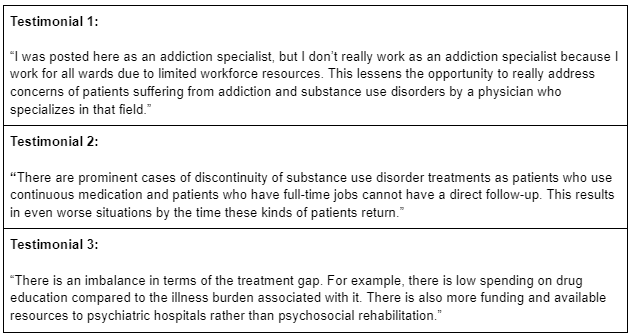
Study and analyze some hypothetical testimonials of primary healthcare providers to challenges in integrating and strengthening substance use services into primary care.
Step 3. Respond
Write a 300-450-word reflective piece of writing that will discuss strategies and approaches that may be implemented to address the challenges and barriers covered by all testimonials. To be more specific, your response should include the following:
- Strategies and approaches to addressing the challenges described in the three testimonials
- At least one strategy/approach that may be implemented for challenges/barriers that are not described in any of the testimonials
- Potential outcomes to substance use services within primary care settings
Step 4: Share
To share your work, click on the “Add a New Discussion” button under this post and paste your work in the “Message” box. Make sure to reference others’ intellectual property when necessary. All references should follow 7th Edition APA formatting. For further instructions, see the resource on the Himmelfarb Health Sciences Library: APA citation resource (N.B. references are excluded from word counts).
Step 5: Interact
To complete the activity, you will need to reply to at least two posts made by your peers in a respectful and professional manner. Ensure that your post engages your peers' ideas by including a reflection on their comments, sharing ideas of other potential difficulties and parties involved, or asking thought-provoking questions. If peer comments on your posting, please reply. To post a reply, click “Reply” on a particular discussion, write your feedback and then click on “Post to forum.”
OPTIONAL Step 6: Interact (10 minutes)
If you would like to, you can reply to your peers' posts in a respectful and professional manner. Ensure that your post engages your peers' ideas by including a reflection on their comments, sharing ideas of other potential difficulties and parties involved, or asking thought-provoking questions. If a peer comments on your posting, please reply. To post a reply, click “Reply” on a particular discussion, write your feedback and then click on “Post to forum.”
-
Quiz: Module 1
To access the quiz, click on the name of the quiz provided above. On the following screen, click the "Preview quiz now" button to respond to the questions.
TO PASS THIS QUIZ YOU MUST OBTAIN A SCORE OF 4/6
Not available unless: The activity Course Registration is marked complete ...Not available unless:- The activity Course Registration is marked complete
- The activity Pre-Test is marked complete
-
 Competencies covered in this module:
- Be competent in addressing stigma, and promoting and protecting the human rights of those you serve.
-
Learning Objectives:
Upon completion of this lesson, you will be able to:- Discuss international and national standards, legislation, and policies on mental health and human rights.
- Discuss stigma and its impact, as well as practical strategies to address it.
- Explain how to prevent stigma, marginalization, and discrimination and promote the social inclusion of people with mental, neurological, and substance use disorders by fostering strong links with employment, education, social (including housing), and other relevant sectors.
- Identify care provision in a way that respects the dignity of the person, is culturally sensitive and appropriate, and is free from discrimination on the basis of race, color, sex, language, religion, political or other opinion, nationality, ethnicity, indigenous or social origin, property, birth, age, or other status.
- Recognize matters of confidentiality, as well as the patient's right to privacy.
- Demonstrate how to ensure a patient understands the proposed treatment and provides free and informed consent for treatment.
-
Required Learning Resources and Activities
-
-
Students mustView
Read the entire webpage to familiarize yourself with how stigmas to substance use problems impact the dignity and human rights of affected individuals. (30 minutes)
Health and Human Rights Journal - 2021
-
Students mustView
Read the content from "Addressing mental health stigma in the LMICs" until " Conclusion." (17 minutes)
Asian Journal of Psychiatry - 2021
-
Students mustView
Read the content from the " Introduction" until "Enhancing Healthcare Team Outcomes". (39 minutes)
National Center for Biotechnology Information (NCBI) - 2021
-
Students mustView
Read the entire document to understand the patient's right to privacy and the physician's duty of confidentiality. (14 minutes)
Canadian Medical Association (CMA) - 2017
-
Students mustView
Read the entire webpage. (16 minutes)
StatPearls Publishing - 2021
-
Students mustViewStart discussions: 1
In this activity, you will assume the role of a neuropsychiatrist-radio reporter and present a special report on stigma, marginalization, and discrimination towards people suffering from mental/neurological/substance use disorders commonly experienced in one country.
Step 1. Research
Select three countries where stigma, marginalization, and discrimination towards people with mental/neurological/substance use disorders are common. More specifically, for each country, look for the following:
- Documented cases of stigma, marginalization, and discrimination against people with mental/neurological/substance use disorders
- Description of the cases
- Reported reasons why these people are common targets of stigma and discrimination
- Impact of stigma, marginalization, and discrimination
- Preventive strategies and interventions done to address these cases
Step 2. Respond
Assume the role of a radio reporter who has a formal background in neurology and psychiatry. You are assigned to present a special report on stigma, marginalization, and discrimination towards people suffering from mental/neurological/substance use disorders that are commonly experienced in three countries. You are expected to audio record a 3-7-minute special report that covers all the key points introduced in Step 1. Additionally, the special report should include the following:
- Your own recommendations as a radio reporter/neuropsychiatrist to address the documented cases
- Ways to ensure that a patient understands the proposed treatment for a mental/neurological/substance use disorder by providing free and informed consent for treatment.
Step 3. Rehearse and Record
Rehearse the audio report before making an audio recording of your final work. Ensure that all the necessary and required points are covered by your audio report. Refer to the rubric below as your guide.
Step 4. Share
To share your audio recording, click on the “Add a New Discussion” button under this post and paste your work in the “Message” box. Make sure to reference others’ intellectual property when necessary. All references should follow 7th Edition APA formatting. For further instructions, see the resource on the Himmelfarb Health Sciences Library: APA citation resource (N.B. references are excluded from word counts).
Step 5. Interact
Evaluate and categorize the work from one of your peers based on items A - E of the rubric below. Provide a rationale for the grade you have provided, as well as comments or suggestions for improvement. To post a reply, click “Reply” on a particular discussion, write your feedback and then click on “Post to forum.” You can use the list below as an example:
Item A is .…. because…. My suggestions for improvement are….
Item B is .…. because…. My suggestions for improvement are….
Item C is .…. because…. My suggestions for improvement are….
Item D is .…. because…. My suggestions for improvement are….
Item E is .…. because…. My suggestions for improvement are….OPTIONAL Step 6: Interact (10 minutes)
If you would like to, you can reply to your peers' posts in a respectful and professional manner. Ensure that your post engages your peers' ideas by including a reflection on their comments, sharing ideas of other potential difficulties and parties involved, or asking thought-provoking questions. If a peer comments on your posting, please reply. To post a reply, click “Reply” on a particular discussion, write your feedback and then click on “Post to forum.”
-
Quiz: Module 2
To access the quiz, click on the name of the quiz provided above. On the following screen, click the "Preview quiz now" button to respond to the questions.
TO PASS THIS QUIZ YOU MUST OBTAIN A SCORE OF 8/10
Not available unless: The activity Quiz: Module 1 is marked complete -
Students mustMark as done
Recommended Additional Readings
-
Students mustView
Read the entire document. (30 minutes)
United For Global Mental Health - 2021
-
Students mustView
Read the entire article to understand stigmas related to mental illness and how it creates barriers to access and quality care. (18 minutes)
National Center for Biotechnology Information (NCBI) - 2017
-
Students mustView
Read the entire webpage. (6 minutes)
Utah State University - 2020
-
Students mustView
Read the entire article to better understand strategies to assist in reducing the stigma of mental health. (32 minutes)
NCBI- 2017
-
Students mustView
Read the content under the headings "Equality and
Diversity, Inclusion, and Discrimination" until "Information, advice, and support" on pages 1-7. (13 minutes)Skills for Care - 2018
-
Students mustView
Read the guide. (60 minutes)
The Canadian Medical Protective Association - 2021
-
 Competencies covered in this module:
- Be competent in administering the ASSIST questionnaire.
-
Learning Objectives:
Upon completion of this lesson, you will be able to:- Explore and familiarize yourself with the Alcohol, Smoking, and Substance Involvement Screening Test (ASSIST), its background, and rationale for use in primary care.
- Summarize general and health-related problems related to substance use.
- Demonstrate interviewing skills necessary to screen for substance disorders using the ASSIST Screening Tool.
- Explain how to accurately score the answers to the ASSIST questionnaire.
- Explain the mhGAP model of care for alcohol and substance use disorders.
- Recognize a patient using an ASSIST Scorecard and give appropriate feedback.
- Explore other evidence-based models of screening and brief intervention in primary care.
-
Required Learning Resources and Activities
-
Students mustView
Read the content under the headings " Introduction", "Why you should use the ASSIST-Lite tool" and How to use the ASSIST-Lite tool: a step-by-step guide." (18 minutes)
Public health England - 2021
-
Students mustView
Read the first part of Chapter 1 (pages 6) and Appendix A (pages 35-39). (16 minutes)
The University of Adelaide - 2020
-
Students mustView
Read the content under the heading "Disorders Due to Substance Use" on pages 105-130. (53 minutes)
WHO - 2016
-
Students mustView
Read the content under the headings " The ASSIST Introduction", "Good practice in ASSIST questionnaire administration" and " How to administer the questionnaire" on pages 20-31. (31 minutes)
WHO - 2010
-
Students mustView
Watch the video entitled "How to administer the assist" (5 minutes)
ASSIST Portal - 2019
-
Students mustView
Read the content under the headings "Scoring of the Assist questionnaire" on pages 32-33 (5 minutes)
WHO - 2010
-
Students mustView
Read the content under the heading "Summary of Achievement." (4 minutes)
WHO - 2017
-
Students mustView
Read figure 1 (page 4), the section "feedback" (page 8), chapter 5 "PUTTING IT ALL TOGETHER" (pages 16 to 20), as well as Appendix B, C, and D (pages 40 to 47). (35 minutes)
The University of Adelaide - 2020
-
Students mustView
Watch the video entitled "ASSIST linked Brief Intervention" (6 minutes)
ASSIST Portal - 2019
-
Students mustView
Read chapters 2, 3, and 4 (pages 8 to 15). (32 minutes)
The University of Adelaide - 2020
-
Students mustViewStart discussions: 1
In this activity, you will role-play a practice interview using the ASSIST screening tool between a physician and a patient suffering from substance use disorders and explore other evidence-based models of screening and brief intervention in primary care.
Step 1. Review
Review how to use the ASSIST screening tool from the learning resources in this lesson.
Step 2. Prepare
Prepare the following prior to the role-play:
- The ASSIST-Lite form for general healthcare services (You can download the tool here: https://www.gov.uk/government/publications/assist-lite-screening-tool-how-to-use)
- The patient actor (Ask a friend or a person to play as the patient suffering from a substance use problem)
- The environment where the role-play interview will be simulated
- This can be a recorded face-to-face interview or a recorded virtual interview via Zoom/Skype/Microsoft Teams, etc.
Note: This should be a fictional interview. To respect privacy and confidentiality principles, please do not record an interview with one of your actual patients.
-
Gather information for at least two other evidence-based models of screening and brief intervention in primary care.
Step 3. Record
Record a 3-5-minutes audio that exhibits the role-playing of how to administer the ASSIST screening tool to the patient actor, proposed actions/treatments, and your exploration of other evidence-based models of screening and brief intervention in primary care. Make sure that the following will also be demonstrated in the video recording:
- Skills needed/required to screen for substance disorders using the ASSIST screening tool
- Correct administration of ASSIST screening tool
After the role-play screening, by the end of your video, discuss at least two other evidence-based models of screening and brief intervention in primary care. Ensure that the following details are included in the end-of-video discussion:
- Primary and distinct features of at least two other models
- Pros and cons of using these screening models
- Brief guidelines on how to use these models
Step 4. Share
To share your work, click on the “Add a New Discussion” button under this post and paste your work in the “Message” box. Make sure to reference others’ intellectual property when necessary. All references should follow 7th Edition APA formatting. For further instructions, see the resource on the Himmelfarb Health Sciences Library: APA citation resource (N.B. references are excluded from word counts).
Step 5. Interact
Evaluate and categorize the work from one of your peers based on items A - E of the rubric below. Provide a rationale for the grade you have provided, as well as comments or suggestions for improvement. To post a reply, click “Reply” on a particular discussion, write your feedback and then click on “Post to forum.” You can use the list below as an example:
Item A is.....because.....My suggestions for improvement are.....
Item B is.....because.....My suggestions for improvement are.....
Item C is.....because.....My suggestions for improvement are.....
Item D is.....because.....My suggestions for improvement are.....
Item E is.....because.....My suggestions for improvement are.....OPTIONAL Step 6: Interact (10 minutes)
If you would like to, you can reply to your peers' posts in a respectful and professional manner. Ensure that your post engages your peers' ideas by including a reflection on their comments, sharing ideas of other potential difficulties and parties involved, or asking thought-provoking questions. If a peer comments on your posting, please reply. To post a reply, click “Reply” on a particular discussion, write your feedback and then click on “Post to forum.”
-
Quiz: Module 3
To access the quiz, click on the name of the quiz provided above. On the following screen, click the "Preview quiz now" button to respond to the questions.
TO PASS THIS QUIZ YOU MUST OBTAIN A SCORE OF 8/10
Not available unless: The activity Quiz: Module 2 is marked complete -
Recommended Additional Readings
-
Students mustView
This website provides an overview of the effects of various drugs and substances.
Click on the icons "alcohol", "cannabis", "cocaine", "heroin", and "opioids" and read the related content.
If you are interested in knowing more about the effects of other drugs and substances, you can click on the corresponding icons. (30 minutes)Alcohol and drug foundation - 2021
-
Students mustView
Read pages 39 to 45 to learn more about the skills needed for efficient screening of substance use disorders. (10 minutes)
Substance Abuse and Mental Health Services Administration (SAMHSA) - 2019
-
Students mustView
Read the content under the headings " Key Messages" until "Screening for Past and Present Mental Disorders." (44 minutes)
Substance Abuse and Mental Health Services Administration (SAMHSA) - 2020
-
Students mustView
Watch the video entitled "Assist with Substance."(33 minutes)
ASSIST Portal - 2019
-
Students mustView
Read the entire article to learn about SBIRT as a method to identify and deliver services to those at risk for substance use disorders, depression, and other mental health conditions. (26 minutes)
BMC - 2017
-
Students mustView
From the menu on the left-hand side, read the 'Key Concepts and Learning Goals', then read the 'Questions' section. Complete the 'Questions' and post them online by entering your name and clicking ‘Done'. Continue through the modules from the 'Introduction' section and complete 'Clinical Evaluation'. While watching the 'Initial Visit Video', take note of the blue icons and comments to the right of the video. At appropriate times during the video, these comments will be highlighted in yellow. At this time, you can click on the blue icon and another smaller video will pop up. This smaller video will share thoughts and comments running through the minds of the doctors and patients during the interview. (60 minutes)
NIDA Centers of Excellence Physician Information - 2018
-
 Competencies covered in this module:
Deepen your understanding of aspects related to tobacco use cessation. - Deepen your understanding of alcohol and other substance use disorders, including their impact and care.
-
Learning Objectives:
Upon completion of this lesson, you will be able to:- Identify the effectiveness of tobacco cessation interventions.
- Recognize the general benefits and challenges of quitting smoking.
- Describe the personal health disease risks (e.g., cardiovascular, respiratory, and cancer) associated with tobacco use and involuntary (secondhand) exposure to tobacco smoke.
- Explain how brief advice is given in practice.
- Discuss the impact of alcohol on overall health and be able to educate people about harmful alcohol use, including during pregnancy and breastfeeding.
- Identify the resources (including community support) and tips to encourage self-monitoring of symptoms and be able to explain when to seek care immediately.
- Discuss common consequences of other substance use.
-
Required Learning Resources and Activities
-
Students mustView
Read the abstract, introduction, and discussion section to the end of the conclusion. (17 minutes)
European Addiction Research - 2020
-
Students mustView
Download the PDF and read the table. (5 minutes)
WHO - 2001
-
Students mustView
Read from the abstract to 'Interventions to combat smoking.' (28 minutes)
Psychology and Health - 2017
-
Students mustView
Read the entire article, which describes the personal health risks of tobacco use. (5 minutes)
CDC - 2021- reviewed
-
Students mustView
Read the entire webpage. (4 minutes)
CDC - 2025
-
Students mustView
Read the entire article, which provides further information on how to deal with tobacco withdrawal symptoms in language adapted for patient self-help. (10 minutes)
NIH - 2022
-
Students mustView
Read this factsheet to learn more about how alcohol use and abuse can affect health. (10 minutes)
CDC - 2021- reviewed
-
Students mustView
Read this resource to learn about the effects and risks of drinking alcohol for teens and adults. (7 minutes)
MedlinePlus - 2020
-
Students mustView
Read the entire webpage. (5 minutes)
Australian Government, Department of health - 2020
-
Students mustView
Read the entire webpage. (10 minutes)
Better Health-Victoria State Government - 2021
-
Students mustView
Read the entire article. (33 minutes)
Stat Pearls - 2021
-
Students mustViewStart discussions: 1
In this activity, you will write a social media post that talks about the impact of alcohol on pregnancy, breastfeeding, and overall health and common consequences of other substance use.
Step 1. Review
Review all the learning resources for this lesson.
Step 2. Study
Study the given scenario.
Scenario:
The mayor of your locality has observed a documented rise in alcohol and substance use problems in the general population, but most especially among pregnant women and women who recently gave birth. In order to address this issue, the mayor thought of disseminating information about the impact of alcohol and substance use on pregnancy, breastfeeding, and overall health, primarily through your city’s official social media account. As the chief gynecologist of your city, the mayor requested you to draft the language for a social media post to educate women, including the general public, about harmful alcohol use, including during pregnancy and breastfeeding.
Step 3. Respond
Write 200-400 words for a social media infographic post with the following inclusions:
- Prevalence of alcohol and substance use among pregnant, new mothers, and the general population
- Key risk factors for their alcohol consumption and substance use
- Current status of pregnant women, new mothers, and the general population with alcohol and substance use/consumption problems
- Impact of alcohol use on pregnancy and breastfeeding as well as overall health
- Challenges and barriers to treatment and management
Recommendations
Note: You can include graphics or pictures if relevant.
Step 4: Share
To share your work, click on the “Add a New Discussion” button under this post and paste your work in the “Message” box. Make sure to reference others’ intellectual property when necessary. All references should follow 7th Edition APA formatting. For further instructions, see the resource on the Himmelfarb Health Sciences Library: APA citation resource (N.B. references are excluded from word counts).
Step 5: Interact
To complete the activity, you will need to reply to at least two posts made by your peers in a respectful and professional manner. Ensure that your post engages your peers' ideas by including a reflection on their comments, sharing ideas of other potential difficulties and parties involved, or asking thought-provoking questions. If peer comments on your posting, please reply. To post a reply, click “Reply” on a particular discussion, write your feedback and then click on “Post to forum.”
OPTIONAL Step 6: Interact (10 minutes)
If you would like to, you can reply to your peers' posts in a respectful and professional manner. Ensure that your post engages your peers' ideas by including a reflection on their comments, sharing ideas of other potential difficulties and parties involved, or asking thought-provoking questions. If a peer comments on your posting, please reply. To post a reply, click “Reply” on a particular discussion, write your feedback and then click on “Post to forum.”
-
Quiz: Module 4
To access the quiz, click on the name of the quiz provided above. On the following screen, click the "Preview quiz now" button to respond to the questions.
TO PASS THIS QUIZ YOU MUST OBTAIN A SCORE OF 8/10
Not available unless: The activity Quiz: Module 3 is marked complete -
Students mustMark as done
Recommended Additional Readings
-
-
Students mustView
Read the entire webpage. (17 minutes)
Very Well Mind - 2022
-
-
Students mustView
Read the introduction until the end of the section "Where do I get more information." (31 minutes)
UptoDate - 2021
-
Students mustView
This resource will give you a good understanding of the impact of alcohol on the body. (30 minutes)
NIH
-
Students mustView
Read pages 159 to 182 of the book. (66 minutes)
Pathways of Addiction: Opportunities in Drug Abuse Research
- 2022
-
 Competencies covered in this module:
- Be able to recognize severe mental health risks that are sometimes associated with substance use.
- Be aware of how substance use can affect sexuality and the risk of HIV infection.
- Be aware of alcohol comorbidities relating to HIV, depression, psychosis, and reproduction (Fetal Alcohol Spectrum Disorders).
- Be aware of special reproductive health issues for women in relation to substance use, comorbidity, and pharmacological treatment.
- Be able to assist patients in leading healthy lifestyles.
-
Learning Objectives:
Upon completion of this lesson, you will be able to:- Identify evidence of severe self-injury, such as signs of poisoning or intoxication, or signs/symptoms requiring urgent medical treatment such as bleeding from self-inflicted wounds, loss of consciousness, or extreme lethargy.
- Recognize how substance abuse can impact HIV-related risks.
- Identify the need for education and support for those with mental illness and/or substance use disorders in relation to risky behavior (e.g., unprotected sex).
- Explain why those who drink alcohol have a higher chance of contracting HIV.
- Explore potential risks of medications for the fetus or baby when providing care to a pregnant or breastfeeding woman. Ensure that the babies being breastfed by women on medications are monitored for adverse effects or withdrawal and undergo comprehensive examinations if required.
- Discuss plans for contraception and pregnancy with women of childbearing age.
- Demonstrate assisting patients in acquiring healthy lifestyles, which may improve mental health and help manage substance use triggers, such as stress.
- Demonstrate how to perform/conduct a general healthy weight assessment (BMI, weight, and height).
-
Required Learning Resources and Activities
-
Students mustView
Read the sections on self-harm and suicide (pgs. 131-140). (13 minutes)
WHO - 2016
-
-
Students mustView
Read section 5 "Presentation of self‑harm" (pages 34 to 45) (31 minutes)
Royal College of Psychiatrists - 2020
-
Students mustView
Read each of the following sections: 'What Is Co-morbidity?', 'Is Drug Addiction a Mental Illness?', 'How Common Are Comorbid Drug Addiction and Other Mental Illnesses?', and the first 3 paragraphs of 'Why Do These Disorders Often Co-occur?' (7 minutes)
NIH-NIDA - 2018
-
Students mustView
Read the entire article. (45 minutes)
Clinicalinfo. Hiv.gov - 2021
-
Students mustView
Read chapter 3. (75 minutes)
SAMHSA - 2020
-
Students mustView
Read the entire webpage. (5 minutes)
CDC - 2018
-
Students mustView
Read the entire webpage. (4 minutes)
HIVinfo.NIH.gov - 2018
-
Students mustView
Read the following sections "Introduction," "Results" and "Discussion". (19 minutes)
Dove Press - 2017
-
-
Students mustView
Read the entire article. (10 minutes)
Shanghai Archives of Psychiatry - 2017
-
-
Students mustView
Read "Substance Use While Pregnant and Breastfeeding" on pages 12-23. (19 minutes)
National institute on drug abuse - 2020
-
Students mustViewStart discussions: 1
In this activity, you will assume the role of a chief gynecologist of a local hospital and write dialogue as a full response to demonstrate effective communication with patients on maternity and reproductive health care.
Step 1. Review
Review the learning resources for this lesson.
Step 2. Study
Study the given scenario below:
You are the chief gynecologist of the local central hospital. This week you are deployed to conduct consultations with a group of pregnant women and new mothers who are seeking maternity care. One patient, a pregnant woman who has a pre-existing opioid use disorder, is accompanied by two sisters: one is a breastfeeding mother who is planning to use contraception and the other sister is trying to conceive. As the gynecologist, you are expected to communicate the potential risks of opioid use disorder medications for the baby and arrange plans for contraception and pregnancy respectively for the two sisters.
Step 3. Respond
Write a 300-800-word dialogue as a full response that demonstrates effective communication between a gynecologist and the patients regarding the following:
For the pregnant patient (at least 200 words)
- Assessment of the need for opioid use disorder medications for the pregnant woman
- Potential risks of medication against the benefit of treatment on mother and fetus
- Safety of the medication (stage of pregnancy, route of administration, dose)
- Alternative non-drug measures
- Monitoring the efficacy of medication throughout the exposure
For the breastfeeding mother on contraception (at least 200 words)
- Hormonal and non-hormonal methods of contraception
- Risks and benefits of different methods of contraception, especially for breastfeeding women
- Safe, appropriate, and effective contraception options for breastfeeding
- Planning and monitoring efficacy of the chosen contraceptive method
For the patient requesting a fertility consultation (at least 200 words)
- Assessment of the fertility status of the patient
- Is the patient having a hard time getting pregnant?
- If so, what makes it difficult for the patient to get pregnant?
- Is she taking birth control pills or other medications prior to the consultation?
- Lifestyle changes and supplement options
- Other fertility options
- Pros and cons
- Arrangement of fertility plan for the patient and her partner
- Fertility Test
- Planning and monitoring efficacy of the selected fertility plan
Step 4: Share
To share your work, click on the “Add a New Discussion” button under this post and paste your work in the “Message” box. Make sure to reference others’ intellectual property when necessary. All references should follow 7th Edition APA formatting. For further instructions, see the resource on the Himmelfarb Health Sciences Library: APA citation resource (N.B. references are excluded from word counts).
Step 5: Interact
To complete the activity, you will need to reply to at least two posts made by your peers in a respectful and professional manner. Ensure that your post engages your peers' ideas by including a reflection on their comments, sharing ideas of other potential difficulties and parties involved, or asking thought-provoking questions. If a peer comments on your posting, please reply. To post a reply, click “Reply” on a particular discussion, write your feedback and then click on “Post to forum.
OPTIONAL Step 6: Interact (10 minutes)
If you would like to, you can reply to your peers' posts in a respectful and professional manner. Ensure that your post engages your peers' ideas by including a reflection on their comments, sharing ideas of other potential difficulties and parties involved, or asking thought-provoking questions. If a peer comments on your posting, please reply. To post a reply, click “Reply” on a particular discussion, write your feedback and then click on “Post to forum.”
-
Recommended Additional Readings
-
-
Students mustView
Read the entire chapter. (80 minutes)
SAMHSA - 2020
-
Students mustView
Read the entire article. (12 minutes)
StatPearls Publishing - 2021
-
Students mustView
Read the flowchart on page 3, as well as Section 2 "Initial newborn care," Section 3 "assessment," and Section 4 "Supportive care" on pages 8-15. (23 minutes)
Queensland Health - 2021
-
Students mustView
Read the entire document. (7 minutes)
SAMHSA - 2019
-
Learning Objectives:
Upon completion of this lesson, you will be able to:- Demonstrate assisting patients in acquiring healthy lifestyles, which may improve mental health and help manage substance use triggers, such as stress.
- Demonstrate how to perform/conduct a general healthy weight assessment (BMI, weight, and height)
-
Students mustMark as done
Required Learning Resources and Activities
-
Students mustView
Read the entire webpage. (5 minutes)
The University of Arizona - 2019
-
Students mustView
Read the entire webpage. (7 minutes)
National Institutes of Health - 2020
-
-
Students mustView
Read the entire web page about exercise and mental health, paying special attention to the benefits and possible tips that you can give to patients who may be suffering from mental health disorders, to increase their level of physical activity. (18 minutes)
Mental Health Foundation - 2022- reviewed
-
Students mustView
Read through this resource to learn about healthy weights. (15 minutes)
CDC - 2020
-
Students mustView
Read this entire resource that provides a background on the usefulness and limitations of the BMI. (10 minutes)
CDC - 2021
-
Students mustView
This is a direct link to an online BMI calculator (in metrics units). Please calculate your own BMI for practice. (5 minutes)
NIH
-
Students mustViewStart discussions: 1
In this activity, you will audio-record a follow-up consultation between a physician and a recovering substance user and demonstrate how to perform a general healthy weight assessment and assist the patient in planning his lifestyle.
Step 1. Review
Review the learning resources for this lesson.
Step 2. Study
Study the given scenario:
You are attending a follow-up meeting with a 16-year old recovering substance and alcohol user. He is accompanied by his father. For this consultation, you will conduct a psychosocial and lifestyle assessment in order to assist the patient in acquiring a healthy lifestyle to improve mental health and management of substance use triggers such as stress.
Step 3. Record
Record the given scenario through an audio role-play by acting as the physician. As for the patient and his father, you may ask for other persons to act out the roles as long as they are not your actual patients. In the absence of human resources, you may act out all the roles. The simulation video must be within 3-5 minutes. Additionally, it must cover the following:
- General healthy weight assessment of the patient (BMI, weight, height)
- A discussion on the following topics
- Patient’s well-being
- Patient’s social, school, and home environments
- Patient’s lifestyle (nutrition, substance use, physical exercise, and sleep behavior)
- Development of a lifestyle caring plan with the patient
- Changes in diet, nutrition, physical exercise, and sleeping behavior
- Practicing techniques to manage mental health, stress, and other substance use triggers
- Building positive relationships
- Religious/Spiritual/ Recreational involvement
Note: This can be a recorded face-to-face interview or a recorded virtual interview via Zoom/Skype/Microsoft Teams, etc.
Step 4. Share
To share your work, click on the “Add a New Discussion” button under this post and paste your work in the “Message” box. Make sure to reference others’ intellectual property when necessary. All references should follow 7th Edition APA formatting. For further instructions, see the resource on the Himmelfarb Health Sciences Library: APA citation resource (N.B. references are excluded from word counts).
Step 5. Interact
Evaluate and categorize the work from one of your peers based on items A - E of the rubric below. Provide a rationale for the grade you have provided, as well as comments or suggestions for improvement. To post a reply, click “Reply” on a particular discussion, write your feedback and then click on “Post to forum.” You can use the list below as an example:
Item A is .…. because…. My suggestions for improvement are….
Item B is .…. because…. My suggestions for improvement are….
Item C is .…. because…. My suggestions for improvement are….
Item D is .…. because…. My suggestions for improvement are….
Item E is .…. because…. My suggestions for improvement are....OPTIONAL Step 6: Interact (10 minutes)
If you would like to, you can reply to your peers' posts in a respectful and professional manner. Ensure that your post engages your peers' ideas by including a reflection on their comments, sharing ideas of other potential difficulties and parties involved, or asking thought-provoking questions. If a peer comments on your posting, please reply. To post a reply, click “Reply” on a particular discussion, write your feedback and then click on “Post to forum.”
-
Quiz: Module 5
To access the quiz, click on the name of the quiz provided above. On the following screen, click the "Preview quiz now" button to respond to the questions.
TO PASS THIS QUIZ YOU MUST OBTAIN A SCORE OF 8/10
Not available unless: The activity Quiz: Module 4 is marked complete -
Students mustMark as done
Recommended Additional Readings
-
Students mustView
This link provides several self-help wellness modules covering issues such as anger, sleep, and diet. (30 minutes)
HeretoHelp - 2019
-
 Competencies covered in this module:
- Be proficient in effective communication with those to whom you provide care, their family, and their caregivers.
-
Learning Objectives:
Upon completion of this lesson, you will be able to:- Recognize how to use simple and clear language, and ask the person for his or her own understanding of the condition. Provide information to the person on their health status in terms that they can understand, and be friendly, respectful, and non-judgmental at all times.
- Explain how communication is clear, compassionate, and reflective of age, gender, culture, and language differences.
- Demonstrate how to keep caregivers informed about the person’s health status, including issues related to assessment, treatment, follow-up, and any potential side effects while ensuring the patient's consent.
- Recognize how to respond to disclosure of private and distressing information (e.g., regarding sexual assault or self-harm) with sensitivity.
-
Required Learning Resources and Activities
-
Students mustMark as done
Read the entire webpage. (15 minutes)
CPD Online College - 2021
-
Students mustView
Read the entire webpage. (2 minutes)
Minnesota Department of Health - 2022
-
Students mustView
Read the content under the headings " Improving Communication", "Communicating with Patients." and "Guidelines for successful therapeutic interactions". (8 minutes)
InTechOpen - 2017
-
Students mustView
Read from the abstract to conclusion. (33 minutes)
BMC Nursing - 2021
-
Students mustView
Read the entire webpage, paying special attention to the section "Sharing information with those close to the patient." (12 minutes)
General Medical Council - 2018
-
Students mustView
Read the entire article. (14 minutes)
AAFP - 2019
-
Students mustViewStart discussions: 1
In this activity, you will assume the role of a group therapist and prepare a script as a response to the disclosure of private and distressing information in the given scenario and how to build effective communication and relationship with the caregiver by keeping caregivers informed about the person’s health status, including issues related to assessment, treatment, follow-up, and any potential side effects, while ensuring the patient's consent.
Step 1. Review
Review the learning resources for this lesson.
Step 2. Study
Analyze and study the given scenario below:
A group therapist was currently conducting a round-robin discussion where the members were being asked to share their triumphs and challenges in their lifestyle plans for this week. The discussion was going well until Imee, a 60-year old patient who has lung cancer and severe alcohol consumption, openly shared a distressing incident that happened in her household. Apparently, she tried suicidal drowning by jumping into the pool when everybody was supposed to be sleeping. At that time, her caregiver was on leave to take care of a personal business. The group therapist arranged individual therapy with the patient to address the incident. After attaining consent from the patient, the therapist decided to arrange a dialogue with Imee’s caregiver to inform him/her about the patient’s worsening condition, including issues related to assessment, treatment, follow-up, and any potential side effects.
Step 3. Reflect and Write
Reflect on the given scenario by thinking about two approaches to building effective communication with the caregiver, potential issues, and advantages of their approaches. Then, write a 300-600-word script that will demonstrate one of the two approaches if you are in the position of the group therapist. To be more specific, it must be able to show your:
- Response to the disclosure of private and distressing information in the given scenario
- Approach of how you will build effective communication and relationship with the caregiver, keep the caregiver informed about the person’s health status, including potential issues related to assessment, treatment, follow-up, and any potential side effects, while ensuring the patient's consent.
Step 4. Share
To share your work, click on the “Add a New Discussion” button under this post and paste your work in the “Message” box. Make sure to reference others’ intellectual property when necessary. All references should follow 7th Edition APA formatting. For further instructions, see the resource on the Himmelfarb Health Sciences Library: APA citation resource (N.B. references are excluded from word counts).
Step 5. Interact
Evaluate and categorize the work from one of your peers based on items A - E of the rubric below. Provide a rationale for the grade you have provided, as well as comments or suggestions for improvement. To post a reply, click “Reply” on a particular discussion, write your feedback and then click on “Post to forum.” You can use the list below as an example:
Item A is .…. because…. My suggestions for improvement are….
Item B is .…. because…. My suggestions for improvement are….
Item C is .…. because…. My suggestions for improvement are….
Item D is .…. because…. My suggestions for improvement are….
Item E is .…. because…. My suggestions for improvement are….OPTIONAL Step 6: Interact (10 minutes)
If you would like to, you can reply to your peers' posts in a respectful and professional manner. Ensure that your post engages your peers' ideas by including a reflection on their comments, sharing ideas of other potential difficulties and parties involved, or asking thought-provoking questions. If a peer comments on your posting, please reply. To post a reply, click “Reply” on a particular discussion, write your feedback and then click on “Post to forum.”
-
Quiz: Module 6
To access the quiz, click on the name of the quiz provided above. On the following screen, click the "Preview quiz now" button to respond to the questions.
TO PASS THIS QUIZ YOU MUST OBTAIN A SCORE OF 7/9
Not available unless: The activity Quiz: Module 5 is marked complete -
Recommended Additional Readings
-
Students mustMark as done
Read the entire webpage. (7 minutes)
NIH - 2021
-
Students mustMark as done
Read the entire webpage. (3 minutes)
Stanford News: Stanford University - 2019
-
-
Students mustMark as done
Read the entire article. (10 minutes)
Expert Review of Pharmacoeconomics & Outcomes Research - 2020
-
Students mustView
Under the heading of Resource Materials, click to download the file named 'Powerpoint Slides (4.2MB)', which has lecture notes. Review slides 1-19, 23-39 and 44-58 and be sure to read the speaker notes as well. The rest of the slides are supplementary for this training. (30 minutes)
NIH
-
Students mustView
Read the document. (50 minutes)
Welsh Government - 2019
-
Students mustView
Read the entire webpage. (5 minutes)
Hampshire Safeguarding Children Partnership - 2020
-
Students mustView
Read the entire webpage. (13 minutes)
General Medical Council - 2017
-
-
Final Exam Quiz
To take the final exam, you must complete all quizzes and complete all the required activities. The final exam consists of 39 questions, and you will have 78 minutes to complete it. When the time is over, you will have two minutes to submit your attempt before it expires, and your progress is discarded. You will not be able to answer additional questions in the grace period.
To access the exam, click on the name of the exam provided above. On the following screen, click the attempt quiz button to respond to the questions.
Not available unless: All of: ...Not available unless:-
All of:
- The activity Course Registration is marked complete
- The activity Pre-Test is marked complete
- The activity Quiz: Module 1 is marked complete
- The activity Quiz: Module 2 is marked complete
- The activity Quiz: Module 3 is marked complete
- The activity Quiz: Module 4 is marked complete
- The activity Quiz: Module 5 is marked complete
- The activity Quiz: Module 6 is marked complete
-
All of:
- The activity Discussion Forum 1: Improving Mental Health and Substance Use Care (300 minutes) is marked complete
- The activity Peer Activity 1: A Reporter’s Special Episode (360 minutes) is marked complete
- The activity Peer Activity 2: Exploring ASSIST as a screening tool and other evidence-based models [360 minutes] is marked complete
- The activity Discussion Forum 2: The Impact of Alcohol on Pregnancy and Breastfeeding (300 minutes) is marked complete
- The activity Discussion Forum 3: Maternity Care and Reproductive Health Care (420 minutes) is marked complete
- The activity Peer Activity 3: A Lifestyle Assessment Simulation (360 minutes) is marked complete
- The activity Peer Activity 4: Understanding Family Caregiver Communication (420 minutes) is marked complete
-
All of:
-
-
 In this section, you can provide feedback about this course to help us make NextGenU.org better. Once evaluations are completed, you will be able to download your certificate of completion.
-
Course Evaluation QuestionnaireNot available unless: The activity Final Exam is marked complete
-
Self Evaluation QuestionnaireNot available unless: The activity Final Exam is marked complete
-
-
-
Students mustMark as done
-
Students mustMark as done
-
-