Physics
-
SciencesPhysicsResume0% complete0% complete
Introduction
Show More Show LessWelcome to the Physics course, part of the series for the Pre-Health Sciences Training Certificate. This course and the certificate are designed primarily for learners interested in preparing for and gaining entry to health-related programs and to help address the prerequisites for the Medical College Admission Test (MCAT). This Physics course provides learners with a comprehensive overview of concepts in Physics that are necessary for developing critical thinking skills and applicable to understanding specific bodily functions. It explores the fundamental principles of Newton’s Laws, Energy, Waves, Fluids, Electricity, Light, and Magnetism.
-
Students mustStudent must submit this questionnaire to complete it
-
Students mustViewReceive a grade
Show More-
Physics Homepage
Highlighted

Welcome to the Physics course, part of the series for the Pre-Health Sciences Training Certificate. This course and the certificate are designed primarily for learners interested in preparing for and gaining entry to health-related programs and to help address the prerequisites for the Medical College Admission Test (MCAT). This Physics course provides learners with a comprehensive overview of concepts in Physics that are necessary for developing critical thinking skills and applicable to understanding specific bodily functions. It explores the fundamental principles of Newton’s Laws, Energy, Waves, Fluids, Electricity, Light, and Magnetism.
The Physics course is sponsored in part by the International Development Research Centre and the University of the Incarnate Word School of Osteopathic Medicine. Like all NextGenU.org courses, it is competency-based, using competencies based on the Association of American Medical Colleges’ Medical College Admission Test. It uses learning resources from accredited, academic, professional, and world-class organizations and universities such as Rice University. This course was designed by Alixandria Ali BSc; Kabiru Gulma B. Pharm, MBA, MSc., Ph.D.; Marco Aurelio Hernandez, Ph.D., MSc; MSc; BSc.; Felix Emeka Anyiam, MPH, MScPH, DataSc.; Pablo Baldiviezo MD, MSc, DiplEd; Tristan Aaron Wild, BMSc (Hons); Davy Lau; and Cassandra Wild.
For publications on NextGenU.org’s courses’ efficacy, see NextGenU.org’s publication page.
There are eight (8) modules to complete, which provide an introduction to:
Module 1: Translational Motion
Module 2: Forces and Newton's Laws
Module 3: Momentum, Work, and Energy
Module 4: Waves
Module 5: Fluids and Solids
Module 6: Electricity and Magnetism
Module 7: Light and Lenses
Module 8: Atomic and Particle PhysicsThe completion time for this course is estimated at 94 hours, comprising 82 hours of learning resources and 12 hours of participating in learning activities and quizzes to assist the learners in synthesizing learning materials. This course is equivalent to 2 credit hours in the U.S. undergraduate/bachelor’s degree system.
The course requires the completion of all quizzes, discussion forums, and practical activities to receive a course certificate. Practice quizzes are available throughout the course and contain 10 Multiple-Choice Questions each. After you’ve completed each module, quiz, and learning activity, at the end of the course, you’ll have access to a final exam consisting of 40 Multiple-Choice Questions and a chance to evaluate this course. Participants have up to three opportunities to take the final exam and achieve the required passing score of >=70%. Once you’ve passed the final exam and completed the evaluations, you will be able to download a certificate of completion from NextGenU.org and our course’s co-sponsoring organizations.
We keep all of your personal information confidential, never sell any of your information, and only use anonymized data for research purposes. Also, we are happy to report your testing information and share your work with anyone (your school, employer, etc.) at your request.
Engaging with this Course:
This free course is aimed at students who have graduated from high school and want to prepare to become a health professional and/or pass the MCAT exam. You may also browse this course for free to learn for your personal enrichment. There are no requirements.
To obtain a certificate, a learner must first register for the course and then successfully complete:
- The pre-test,
- All the reading requirements,
- All quizzes and pass with 80% with unlimited attempts,
- All practical activities,
- All discussion forums,
- The final lab activity,
- The final exam with a minimum of 80% and a maximum of 3 attempts, and
- The self and course evaluation forms.
To obtain credit:- Complete all requirements listed above for the certificate, and
- Your learning institution or workplace should approve the partner-university-sponsored NextGenU.org course for educational credit, as they usually would for their learner taking a course anywhere.
NextGenU.org is happy to provide your institution with:- A link to and description of the course training so they can see all of its components, including the co-sponsoring institutions,
- Your grade on the final exam,
- Your work products (e.g., discussion forum responses) and any other required or optional shared materials that you produce and authorize to share with them,
- Your evaluations -- course and self-assessments,
- A copy of your certificate of completion with the co-sponsoring organizations listed.
To obtain a degree, NextGenU.org co-sponsors degree programs with institutional partners. To obtain a full degree co-sponsored with NextGenU.org, registrants must be enrolled in a degree program as a student of a NextGenU.org institutional partner. If you think your institution might be interested in offering a degree with NextGenU.org, contact us.We hope you will find this a rewarding learning experience, and we count on your assessment and feedback to help us improve this training for future students.
Here are the next steps to take the course and earn a certificate:
- Complete the registration form,
- Take the pre-test, and
- Begin the course with Module 1:Translational Motion. In each lesson, read the description, complete all required readings and any required activity, as well as take the corresponding quizzes.
-
We've utilized the Quizlet platform to create specialized flashcards designed to reinforce and test your knowledge throughout this course. Simply click the links to freely access them. Feel free to browse through our other sets of flashcards. Dive in and happy studying!
-
Competencies covered in this module:- Translational motion, forces, work, energy, and equilibrium in living systems.
-
Upon completion of this lesson, you will be able to:Learning Objectives:
- Explain how the methods of science are used to make scientific discoveries.
- Compare and contrast hypothesis, theory, and law
- .Recognize commonly used SI units and the relationships between them.
- Express quantities given in SI units using metric prefixes.
-
Students mustMark as done
Required Learning Resources and Activities
-
-
Students mustView
Read the entire webpage. (66 minutes)
OpenStax -2023
-
Upon completion of this lesson, you will be able to:Learning Objectives:
- Distinguish between scalar and vector units.
- Explain how the magnitude of a vector is defined in terms of the components of a vector.
- Identify the direction angle of a vector in a plane .
- Apply analytical methods of vector algebra to find resultant vectors and to solve vector equations for unknown vectors.
-
Students mustMark as done
Required Learning Resources and Activities
-
Students mustView
Read from the section "Components of a Vector" to the end of the section "Scalars vs. Vectors," and watch the video. (16 minutes)
The LibreTexts Physics - 2020
-
Students mustView
Read from the section "Adding and Subtracting Vectors Graphically" to the end, and watch the videos. (16 minutes)
The LibreTexts Physics - 2020
-
Upon completion of this lesson, you will be able to:Learning Objectives:
- Explain the relationships between instantaneous velocity, average velocity, instantaneous speed, average speed, displacement, and time.
- Calculate velocity and speed given initial position, initial time, final position, and final time.
- Represent and calculate acceleration using graphical methods .
- Analyze and describe how the values of the position, velocity, and acceleration change during a free fall.
- Apply the principle of independence of motion to solve projectile motion problems.
-
Students mustMark as done
Required Learning Resources and Activities
-
Students mustView
Read the entire page and watch the videos. (25 minutes)
OpenStax - 2023
-
Students mustView
Read the entire page and watch the videos. (25 minutes)
OpenStax - 2023
-
-
Students mustView
Read the entire webpage and, if you are able to, interact with the virtual demonstration. (16 minutes)
OpenStax - 2023
-
Students mustView
Read the entire webpage and, if you are able to, interact with the virtual demonstration. (28 minutes)
OpenStax - 2023
-
Students mustView
Read the entire webpage and, if you are able to, interact with the virtual demonstration. (37 minutes)
OpenStax - 2023
-
Students mustView
Read the entire page and watch the videos. (13 minutes)
The LibreTexts Physics - 2019
-
Students mustView
Read the entire page. (31 minutes)
The LibreTexts Physics - 2022
-
Students mustViewStart discussions: 1
Step 1. Review
Review the learning resources for this lesson before studying the case problem.
Step 2. Analyze
Analyze the case problem below.
Background: A projectile is an object that is projected or launched into the air and then moves through the air under the sole influence of gravity. In this sense, a projectile is a free-falling object that experiences a downward acceleration of approximately 10 m/s/s.
Getting Ready: Navigate to the Projectile Simulator in the Physics Interactives section of The Physics Classroom website:
http://www.physicsclassroom.com/Physics-Interactives/Vectors-and-Projectiles/Projectile-Simulator
Click on Launch Interactive
Once the Interactive opens, set the Speed to 10 m/s. Set the Angle to 0 degrees. Set the Height to 120 m. Select Show Velocity Vectors in order to enable this feature.
Directions and Questions:
1. Click the Start button and observe the simulation. The red arrows are velocity vectors. They are indicators of how fast the object is moving horizontally and vertically. The length of the arrow indicates how fast the object is moving in that direction. Does the object change how fast it is moving in the horizontal direction? _________ Explain why you answered this way.
2. Reset and Start the animation again to answer the following question: Does the object change how fast it is moving in the vertical direction? _________ Explain why you answered this way.
3. How does the initial horizontal velocity (right after it starts moving) compare to the final horizontal velocity (just before hitting the ground)? a. They are equal. b. The initial is greater c. The final is greater
4. How does the initial vertical velocity (right after it starts moving) compare to the final vertical velocity (just before hitting the ground)? a. They are equal. b. The initial is greater c. The final is greater
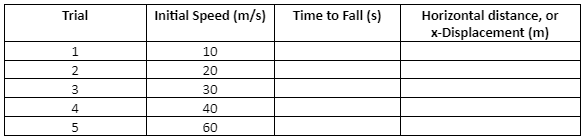
5. Now run the several trials to fill in the table. Click Reset after each trial to prepare for the next. Keep the initial height at 120 m and the angle at 0 degrees.

Step 3. Respond
After analyzing the data above, respond to the case problem by answering the following questions:
6. Describe the effect that increasing launch speed has upon the time to fall.
7. Describe the effect that increasing launch speed has upon the horizontal distance or x-displacement.
Step 4. Share
To share your work, click on the “Reply” button under this post and paste your work (the answers to the questions) into the “Message” box. Make sure to reference others’ intellectual property when necessary. All references should follow 7th Edition APA formatting. For further instructions, see the resource on the Himmelfarb Health Sciences Library: APA citation resource (N.B. references are excluded from word counts).
Step 5: Interact
To complete the activity, evaluate and categorize the work from one of your peers based on items A - D of this rubric. Provide a rationale for your grade and comments or suggestions for improvement. To post a reply, click “Reply” on a particular discussion, write your feedback, then click “Post to forum.” You can use the list below as an example:
Item A is .…. because…. My suggestions for improvement are….
Item B is .…. because…. My suggestions for improvement are….
Item C is .…. because…. My suggestions for improvement are….
Item D is .…. because…. My suggestions for improvement are….OPTIONAL Step 6: Interact (10 minutes)
If you would like to, you can reply to your peers' posts in a respectful and professional manner. Ensure that your post engages your peers' ideas by including a reflection on their comments, sharing ideas of other potential difficulties and parties involved, or asking thought-provoking questions. If a peer comments on your posting, please reply. To post a reply, click “Reply” on a particular discussion, write your feedback and then click on “Post to forum.”
OPTIONAL Step 7: Interact (10 minutes)
If you would like to, you can reply to your peers' posts in a respectful and professional manner. Ensure that your post engages your peers' ideas by including a reflection on their comments, sharing ideas of other potential difficulties and parties involved, or asking thought-provoking questions. If a peer comments on your posting, please reply. To post a reply, click “Reply” on a particular discussion, write your feedback and then click on “Post to forum.”
-
Quiz: Module 1
To access the quiz, click on the name of the quiz provided above. On the following screen, click the "Preview quiz now" button to respond to the questions.
TO PASS THIS QUIZ YOU MUST OBTAIN A SCORE OF 80%.
Not available unless: The activity Course Registration is marked complete ...Not available unless:- The activity Course Registration is marked complete
- The activity Pre-Test is marked complete
- Explain the relationships between instantaneous velocity, average velocity, instantaneous speed, average speed, displacement, and time.
-
Competencies covered in this module:- Translational motion, forces, work, energy, and equilibrium in living systems.
- Translational motion, forces, work, energy, and equilibrium in living systems.
-
Upon completion of this lesson, you will be able to:Learning Objectives:
- Define Newton's first law of motion, and understand the concepts of mass and inertia.
- Define Newton's second law of motion and apply the equation F(net) = ma to physics problems.
- Define Newton's third law of motion and use free-body diagrams to visualize action-reaction pairs.
- Calculate the gravitational force between two point masses.
- Distinguish between static and kinetic friction and solve physics problems involving friction.
-
Students mustMark as done
Required Learning Resources and Activities
-
-
Students mustView
Read the entire page and watch the videos. (21 minutes)
OpenStax - 2023
-
Students mustView
Read the entire page and watch the videos. (25 minutes)
OpenStax - 2023
-
Students mustView
Read the entire page and watch the videos. (28 minutes)
OpenStax - 2023
-
Students mustView
Read from the beginning of the webpage until the end of "Virtual Physics." (7 minutes)
OpenStax - 2023
-
Students mustView
Read the entire page and watch the videos. (35 minutes)
OpenStax - 2023
-
Upon completion of this lesson, you will be able to:Learning Objectives:
- Describe Hooke’s law and simple harmonic motion, periodic motion, and oscillation.
-
Students mustMark as done
Required Learning Resources and Activities
-
Students mustView
Read the entire page and watch the videos. (27 minutes)
OpenStax - 2023
-
Students mustViewStart discussions: 1
Step 1. Review
Review the learning resources for this lesson before studying the case problem.
Step 2. Analyze
Analyze the case problem below:
Hooke’s Law is a fundamental principle of physics that describes the relationship between the force exerted on an object, and the object’s deformation. It states that the force required to stretch of compress a spring is proportional to the amount of deformation, and is given by the equation F = ‒kx, where F is the force, x is the displacement of the spring from its equilibrium position, and k is a constant known as the spring constant.
In this lab, you will use virtual masses and springs to investigate the behavior of Hooke’s Law, including how the spring constant affects the amount of force required to stretch or compress the spring, and how the displacement of the spring from its equilibrium position affects the force exerted on the object.
By conducting virtual experiments in this lab, you will gain a deeper understanding of the principles of physics and Hooke’s Law, and develop your problem-solving and critical thinking skills. So, put on your lab coat and get ready to explore the exciting world of masses and springs.
Topics:
- Measurement
- Periodic Motion
- Hooke's Law
Directions:
Navigate to the University of Colorado Masses and Springs Simulator Lab at:
https://phet.colorado.edu/sims/html/masses-and-springs-basics/latest/masses-and-springs-basics_en.html
Since this activity is inquiry-based, once the Interactive opens, hang masses from the springs and discover how they stretch and oscillate; compare two mass-spring systems, and experiment with spring constant.
Step 3. Respond
Respond to the case problem after analysis by answering the following questions:
- How does the spring constant affect the amount of force required to stretch or compress a spring?
- How does the displacement of the spring from its equilibrium position affect the force exerted on the object?
- How would you find the mass of one of the unknown weights?
- In what ways does Hooke’s Law apply to real-world scenarios beyond simple masses and springs?
- Can you think of any applications of the principles you learned in this simulation in engineering, physics, or other fields?
Step 4. Share
To share your work, click on the “Reply” button under this post and paste your work into the “Message” box. Make sure to reference others’ intellectual property when necessary. All references should follow 7th Edition APA formatting. For further instructions, see the resource on the Himmelfarb Health Sciences Library: APA citation resource (N.B. references are excluded from word counts).
Step 5: Interact
To complete the activity, evaluate and categorize the work from one of your peers based on items A - D of this rubric. Provide a rationale for your grade and comments or suggestions for improvement. To post a reply, click “Reply” on a particular discussion, write your feedback, then click “Post to forum.” You can use the list below as an example:
Item A is .…. because…. My suggestions for improvement are….
Item B is .…. because…. My suggestions for improvement are….
Item C is .…. because…. My suggestions for improvement are….
Item D is .…. because…. My suggestions for improvement are….OPTIONAL Step 6: Interact (10 minutes)
If you would like to, you can reply to your peers' posts in a respectful and professional manner. Ensure that your post engages your peers' ideas by including a reflection on their comments, sharing ideas of other potential difficulties and parties involved, or asking thought-provoking questions. If a peer comments on your posting, please reply. To post a reply, click “Reply” on a particular discussion, write your feedback and then click on “Post to forum.”
OPTIONAL Step 7: Interact (10 minutes)
If you would like to, you can reply to your peers' posts in a respectful and professional manner. Ensure that your post engages your peers' ideas by including a reflection on their comments, sharing ideas of other potential difficulties and parties involved, or asking thought-provoking questions. If a peer comments on your posting, please reply. To post a reply, click “Reply” on a particular discussion, write your feedback and then click on “Post to forum.”
-
Upon completion of this lesson, you will be able to:Learning Objectives:
- Solve problems involving angle of rotation and angular velocity.
- Apply Newton’s second law to develop the equation for centripetal force.
- Describe rotational kinematic variables and equations and relate them to their linear counterparts.
-
Students mustMark as done
Required Learning Resources and Activities
-
Students mustView
Read the entire page and watch the videos. (30 minutes)
OpenStax - 2023
-
Students mustView
Read the entire page and watch the videos. (33 minutes)
OpenStax - 2023
-
Students mustView
Read the entire page and watch the videos. (28 minutes)
OpenStax - 2023
-
Quiz: Module 2
To access the quiz, click on the name of the quiz provided above. On the following screen, click the "Preview quiz now" button to respond to the questions.
TO PASS THIS QUIZ YOU MUST OBTAIN A SCORE OF 80%.
Not available unless: The activity Quiz: Module 1 is marked complete
-
Competencies covered in this module:- Translational motion, forces, work, energy, and equilibrium in living systems.
- Principles of chemical thermodynamics and kinetics.
- Importance of fluids for the circulation of blood, gas movement, and gas exchange.
-
Upon completion of this lesson, you will be able to:Learning Objectives:
- Describe momentum, impulse, and the impulse-momentum theorem.
- Describe the law of conservation of momentum.
- Distinguish between elastic and inelastic collisions.
-
Students mustMark as done
Required Learning Resources and Activities
-
Students mustView
Read the entire page. (15 minutes)
OpenStax - 2023
-
-
Students mustView
Read the entire page and watch the videos. (36 minutes)
OpenStax - 2023
-
Upon completion of this lesson, you will be able to:Learning Objectives:
- Describe and apply the work-energy theorem .
- Perform calculations related to kinetic and potential energy.
-
Students mustMark as done
Required Learning Resources and Activities
-
Students mustView
Read the entire page and watch the videos. (35 minutes)
OpenStax - 2023
-
Students mustView
Read the entire page and watch the videos. (25 minutes)
OpenStax - 2023
-
Students mustView
Read the entire page and watch the videos. (34 minutes)
OpenStax - 2023
-
Upon completion of this lesson, you will be able to:Learning Objectives:
- Understand the postulates on which the special theory of relativity was based .
- Explain and perform calculations involving mass-energy equivalence .
-
Students mustMark as done
Required Learning Resources and Activities
-
Students mustView
Read the entire page and watch the videos. (30 minutes)
OpenStax - 2023
-
Students mustView
Read the entire page. (25 minutes)
OpenStax - 2023
-
Upon completion of this lesson, you will be able to:Learning Objectives:
- Explain that temperature is a measure of internal kinetic energy .
- Solve problems involving specific heat and heat transfer .
- Solve problems involving thermal energy changes when heating and cooling substances with phase changes.
-
Students mustMark as done
Required Learning Resources and Activities
-
Students mustView
Read the entire page and watch the videos. (15 minutes)
OpenStax - 2023
-
Students mustView
Read the entire page. (23 minutes)
OpenStax - 2023
-
Students mustView
Read the entire page. (21 minutes)
OpenStax - 2023
-
Students mustViewStart discussions: 1
Step 1. Review
Review the learning resources for this lesson before studying the case problem.
Step 2. Analyze
Analyze the case problem below.
Heat transfer is an important topic in thermodynamics and engineering, as it is involved in many everyday processes, from cooking food to designing and operating power plants. Understanding the principles of heat transfer is essential for engineers, physicists, biologists, and other professionals working in fields related to energy production and usage.
In this lab we will focus on the concepts of heat flux and conduction, which describe how heat flows from one point to another through a material. By the end of the sim lab, you should have a better understanding of these concepts and how they apply to the real world.
Directions:
Navigate to the University of Colorado LearnChemE Simulator Lab at:
https://learncheme.com/simulations/heat-transfer/conduction-through-a-composite-wall/
This simulation calculates temperature profiles and the heat flux for steady-state conduction through multiple walls in series. The total wall thickness is 10 cm. Change the temperature of the left wall with a slider; the temperature of the right wall is fixed at 45°C. Change the thickness of the glass, concrete, and stainless-steel walls using sliders. Use the dropdown menu to select the material (fiberglass, brick, or lead) of the right wall. The heat flux is the same through each wall.
Use any two different settings of your choice and calculate
Rtotal
The flux, q
T1, T2, T3, and T4, the temperatures of the walls from left (T1) to right (T4)
Step 3. Respond
Respond to the case problem after analysis by answering the following questions:
- What did you learn about heat transfer through composite walls and how did the simulation help you understand this concept?
- How could the concepts and skills you learned in this lab be applied in real-world scenarios, such as designing energy-efficient buildings or improving the efficiency of industrial processes?
Step 4. Share
To share your work, click on the “Reply” button under this post and paste your work into the “Message” box. Make sure to reference others’ intellectual property when necessary. All references should follow 7th Edition APA formatting. For further instructions, see the resource on the Himmelfarb Health Sciences Library: APA citation resource (N.B. references are excluded from word counts).
Step 5: Interact
To complete the activity, evaluate and categorize the work from one of your peers based on items A - D of this rubric. Provide a rationale for your grade and comments or suggestions for improvement. To post a reply, click “Reply” on a particular discussion, write your feedback, then click “Post to forum.” You can use the list below as an example:
Item A is .…. because…. My suggestions for improvement are….
Item B is .…. because…. My suggestions for improvement are….
Item C is .…. because…. My suggestions for improvement are….
Item D is .…. because…. My suggestions for improvement are….OPTIONAL Step 6: Interact (10 minutes)
If you would like to, you can reply to your peers' posts in a respectful and professional manner. Ensure that your post engages your peers' ideas by including a reflection on their comments, sharing ideas of other potential difficulties and parties involved, or asking thought-provoking questions. If a peer comments on your posting, please reply. To post a reply, click “Reply” on a particular discussion, write your feedback and then click on “Post to forum.”
OPTIONAL Step 7: Interact (10 minutes)
If you would like to, you can reply to your peers' posts in a respectful and professional manner. Ensure that your post engages your peers' ideas by including a reflection on their comments, sharing ideas of other potential difficulties and parties involved, or asking thought-provoking questions. If a peer comments on your posting, please reply. To post a reply, click “Reply” on a particular discussion, write your feedback and then click on “Post to forum.”
-
Upon completion of this lesson, you will be able to:Learning Objectives:
- Explain the laws of thermodynamics .
- Solve problems involving thermal efficiency .
-
Students mustMark as done
Required Learning Resources and Activities
-
Students mustView
Read the entire page. (7 minutes)
OpenStax - 2023
-
Students mustView
Read the entire page and watch the videos. (70 minutes)
OpenStax - 2023
-
Students mustView
Read the entire page. (15 minutes)
OpenStax - 2023
-
Students mustView
Read the entire page. (17 minutes)
OpenStax - 2023
-
Quiz: Module 3
To access the quiz, click on the name of the quiz provided above. On the following screen, click the "Preview quiz now" button to respond to the questions.
TO PASS THIS QUIZ YOU MUST OBTAIN A SCORE OF 80%.
Not available unless: The activity Quiz: Module 2 is marked complete
-
Competencies covered in this module:- Translational motion, forces, work, energy, and equilibrium in living systems.
- How light and sound interact with matter.
-
Upon completion of this lesson, you will be able to:Learning Objectives:
- Distinguish a pulse wave from a periodic wave.
- Distinguish a longitudinal wave from a transverse wave .
-
Students mustMark as done
Required Learning Resources and Activities
-
Students mustView
Read the entire page and watch the videos. (25 minutes)
OpenStax - 2023
-
Upon completion of this lesson, you will be able to:Learning Objectives:
- Relate wave frequency, period, wavelength, and velocity.
- Describe the interference of waves and distinguish between constructive and destructive interference of waves.
- Distinguish reflection from refraction of waves.
-
Students mustMark as done
Required Learning Resources and Activities
-
Students mustView
Read the entire page and watch the videos. (46 minutes)
OpenStax - 2023
-
Students mustView
Read the entire webpage and, if you are able to, interact with the virtual demonstration. (24 minutes)
OpenStax - 2023
-
Upon completion of this lesson, you will be able to:Learning Objectives:
- Relate the characteristics of waves to the properties of sound waves.
- Relate the speed of sound to the frequency and wavelength of a sound wave.
- Solve problems involving the intensity of a sound wave.
- Describe how humans produce and hear sounds.
-
Students mustMark as done
Required Learning Resources and Activities
-
Students mustView
Read the entire webpage and, if you are able to, interact with the virtual demonstration. (28 minutes)
OpenStax - 2023
-
Students mustView
Read the entire page. (19 minutes)
OpenStax - 2023
-
Upon completion of this lesson, you will be able to:Learning Objectives:
- Calculate the frequency shift of sound from a moving object by the Doppler shift formula, and calculate the speed of an object by the Doppler shift formula.
- Contrast an open-pipe and closed-pipe resonator.
- Solve problems involving harmonic series and beat frequency.
-
Students mustMark as done
Required Learning Resources and Activities
-
Students mustView
Read the entire page and watch the videos. (47 minutes)
OpenStax - 2023
-
Students mustView
Read the entire webpage and, if you are able to, interact with the virtual demonstration. (35 minutes)
OpenStax - 2023
-
Students mustViewStart discussions: 1
Step 1. Review
Review the learning resources for this lesson before studying the case problem.
Step 2. Analyze
Analyze the case problem below.
Directions and Questions:
Navigate to the Wave Addition simulation of The Physics Classroom at:https://www.physicsclassroom.com/Physics-Interactives/Waves-and-Sound/Wave-Addition/Wave-Addition-Interactive
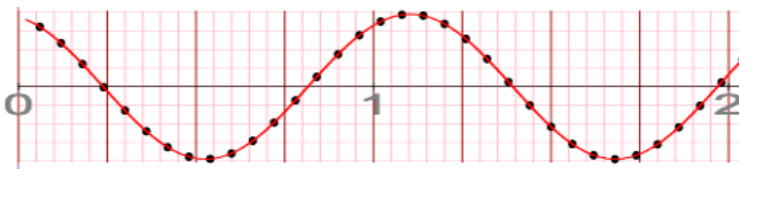
Getting Acquainted: The Wave Addition Interactive displays two animated waves – Wave 1 (Red) and Wave 2 (Blue) – and the Wave Sum (1 + 2) at the top of the simulation window. The controls and buttons are located at the bottom of the simulation window. Before you begin this activity, get acquainted with how it works by playing with the various buttons and slider controls. Tap a button or drag a slider and observe how the waves change or how the wave display changes. Don’t worry about ruining anything. You can always reload the page to reset the simulation to its original state. Your goal is to get acquainted with the interface and to do a bit of exploring of waves. Be sure to learn how to adjust the various wave properties of both Wave 1 (Red) and Wave 2 (Blue). These properties include frequency (f), wavelength (l), velocity or speed (v), and wavelength (λ). Learn how to stop and start the simulation, how to display a Dot, a Line, and an Amplitude Bar for the waves, and how to change the wave from a transverse wave to a longitudinal wave.
Procedures and Questions:
1. Once you have done some exploring as described in the Getting Ready section, you are ready to study Wave Interference. Tap on the Destruct button in the top row of the Control Panel.
Finally, tap on the Line and the Dots buttons so that the wave is represented by a collection of dots and connecting lines. The dots can be thought of as the particles of the medium. For instance, you could think of each dot as representing each coil of a Slinky or as a very small section of a vibrating rope.
2. Run the simulation so that Wave 1 and Wave 2 are moving. Observe the Wave Sum (labeled 1 + 2). Describe the displacement of each individual dot for the Wave Sum.
3. Interference is the meeting up of two waves that are traveling through the same medium. This form of interference that is occurring at each location is known as Destructive Interference. Stop the simulation so that you can answer the following question.Destructive interference will occur at any location where …
a. Each individual wave is stationary.
b. the displacement of particles for both waves is in the same direction (e.g., both up).
c. the displacement of particles for one wave is upward and the other is downward.
4. Consider the wave below. We will call it Wave 1. Sketch what Wave 2 must look like in order for it to interfere with Wave 1 such that destructive interference occurs for every particle along the length of the 2-meter long medium.5. Tap on the Construct button in order to view an example of constructive interference. Describe how the Wave Sum for a constructive interference situation is different than destructive interference.
6. Stop the simulation and analyze any of the points along the medium in order to answer this:
Constructive interference will occur at any location where …
a. Each individual wave is stationary.
b. The displacement of particles for both waves is in the same direction (e.g., both up).
c. The displacement of particles for one wave is upward and the other is downward.
7. So far, we’ve seen situations in which Wave 1 and Wave 2 have the same amplitude. But constructive and destructive interference is not limited to situations in which each wave has the same amplitude. Tap on the Destruct button again. Observe the Wave Sum. Then change the amplitude of Wave 1 to 0.16 m; keep the amplitude of Wave 2 at 0.32 m. This is also an example of destructive interference. Observe the Wave Sum. Describe how it is different from a situation in which two waves have the same amplitude (as in Question 2).
Step 3. Respond
Write a 300-word summary of your lab and your reflections on it. Include the answers to the questions given above.
Step 4. Share
To share your work, click on the “Reply” button under this post and paste your work into the “Message” box. Make sure to reference others’ intellectual property when necessary. All references should follow 7th Edition APA formatting. For further instructions, see the resource on the Himmelfarb Health Sciences Library: APA citation resource (N.B. references are excluded from word counts).
Step 5: Interact
To complete the activity, evaluate and categorize the work from one of your peers based on items A - D of this rubric. Provide a rationale for your grade and comments or suggestions for improvement. To post a reply, click “Reply” on a particular discussion, write your feedback, then click “Post to forum.” You can use the list below as an example:
Item A is .…. because…. My suggestions for improvement are….
Item B is .…. because…. My suggestions for improvement are….
Item C is .…. because…. My suggestions for improvement are….
Item D is .…. because…. My suggestions for improvement are….OPTIONAL Step 6: Interact (10 minutes)
If you would like to, you can reply to your peers' posts in a respectful and professional manner. Ensure that your post engages your peers' ideas by including a reflection on their comments, sharing ideas of other potential difficulties and parties involved, or asking thought-provoking questions. If a peer comments on your posting, please reply. To post a reply, click “Reply” on a particular discussion, write your feedback and then click on “Post to forum.”
OPTIONAL Step 7: Interact (10 minutes)
If you would like to, you can reply to your peers' posts in a respectful and professional manner. Ensure that your post engages your peers' ideas by including a reflection on their comments, sharing ideas of other potential difficulties and parties involved, or asking thought-provoking questions. If a peer comments on your posting, please reply. To post a reply, click “Reply” on a particular discussion, write your feedback and then click on “Post to forum.”
-
Quiz: Module 4
To access the quiz, click on the name of the quiz provided above. On the following screen, click the "Preview quiz now" button to respond to the questions.
TO PASS THIS QUIZ YOU MUST OBTAIN A SCORE OF 80%.
Not available unless: The activity Quiz: Module 3 is marked complete
-
Competencies covered in this module:- Importance of fluids for the circulation of blood, gas movement, and gas exchange.
-
Upon completion of this lesson, you will be able to:Learning Objectives:
- Describe the characteristics of the phases of matter at the molecular or atomic level .
- Define density.
- Define and understand the rationale behind cohesion and adhesion.
-
Students mustMark as done
Required Learning Resources and Activities
-
Students mustView
Read the entire page. (16 minutes)
The LibreTexts Physics - 2022
-
Students mustView
Read the entire page. (5 minutes)
The LibreTexts Physics - 2020
-
Upon completion of this lesson, you will be able to:Learning Objectives:
- Define density and pressure, and understand the relationship between depth in a fluid and hydrostatic pressure.
- Apply Pascal's law to a hydraulic system.
-
Students mustMark as done
Required Learning Resources and Activities
-
Students mustView
Read the entire page and watch the videos. (81 minutes)
The LibreTexts Physics - 2020
-
Students mustViewStart discussions: 1Step 1. Review
Review the learning resources for this lesson before studying the case problem.
Step 2. Analyze
Analyze the case problem below.Directions and Questions:
Navigate to the Wave Addition simulation with PhET at:
https://phet.colorado.edu/sims/html/under-pressure/latest/under-pressure_en.html
Push the big Play arrow. Start with the default settings. In addition, fill the tank with water and select “Ruler”, like the diagram to the right.
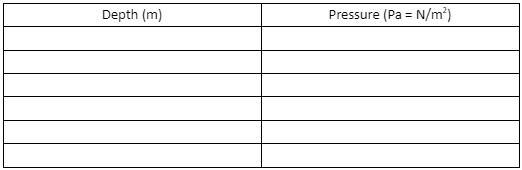
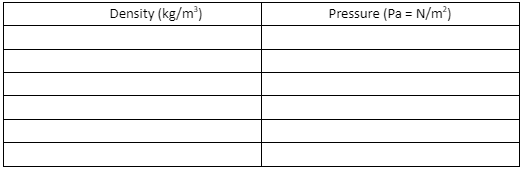
Click on the pressure gauge to move it toward the water. Measure the pressure in the water at every 0.50 m from the surface to the bottom. Record your results on the table below. Note that the simulation will give you kPa. Convert to Pa before entering the values on the table.

4. Use Excel, or similar, to make a graph of pressure vs depth. Do a linear best fit and include the equation on the graph. Copy and paste your graph and equation below.
a. What is the physical meaning of the slope?
b. What is the physical meaning of the y-intercept?
5. Now, pick a depth and vary the fluid density from 700 to 1,400 kg/m3. Record your results on the table below. Note that the simulation will give you kPa. Convert to Pa before entering the values on the table. My chosen depth was:

6. Use Excel, or similar, to make a graph of pressure vs density. Do a linear best fit and include the equation on the graph. Copy and paste your graph and equation below
7. Click on the icon with the question mark on the sink to access the mystery fluid portion. Determine the density of a mystery fluid. If your last name starts with A-H, test Fluid A. If your last name starts with I-N, test Fluid B. If your last name starts with O-Z, test Fluid C. Describe your method and results below.
8. Based on what you learned in this activity, what is the formula for determining the pressure in a fluid? State what each of the symbols mean.
Step 3. Respond
Write a 300-word summary of your lab and your reflections on it. Include the answers to the questions given above.Step 4. Share
To share your work, click on the “Reply” button under this post and paste your work into the “Message” box. Make sure to reference others’ intellectual property when necessary. All references should follow 7th Edition APA formatting. For further instructions, see the resource on the Himmelfarb Health Sciences Library: APA citation resource (N.B. references are excluded from word counts).Step 5: Interact
To complete the activity, evaluate and categorize the work from one of your peers based on items A - D of this rubric. Provide a rationale for your grade and comments or suggestions for improvement. To post a reply, click “Reply” on a particular discussion, write your feedback, then click “Post to forum.” You can use the list below as an example:Item A is .…. because…. My suggestions for improvement are….
Item B is .…. because…. My suggestions for improvement are….
Item C is .…. because…. My suggestions for improvement are….
Item D is .…. because…. My suggestions for improvement are….OPTIONAL Step 6: Interact (10 minutes)
If you would like to, you can reply to your peers' posts in a respectful and professional manner. Ensure that your post engages your peers' ideas by including a reflection on their comments, sharing ideas of other potential difficulties and parties involved, or asking thought-provoking questions. If a peer comments on your posting, please reply. To post a reply, click “Reply” on a particular discussion, write your feedback and then click on “Post to forum.”
OPTIONAL Step 7: Interact (10 minutes)
If you would like to, you can reply to your peers' posts in a respectful and professional manner. Ensure that your post engages your peers' ideas by including a reflection on their comments, sharing ideas of other potential difficulties and parties involved, or asking thought-provoking questions. If a peer comments on your posting, please reply. To post a reply, click “Reply” on a particular discussion, write your feedback and then click on “Post to forum.”
-
Upon completion of this lesson, you will be able to:Learning Objectives:
- Understand Archimedes' principle and calculate buoyant force and specific gravity .
- Use the continuity equation to calculate the flow rate from area and velocity.
-
Students mustMark as done
Required Learning Resources and Activities
-
Students mustView
Read the entire page and watch the videos. (25 minutes)
The LibreTexts Physics - 2020
-
Students mustView
Read the entire page and watch the videos. (11 minutes)
The LibreTexts Physics - 2020
-
Upon completion of this lesson, you will be able to:Learning Objectives:
- Perform calculations using Bernoulli's equation.
- Apply Bernoulli's equation to a U/pitot tube.
-
Students mustMark as done
Required Learning Resources and Activities
-
Students mustView
Read the entire page and watch the videos. (49 minutes)
The LibreTexts Physics - 2019
-
Students mustView
Read the entire page. (13 minutes)
The LibreTexts Physics - 2022
-
Upon completion of this lesson, you will be able to:Learning Objectives:
- Define laminar and turbulent flow, calculate viscosity, and calculate flow using Poiseuille's law.
-
Students mustMark as done
Required Learning Resources and Activities
-
Students mustView
Read the entire page. (25 minutes)
The LibreTexts Physics - 2022
-
Upon completion of this lesson, you will be able to:Learning Objectives:
- Explain the concepts of stress and strain in describing elastic deformations of materials.
- Describe the range where materials show plastic behavior and the limit where the deformation of materials is elastic.
-

Students mustMark as done
Required Learning Resources and Activities
-
Students mustView
Read the entire page. (17 minutes)
The LibreTexts Physics - 2022
-
Students mustView
Read the entire page. (12 minutes)
The LibreTexts Physics - 2022
-
Students mustView
Read the entire page. (8 minutes)
The LibreTexts Physics - 2022
-
Quiz: Module 5
To access the quiz, click on the name of the quiz provided above. On the following screen, click the "Preview quiz now" button to respond to the questions.
TO PASS THIS QUIZ YOU MUST OBTAIN A SCORE OF 80%.
Not available unless: The activity Quiz: Module 4 is marked complete
-
Competencies covered in this module:- Electrochemistry and electrical circuits and their elements.
-
Upon completion of this lesson, you will be able to:Learning Objectives:
- Use conservation of charge to calculate quantities of charge transferred between objects.
- Describe electric polarization and charging by induction.
- Solve problems involving Coulomb’s law.
-
Students mustMark as done
Required Learning Resources and Activities
-
Students mustView
Read the entire webpage and, if you are able to, interact with the virtual demonstration. (35 minutes)
OpenStax - 2023
-
Students mustView
Read the entire page and watch the videos. (29 minutes)
OpenStax - 2023
-
Upon completion of this lesson, you will be able to:Learning Objectives:
- Calculate the strength of an electric field.
- Create and interpret drawings of electric fields.
- Calculate the electric potential difference between two point charges and in a uniform electric field.
- Explain the properties of capacitors and dielectrics.
-
Students mustMark as done
Required Learning Resources and Activities
-
Students mustView
Read the entire page and watch the videos. (29 minutes)
OpenStax - 2023
-
Students mustView
Read the entire page and watch the videos. (49 minutes)
OpenStax - 2023
-
Students mustView
Read the entire webpage and, if you are able to, interact with the virtual demonstration. (35 minutes)
OpenStax - 2023
-
Upon completion of this lesson, you will be able to:Learning Objectives:
- Calculate current and solve problems involving Ohm’s law.
- Calculate the equivalent resistance of resistors in a series and apply Ohm’s law to resistors in a series.
- Calculate the equivalent resistance of resistor combinations containing series and parallel resistors.
- Calculate electric power in circuits of resistors in series, parallel, and complex arrangements.
-
Students mustMark as done
Required Learning Resources and Activities
-
Students mustView
Read the entire webpage and, if you are able to, interact with the virtual demonstration. (39 minutes)
OpenStax - 2023
-
Students mustView
Read the entire webpage and, if you are able to, interact with the virtual demonstration. (51 minutes)
OpenStax - 2023
-
Students mustView
Read the entire webpage and, if you are able to, interact with the virtual demonstration. (34 minutes)
OpenStax - 2023
-
-
Upon completion of this lesson, you will be able to:Learning Objectives:
- Describe and interpret drawings of magnetic fields around permanent magnets and current-carrying wires.
- Calculate the magnitude and direction of magnetic force in a magnetic field and the force on a current-carrying wire in a magnetic field.
-
Students mustMark as done
Required Learning Resources and Activities
-
Students mustView
Read the entire page. (6 minutes)
The LibreTexts Physics - 2022
-
Students mustView
Read the entire webpage, watch the videos, and, if you are able to, interact with the virtual demonstration. (69 minutes)
OpenStax - 2023
- Describe and interpret drawings of magnetic fields around permanent magnets and current-carrying wires.
-
Upon completion of this lesson, you will be able to:Learning Objectives:
- Explain how electric motors, generators, and transformers work.
-
Students mustMark as done
Required Learning Resources and Activities
-
Students mustView
Read the entire webpage and, if you are able to, interact with the virtual demonstration. (41 minutes)
OpenStax - 2023
- Explain how electric motors, generators, and transformers work.
-
Upon completion of this lesson, you will be able to:Learning Objectives:
- Calculate induced electromotive force and current.
-

Students mustMark as done
Required Learning Resources and Activities
-
Students mustView
Read the entire webpage, watch the videos, and, if you are able to, interact with the virtual demonstration. (42 minutes)
OpenStax - 2023
-
Students mustViewStart discussions: 1Step 1. Review
Review the learning resources for this lesson before studying the case problem.
Step 2. Analyze
Analyze the case problem below.PART 1: Faraday’s Law
Directions and Questions:
Navigate to the Faraday’s Law simulation with PhET at:
https://phet.colorado.edu/sims/html/faradays-law/latest/faradays-law_en.html
Click on “Field Lines” to see the magnetic field around the magnet. Draw a sketch of what you notice.
What happens as you move the north side of the magnet into the coil?
How does the Voltage change as you move the south side rather than the North?
What happens if you move the magnet into the coil very slowly vs. very quickly. What relationship can you make between the motion of the magnet and the current produced?
Can you produce a current when the magnet goes up and down in the loops?
Next try two rings vs. four rings. What relationship can you make between the number of loops and the current produced.
Lastly, try putting the magnet in the loops and click the magnet flip button. What happens as you spin the magnet several times?
Look at the Voltage needle as you spin it multiple times. What type of current do you think it is producing? AC or DC?
PART 2: Faraday’s Electromagnetic Lab
Directions and Questions:
Navigate to the Faraday’s Law simulation with PhET at:
https://phet.colorado.edu/sims/cheerpj/faraday/latest/faraday.html?simulation=faraday
Analysis: Bar Magnet
Select “Bar Magnet” in the top left corner.
1. Click on the magnetic compass and move around the bar magnet.
Explain the orientation of the compass needle
2. Click on “Flip Polarity” button on right menu
Explain two changes this causes in the simulation
Magnetic field: _____________
Magnetic compass: ____________
3. Click on “Show Field Meter” toggle on the right menu.
Move the meter around and observe the magnetic field strengths. Note: the meter reads in G (Gauss) rather then T (Tesla); 1 T = 10 000 G
Complete the following statements and do NOT put the meter on top of the magnet.
a) B gets stronger as ___________________________________________________ and weaker as __________________________________________________________.Analysis: Pickup Coil
Select “Pickup Coil” in the top left corner.
1. Move the bar magnet left and right THROUGH the coil of wire. Describe the orientation of the magnetic field compared to the coil when the most current is generated.
You can toggle the indicator from the bulb to the voltage gauge.
2. Increase the number of Loops to 3.How does the number of loops affect the current flow: the greater the number of loops, the _______ the current.
3. Increase or decrease the Loop Area
4. How does Loop Area affect the current flow? Describe the effect and provide a plausible explanation.
5. Why is little to no current generated when the bar magnet is moved up and down?Analysis: Electromagnet
Select “Electromagnet” along the top.
The animation demonstrates Real Current; Conventional Current is the opposite direction.
Using the Right-Hand-Rule, correctly label the poles of the battery + and -2. Slowly reverse the battery polarity by sliding the switch on the battery from the right position to the left position. Describe the electron flow and magnetic field ½ way and all the way to the left (fully reversed).
½ way:
electron flow: _________________________________________________________
magnetic field: ________________________________________________________
fully reversed:
electron flow: _________________________________________________________
magnetic field: ________________________________________________________
Analysis: Transformer
Select “Transformer” along the top.
Move the smaller, left, powered, primary coil close to or inside the larger, secondary coil.
Why is no current generated in the secondary coil?
__________________________________________________________________________
2. Now toggle the Current Source from DC to AC.
Why is current generated in the secondary coil now?__________________________________________
3. Now toggle the Pickup Coil Indicator from bulb to voltage meter.
Now vary the frequency from 5% to 100%.Describe the relationship between frequency and current flow (or voltage as from the voltage meter) in the secondary coil
As frequency decreases __________________________________________________
and as frequency increases ________________________________________________
Step 3. Respond
Write a 300-word summary of your lab and your reflections on it.Step 4. Share
To share your work, click on the “Reply” button under this post and paste your work into the “Message” box. Make sure to reference others’ intellectual property when necessary. All references should follow 7th Edition APA formatting. For further instructions, see the resource on the Himmelfarb Health Sciences Library: APA citation resource (N.B. references are excluded from word counts).Step 5: Interact
To complete the activity, evaluate and categorize the work from one of your peers based on items A - D of this rubric. Provide a rationale for your grade and comments or suggestions for improvement. To post a reply, click “Reply” on a particular discussion, write your feedback, then click “Post to forum.” You can use the list below as an example:Item A is .…. because…. My suggestions for improvement are….
Item B is .…. because…. My suggestions for improvement are….
Item C is .…. because…. My suggestions for improvement are….
Item D is .…. because…. My suggestions for improvement are….OPTIONAL Step 6: Interact (10 minutes)
If you would like to, you can reply to your peers' posts in a respectful and professional manner. Ensure that your post engages your peers' ideas by including a reflection on their comments, sharing ideas of other potential difficulties and parties involved, or asking thought-provoking questions. If a peer comments on your posting, please reply. To post a reply, click “Reply” on a particular discussion, write your feedback and then click on “Post to forum.”
OPTIONAL Step 7: Interact (10 minutes)
If you would like to, you can reply to your peers' posts in a respectful and professional manner. Ensure that your post engages your peers' ideas by including a reflection on their comments, sharing ideas of other potential difficulties and parties involved, or asking thought-provoking questions. If a peer comments on your posting, please reply. To post a reply, click “Reply” on a particular discussion, write your feedback and then click on “Post to forum.”
-
Quiz: Module 6
To access the quiz, click on the name of the quiz provided above. On the following screen, click the "Preview quiz now" button to respond to the questions.
TO PASS THIS QUIZ YOU MUST OBTAIN A SCORE OF 80%.
Not available unless: The activity Quiz: Module 5 is marked complete
- Calculate induced electromotive force and current.
-
Competencies covered in this module:- How light and sound interact with matter.
-
Upon completion of this lesson, you will be able to:Learning Objectives:
- Describe and explain the differences and similarities of each section of the electromagnetic spectrum and the applications of radiation from those sections.
- Solve quantitative problems involving the behavior of electromagnetic radiation.
-
Students mustMark as done
Required Learning Resources and Activities
-
Students mustView
Read the entire webpage, watch the videos, and, if you are able to, interact with the virtual demonstration. (44 minutes)
OpenStax - 2023
-
Students mustView
Read the entire page and watch the videos. (31 minutes)
OpenStax - 2023
- Describe and explain the differences and similarities of each section of the electromagnetic spectrum and the applications of radiation from those sections.
-
Upon completion of this lesson, you will be able to:Learning Objectives:
- Explain reflection from mirrors.
- Explain refraction at media boundaries.
- Describe and predict image formation and magnification as a consequence of refraction through convex and concave lenses.
- Explain how the human eye works in terms of geometric optics.
- Perform calculations involving diffraction and interference, in particular, the wavelength of light, using data from a two-slit interference pattern.
-
Students mustMark as done
Required Learning Resources and Activities
-
Students mustView
Read the entire page and watch the videos. (45 minutes)
OpenStax - 2023
-
Students mustView
Read the entire webpage, watch the videos, and, if you are able to, interact with the virtual demonstration. (49 minutes)
OpenStax - 2023
-
Students mustView
Read the entire webpage, watch the videos, and, if you are able to, interact with the virtual demonstration. (65 minutes)
OpenStax - 2023
-
Students mustViewStart discussions: 1Step 1. Review
Review the learning resources for this lesson before studying the case problem.
Step 2. Analyze
Analyze the case problem below.PART 1: Bending of Light (30 minutes)
Directions:
Navigate to the Refraction simulation with PhET at:
https://phet.colorado.edu/sims/html/bending-light/latest/bending-light_en.html
Select the “More Tools” tab
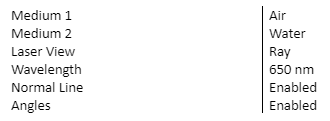
Set the following parameters:

Turn on the laser source.
Using the protractor in the “Toolbox” measure the angle of incidence, I, (the angle between the normal line and the ray of light from the source), the angle of reflection, (The angle between the normal line and the reflected ray), and the angle of refraction, r, (the angle between the normal line and the transmitted ray).

Using the Speed Meter in the Toolbox, measure the speed of the incident ray, reflected ray, and refracted ray.

Repeat procedures (3) – (5), but this time, select “Water” as the first medium and “Air” as the second medium.
Guide Questions:
- What happens to the light from the laser when it strikes the boundary between air and water?
- What relationship exists between the angle of incidence and the angle of reflection?
- How does light bend when it travels from air to water? water to air?
- What happens to the speed of light when it travels from air to water? water to air?
PART 2: Snell’s Law (60 minutes)
Introduction:
When light travels between two different mediums, the velocity and wavelength changes. The result is the “bending” of the light. The “bending” of light is referred to as refraction. The “bending” follows a convenient mathematical relationship called Snell’s law,
Student Learning Outcomes:- Determine the relationship between the incident angle of a light beam and the refracted angle of the light beam as the beam passes from one medium to another.
- Demonstrate the application of Snell’s Law. As consequence, students will be able to
- Determine the critical angle for a light beam that travels from a more dense medium to a less dense medium.
Directions:
Start the PhET “Bending Light” simulation and click on? More Tools.”
Turn on the laser and drag the circular protractor such that the protractor is centered along the normal line and the boundary between the two mediums. Also, drag the speed indicator tool out from the tools located at the lower left of the simulation. The laser can be dragged to change the incident angle. Play with the simulation and try changing some of the different parameters. Make sure to select “Ray” and check the “Angles” box. The top area, the air, is considered medium 1.
The index of refraction, given by the letter n, is defined as the ratio of the speed of light in a vacuum to the speed of light in a medium: n = c/v , where c = 3.0 x 10⁸ m/s. As light travels into different substances, the velocity of light is lower. For our purposes the speed of light in a vacuum will be the same as that of air. Use the speed tool to measure the velocity of light in the glass. Write the velocity in terms of c.
Use the definition for the index of refraction and calculate to verify that the index of refraction for glass is 1.5.
The relationship between the velocity, frequency, and wavelength of a wave is given by v = f𝜆. Since the frequency remains constant when light travels between different media, an expression can be written to solve for λ2 . For medium 1, v1 = f𝜆1 and for medium 2, v2 = f𝜆2. By making an appropriate substitution, write a mathematical expression for 𝜆2, in terms of v1, v2, and 𝜆1 .
Set the following initial data:
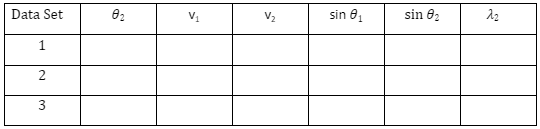
Writing all velocities in terms of the speed of light, c, record your measured values for sin 𝜃1 and sin 𝜃2 to three significant figures, and your calculated value for 𝜆2 in nanometers, complete the table below.

Use the above data and complete the table below for the ratios given. Record your values to 3 sig. figs.
Based upon the pattern you see above for the ratios across different data sets, write a complete mathematical expression for Snell’s Law. Verify your expression by looking up Snell’s Law in your textbook.
Question (Problem solving using Snell’s Law):
A scuba diver on a boat (index of refraction = 1.000) shines a violet light (415 nm) towards the water (index of refraction = 1.336) to illuminate some phosphorescent coral. With what wavelength in nanometers does the light strike the coral? What is the velocity of the light when it strikes the coral, in terms of c? (Hint: the velocity of light in air is 1.00c)
Step 3. Respond
Write a 300-word summary of your lab and your reflections on it. Include the answers to the questions given.Step 4. Share
To share your work, click on the “Reply” button under this post and paste your work into the “Message” box. Make sure to reference others’ intellectual property when necessary. All references should follow 7th Edition APA formatting. For further instructions, see the resource on the Himmelfarb Health Sciences Library: APA citation resource (N.B. references are excluded from word counts).Step 5: Interact
To complete the activity, evaluate and categorize the work from one of your peers based on items A - D of this rubric. Provide a rationale for your grade and comments or suggestions for improvement. To post a reply, click “Reply” on a particular discussion, write your feedback, then click “Post to forum.” You can use the list below as an example:Item A is .…. because…. My suggestions for improvement are….
Item B is .…. because…. My suggestions for improvement are….
Item C is .…. because…. My suggestions for improvement are….
Item D is .…. because…. My suggestions for improvement are….OPTIONAL Step 6: Interact (10 minutes)
If you would like to, you can reply to your peers' posts in a respectful and professional manner. Ensure that your post engages your peers' ideas by including a reflection on their comments, sharing ideas of other potential difficulties and parties involved, or asking thought-provoking questions. If a peer comments on your posting, please reply. To post a reply, click “Reply” on a particular discussion, write your feedback and then click on “Post to forum.”
OPTIONAL Step 7: Interact (10 minutes)
If you would like to, you can reply to your peers' posts in a respectful and professional manner. Ensure that your post engages your peers' ideas by including a reflection on their comments, sharing ideas of other potential difficulties and parties involved, or asking thought-provoking questions. If a peer comments on your posting, please reply. To post a reply, click “Reply” on a particular discussion, write your feedback and then click on “Post to forum.”
- Explain reflection from mirrors.
-
Upon completion of this lesson, you will be able to:Learning Objectives:
- Explain how photon energies vary across divisions of the electromagnetic spectrum.
- Describe how the photoelectric effect could not be explained by classical physics.
-
Describe the use of the photoelectric effect in biological applications, photoelectric devices, and movie soundtracks.
- Explain the particle-wave duality of light.
-
Students mustMark as done
Required Learning Resources and Activities
-
Students mustView
Read the entire page. (18 minutes)
OpenStax - 2023
-
Students mustView
Read the entire webpage and, if you are able to, interact with the virtual demonstration. (39 minutes)
OpenStax - 2023
-
-
Quiz: Module 7
To access the quiz, click on the name of the quiz provided above. On the following screen, click the "Preview quiz now" button to respond to the questions.
TO PASS THIS QUIZ YOU MUST OBTAIN A SCORE OF 80%.
Not available unless: The activity Quiz: Module 6 is marked complete
- Explain how photon energies vary across divisions of the electromagnetic spectrum.
-
Competencies covered in this module:- Atoms, nuclear decay, electronic structure, and atomic chemical behavior.
-
Upon completion of this lesson, you will be able to:Learning Objectives:
- Describe the emission and absorption spectra of atoms.
-
Describe the quantum model of the atom.
- Write nuclear equations associated with the various types of radioactive decay.
- Calculate radioactive half-life and solve problems associated with radiometric dating.
- Describe how the processes of fission and fusion work in nuclear weapons and in generating nuclear power.
- Describe the ionizing effects of radiation and how they can be used for medical treatment.
-
Students mustMark as done
Required Learning Resources and Activities
-
Students mustView
Read the entire webpage and, if you are able to, interact with the virtual demonstration. (66 minutes)
OpenStax - 2023
-
Students mustView
Read the entire webpage and, if you are able to, interact with the virtual demonstration. (47 minutes)
OpenStax - 2023
-
Students mustView
Read the entire webpage and, if you are able to, interact with the virtual demonstration. (20 minutes)
OpenStax - 2023
-
Students mustView
Read the entire webpage and, if you are able to, interact with the virtual demonstration. (50 minutes)
OpenStax - 2023
-
Students mustView
Read the entire webpage. (17 minutes)
OpenStax - 2023
-
Students mustViewStart discussions: 1Step 1. Review
Review the learning resources for this lesson before studying the case problem.
Step 2. AnalyzeAnalyze the case problem below.
Directions and Questions:
Navigate to the Refraction simulation with PhET at:
(It takes a few minutes to load)
Part 1:Exploration
In this section you will familiarize yourself with the controls
General:
∙ Be sure to try all the different tabs at the top of the simulation.
∙ You can Pause the sim and then use Step to incrementally analyze.
Fission: One Nucleus Tab:
∙ Fire the gun to shoot a neutron at the Uranium nucleus and make it decay.
∙ After the Uranium nucleus decays, press Reset to start over with a new one. Chain Reaction Tab:
∙ Add a containment vessel, fill it with U-235 and U-238, and fire the gun to create a chain reaction.
∙ Grab the edge of the containment vessel and drag it in or out to change the size.
Nuclear Reactor Tab:
∙ Fire neutrons to create a chain reaction. Moving the control rod adjuster out of the reactor will allow the reaction to spread more quickly.
Click on ‘Run Now’ and select the tab that says ‘Fission: One Nucleus’
Fission: One Nucleus:
Experiment with shooting the neutron gun and watch what happens.
What happens when the U-235 nucleus is “hit” with a neutron? There are a number of things that happen here, describe all of them in as much detail as you can. Use the pause button when needed
Part 2: Chain Reaction:
Select the “Chain Reaction” tab at the top. Experiment with changing the settings and shooting the neutron gun and watch what happens. Then answer the questions below.
- Click the ‘Reset All’ button and then set the initial number of U-235 nuclei to 100 and U-238 to 0. What happens when you fire the neutron gun?
- Explain what makes this a “chain reaction”.
- Click ‘Reset’ and then set the initial number of U-238 nuclei to 100 and U-235 to 0. Explain what happens when you fire the gun. Does this cause a chain reaction? Try multiple times to start a chain reaction with the U-238. Explain why this happens.
- Set the initial numbers of U-235 nuclei and U-238 nuclei to the numbers in the table below. Record your results.

What happens to the reaction as the proportion of U-238 nuclei increases? Explain why this happens.
Part 2: Nuclear Reactor
Directions and Questions
Select the “Nuclear Reactor” tab at the top. Experiment with changing the settings and firing the neutrons and watch what happens. Then answer the questions below.
Watch very closely to the fission reactions as they happen. Specifically watch what happens to the loose neutrons after the reaction.
a) What happens if the neutrons hit another nucleus?
b) What happens if the neutrons hit a control rod?Compare the chain reaction that occurs when the control rods are inserted further into the reactor versus when they are pulled all/mostly out of the reactor.
The bar graphs on the right of the display show the “Power Output” and the “Energy Produced”. What is the difference between these two quantities?
Step 3. Respond
Write a 300-word summary of your lab and your reflections on it. Include the answers to the questions given.Step 4. Share
To share your work, click on the “Reply” button under this post and paste your work into the “Message” box. Make sure to reference others’ intellectual property when necessary. All references should follow 7th Edition APA formatting. For further instructions, see the resource on the Himmelfarb Health Sciences Library: APA citation resource (N.B. references are excluded from word counts).Step 5: Interact
To complete the activity, evaluate and categorize the work from one of your peers based on items A - D of this rubric. Provide a rationale for your grade and comments or suggestions for improvement. To post a reply, click “Reply” on a particular discussion, write your feedback, then click “Post to forum.” You can use the list below as an example:Item A is .…. because…. My suggestions for improvement are….
Item B is .…. because…. My suggestions for improvement are….
Item C is .…. because…. My suggestions for improvement are….
Item D is .…. because…. My suggestions for improvement are….OPTIONAL Step 6: Interact (10 minutes)
If you would like to, you can reply to your peers' posts in a respectful and professional manner. Ensure that your post engages your peers' ideas by including a reflection on their comments, sharing ideas of other potential difficulties and parties involved, or asking thought-provoking questions. If a peer comments on your posting, please reply. To post a reply, click “Reply” on a particular discussion, write your feedback and then click on “Post to forum.”
OPTIONAL Step 7: Interact (10 minutes)
If you would like to, you can reply to your peers' posts in a respectful and professional manner. Ensure that your post engages your peers' ideas by including a reflection on their comments, sharing ideas of other potential difficulties and parties involved, or asking thought-provoking questions. If a peer comments on your posting, please reply. To post a reply, click “Reply” on a particular discussion, write your feedback and then click on “Post to forum.”
- Describe the emission and absorption spectra of atoms.
-
Upon completion of this lesson, you will be able to:Learning Objectives:
- Explain how particle accelerators work to gather evidence about particle physics.
-

Distinguish matter from antimatter.
- Define a Higgs boson and its importance to particle physics.
- Explain how grand unification theories can be tested.
-
Students mustMark as done
Required Learning Resources and Activities
-
Students mustView
Read the entire webpage. (27 minutes)
OpenStax - 2023
-
-
Students mustView
Read the entire webpage. (17 minutes)
OpenStax - 2023
-
Quiz: Module 8
To access the quiz, click on the name of the quiz provided above. On the following screen, click the "Preview quiz now" button to respond to the questions.
TO PASS THIS QUIZ YOU MUST OBTAIN A SCORE OF 80%.
Not available unless: The activity Quiz: Module 7 is marked complete
- Explain how particle accelerators work to gather evidence about particle physics.
-
-
Final Exam Quiz
To take the final exam, you must complete all quizzes and complete all the required activities. The final exam consists of 40 questions, and you will have 40 minutes to complete it. When the time is over, you will have two minutes to submit your attempt before it expires, and your progress is discarded. You will not be able to answer additional questions in the grace period.
To access the exam, click on the name of the exam provided above. On the following screen, click the attempt quiz button to respond to the questions.
Not available unless: All of: ...Not available unless:-
All of:
- The activity Course Registration is marked complete
- The activity Pre-Test is marked complete
- The activity Quiz: Module 1 is marked complete
- The activity Quiz: Module 2 is marked complete
- The activity Quiz: Module 3 is marked complete
- The activity Quiz: Module 4 is marked complete
- The activity Quiz: Module 5 is marked complete
- The activity Quiz: Module 6 is marked complete
- The activity Quiz: Module 7 is marked complete
- The activity Quiz: Module 8 is marked complete
-
All of:
- The activity Practical Activity 1 (70 minutes) is marked complete
- The activity Practical Activity 2 (70 minutes) is marked complete
- The activity Practical Activity 3 (70 minutes) is marked complete
- The activity Practical Activity 4 (90 minutes) is marked complete
- The activity Practical Activity 5 (60 minutes) is marked complete
- The activity Practical Activity 6 (90 minutes) is marked complete
- The activity Practical Activity 7 (90 minutes) is marked complete
- The activity Practical Activity 8 (60 minutes) is marked complete
-
All of:
-
-
In this section, you can provide feedback about this course to help us make NextGenU.org better. Once evaluations are completed, you will be able to download your certificate of completion.
Click here give your feedback
-
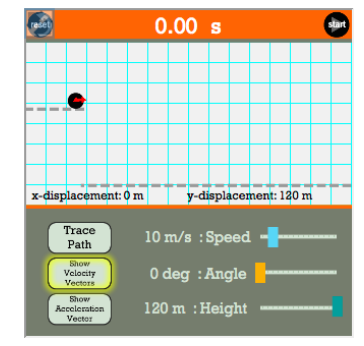
Course Evaluation QuestionnaireNot available unless: The activity Final Exam is complete and passed
-
Self Evaluation QuestionnaireNot available unless: The activity Final Exam is complete and passed
-
-