Substance Use Disorders in Primary Care
You do not have permission to view discussions in this forum.
-
Medicine CoursesSubstance Use Disorders in Primary CareResume0% complete0% complete
-
Students mustStudent must submit this questionnaire to complete it
-
Students mustViewReceive a grade
Show More-

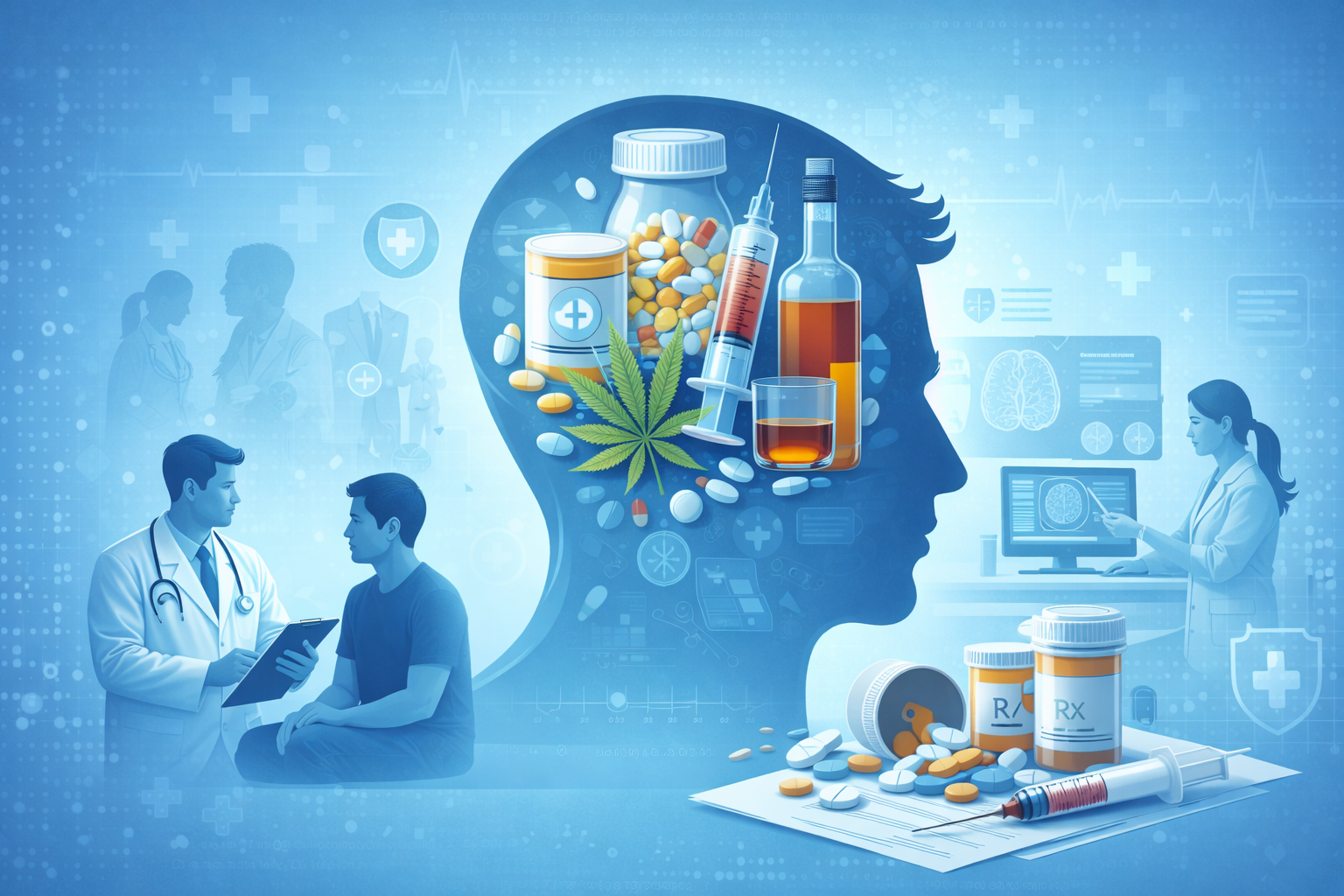 Welcome to Substance Use Disorders in Primary Care (SUDPC). The SUDPC course provides an introduction to the prevention, screening, and treatment (medication, risk of interactions with substances, psychological therapies) of substance use disorders related to alcohol, tobacco, and other drug use. The course also provides an introduction to the health consequences associated with substance use disorders and the links between substance use disorders and mental health disorders. Students will gain practical knowledge on how to communicate with patients, conduct a medical consultation to assess substance use disorders, monitor treatment effects, and decide when to refer their patients to specialized settings. The course uses various formats of learning resources (e.g., academic publications, health agencies recommendations, medical associations recommendations, and government guidelines), and its activities allow students to practice techniques with their local peers in hopes of reducing the prevalence and burden of substance use disorders.
This SUDPC course is sponsored by the Africa Mental Health Foundation, and the University of Florida. Like all NextGenU.org courses, it is competency-based, using competencies adapted from the WHO Mental Health Gap Action Programme (mhGAP) and learning resources from accredited, world-class organizations such as the National Institute on Drug Abuse, Substance Abuse and Mental Health Services Administration, and the World Health Organization.
The course was initially co-developed by Veronic Clair, MD, MSc, CCFP, FRCPC; Sukhdeep Jassar, MPH; and Abednego Musau, MBChB. The course was redesigned and updated by Pablo Baldiviezo, MD, DiplEd; Carolina Bustillos, MD, DiplEd; Genikka Camille Gabral, B.ED, MSc; Magali Collonnaz, MD, MPH, MSc; Felix Emeka Anyiam, MPH, MScPH, DataSc.; Yhan O'Neil Williams, BSc, Ph.D.; Hugo Rojas, MD, MSc, DiplEd;
For publications on NextGenU.org’s courses’ efficacy, see NextGenU.org’s publication page. Subscribe to our newsletter to be notified of future updates, new courses, and to be part of our community.
There are six (6) modules to complete, which provide an introduction to:
- Foundations of Substance Use Disorders in Primary Care
- Addressing Stigma and Human Rights in Substance Use Disorders
- Medical Management of Substance Use Disorders
- Screening and Brief Intervention for Substance Use Disorders
- Managing Comorbidities and Special Populations
- Effective Communication in Substance Use Disorder Management
The completion time for this course is estimated at 148 hours, comprising 28 hours of learning resources, 56 hours of studying and assimilating content, and 64 hours of participating in learning activities and quizzes, to assist the learners in the synthesis of learning materials. This course is equivalent to 3 credit hours.The course requires completion of Discussion Forums and Peer Activities. At the end of each module, there is a practice quiz of ten (10) multiple-choice questions. After you’ve completed each module, quiz, and learning activity, at the end of the course, you’ll have access to a final exam consisting of fifty (50) multiple-choice questions and a chance to evaluate this course. Participants have up to three opportunities to take the final exam and achieve the required score of >=80%.
Once you’ve passed the last test, you will be able to download a certificate of completion from NextGenU.org and our course’s co-sponsoring organizations. We keep your personal information confidential, never sell any of your information, and only use anonymized data for research purposes. Also, we are happy to report your testing information and share your work with anyone (your school, employer, etc.) at your request.
Engaging with this Course:
You may browse this course for free to learn for your personal enrichment; there are no requirements. To register for this course, it is a requirement that learners have a college-level/bachelor's degree.
To obtain a certificate, a learner must first register for the course and then successfully complete:- Pre-test,
- All the reading requirements,
- All quizzes and pass with a 80% with unlimited attempts,
- All peer activities,
- All discussion forums,
- The final exam with a minimum of 80% and a maximum of 3 attempts, and
- The self and course evaluation forms.
To obtain credit:- Complete all requirements listed above for the certificate, and
- Your learning institution or workplace should approve the partner-university-sponsored NextGenU.org course for educational credit, as they would for their learner taking a course anywhere.
NextGenU.org is happy to provide your institution with:- A link to and description of the course training, so they can see all its components, including the co-sponsoring universities and other professional organization co-sponsors,
- Your grade on the final exam,
- Your work products (e.g., case study activities) and any other required or optional shared materials that you produce and authorize to share with them,
- Your evaluations -- course, self-assessments, and
- A copy of your certificate of completion, with the co-sponsoring universities and other organizations listed.
To obtain a degree, NextGenU.org co-sponsors degree programs with institutional partners. To obtain a full degree co-sponsored with NextGenU.org, registrants must be enrolled in a degree program as a student of a NextGenU.org institutional partner. If you think your institution might be interested in offering a degree with NextGenU.org, contact us.We hope you will find this a rewarding learning experience, and we count on your assessment and feedback to help us improve this training for future students.
Here are the next steps to take the course and earn a certificate.- Complete the registration form.
- Take the pre-test.
- Begin the course with Module 1: Introduction to Substance Use Disorder Services in Primary Care. In each lesson, read the description, complete all required readings and any required activity, and take the corresponding quizzes.
This course meets nationally approved standards of education developed for the addiction/substance use disorders counseling profession. This course's participants are assured that the continuing education (CE) credits provided will be accepted toward national credentialing by the NAADAC Certification Commission for Addiction Professionals (NCC AP), as well as by many of the individual state licensing/certification bodies in the addiction and other helping professions.
*The previous version of this course is not available for new registrations. Only students that were registered before can complete it.
-
 Competency covered in this module:
- Understand and be receptive to including mental health and substance use disorder services in primary care.
Approximate time required for the readings for this module (at 144 words/minute): 10 hours and 19 minutes.
-
Students mustMark as done
Required Learning Resources
-
Students mustMark as done
The lesson summary includes key information needed to meet the objectives of this module. You are encouraged to review it carefully. At the end of the lesson summary, you'll also find a list of references with clickable links, you can explore them if you'd like to learn more or dive deeper into the topic.
355.0 KB -
Students mustMark as done
Supplementary Learning Resources (Not Required)
-
Students mustMark as done
In this document, we summarized key topics of the module to help you study. Please note that these notes do not cover all of the material in its entirety; you are still encouraged to read and study all of the required learning resources.
313.8 KB -
Students mustView
Here are specialized flashcards designed to reinforce and test your knowledge throughout this course.
-
Students mustMark as done
-
Learning Outcomes:
Upon completion of this lesson, you will be able to:- Discuss how primary health care can be involved in lessening the burden of mental illness, including substance use disorders.
- Define the concept of "task-shifting."
- Describe the WHO mhGAP principles of care and priority conditions.
- Summarize the science behind substance abuse and its possible effects on health and social functioning.
-
Required Learning Resources and Activities
-
Students mustView
Read the following sections: Executive summary (Page 1), The issue (Pages 4-5), Opportunities and challenges (Page 7), and Actions (Pages 2 and 9-10). (22 minutes)
WHO - 2018
-
Students mustView
Read Pages 1-2 and Figure 1. (10 minutes)
Pan African Medical Journal - 2023
-
Students mustView
Read the preface (pg. iii), the introduction (pgs. 1-4), the module "Essential Care & Practice," (pgs. 5-14), and the "Overview of Priority MNS Conditions" (pgs 16-18) to understand the World Health Organization's recommendations on addressing mental, neurological and substance use disorders in primary care. (35 minutes)
WHO - 2019
-
Students mustView
Read the sections "Drug Misuse and Addiction", "Drugs and the Brain," and "Addiction and Health." (41 minutes)
National Institute on Drug Abuse - 2020
-
Students mustViewStart discussions: 1
SLOs:
Discuss how primary health care can be involved in lessening the burden of mental illness, including substance use disorders
Define the concept of "task-shifting"
Describe the WHO mhGAP principles of care and priority conditions
Summarize the science behind substance abuse and its possible effects on health and social functioning
General Instructions:
In this activity, you will demonstrate your understanding of the foundational concepts of integrating substance use disorder services in primary care settings.
Step 1: Select and Reflect
Review the WHO Mental Health Gap Action Programme (mhGAP) Intervention Guide, focusing on the sections related to substance use disorders and their integration into primary care.
Examine the concept of "task-shifting" in healthcare delivery, particularly as it applies to mental health and substance use disorders.
Study the neurobiology of addiction and the evidence base for substance use disorder interventions in primary care settings.
Review the current global burden of substance use disorders and the potential role of primary care in addressing this burden.
Step 2: Respond
Based on your readings, post your thoughts (300-500 words) addressing the following:
Analyze how primary care can effectively integrate substance use disorder services using the task-shifting approach
Discuss the WHO mhGAP principles of care and how they can be implemented in primary care settings
Explain the neurobiological basis of substance use disorders and how this understanding can inform treatment approaches in primary care
Propose evidence-based strategies for primary care providers to address the burden of substance use disorders in their communities
Step 3: Share
To share your work, click on the "Add a new discussion topic" button under this post and paste your work into the "Message" box. Make sure to reference others' intellectual property when necessary. All references should follow 7th Edition APA formatting. For further instructions, see the resource on the Himmelfarb Health Sciences Library: APA citation resource (N.B.: references are excluded from word counts.
-
Quiz: Module 1
To access the quiz, click on the name of the quiz provided above. On the following screen, click the attempt quiz button to view the case studies and respond to the questions.
TO PASS THIS QUIZ YOU MUST OBTAIN A SCORE OF 80%.
Not available unless: The activity Course Registration is marked complete ...Not available unless:- The activity Course Registration is marked complete
- The activity Pre-Test is marked complete
-
 Competency covered in this
module:
Competency covered in this
module:
- Being aware of and being able to address stigma promoting and protecting the human rights of those you serve.
Approximate time required for the readings for this module (at 144 words/minute): 22 hours and 10 minutes.
-
Students mustMark as done
Required Learning Resources
-
Students mustMark as done
The lesson summary includes key information needed to meet the objectives of this module. You are encouraged to review it carefully. At the end of the lesson summary, you'll also find a list of references with clickable links, you can explore them if you'd like to learn more or dive deeper into the topic.
520.9 KB -
Students mustMark as done
Supplementary Learning Resources (Not Required)
-
Students mustMark as done
In this document, we summarized key topics of the module to help you study. Please note that these notes do not cover all of the material in its entirety; you are still encouraged to read and study all of the required learning resources.
495.6 KB -
Students mustView
Here are specialized flashcards designed to reinforce and test your knowledge throughout this course.
-
Students mustMark as done
- Being aware of and being able to address stigma promoting and protecting the human rights of those you serve.
-
Learning Outcomes:
Upon completion of this lesson, you will be able to:- Describe stigma and its potential impact, as well as the practical strategies to address it.
- Describe how physician/clinician attitudes toward patients with substance use disorders can impact recognition, diagnosis, and treatment of patients.
- Illustrate care that is free from discrimination on the basis of race, color, sex, language, religion, political or other opinions, nationality, ethnicity, indigenous or social origin, property, birth, age, or other status.
- Discuss how to provide care in a way that respects the dignity of the person and is culturally sensitive and appropriate.
- Discuss how to minimize stigma, marginalization, and discrimination, and promote the social inclusion of people with mental, neurological, and substance use disorders by fostering strong links with employment, educational, social (including housing), and other relevant sectors.
-
Required Learning Resources
-
Students mustView
Read the entire paper. (18 minutes)
Cureus - 2023
-
Students mustView
Read the entire paper. (10 minutes)
StatPearls - 2021
-
-
Students mustView
Under "Essential Care & Practice," read the sections "Use effective communication skills" and "Promote respect and dignity" in Module 1: Essentiel care and practice (pgs. 6-7). (4 minutes)
WHO - 2019
-
Students mustView
Read the entire paper. (33 minutes)
Asian Journal of Psychiatry - 2021
-
Learning Outcomes:
Upon completion of this lesson, you will be able to:- Explain international and national standards, legislation, and policies on mental health and human rights.
- Demonstrate how to pay greater attention to the patient's right to privacy and confidentiality.
- Demonstrate how a patient (or their designated decision-maker) is aware of the proposed therapy and has given their free and informed permission.
-
Students mustMark as done
Required Learning Resources and Activities
-
Students mustView
Read from "Chapter 1: Rethinking legislation on mental health" to the end of "1.4 The international human rights framework." (35 minutes)
WHO - United Nations Human Rights - 2023
-
Students mustView
Read the entire article. (1 hour 58 minutes)
StatPearls- 2023
-
Students mustView
Read the document to learn about consent. (60 minutes)
The Canadian Medical Protective Association-Empowering better healthcare - 2024
-
Students mustView
Read the entire webpage. (1 hour 24 minutes)
StatPearls - 2024
-
Students mustViewStart discussions: 1
SLOs:
Describe stigma and its potential impact, as well as the practical strategies to address it
Describe how physician/clinician attitudes toward patients with substance use disorders can impact recognition, diagnosis, and treatment of patients
Illustrate care that is free from discrimination
Discuss how to provide care in a way that respects dignity and is culturally appropriate
Explain international and national standards on mental health and human rights
Demonstrate how to respect patient privacy and informed consent
General Instructions:
In this activity, you will work to develop an anti-stigma intervention for healthcare settings that addresses human rights concerns in substance use disorder treatment.
Step 1: Research and Analysis
Review international human rights standards relevant to mental health and substance use disorders, including the UN Convention on the Rights of Persons with Disabilities
Examine evidence on the impact of stigma on healthcare outcomes for people with substance use disorders
Study effective anti-stigma interventions that have been implemented in healthcare settings
Research policies and legislation that protect the rights of individuals with substance use disorders
Step 2: Create and Submit
Develop a comprehensive anti-stigma intervention plan (500-750 words) that includes:
Assessment of current stigma-related barriers in healthcare settings
Analysis of how clinician attitudes affect diagnosis and treatment of substance use disorders
Proposed evidence-based strategies to address identified barriers
Implementation plan that incorporates human rights principles
Evaluation metrics to measure effectiveness
-
Quiz: Module 2
To access the quiz, click on the name of the quiz provided above. On the following screen, click the attempt quiz button to view the case studies and respond to the questions.
TO PASS THIS QUIZ YOU MUST OBTAIN A SCORE OF 80%.
Not available unless: The activity Quiz: Module 1 is marked complete
-
 Competency covered in this module:
 - Understand the various best practices for the medical management of tobacco, alcohol, and other substance use disorders in primary care.
Approximate time required for the readings for this module (at 144 words/minute): 34 hours and 4 minutes.
-
Students mustMark as done
Required Learning Resources
-
Students mustMark as done
The lesson summary includes key information needed to meet the objectives of this module. You are encouraged to review it carefully. At the end of the lesson summary, you'll also find a list of references with clickable links, you can explore them if you'd like to learn more or dive deeper into the topic.
681.7 KB -
Students mustMark as done
Supplementary Learning Resources (Not Required)
-
Students mustMark as done
In this document, we summarized key topics of the module to help you study. Please note that these notes do not cover all of the material in its entirety; you are still encouraged to read and study all of the required learning resources.
798.7 KB -
Students mustView
Here are specialized flashcards designed to reinforce and test your knowledge throughout this course.
-
Students mustMark as done
-
Learning Outcomes:
Upon completion of this lesson, you will be able to:- Discuss the effectiveness of tobacco cessation interventions.
- Recognize quick, in-practice resources to support tobacco cessation interventions.
- Describe the personal health disease risks (cardiovascular, respiratory, and cancer) associated with tobacco use.
- Describe the general benefits of quitting smoking.
- Discuss the symptoms of tobacco withdrawal and the methods of dealing with those symptoms.
- Summarize the health consequences of involuntary (secondhand) exposure to tobacco smoke.
- Describe the link between tobacco and Chronic Obstructive Pulmonary Disorder (COPD) and be familiar with best practices for the management of COPD.
-
Required Learning Resources and Activities
-
Students mustView
Read the entire article (7 minutes)
WHO - 2020
-
Students mustView
Read the following sections "Background", "Discussion", and "Conclusions"." (63 minutes)
BMC Systematic Reviews - 2024
-
Students mustView
Read the webpage and the first two PDF documents: "You Can Help Your Patients Quit Tobacco Use" and "A Practical Guide to Help Your Patients Quit Using Tobacco." (13 minutes)
CDC - 2024
-
Students mustView
Read the entire article (11 minutes)
National Institute on Drug Abuse - 2020
-
Students mustView
Read the entire article. (49 minutes)
ACS - 2024
-
Students mustView
Watch the video and read the entire webpage. (22 minutes)
CDC - 2024
-
Students mustView
Read the entire webpage. (1 hour 32 minutes)
NIH- 2022
-
Students mustView
Read this resource to learn more about the effects of secondhand smoke on the health of children. (19 minutes)
CDC - 2025
-
Students mustView
Read the entire article. (1 hour 54 minutes)
BBMC - 2024
-
Students mustMark as done
Recommended Additional Readings
-
Students mustView
This webpage lists various smoking cessation tools and resources. In the section "Physician Resources and Tools," read the first document, "Tobacco and Nicotine Cessation Toolkit," and watch the video "Video: Mental Health Conditions and Cigarettes."
Although not required, you can read any other resource from this webpage. (27 minutes)The American Academy of Family Physicians Foundation - 2020
-
Learning Outcomes:
Upon completion of this lesson, you will be able to:- Describe the general approaches to address alcohol, tobacco, and other substance use in primary care.
- Recognize the symptoms of acute intoxication for a substance and treat or refer accordingly.
- Demonstrate how to take a thorough medical history, including the history of the presenting complaint(s), past history, and family history (as relevant), and know the red flags for substance use disorders.
- Summarize the evidence-based model of brief intervention in primary care for other psychoactive substances.
-
Students mustMark as done
Required Learning Resources and Activities
-
Students mustView
Read the entire article. (13 minutes)
South African Family Practice - 2021
-
Students mustView
Read the entire article. (8 minutes)
American Academy of Family Physicians - 2019
-
Students mustView
In the "mhGAP Intervention Guide," review the section entitled "Disorders due to substance use" on pages 105 to 130. (51 minutes)
WHO - 2015
-
Students mustView
Read the entire web page. (35 minutes)
Substance Abuse and Mental Health Services Administration - 2015
-
Students mustView
Read the entire article plus (15 minutes)
CDC- 2024
-
-
Students mustView
Read the entire webpage.. (5 minutes)
Substance Abuse and Mental Health Services Administration - 2021
-
Students mustView
Download the PDF and read the entire document.. (1 minute)
UMass Chan Medical School - 2019
-
Students mustView
Read the entire document. (35 minutes)
American Society of Addiction Medicine - 2020
-
Students mustView
Read the sections on "Efficacy Of Brief Interventions In Various Substance Use Disorders" and "Special Populations And Newer Delivery Formats". (50 minutes)
Wolters Kluwer -- Medknow Publications - 2020
-
Students mustView
Read the following sections: 1.4, 1.5, 2.2-2.7. (1 hour 20 minutes)
Intechopen - 2020
-
Students mustMark as done
Recommended Additional Readings
-
Students mustView
Read the entire post. (26 minutes)
Verywell Mind's - 2024
- Describe the general approaches to address alcohol, tobacco, and other substance use in primary care.
-
Learning Outcomes:
Upon completion of this lesson, you will be able to:- Describe the specific effects of alcohol on the overall health.
- Describe the specific effects of alcohol on the liver.
- Demonstrate how to assess the person for alcohol withdrawal symptoms and treat or refer accordingly.
-
Students mustMark as done
Required Learning Resources and Activities
-
-
Students mustView
Read the entire webpage. (20 minutes)
Australian Government Department of Health - 2024
-
Students mustView
Read the entire webpage and the video titled: "Video: liver disease" (20 minutes)
NHS - 2025
-
Students mustView
Read the "Introduction" and "Alcohol consumption and ALD" sections. (8 minutes)
Elsevier B.V. - 2021
-
Students mustView
Read the summary of recommendations (pp. 4-15), stop at the Introduction. (55 minutes)
The American Society of Addiction Medicine - 2020
-
Students mustView
Download the document and read the entire scale. (5 minutes)
Insight - 2024
-
Students mustView
Read the abstract and the introduction (pages 1 and 2). (10 minutes)
Drug and Alcohol Dependence - 2021
-
Students mustMark as done
Recommended Additional Readings
-
Students mustView
Read the entire article. (60 minutes)
Cureus Inc. - 2022
-
Students mustViewStart discussions: 1
SLOs:
Discuss effective tobacco cessation interventions and resources
Describe health risks associated with tobacco use and benefits of quitting
Describe approaches to address various substance use disorders in primary care
Recognize symptoms of intoxication and withdrawal
Demonstrate assessment and intervention skills for substance use disorders
General Instructions:
In this activity, you will demonstrate your understanding of evidence-based approaches to the medical management of substance use disorders in primary care.
Step 1: Select and Reflect
Review clinical practice guidelines for tobacco cessation interventions
Study the pharmacological and behavioral treatments for alcohol use disorder
Examine the assessment and management of withdrawal syndromes
Research the integration of substance use disorder treatment in primary care settings
Step 2: Respond
Create a detailed post (400-600 words) addressing:
Evidence-based approaches to tobacco cessation appropriate for primary care settings
Pharmacological and non-pharmacological interventions for alcohol use disorder
Assessment and management strategies for substance intoxication and withdrawal
Implementation challenges and solutions for substance use disorder treatment in primary care
Comparative effectiveness of different intervention approaches
Step 3: Share
To share your work, click on the "Add a new discussion topic" button under this post and paste your work into the "Message" box. Make sure to reference others' intellectual property when necessary. All references should follow 7th Edition APA formatting. For further instructions, see the resource on the Himmelfarb Health Sciences Library: APA citation resource (N.B.: references are excluded from word counts).
-
Quiz: Module 3
To access the quiz, click on the name of the quiz provided above. On the following screen, click the attempt quiz button to view the case studies and respond to the questions.
TO PASS THIS QUIZ YOU MUST OBTAIN A SCORE OF 80%.
Not available unless: The activity Quiz: Module 2 is marked complete
-
Approximate time required for the readings for this module (at 144 words/minute): 13 hours and 49 minutes.
Competency covered in this module:

- Understand how to effectively screen for substance use disorders using the ASSIST package.
- Be able to deliver an effective brief intervention to address substance abuse.
-
Students mustMark as done
Required Learning Resources
-
Students mustMark as done
The lesson summary includes key information needed to meet the objectives of this module. You are encouraged to review it carefully. At the end of the lesson summary, you'll also find a list of references with clickable links, you can explore them if you'd like to learn more or dive deeper into the topic.
378.2 KB -
Students mustMark as done
Supplementary Learning Resources (Not Required)
-
Students mustMark as done
In this document, we summarized key topics of the module to help you study. Please note that these notes do not cover all of the material in its entirety; you are still encouraged to read and study all of the required learning resources.
380.6 KB -
Students mustView
Here are specialized flashcards designed to reinforce and test your knowledge throughout this course.
-
Students mustMark as done
-
Learning Objectives:
Upon completion of this lesson, you will be able to:- Demonstrate the skills necessary to screen for substance disorders using the ASSIST Screening Tool.
- Recognize the skills required for addiction prevention counseling.
- Demonstrate the skills that help set respectful limits on patient requests for prescription medication.
- Demonstrate how to clearly and supportively recommend treatment to patients with substance use disorders.
- Demonstrate the skills for evaluating a patient’s stage of change, readiness to accept the diagnosis, and readiness to undertake behavior change.
-
Required Learning Resources and Activities
-
Students mustView
Read-only the section "How to use the ASSIST-Lite tool: a step-by-step guide". (25 minutes)
Public Health England - 2021
-
Students mustView
Read the entire web page (20 minutes)
WCC Library - Substance Abuse and Mental Health Services Administration - 2017
-
Students mustView
Read the section "Key principles for appropriate opioid prescribing in general practice" on page 1, the section "Clinical governance - 2.1 Patient focus" on pages 13 to 15, and the section "2.4 Accountable prescribing of opioids in general practice" on pages 21 to 23. (18 minutes)
The Royal Australian College of General Practitioners - 2019
-
-
Students mustView
Read the entire article. (29 minutes)
US National Library of Medicine - 2018
-
Students mustView
Read the following sections: “Overview”, “Psychological theory “, “Readiness to Change”, “Specific Techniques”, and “Principles”. (60 minutes)
Wolterskluwer - 2025
-
Students mustViewStart discussions: 1
SLOs:
Demonstrate skills for screening substance use disorders using the ASSIST tool
Recognize addiction prevention counseling skills
Demonstrate skills for setting limits, recommending treatment, and evaluating readiness for change
General Instructions:
In this peer activity, you will practice implementing screening and brief intervention techniques for substance use disorders in primary care settings.
Step 1: Preparation
Review the WHO ASSIST screening tool and implementation guidelines
Study the principles of Motivational Interviewing for substance use disorders
Examine the Stages of Change model and its application to substance use treatment
Step 2: Develop and Record
Create a simulated screening and brief intervention demonstration that includes:
Implementation of the ASSIST screening tool with a standardized patient (role-played)
Assessment of readiness for change
Delivery of a brief intervention using motivational interviewing techniques
Setting appropriate limits and making treatment recommendations
Addressing potential challenges or resistance
You may either:
Write a detailed script (600-800 words) of the interaction, or
Create a video recording (10-15 minutes) of the simulated encounter.
-
Quiz: Module 4
To access the quiz, click on the name of the quiz provided above. On the following screen, click the attempt quiz button to view the case studies and respond to the questions.
TO PASS THIS QUIZ YOU MUST OBTAIN A SCORE OF 80%.
Not available unless: The activity Quiz: Module 3 is marked complete -
Students mustMark as done
Recommended Additional Readings
-
Students mustView
Read Chapter 1 "A New Look at Motivation" from pages 1 to 16, and Chapter 2 "Motivational Counseling and Brief Intervention" from page 17 to page 25. Although not required, you can read the remaining content of chapter 2 from page 26 to page 33. (51 minutes)
NIH - Substance Abuse and Mental Health Services Administration - 2019
-
 Competency covered in this module:
- Be able to provide general care, monitoring, and follow-up, taking into consideration general health status, common comorbidities, and issues faced by those with substance use disorders.
- Understand comorbidities associated with alcohol abuse, including HIV, depression, psychosis, and reproduction implications such as fetal alcohol spectrum disorders.
- Address special reproductive health issues for women using substances or receiving pharmacological treatments for comorbidities.
- Understand the importance of promoting healthy lifestyles and the general well-being of those with substance use disorders and/or mental health conditions.
-
Students mustMark as done
Required Learning Resources
-
Students mustMark as done
The lesson summary includes key information needed to meet the objectives of this module. You are encouraged to review it carefully. At the end of the lesson summary, you'll also find a list of references with clickable links, you can explore them if you'd like to learn more or dive deeper into the topic.
899.3 KB -
Students mustMark as done
Supplementary Learning Resources (Not Required)
-
Students mustMark as done
In this document, we summarized key topics of the module to help you study. Please note that these notes do not cover all of the material in its entirety; you are still encouraged to read and study all of the required learning resources.
1.0 MB -
Students mustView
Here are specialized flashcards designed to reinforce and test your knowledge throughout this course.
-
Students mustMark as done
-
Learning Outcomes:
Upon completion of this lesson, you will be able to:- Distinguish the link between various mental health conditions and substance use disorders.
- Recognize evidence of SEVERE self-injury such as signs of poisoning or intoxication or signs/symptoms requiring urgent medical treatment such as bleeding from a self-inflicted wound, loss of consciousness, or extreme lethargy.
- Explain how to maintain regular contact and follow-up with patients as needed.
- Explain how to identify and manage depression in all who have a tobacco, alcohol, or other substance use disorder.
- Explain how and when to ask patients for self-harm or suicidal thoughts and how to offer psychosocial support.
- Discuss how to offer psychosocial support to patients with self-harm and suicidal thoughts.
-
Required Learning Resources and Activities
-
Students mustView
Read the entire article (30 minutes)
National Library of Medicine - 2020
-
Students mustView
Read the sections on: "What are co-occurring disorders or health conditions?", "How many people have both a substance use disorder and another mental disorder?" "Why do substance use problems often occur along with other mental disorders?" "Can a person have more than one substance use disorder?" "Other health conditions often co-occur with substance use disorders" and "Treatment for co-occurring disorders". (24 minutes)
National Institute on Drug Abuse - 2024
-
Students mustView
Read the sections on self-harm and suicide (PDF pgs. 139-147). (13 minutes)
WHO - 2019
-
Students mustView
Read the entire article. (10 minutes)
National Center for Biotechnology Information, US National Library of Medicine - 2021
-
Students mustView
Read the section on depression (PDF pages 27-31). (18 minutes)
WHO - 2019
-
Students mustView
Watch the first three videos, consider the fourth video as complementary. (48 minutes)
The New England Journal of Medicine - 2024
-
Students mustView
Read the entire article. (60 minutes)
American Psychological Association - 2022
-
Students mustView
Read Section 6 (pgs. 46-50). (14 minutes)
Royal College of Psychiatrists - 2020
-
Students mustView
Read the section on "Treatment / Management". (22 minutes)
StatPearls Publishing LLC - 2024
-
Students mustMark as done
Recommended Additional Readings
-
Students mustView
Read the entire article.
NICE Guideline - 2022
-
Students mustView
Read the entire article. (9 minutes)
British Journal of General Practice - 2020
- Distinguish the link between various mental health conditions and substance use disorders.
-
Learning Outcomes:
Upon completion of this lesson, you will be able to:- Explain how substance use (including alcohol and tobacco) interacts with HIV.
- Summarize the relationship between alcohol use and HIV, including the increased risk of HIV infection in those who consume alcohol.
- Explore the relationship between Substance Use Disorders and HIV infection.
-
Students mustMark as done
Required Learning Resources and Activities
-
Students mustView
Read the entire webpage. (42 minutes)
HIVinfo.NIH.gov - 2024
-
-
Students mustView
Read the entire webpage. (4 minutes)
HIVinfo.NIH.gov - 2024
-
Students mustView
Read the following sections: “Background”, “Substance Use Disorders in People with HIV”, and “Alcohol Use Disorder”. (55 minutes)
National HIV Curriculum - 2025
-
Students mustView
Read the entire article. (50 minutes)
NIH - Clinical Info HIV .org - 2024
-
Students mustView
Read the table on PDF page 69: Figure 2-6 "Medical Complications of Substance Abuse That May Affect Differential Diagnosis of Injection Drug Users With HIV". (5 minutes)
Substance Abuse and Mental Health Services Administration Center for Substance Abuse Treatment - 2014
-
Students mustMark as done
Recommended Additional Readings
-
Students mustView
Read the entire webpage. (6 minutes)
HIVinfo.NIH.gov - 2024
-
Students mustView
Read the entire webpage. (9 minutes)
NAM - 2020
-
Students mustView
Read the Abstract, Background, Discussion, and Conclusion of the article. (18 minutes)
Harm Reduction Journal - 2019
-
Students mustView
Read the Abstract, Background, Discussion, and Conclusion of the article. (11 minutes)
Substance Abuse Treatment, Prevention, and Policy - 2019
-
Students mustView
Read the entire article. (37 minutes)
PLOS One - 2022
- Explain how substance use (including alcohol and tobacco) interacts with HIV.
-
Learning Outcomes:
Upon completion of this lesson, you will be able to:- Describe the links between alcohol and other substance use and reproduction, and be able to discuss pregnancy planning and contraception methods with men and with women of childbearing age.
- Identify the potential risks of medications and substance use on the fetus or baby when providing care to a pregnant or breastfeeding woman.
- Explain how babies being breastfed by women on medications are monitored for adverse effects or withdrawal, and undergo comprehensive examinations if required.
-
Students mustMark as done
Required Learning Resources and Activities
-
Students mustView
Read the sections "Introduction" and "Conclusions." (10 minutes)
Reproductive Biology and Endocrinology - 2020
-
Students mustView
Read the sections "Introduction", "Results", and "Discussion". (35 minutes)
Drug and Alcohol Review by John Wiley & Sons Australia, Ltd - 2022
-
Students mustView
Interact with the tabs to read the entire web page. (20 minutes)
American College of Obstetricians and Gynecologists - 2024
-
Students mustView
Read the entire document. (1 hour 39 minutes)
StatPearls Publishing LLC. - 2023
-
Students mustView
Read the entire webpage. (26 minutes)
CDC - 2025
-
Students mustView
Read the following sections: "Introduction", "Results", and "Discussion". (60 minutes)
Springer Nature Limited- 2024
-
Students mustView
Read the entire article. (12 minutes)
StatPearls Publishing - 2021
-
Students mustMark as done
Recommended Additional Readings
-
Students mustView
Read the flowchart on page 3, as well as Section 2 "Initial newborn care," Section 3 "assessment," and Section 4 "Supportive care" on pages 8-15. (23 minutes)
Queensland Health - 2021
-
Learning Outcomes:
Upon completion of this lesson, you will be able to:- Recognize when to refer patients - Assist the patient in acquiring healthy lifestyles, which can improve mental health and help manage substance use disorder triggers such as stress - Perform a general healthy weight assessment (BMI, weight, and height)."
- Explain how, at follow-ups, to reassess the person’s expectations of treatment, clinical status, understanding of treatment, and adherence to the treatment and correct any misconceptions.
- Explain how to continually monitor for treatment effects and outcomes, drug interactions with substances (alcohol and illicit drugs), and medicines (both naturopathic and traditional) and adjust accordingly.
- Explore involvement in self-help and family support groups, where available.
- Identify and mobilize possible sources of social and community support in the local area, including educational, housing, and vocational supports.
- Discuss the self-monitoring of symptoms and explain when to seek care immediately.
- Identify when it is appropriate to involve the carer or family member in the person’s care.
- Explore strategies that promote autonomy and independent living among individuals with substance use disorders, while minimizing reliance on institutional or long-term residential care.
- Explore useful self-help and well-being resources for Substance Use Disorder patients.
- Describe when to assist the patient in acquiring a healthy lifestyle, which can improve mental health and help manage substance use disorder triggers such as stress.
- Describe how to perform a general healthy weight assessment (BMI, weight, and height).
-
Students mustMark as done
Required Learning Resources and Activities
-
Students mustView
Read the entire article. (32 minutes)
StatPearls Publishing LLC. - 2025
-
Students mustView
Read the entire webpage. (5 minutes)
The University of Arizona - 2019
-
Students mustView
Read the entire webpage. (7 minutes)
National Institutes of Health - 2020
-
-
Students mustView
Read No.5 "Follow-up" in the "Essential care and practice" section (PDF pg. 21), as well as Sub 3 "Follow-up" in the Disorders due to substance use" section (PDF pgs. 136-137). (6 minutes)
WHO- 2019
-
Students mustView
Read the entire article. (43 minutes)
NCBI - 2021
-
Students mustView
Read the sections "Introduction," "Findings," and "Discussion." (35 minutes)
SAGE Publications Ltd - 2020
-
-
Students mustView
Read the entire article (58 minutes)
NIAAA - 2025
-
Students mustView
Read the entire webpage. (19 minutes)
Alcohol and Drug Foundation - 2024
-
Students mustView
Read Sections 1 "Monitoring, support and review," 2 "What to do when a treatment and recovery care plan is not working?" and 3 "How to respond if OST is not working?". (34 minutes)
Public Health England - 2021
-
Students mustView
Read the entire webpage. (15 minutes)
US Department of Veterans Affairs - 2025
-
Students mustView
Read the entire chapter: "Chapter 3—Family Counseling Approaches ". (60 minutes)
SAMHSA - 2020
-
Students mustView
Read section 4.2 "Vocational, educational, and housing support" on pgs. 83-84. (4 minutes)
WHO - 2019
-
Students mustView
Read pages 1 to 7. (19 minutes)
SAMHSA - 2021
-
Students mustView
Read the entire webpage. (14 minutes)
CDC - 2022
-
Students mustView
Read the entire webpage. (49 minutes)
AAC - 2024
-
Students mustView
Read the entire webpage. (21 minutes)
AAC - 2025
-
Students mustView
Read the selected sections: "Introduction" and "Discussion". (77 minutes)
Springer Nature Limited - 2024
-
Students mustView
Read Chapter 4—Counseling Approaches for Sustaining Recovery and Promoting a Healthy Life (153-205). (60 minutes)
SAMHSA) - 2023
-
Students mustView
Read the following sections: "Introduction", "Results", and "Discussion". (54 minutes)
Springer Nature Limited - 2023
-
Students mustView
Read the sheets under the sections "Lifestyle: Exercise, diet & sleep" and "Meditation and relaxation." Although not required, you may read the other sheets from this resource. (30 minutes)
Black Dog Institute - 2025
-
Students mustView
Read the entire web page (10 minutes)
Samarpan - 2024
-
Students mustView
Read the entire guide. (10 minutes)
Harm Reduction Coalition - 2020
-
Students mustView
Read the introduction (pgs. 1-3), discussion, and conclusion (pgs. 27-31). (28 minutes)
International Journal of Environmental Research and Public Health - 2020
-
Students mustView
Read the entire webpage. (7 minutes)
State Government of Victoria - 2021
-
Students mustView
Read the entire webpage. (11 minutes)
Utah State University - 2020
-
Students mustView
Read the entire article. (11 minutes)
Journal of Addictive Behaviours and Therapy - 2024
-
Students mustView
Read the entire webpage. (8 minutes)
Cleveland Clinic - 2022
-
Students mustView
Interact with the website and read the complete content. (10 minutes)
2024 calculator.net - 2024
-
Students mustMark as done
Recommended Additional Readings
-
Students mustView
Read Chapter 3: "Screening and Assessment of Co-Occurring Disorders" (pages 31-68). (132 minutes)
NIH - SAMHSA- 2020
-
Students mustView
Read the entire article. (60 minutes)
NCBI - 2023
-
Students mustViewStart discussions: 1
SLOs:
Distinguish links between mental health conditions and substance use disorders
Explain how substance use interacts with HIV
Describe reproductive health considerations for substance users
Identify strategies for follow-up care and community support
General Instructions:
In this activity, you will analyze the complex relationships between substance use disorders and comorbid conditions, with special attention to vulnerable populations.
Step 1: Select and Reflect
Review evidence on the bidirectional relationship between mental health disorders and substance use
Study the impact of substance use on HIV transmission, progression, and treatment adherence
Examine the effects of substance use during pregnancy and reproductive health implications
Step 2: Respond
Develop a comprehensive post (400-600 words) addressing one of the following topics:
Dual Diagnosis: Strategies for managing co-occurring mental health and substance use disorders in primary care
Substance Use and HIV: Approaches to prevention, screening, and integrated treatment
Substance Use in Pregnancy: Screening, intervention, and harm reduction approaches
Community-Based Recovery Support: Models for long-term management and wellness
Your post should include:
Analysis of evidence-based approaches to your chosen topic
Discussion of implementation challenges in primary care settings
Consideration of cultural and contextual factors
Recommendations for integrated care delivery
Step 3: Share
To share your work, click on the "Add a new discussion topic" button under this post and paste your work into the "Message" box. Make sure to reference others' intellectual property when necessary. All references should follow 7th Edition APA formatting. For further instructions, see the resource on the Himmelfarb Health Sciences Library: APA citation resource (N.B.: references are excluded from word counts).
-
Quiz: Module 5
To access the quiz, click on the name of the quiz provided above. On the following screen, click the attempt quiz button to view the case studies and respond to the questions.
TO PASS THIS QUIZ YOU MUST OBTAIN A SCORE OF 80%.
Not available unless: The activity Quiz: Module 4 is marked complete
-
 Competency
covered in this module:
Competency
covered in this module: - Communicate effectively with those to whom you provide care, their family, and caregivers.
-
Students mustMark as done
Supplementary Learning Resources (Not Required)
-
Students mustMark as done
The lesson summary includes key information needed to meet the objectives of this module. You are encouraged to review it carefully. At the end of the lesson summary, you'll also find a list of references with clickable links, you can explore them if you'd like to learn more or dive deeper into the topic.
315.1 KB · Uploaded 11/13/25, 18:41 -
Students mustMark as done
In this document, we summarized key topics of the module to help you study. Please note that these notes do not cover all of the material in its entirety; you are still encouraged to read and study all of the required learning resources.
425.7 KB -
Students mustView
Here are specialized flashcards designed to reinforce and test your knowledge throughout this course.
-
Students mustMark as done
-
Learning Outcomes:
Upon completion of this lesson, you will be able to:- Demonstrate how to use simple and clear language.
- Demonstrate how to ask the person for their own understanding of the condition.
- Explain how to provide information to the person on their health status in terms that they can understand.
- Recognize that you must be friendly, respectful, and non-judgmental at all times.
- Recognize that communication is clear, empathic, and sensitive to age, gender, culture, and language differences.
- Demonstrate how to respond to the disclosure of private and distressing information (e.g., regarding sexual assault or self-harm) with sensitivity.
- Identify the typical family's reaction to knowledge of substance use issues in a family member.
- Demonstrate how to gain the consent of the person to keep carers informed about the person’s health status, including issues related to assessment, treatment, follow-up, and any potential side effects.
-
Required Learning Resources and Activities
-
Students mustMark as done
Read the entire article. (16 minutes)
National Council for Mental Wellbeing - 2021
-
Students mustMark as done
Read the overview, download and read the factsheet titled "Improving Oral Communication to Promote Health Literacy" and watch the video "Health literacy skit." (12 minutes)
Pacific University of Oregon - 2017
-
Students mustView
Read the entire webpage. (7 minutes)
NIH - 2021
-
Students mustMark as done
Read the entire article. (20 minutes)
VA.gov - 2024
-
Students mustView
Read the entire post. (7 minutes)
New Directions Assessments- 2022
-
Students mustView
Read the introduction (pgs. 1-2) and discussion (pgs. 4-8). (25 minutes)
Science Advances - 2021
-
Students mustView
Read the entire article. (3 minutes)
Medical Economics Journal- 2021
-
Students mustView
Read the entire webpage. (15 minutes)
CPD Online College - 2025
-
Students mustView
Read the entire article. (25 minutes)
American association of family physicians - 2017
-
Students mustView
Read the entire webpage. (2 minutes)
Minnesota Department of Health - 2023
-
-
Students mustView
Watch the video entitled "In Your Words." (7 minutes)
US Department of Health & Human Services - 2020
-
Students mustView
Read the entire article. (10 minutes)
Expert Review of Pharmacoeconomics & Outcomes Research - 2020
-
Students mustView
Read the entire webpage. (60 minutes)
NIH - 2023
-
Students mustView
Read pages 13-22, as well as Appendix 1 on page 26. (25 minutes)
Royal College of Nursing - 2020
-
Students mustView
Read the entire webpage. (5 minutes)
Hampshire Safeguarding Children Partnership - 2020
-
Students mustView
Read the entire webpage. (13 minutes)
General Medical Council - 2017
-
Students mustView
Read the sections: "Introduction" and "Clinical Significance". (37 minutes)
StatPearls Publishing LLC - 2023
-
Students mustView
Read the entire article. (50 minutes)
AAC - 2025
-
Students mustView
Read the entire resource, which covers how to talk to children of adults who drink too much. The way the questions are answered can be applied to other types of substance use as well (besides alcohol), providing that the relevant information for the substance is given instead.
(15 minutes)
camh- 2022
-
Students mustView
Read from "A Family Perspective" up to the end of the article. (15 minutes)
Adfam - 2021
-
Students mustView
Read the introduction (pages 1-2), results (pages 7-10), and conclusion (pages 11-12). (22 minutes)
Drugs: Education, Prevention and Policy - 2020
-
Students mustView
Read the entire webpage, paying special attention to the section "Sharing information with those close to the patient." (12 minutes)
General Medical Council - 2018
-
Students mustView
Read the sections on: "Respect for Patient Autonomy", "Informed Consent Prior to Treatment", and "Health Information Privacy and Control". (32 minutes)
StatPearls Publishing LLC. - 2024
-
Students mustMark as done
Recommended Additional Readings
-
Students mustView
Read the entire webpage. (3 minutes)
CDC - 2024
-
Students mustViewStart discussions: 1
SLOs:
Demonstrate use of clear, empathic, and culturally sensitive communication
Explain how to provide information in understandable terms
Recognize techniques for responding to sensitive disclosures
Identify strategies for communicating with families about substance use issues
General Instructions:
In this peer activity, you will develop and practice advanced communication skills for substance use disorder management in primary care.
Step 1: Preparation
Review principles of patient-centered communication in substance use disorder treatment
Study cultural considerations in substance use disorder communication
Examine strategies for communicating with families and caregivers
Explore methods for explaining complex medical information in accessible language
Step 2: Create and Submit
Develop a communication toolkit (600-800 words) that includes:
Scripts for initiating conversations about substance use with patients
Strategies for responding to defensive reactions or denial
Approaches for discussing substance use with family members
Techniques for explaining treatment options in clear, non-stigmatizing language
Cultural adaptations for diverse patient populations.
-
Quiz: Module 6
To access the quiz, click on the name of the quiz provided above. On the following screen, click the attempt quiz button to view the case studies and respond to the questions.
TO PASS THIS QUIZ YOU MUST OBTAIN A SCORE OF 80%.
Not available unless: The activity Quiz: Module 5 is marked complete
-
-
Final Exam Quiz
To take the final exam, you must complete all quizzes and complete all the required activities. The final exam consists of 20 questions, and you will have 20 minutes to complete it. When the time is over, you will have two minutes to submit your attempt before it expires, and your progress is discarded. You will not be able to answer additional questions in the grace period.
To access the exam, click on the name of the exam provided above. On the following screen, click the attempt quiz button to respond to the questions.
Not available unless any of: All of: ...Not available unless any of:-
All of:
-
All of:
- The activity Course Registration is marked complete
- The activity Pre-Test is marked complete
- The activity Quiz: Module 1 is marked complete
- The activity Quiz: Module 2 is marked complete
- The activity Quiz: Module 3 is marked complete
- The activity Quiz: Module 4 is marked complete
- The activity Quiz: Module 5 is marked complete
- The activity Quiz: Module 6 is marked complete
-
All of:
- The activity Module 1: Foundations of Substance Use Disorders in Primary Care is marked complete
- The activity Module 2: Addressing Stigma and Human Rights in Substance Use Disorders is marked complete
- The activity Module 3: Medical Management of Substance Use Disorders is marked complete
- The activity Module 4: Screening and Brief Intervention for Substance Use Disorders is marked complete
- The activity Module 5: Managing Comorbidities and Special Populations is marked complete
- The activity Module 6: Effective Communication in Substance Use Disorder Management is marked complete
-
All of:
- You belong to Miami Med
-
All of:
-
-
 In this section, you can provide feedback about this course to help us make NextGenU.org better. Once evaluations are completed, you will be able to download your certificate of completion.
-
Course Evaluation QuestionnairePlease help us make NextGenU.org courses even better by submitting this evaluation. Your evaluation is confidential and used only for improving our trainings.Not available unless: The activity Final Exam is marked complete
-
Self Evaluation QuestionnairePlease take the time to reflect on how you would evaluate yourself as a learner.Not available unless: The activity Final Exam is marked complete
-
-