Section: Module 1: Lesson 2: Research Theory: Paradigms, Methodologies, and Designs in Health Research | Research Methods for Health Sciences | NextGenU.org
-
Student Learning Outcomes:
- Differentiate the concepts of paradigm, method, and design in research theory.
- Identify the most significant characteristics of the positivist, post-positivist, constructivist, and critical research paradigms.
- Discuss the strengths and weaknesses of the positivist, post-positivist, constructivist, and critical research paradigms.
- Examine the most significant aspects of ontology, epistemology, and methodology according to different research paradigms.
-
Students mustMark as done
Required Learning Resources and Activities
-
Students mustView
Read the content under the heading "Introduction" and "Research Paradigms" until the end of the article. (64 minutes)
The Qualitative Report. - 2017
-
Students mustView
Read the entire article. (34 minutes)
Life Science Journal - 2013
-
Students mustView
Read content under the following headings: "Abstract, Introduction, Paradigm, Post-Positivist Paradigm, Social Constructivist Paradigm, Critical Theory Paradigm". (21 minutes)
British Journal of Social Work - 2015
-
Students mustView
Read the content under Section 2 on page 26: "What Are the Essential Elements of a Research Paradigm? Pertinent Literature". (14 minutes)
International Journal of Higher Education - 2017
-
Students mustViewStart discussions: 1
In this activity, you will select a research problem. You will create a video presentation explaining the different approaches to study the problem from different paradigms, including how ontology, epistemology, and methodology differ. For each paradigm, you will make a comment on the strengths and weaknesses of each.
Step 1: Review
Review the components of Module 1 Lesson 2, especially the four common research paradigms in medical education: positivist, post-positivist, constructivist, and critical research. After reviewing, select a particular health issue of your interest.
Example:
Health issue: Assessing COVID-19 Vaccine Hesitancy in the US population.
Step 2: Analyze
2.1: Select four research paradigms and think of examples about how each of them can help you discover different aspects of a health issue of your choice.
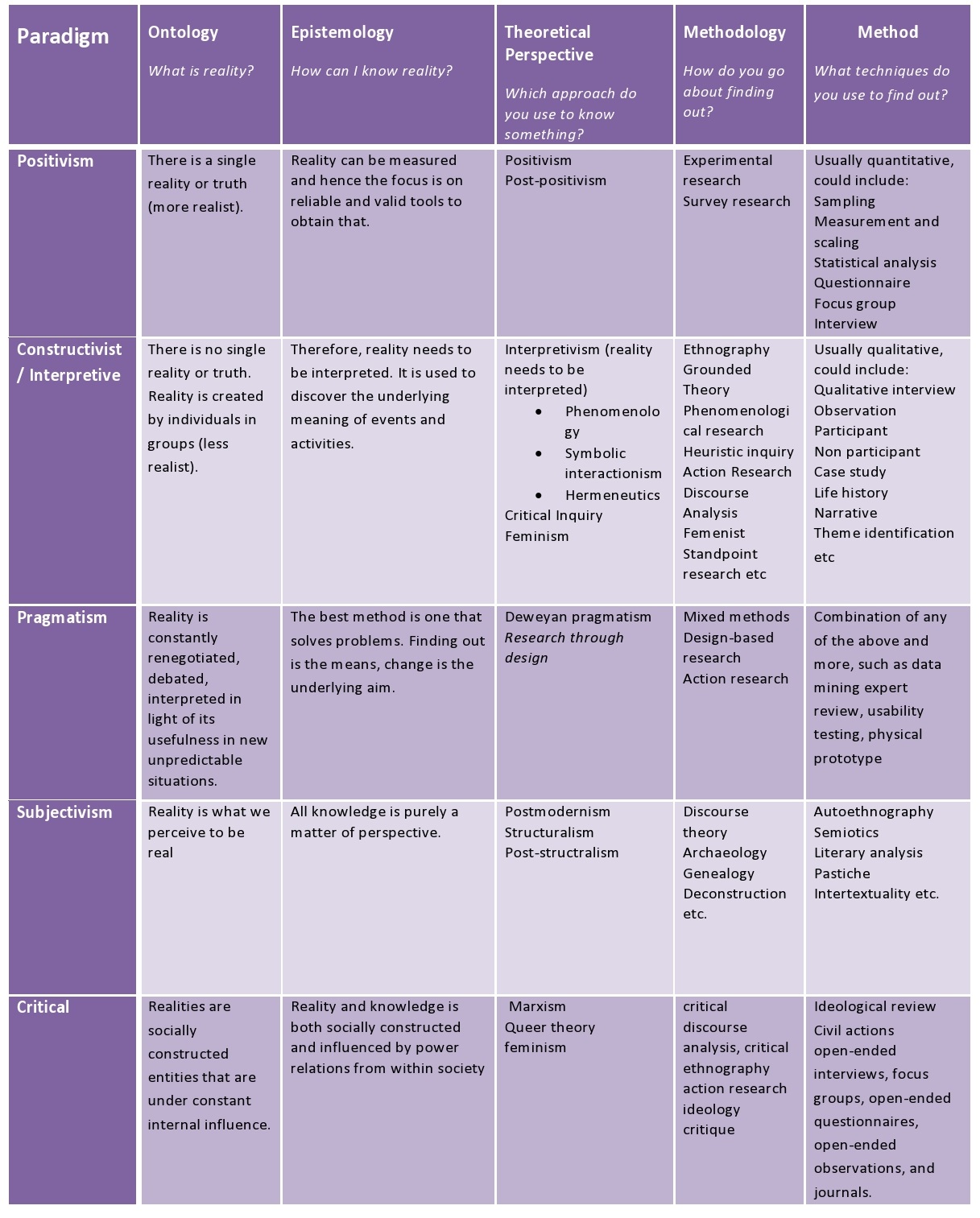
2.2: Now, select one paradigm and reflect on how ontology, epistemology, and methodology differ according to your selected paradigm. The table in this link and the following questions will help you to complete this task:
Ontology: What is out there to know? / What is reality?
Epistemology: How can I know reality?
Methodology: How do I acquire knowledge?
Step 3: Create
Create a 5-minute video presentation that includes:
Your examples on how each research paradigm would help you discover different aspects of the health issue of your choice.
How ontology, epistemology, and methodology differ for a selected paradigm. Use examples related to your selected health issue to illustrate your arguments.
Feel free to use slides for the presentation. You can use the free version of Loom to record and share your video.
Step 4: Self-Analysis and Enhancement
Before you submit, engage in an introspective self-analysis by systematically reviewing each component of your work. Reflect on what aspects of your work were executed well and what could be enhanced. Proceed to refine these elements in your work.
Step 5: Submit
Post a shareable link to your presentation in the forum. To share your work, click on the “Reply” button under this post and paste your link in the “Message” box. Make sure to reference others’ intellectual property when necessary. All references should follow 7th Edition APA formatting. For further instructions, see the resource on the Himmelfarb Health Sciences Library: APA citation resource (N.B. references are excluded from word counts).
OPTIONAL Step 6: Interact (10 minutes)
If you would like to, you can reply to your peers' posts in a respectful and professional manner. Ensure that your post engages your peers' ideas by including a reflection on their comments, sharing ideas of other potential difficulties and parties involved, or asking thought-provoking questions. If a peer comments on your posting, please reply. To post a reply, click “Reply” on a particular discussion, write your feedback and then click on “Post to forum.”
- Differentiate the concepts of paradigm, method, and design in research theory.