Section: Module 2: Lesson 2: Identifying Social and Community Factors that Affect Health | Social and Behavioral Health | NextGenU.org
-
Student Learning Outcomes:
- Define an ecological model as it applies to social and behavioral health.
- Describe the linkages between social and behavioral determinants of health at different levels of the ecological framework.
- Identify community factors that influence public health.
- Discuss how social, behavioral, environmental, and biological factors contribute to public health issues.
- Understand the role and importance of social & community factors in addressing Public Health issues.
- Explore strategies to solve public health problems that make use of social and community factors.
-
Students mustView
Read content on the section “Part 2” on pages 10-33. (20 minutes)
National Cancer Institute - 2012
-
Students mustView
Read the entire article. (31 minutes)
SagePub Journal - 2012
-
Students mustView
Read the entire article. (37 minutes)
National Research Council - 2013
-
Read the entire article. (5 minutes)
American Hospital Association - 2020
-
Read from the title "Abstract" to the title "Community", ¨Society¨ and ¨Conclusion¨(9 minutes)
Springer Science - 2020
-
Read the entire flyer. (10 minutes)
NIH - 2020
-
Students mustView
Read the entire article (6 minutes)
AJMC - 2016
-
Read content from "A Framework for Healthy Communities" to end. (11 minutes)
Journal Article - 2018
-
Read content from "Why Address Social Determinants of Health and Development" to "Summary". (34 minutes)
Community Tool Box - 2013
-
Watch the enitre video This lecture reviewed some of Professor Everitt and his group’s research on the behavioural neuroscience of addiction in experimental animals that seeks to understand the neural and psychological mechanisms of addictive behaviour, including the nature of vulnerability as well as the possibility of developing new treatments. (53 minutes)
-
Students mustViewStart discussions: 1
Instructions: Based on the material covered so far, pick the two (2) strategies that you think are the best/most effective at solving public health problems. Write a discussion (250 -300 words) on why you chose those strategies.
Step 1: Review
Review learning resources for Module 2. Based on the factors that affect the health of individuals and the strategies explored, select two strategies that you think are the most effective.
Step 2: Apply
Think about a specific public health problem related to your area of expertise. Reflect on how the strategies you chose are applied to solving the problem you identified.
Step 3. Respond
Write a 350-500 word report discussing your selected strategies with the following inclusions.
Why did you choose those strategies?
Discuss why the chosen strategies are effective.
Do you think the strategies can be further improved?
Step 4: Share
Submit your discussion. To share your work, click on the button at the bottom of the screen, “Add a new discussion topic.” Include the title of your report and paste your work in the “Message” box. Click “Post to forum.” Make sure to reference others’ intellectual property when necessary. All references should follow 7th Edition APA formatting; see the resource on the Himmelfarb Health Sciences Library for instructions: APA citation resource (references are excluded from word counts).OPTIONAL Step 5: Interact (10 minutes)
If you would like to, you can reply to your peers' posts in a respectful and professional manner. Ensure that your post engages your peers' ideas by including a reflection on their comments, sharing ideas of other potential difficulties and parties involved, or asking thought-provoking questions. If a peer comments on your posting, please reply. To post a reply, click “Reply” on a particular discussion, write your feedback and then click on “Post to forum.”
-
Students mustViewStart discussions: 1
In this activity, you will use some statistical data to analyze social and behavioral determinants of individual health within an ecological framework.
Step 1. Review
Review the learning resources for this module. Focus on social and behavioral determinants of health and ecological models.
Step 2. Study
Study this statistical record.
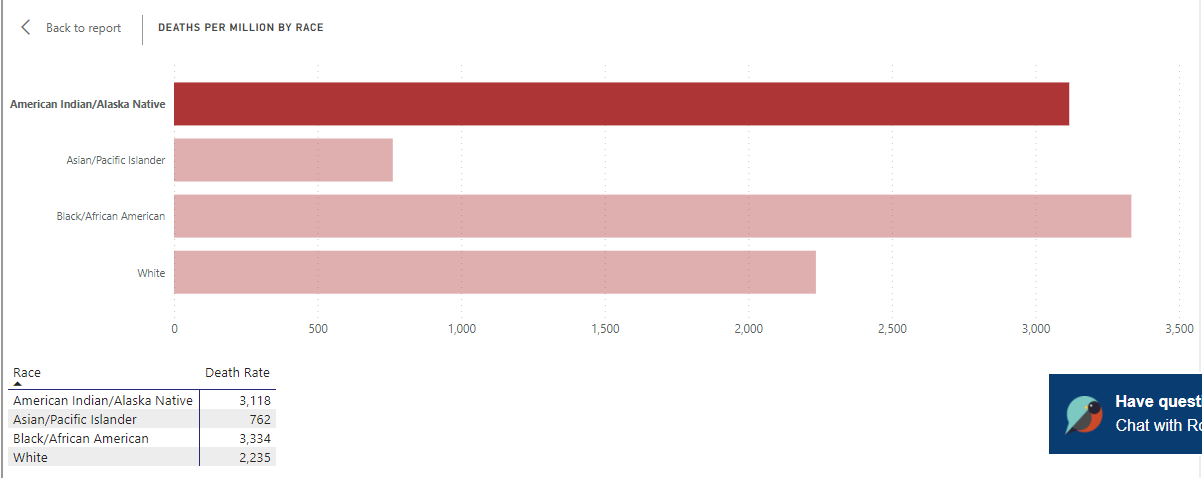
African Americans comprise approximately 14% of Michigan’s population, yet 40% of the state’s COVID-19-related deaths were among African Americans as reported by the state’s official website. Additionally, American Indians and Alaskan Natives who are also state residents fall second in that category. https://www.michigan.gov/coronavirus/0,9753,7-406-98163_98173---,00.html
Step 3: Reflect
Using the data above, reflect on the following questions:
- What social and behavioral determinants of health can be attributed as to why African Americans and Alaskan Natives have more mortality cases?
- How do social and behavioral factors at the individual level affect this health outcome?
- How can an ecological framework be used to understand the effects of social and behavioral factors on the risks of COVID-19 mortality cases for these populations?
Step 4: Respond
Respond by writing a 300-600 word reflective piece of writing covering the questions introduced in step 3.
Step 5: Share
To share your work, click on the “Add a new discussion topic” button under this post and paste your work in the “Message” box. Make sure to reference others’ intellectual property when necessary. All references should follow 7th Edition APA formatting. For further instructions, see the resource on the Himmelfarb Health Sciences Library: APA citation resource (N.B. references are excluded from word counts).
Step 6: Interact
To complete the activity, you will need to reply to at least one post made by your peers in a respectful and professional manner. Ensure that your post engages your peers' ideas by including a reflection on their comments, sharing ideas of other potential difficulties and parties involved, or asking thought-provoking questions. If a peer comments on your posting, please reply. To post a reply, click “Reply” on a particular discussion, write your feedback and then click on “Post to the forum.”
OPTIONAL Step 7: Interact (10 minutes)
If you would like to, you can reply to your peers' posts in a respectful and professional manner. Ensure that your post engages your peers' ideas by including a reflection on their comments, sharing ideas of other potential difficulties and parties involved, or asking thought-provoking questions. If a peer comments on your posting, please reply. To post a reply, click “Reply” on a particular discussion, write your feedback and then click on “Post to forum.”
-
Quiz: Module 2
To access the quiz, click on the name of the quiz provided above. On the following screen, click the "Preview quiz now" button to respond to the questions.
TO PASS THIS QUIZ YOU MUST OBTAIN A SCORE OF 80%.
-
Read content under the following headings: "Social Networks, Social Support, and Health" and "Aspects of Health Influenced by the Social Environment". (13 minutes)
Institute of Medicine (US) - 2006
- Define an ecological model as it applies to social and behavioral health.