

Section: Module 3: Protection From Exposure to Tobacco Smoke | Tobacco Control Legislation (with examples from the Caribbean) | NextGenU.org
-

By the end of this module and upon completion of the required readings and activities, participants will be able to:
- Discuss the rationale and summarize the evidence regarding exposure to second-hand smoke and smoke-free measures;
- Describe the status of implementation of Article 8 of the WHO FCTC in the Caribbean;
- Identify the key elements of smoke-free measures necessary to effectively protect people from exposure to tobacco smoke;
- Assess the common arguments of the tobacco industry and provide effective counter-arguments;
- Analyze the key legal arguments used to try to challenge comprehensive smoke-free measures; and
- Design and draft effective smoke-free measures.
-
Students mustMark as done
Live Session
-
This video is a recording of a webinar session that was delivered to a cohort of students from the Caribbean. Watch the entire video to better understand the module’s content. (58 minutes)
-
Read the entire Slideset. (17 minutes)
1.8 MB -
Students mustMark as done
Required readings and activities
-
Students mustMark as done
Module Introduction
-
-
Students mustMark as done
3.1 Rationale and evidence, including that relevant to novel and emerging nicotine and tobacco products
-
Students mustView
Read the entire document. (11 minutes)
-
Students mustMark as done
3.2 Status of implementation of WHO FCTC compliant smoke-free measures in the Caribbean
-
Students mustView
Read the entire document. (3 minutes)
-
Students mustMark as done
3.3 Implementing WHO FCTC Article 8: Drafting effective smoke-free measures
-
Students mustView
Read the entire document. (29 minutes)
-
Students mustView
Watch the entire video. (3 minutes)
-
Students mustMark as done
3.4 Countering tobacco industry arguments
-
Students mustView
Read the entire document. (4 minutes)
-
Students mustView
Watch the entire video. (8 minutes)
-
Students mustMark as done
3.5 Experiences with legal challenges to comprehensive smoke-free legislation
-
Students mustView
Read the entire document. (4 minutes)
-
Students mustView
Watch the entire video. (8 minutes)
-
Students mustMark as done
Module 3: Key Messages
-
Students mustView
Read the entire document. (3 minutes)
-
Students mustMark as done
Activity
-
Students mustViewStart discussions: 1
In this activity, you will analyze how smoke-free legislation aligns with the nine-component framework for designing effective tobacco control legislation and with the World Health Organization (WHO) Framework Convention on Tobacco Control (FCTC) Article 8 Guidelines. To complete this activity you will need to reply to at least one post made by your peers.
Step 1: Analyze
Review the content in Segment 3.3. Select ONE scenario from below and analyze how you would address the question(s) raised in the chosen scenario:
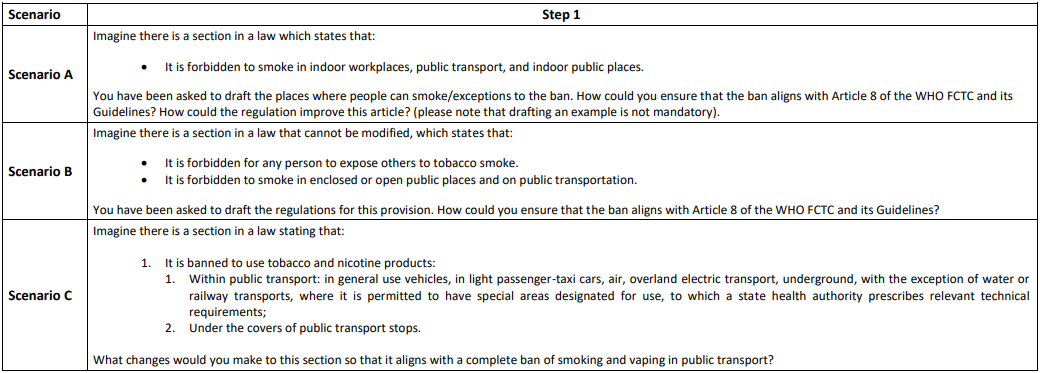
Step 2: Write
Write a 150-300 word discussion post that answers the question(s) raised in Step 1.
Step 3: Share
To share your work, click on the “Add a new discussion topic” button under the post and paste your work in the “Message” box. Make sure to reference others’ intellectual property when necessary. All references should follow 7th Edition APA formatting. For further instructions, see the resource on the Himmelfarb Health Sciences Library: APA citation resource (N.B. references are excluded from word counts).
Step 4: Interact
To complete this activity, you will need to reply respectfully and professionally to at least one post made by your peers. To post a reply, click “Reply” on a particular discussion, write your feedback and then click on “Post to forum.” If your peer(s) comment(s) on your post(s), please reply. Feel free to interact with the work done by other peers as well!
OPTIONAL Step 5: Interact (10 minutes)
If you would like to, you can reply to your peers' posts in a respectful and professional manner. Ensure that your post engages your peers' ideas by including a reflection on their comments, sharing ideas of other potential difficulties and parties involved, or asking thought-provoking questions. If a peer comments on your posting, please reply. To post a reply, click “Reply” on a particular discussion, write your feedback and then click on “Post to forum.”
-
Students mustMark as done
Quiz
-
Students mustViewReceive a gradeReceive a passing grade
To access the quiz, click on the name of the quiz provided above. On the following screen, click the attempt quiz button to respond to the questions.