

Section: Module 3: Lesson 2: Sensory Processing and Sensing the Environment (Vision, hearing and other senses) | Introduction to Psychology | NextGenU.org
-
Learning objectives:
- Describe the pathways that sensory systems follow into the central nervous system.
- Discuss sound, perceptual experiences, waves, and wavelengths.
- Describe the structure and function of the eye and visual processing.
- Describe the basic anatomy and function of the auditory system, encode and perceive pitch and localize sound.
- Describe the taste and somatosensation, smell, pheromones, kinesthetic sense, and vestibular sense.
-
Students mustMark as done
Required Learning Resources and Activities
-
Students mustView
Read the content from " Learning Objectives" until " Spinal Cord and Brain Stem." (16 minutes)
Rice University - 2016
-
Students mustView
Read the entire web page. (8 minutes)
Rice University - 2016
-
-
-
Students mustView
Read the entire web page. (11 minutes)
Rice University - 2016
-
Students mustView
Read the content under the heading " somatosensation". (5 minutes)
Rice University - 2016
-
Students mustView
Read the content under the heading "central processing". (2 minutes)
Rice University - 2016
-
Students mustView
Read the entire web page. (3 minutes)
University of Central Florida - 2020
-
Students mustViewStart discussions: 1
In this activity, you will explore different objects using your senses and discuss how different approaches, laws, and principles in psychology explain how you perceive objects.
Step 1. Review (40 mins)
Review the learning resources relevant to this activity
Step 2. Explore (30 mins)
-
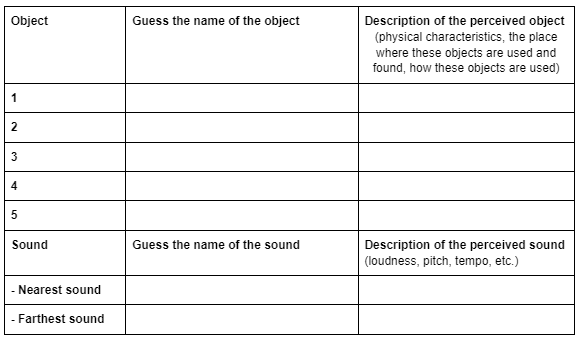
Blindfold yourself (with a mask or a scarf) before starting the activity. Then, ask a friend or a housemate to bring five (5) different objects and place them in front of you. While being blindfolded, use your sensory organs to explore the five objects. Describe the physical characteristics of the objects. Try to guess the name of each object. Finally, based on your perceptions, explain where the objects are often found and used and how these objects are used.
-
While still blindfolded, use your sense of hearing to listen and hear the sounds around you. Examine carefully the nearest and farthest sounds that you can hear.
-
Remove the mask/scarf. Did you identify the 5 objects properly?
Step 3. List (30 mins)
List all the explored sensations and perceptions experienced in Step 1.
Step 4. Analyze (30 mins)
Analyze the contents of the box from Step 3. Reflect on the following principles:
- Bottom-up/top-down processing
- Weber’s Law
- Gestalt Principles of Perception
- Sound waves and wavelengths
Step 5. Respond (210 mins)
Based from your examples in Step 3, respond by writing a 300-800-word discussion piece that covers the following questions:
- How is the bottom-up/top-down approach used in perceiving the five objects?
- How can Weber’s Law help in guessing the names of the objects correctly?
- Which Gestalt Principles of Perception are applied in this kind of activity?
- How are the physical properties of sound waves, such as wavelengths, amplitude, and frequency, associated with perceptual experience?
- Did you recognize the five objects correctly? If not, what was your guess and what was the real object? In your opinion, what could explain the fact that you could not identify the object?
Step 6. Share (10 mins)
To share your work, click on the “Add a new discussion topic” button under this post and paste your work into the “Message” box. Please share the table from Step 3 AND the discussion from step 5. Make sure to reference others’ intellectual property when necessary. All references should follow 7th Edition APA formatting. For further instructions, see the resource on the Himmelfarb Health Sciences Library: APA citation resource (N.B. references are excluded from word counts).
Step 7. Interact (10 mins)
Evaluate and categorize the work from one of your peers based on items A - E of the rubric below. Provide a rationale for the grade you have provided, as well as comments or suggestions for improvement. To post a reply, click “Reply” on a particular discussion, write your feedback and then click on “Post to forum.” You can use the list below as an example:
Item A is .…. because…. My suggestions for improvement are….
Item B is .…. because…. My suggestions for improvement are….
Item C is .…. because…. My suggestions for improvement are….
Item D is .…. because…. My suggestions for improvement are….
Item E is .…. because…. My suggestions for improvement are….OPTIONAL Step 8: Interact (10 minutes)
If you would like to, you can reply to your peers' posts in a respectful and professional manner. Ensure that your post engages your peers' ideas by including a reflection on their comments, sharing ideas of other potential difficulties and parties involved, or asking thought-provoking questions. If a peer comments on your posting, please reply. To post a reply, click “Reply” on a particular discussion, write your feedback and then click on “Post to forum.”
-
-
Quiz: Module 3
To access the quiz, click on the name of the quiz provided above. On the following screen, click the "Preview quiz now" button to respond to the questions.
TO PASS THIS QUIZ YOU MUST OBTAIN A SCORE OF 80%.