

Section: Module 6: Lesson 1: Types of Learning in Psychology | Introduction to Psychology | NextGenU.org
-
Learning objectives:
- Recognize and define three basic forms of learning—classical conditioning, operant conditioning, and observational learning.
- Define observational learning and the steps in the modeling process.
- Describe habituation and dishabituation.
-
Students mustMark as done
Required Learning Resources and Activities
-
Students mustView
Read the entire web page. (7 minutes)
Rice University - 2016
-
Students mustView
Read from "Learning Objectives" to "General Processes in Classical Conditioning." (24 minutes)
Rice University - 2016
-
Students mustView
Read the entire web page. (14 minutes)
Rice University - 2016
-
Students mustView
Read the content under the heading "Habituation." (9 minutes)
Britannica - 2016
-
Students mustViewStart discussions: 1
In this activity, you will examine a fictional case and describe how habituation and dishabituation can impact the case scenario.
Step 1. Review (34 mins)
Review the learning resources for this module.
Step 2. Study (30 mins)
Study the given fictional case assessment table of a person named Ruben below:
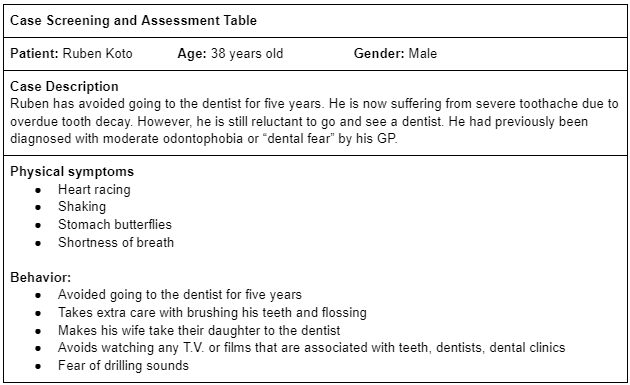
Step 3. Respond (120 mins)
Respond by writing a 200-500-word post that describes how habituation and exposure can help Ruben overcome his phobia and how dishabituation can interfere with and even worsen Ruben’s behavior and phobia. To be more specific, include the following elements in your post:
- Description of habituation and dishabituation as concepts.
- Description of how habituation as a concept can be used to positively address Ruben’s phobia and associated behaviors.
- Description of how dishabituation can worsen the intensity of the phobia and the behavior associated with it.
Step 4. Share (10 mins)
To share your work, click on the “Add a new discussion topic” button under this post and paste your complete work into the “Message” box. Make sure to reference others’ intellectual property when necessary. All references should follow 7th Edition APA formatting. For further instructions, see the resource on the Himmelfarb Health Sciences Library: APA citation resource (N.B. references are excluded from word counts).
Step 5. Interact (10 mins)
To complete the activity, you will need to reply to at least two posts made by your peers in a respectful and professional manner. Ensure that your post engages your peers' ideas by including a reflection on their comments, sharing ideas of other potential difficulties and parties involved, or asking thought-provoking questions. If a peer comments on your posting, please reply. To post a reply, click “Reply” on a particular discussion, write your feedback and then click on “Post to the forum.”
OPTIONAL Step 6: Interact (10 minutes)
If you would like to, you can reply to your peers' posts in a respectful and professional manner. Ensure that your post engages your peers' ideas by including a reflection on their comments, sharing ideas of other potential difficulties and parties involved, or asking thought-provoking questions. If a peer comments on your posting, please reply. To post a reply, click “Reply” on a particular discussion, write your feedback and then click on “Post to forum.”
-
Quiz: Module 6
To access the quiz, click on the name of the quiz provided above. On the following screen, click the "Preview quiz now" button to respond to the questions.
TO PASS THIS QUIZ YOU MUST OBTAIN A SCORE OF 80%.
-
Students mustMark as done
Recommended Additional Readings
-
Students mustView
Read the content under the heading " Introduction" and "Characteristics Of Habituation".
Wiley Online Library - 2022
- Recognize and define three basic forms of learning—classical conditioning, operant conditioning, and observational learning.