

Section: Module 1: Lesson 1: Introduction | Screening for Substance Use Disorders in Primary Care | NextGenU.org
-
Upon completion of this lesson, you will be able to:Learning Objectives:
- Recognize how primary health care can be involved in lessening the burden of mental illness, including substance use disorders, and understand the idea of task-shifting.
- Identify what substances are used and abused and how they affect people’s health and social functioning.
-
Students mustView
Read the content under the heading " The Issue" and " Opportunities and Challenges" on pages 4-9. (12 minutes)
WHO - 2018
-
Students mustView
Read from the beginning of the article to the heading "Methods" to better understand the concept of task-shifting. (5 minutes)
The Journal of Rural Health - 2018
-
Students mustView
Read entire webpage focusing on how drugs affect individual's health and social functioning. (12 minutes)
Better Health Channel - 2017
-
Students mustView
This training is based on the mhGAP goals and recommendations for the implementation of mental health services in primary care. To familiarize yourself with the rationale for doing so and how the mhGAP Intervention Guide works, please read the Introduction, General Principles of Care, and the Master Chart (pp. 1-8 in the document; pp. 9-16 on the page navigator). In this training, we will mostly focus on alcohol and other substance use disorders, including tobacco use. Although tobacco use is not covered in the mhGAP, it will be covered in other resources in this course). The training will also review when to refer to primary care practitioners with additional training in mental health and substance use disorders, for example, in cases of immediate risk of self-harm or danger to others and severe intoxication. NextGenU’s Alcohol, Tobacco and Other Substance Use Disorders: Identification and Management in Primary Care can assist practitioners in addressing those conditions, as well as commonly co-occurring conditions like depression and psychosis. Please save this document so that you can access it later in this course, as well as in your practice as a quick reference guide. You are welcome to review the rest of the mhGAP Intervention Guide to familiarize yourself with the World Health Organization's suggestions for addressing other priority conditions in primary care. (18 minutes)
WHO - 2016
-
Students mustView
Download the booklet. Read the entire manual, as this will be your foundation for understanding the science behind addiction and health. The next module of this training will cover issues of stigma and human rights related to those with mental health conditions (including substance use issues), because stigma and violations of human rights are major barriers in the provision of care to these populations. Stigma and human rights violations can come from people in every part of society, including care providers, family, neighbors, employers, and government officials. This is why our first module starts by exploring these concepts and how they affect those who suffer from mental health or substance use disorders, and what you can do about it when you interact with them. (45 minutes)
NIH - 2020
-
Students mustViewStart discussions: 1
In this activity, you will discuss strategies and approaches that can be implemented to address barriers to substance use care.
Step 1. Review
Review all the learning resources for this lesson.
Step 2. Analyze
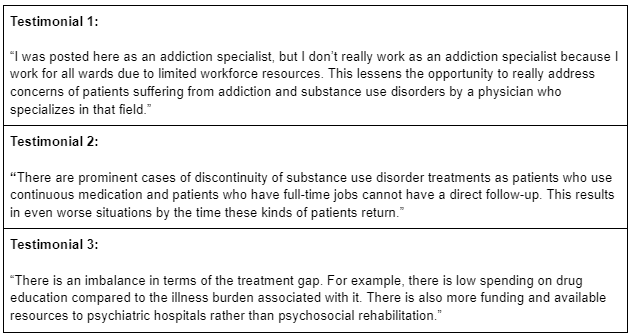
Study and analyze some hypothetical testimonials of primary healthcare providers to challenges in integrating and strengthening substance use services into primary care.
Step 3. Respond
Write a 300-450-word reflective piece of writing that will discuss strategies and approaches that may be implemented to address the challenges and barriers covered by all testimonials. To be more specific, your response should include the following:
- Strategies and approaches to addressing the challenges described in the three testimonials
- At least one strategy/approach that may be implemented for challenges/barriers that are not described in any of the testimonials
- Potential outcomes to substance use services within primary care settings
Step 4: Share
To share your work, click on the “Add a New Discussion” button under this post and paste your work in the “Message” box. Make sure to reference others’ intellectual property when necessary. All references should follow 7th Edition APA formatting. For further instructions, see the resource on the Himmelfarb Health Sciences Library: APA citation resource (N.B. references are excluded from word counts).
Step 5: Interact
To complete the activity, you will need to reply to at least two posts made by your peers in a respectful and professional manner. Ensure that your post engages your peers' ideas by including a reflection on their comments, sharing ideas of other potential difficulties and parties involved, or asking thought-provoking questions. If peer comments on your posting, please reply. To post a reply, click “Reply” on a particular discussion, write your feedback and then click on “Post to forum.”
OPTIONAL Step 6: Interact (10 minutes)
If you would like to, you can reply to your peers' posts in a respectful and professional manner. Ensure that your post engages your peers' ideas by including a reflection on their comments, sharing ideas of other potential difficulties and parties involved, or asking thought-provoking questions. If a peer comments on your posting, please reply. To post a reply, click “Reply” on a particular discussion, write your feedback and then click on “Post to forum.”
-
Quiz: Module 1
To access the quiz, click on the name of the quiz provided above. On the following screen, click the "Preview quiz now" button to respond to the questions.
TO PASS THIS QUIZ YOU MUST OBTAIN A SCORE OF 4/6