

Section: Module 4: Lesson 2: Probability Basics | Intro to Statistics | NextGenU.org
-
Student Learning Outcomes:
Upon completion of this lesson, you will be able to:- Explain the meaning of the probability of an event A in a sample space S.
- Calculate the probability of a specified simple event in a chance experiment with equally likely outcomes determine simple probabilities using the complement rule, and frequencies or count.
- Determine compound probabilities using the addition rules for disjoint and non-disjoint events.
- Find the conditional probabilities of events.
- determine if two given events are independent.
- Find probabilities using the multiplication rule.
- Find probabilities using Bayes' Rule.
- Determine Sensitivity, Specificity, False Negative, and False Positive probabilities, the Prevalence of a disease, the Predictive Value Positive, and Predictive Value Negative of a Screening Test from a contingency table.
-
Students mustView
Read entire page. (4 minutes)
Institute for Work and Health - 2010
-
Students mustView
Read entire page and watch the video included. (25 minutes)
University of Florida - 2022
-
-
Students mustView
Watch entire video. (5 minutes)
Khan Academy - 2022
-
Students mustView
Read entire page. (25 minutes)
University of Florida - 2022
-
Students mustView
Read entire page. (32 minutes)
NIH - National Library of Medicine - 2021
-
Students mustView
Read entire page. (10 minutes)
Boston University School of Public Health - 2021
-
-
Students mustViewStart discussions: 1
Student Learning Outcome (Module 4 Lesson 2): Determine Sensitivity, Specificity, False Negative, and False Positive probabilities, the Prevalence of a disease, the Predictive Value Positive, and Predictive Value Negative of a Screening Test from a contingency table.
Step 1. Review
Review the learning resources for this lesson before studying the case problem.
Step 2. Analyze
Analyze the case problem below.
The paper “Good for Men, Good for Women, bad for People: Simpson’s Paradox and the Important of Sec-Specific Analysis in Observational Studies” (Journal of Women’s Health and Gender-Based Medicine [2001]: 867-872) described a medical study in which one treatment was shown to be better for men and better for women than a competing treatment when the data for men and women were analyzed separately. However, if the data for men and women are combined, it appears as though the competing treatment is better.
To see how this can happen, consider the accompanying data tables constructed from the information in the paper. Subjects in the study were given either Treatment A or Treatment B, and survival was noted. Let S be the event that a patient selected at random survives, A be the event that a patient selected at random received Treatment A, and B be the event that a patient selected at random received Treatment B.
The following table summarizes data for the men who participated in the study:
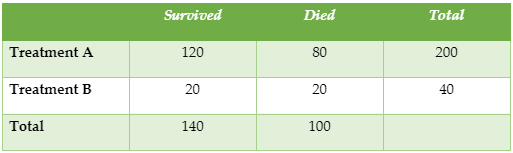
1. Find PS.
2. Find PS|A.
3. Find PS|B.
4. Which treatment appears to be better?Now consider the summary data for women who participated in the study:
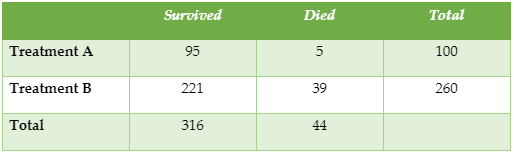
5. Find PS.
6. Find PS|A.
7. Find PS|B.
8. Which treatment appears to be better?Now consider the data summary for men and women combined:
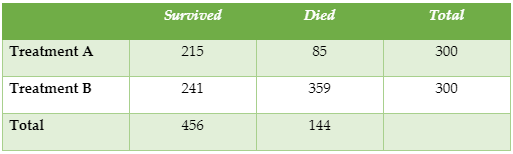
This is an example of what is called Simpson’s paradox.9. Find PS.
10. Find PS|A.
11. Find PS|B.
12. Which treatment appears to be better?Step 3. Respond
Respond to the case problem by writing a brief explanation of why this apparent inconsistency occurs for this data set.
Step 4. Share
To share your work, access to the first post below and click on the “Reply” button under this post and paste your work into the “Message” box. Make sure to reference others’ intellectual property when necessary. All references should follow 7th Edition APA formatting. For further instructions, see the resource on the Himmelfarb Health Sciences Library: APA citation resource (N.B. references are excluded from word counts).
Step 5: Interact
To complete the activity, you will need to reply to at least two posts by your peers respectfully and professionally. Ensure that your post engages your peers' ideas by including a reflection on their comments, sharing ideas of other potential difficulties and parties involved, or asking thought-provoking questions. If a peer comments on your posting, please reply. To post a reply, click “Reply” on a particular discussion, write your feedback and then click on “post to the forum.”
OPTIONAL Step 6: Interact (10 minutes)
If you would like to, you can reply to your peers' posts in a respectful and professional manner. Ensure that your post engages your peers' ideas by including a reflection on their comments, sharing ideas of other potential difficulties and parties involved, or asking thought-provoking questions. If a peer comments on your posting, please reply. To post a reply, click “Reply” on a particular discussion, write your feedback and then click on “Post to forum.”