

Section: Module 1: Lesson 4: Randomization and Sampling | Intro to Statistics | NextGenU.org
-
Student Learning Outcomes:
Upon completion of this lesson, you will be able to:
- Discuss the importance of and identify instances of Random Selection and Random Assignment in Research.
-
Determine the sampling method that will best generate samples for a given situation in research.
- Explain the generation of a stratified, a cluster, a systematic, or any other types of sampling discussed in the text.
-
Students mustView
Read entire page. (2 minutes)
San Diego State University - 2021
-
Students mustView
Read entire page. (2 minutes)
San Diego State University - 2021
-
Students mustView
Read up to the end of page 14. (30 minutes)
University of Central Arkansas - 2013
-
Students mustViewStart discussions: 1
Student Learning outcome (Module 1 Lesson 4): Discuss the importance of and identify instances of Random Selection and Random Assignment in Research.
Step 1. Review
Review the learning resources for this lesson before studying the case problem.
Step 2. Analyze
Analyze the case problem below.
A new drug is introduced. How should an experiment be designed to test its effectiveness? The primary method is comparison. The drug is given to subjects in a treatment group, but other subjects are used as controls ‒ they aren’t treated. The treatment and control groups should be as similar as possible ‒ except for the treatment. Then the responses of the two groups are compared. Subjects should be assigned to the groups at random. A randomized controlled assignment is when an impartial chance procedure is used to assign the subjects to treatment or control. This method provides the best assurance of validity and reliability. However, randomized controlled experiments are hard to do. As a result, doctors often use other designs which are not as good. For example, a new treatment can be tried out on one group of patients, who are compared to “historical controls:” patients treated the old way in the past. Usually, using historical controls, assignment to the groups is not randomized, resulting in a poorly-designed experiment. The problem is that the treatment and historical groups may differ in important ways besides the treatment.
Coronary bypass surgery is a widely used ‒ and very expensive ‒ operation for coronary artery disease. Chalmers and associates identified 29 trials of this surgery (first line of the table below). There were 8 randomized controlled trials, and 7 were quite pessimistic about the value of the operation. By comparison, there were 21 trials with historical controls, and 16 were positive. Three other therapies were evaluated: 5-FU, used in chemotherapy for colon cancer; BCG, used to treat melanoma; and DES, used to prevent miscarriage. The data are given below.
Table 1: A study of studies. Four therapies were evaluated by randomized controlled trials and by trials using historical controls. Conclusions of trials are summarized as positive about the value of the therapy (+) or negative (-).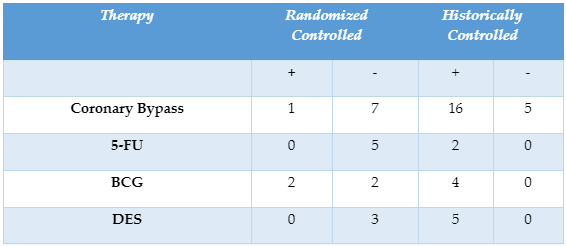
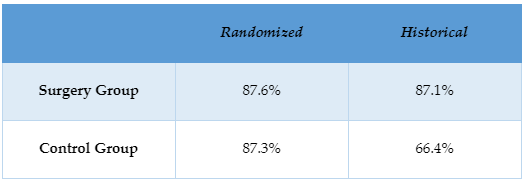
Why are the randomized controlled studies less enthusiastic, and the less well-designed studies more enthusiastic about the value of the surgery?
Look at it in view of the data in the table below.
Table 2: Randomized controlled experiments vs. studies with historical controls: three-year survival rates for surgery patients and patients used as controls in trials of coronary bypass surgery.
Step 3. Respond
Respond to the case problem by answering the question: Why are the randomized controlled studies less enthusiastic and the less well-designed studies more enthusiastic about the value of the surgery?
Step 4. Share
To share your work, access to the first post below and click on the “Reply” button under this post and paste your work into the “Message” box. Make sure to reference others’ intellectual property when necessary. All references should follow 7th Edition APA formatting. For further instructions, see the resource on the Himmelfarb Health Sciences Library: APA citation resource (N.B. references are excluded from word counts).
Step 5: Interact
To complete the activity, you will need to reply to at least two posts by your peers respectfully and professionally. Ensure that your post engages your peers' ideas by including a reflection on their comments, sharing ideas of other potential difficulties and parties involved, or asking thought-provoking questions. If a peer comments on your posting, please reply. To post a reply, click “Reply” on a particular discussion, write your feedback and then click on “post to the forum.”
OPTIONAL Step 6: Interact (10 minutes)
If you would like to, you can reply to your peers' posts in a respectful and professional manner. Ensure that your post engages your peers' ideas by including a reflection on their comments, sharing ideas of other potential difficulties and parties involved, or asking thought-provoking questions. If a peer comments on your posting, please reply. To post a reply, click “Reply” on a particular discussion, write your feedback and then click on “Post to forum.”
-
Students mustViewReceive a gradeReceive a passing grade
To access the quiz, click on the name of the quiz provided above. On the following screen, click the "Preview quiz now" button to respond to the questions.
-
Students mustViewReceive a gradeReceive a passing grade
To access the quiz, click on the name of the quiz provided above. On the following screen, click the "Preview quiz now" button to respond to the questions.