Section: Module 4: Lesson 5: Aromatic Substitution Reactions Part II | Organic Chemistry 2 | NextGenU.org
-
Student Learning Outcomes:
Upon completion of this module, students you will be able to:
- Deduce the products formed from the substitution reactions of disubstituted benzene rings from the orientational interaction of the two substituents.
- Break down the oxidation of alkyl side-chains, the reduction of nitro groups and aryl ketones, the conversion of halogens to organometallic reagents, the hydrolysis of sulfonic acids, and modifying the influence of strong activating groups as examples of electrophilic substitution reactions.
- Break down the mechanisms, main products, and characteristics of redox reactions of fused benzene rings.
- Explain why nucleophilic aromatic substitutions in the presence of very strong bases (like NH2-, NaoH) proceed by elimination, followed by addition rather than through an anionic intermediate (benzyne).
- Outline the mechanism of nucleophilic aromatic substitution and explain the relative reactivity of substituted aryl halides toward nucleophilic substitution by deduction from the mechanism of the reaction.
-
Students mustMark as done
Required Learning Resources and Activities
-
Students mustView
Read the section on electrophilic substitution of disubstituted benzene rings. (3 minutes)
Virtual Textbook of Organic Chemistry Michigan State - 2013
-
Students mustView
Read the section on substituent groups. (10 minutes)
Virtual Textbook of Organic Chemistry Michigan State - 2013
-
Students mustView
Read the section on Fused benzene rings. (2 minutes)
Virtual Textbook of Organic Chemistry Michigan State - 2013
-
Students mustView
Read the sections on Nucleophilic Substitution, Elimination & Addition Reactions. (10 minutes)
Virtual Textbook of Organic Chemistry Michigan State - 2013
-
Students mustViewStart discussions: 1
General Instructions:
In this activity, you will demonstrate your understanding of aromatic systems and amines, their derivatives, and their various reactions.
Step 1: Select and Reflect
Select one of the topics below and demonstrate your understanding of them in theoretical and practical settings:
Nomenclature, Aromaticity, and Aromatic Structure
Structure and Stability of Benzene
Electrophilic Aromatic Substitution, Aromatic Nitration, Aromatic Sulfonation
Step 2: Respond
Answer any one of the following questions:
Using the chemistry tool, draw the structures of the products formed by the following reactions and state their names using IUPAC nomenclature.
*In the case of reaction at the bottom, what will be the final product if H2 + Ni are added under high temperature and pressure?
Which of the following structures is more stable? State your reasons.
Explain what happens in steps one and two and the formation of the sigma complex of the reaction below.
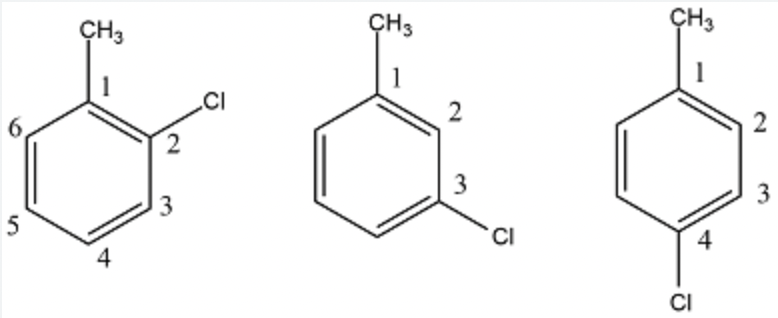
Name the position of the chloride in each of the following diagrams and state the names of the compounds using IUPAC nomenclature.
Step 3: Share
To share your work, click on the “Add a new discussion topic” button under this post and paste your work into the “Message” box. Make sure to reference others’ intellectual property when necessary. You do not need to share your drawings that were done in the chemistry tool, but you can discuss them if needed. All references should follow 7th Edition APA formatting. For further instructions, see the resource on the Himmelfarb Health Sciences Library: APA citation resource (N.B.: references are excluded from word counts).
Step 4: Interact
To complete the activity, evaluate and categorize the work from one of your peers based on items A - E of the rubric below. Provide a rationale for the grade you have provided and comments or suggestions for improvement. To post a reply, click “Reply” on a particular discussion, write your feedback, and click “Post to forum.” You can use the list below as an example:
Item A is….. because ….. My suggestions for improvement are …..
Item B is ….. because ….. My suggestions for improvement are…..
Item C is ….. because ….. My suggestions for improvement are…..
Item D is ….. because …… My suggestions for improvement are ……
Item E is ….. because ….. My suggestions for improvement are …..
OPTIONAL Step 5: Interact (10 minutes)
If you would like to, you can reply to your peers' posts in a respectful and professional manner. Ensure that your post engages your peers' ideas by including a reflection on their comments, sharing ideas of other potential difficulties and parties involved, or asking thought-provoking questions. If a peer comments on your posting, please reply. To post a reply, click “Reply” on a particular discussion, write your feedback and then click on “Post to forum.”
-
Quiz: Module 4
To access the quiz, click on the name of the quiz provided above. On the following screen, click the "Preview quiz now" button to respond to the questions.
TO PASS THIS QUIZ YOU MUST OBTAIN A SCORE OF 80%.