

Section: Module 5: Lesson 2: Hydrostatic Pressure and Pascal's Law | Physics | NextGenU.org
-
Upon completion of this lesson, you will be able to:Learning Objectives:
- Define density and pressure, and understand the relationship between depth in a fluid and hydrostatic pressure.
- Apply Pascal's law to a hydraulic system.
-
Students mustMark as done
Required Learning Resources and Activities
-
Students mustView
Read the entire page and watch the videos. (81 minutes)
The LibreTexts Physics - 2020
-
Students mustViewStart discussions: 1Step 1. Review
Review the learning resources for this lesson before studying the case problem.
Step 2. Analyze
Analyze the case problem below.Directions and Questions:
Navigate to the Wave Addition simulation with PhET at:
https://phet.colorado.edu/sims/html/under-pressure/latest/under-pressure_en.html

Push the big Play arrow. Start with the default settings. In addition, fill the tank with water and select “Ruler”, like the diagram to the right.
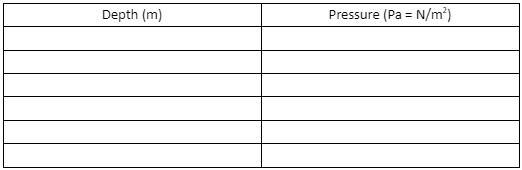
Click on the pressure gauge to move it toward the water. Measure the pressure in the water at every 0.50 m from the surface to the bottom. Record your results on the table below. Note that the simulation will give you kPa. Convert to Pa before entering the values on the table.
4. Use Excel, or similar, to make a graph of pressure vs depth. Do a linear best fit and include the equation on the graph. Copy and paste your graph and equation below.
a. What is the physical meaning of the slope?
b. What is the physical meaning of the y-intercept?
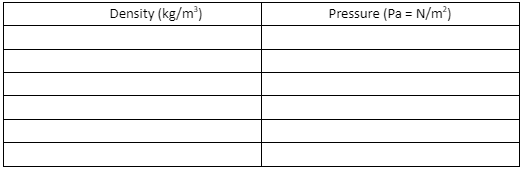
5. Now, pick a depth and vary the fluid density from 700 to 1,400 kg/m3. Record your results on the table below. Note that the simulation will give you kPa. Convert to Pa before entering the values on the table. My chosen depth was:
6. Use Excel, or similar, to make a graph of pressure vs density. Do a linear best fit and include the equation on the graph. Copy and paste your graph and equation below
7. Click on the icon with the question mark on the sink to access the mystery fluid portion. Determine the density of a mystery fluid. If your last name starts with A-H, test Fluid A. If your last name starts with I-N, test Fluid B. If your last name starts with O-Z, test Fluid C. Describe your method and results below.
8. Based on what you learned in this activity, what is the formula for determining the pressure in a fluid? State what each of the symbols mean.
Step 3. Respond
Write a 300-word summary of your lab and your reflections on it. Include the answers to the questions given above.Step 4. Share
To share your work, click on the “Reply” button under this post and paste your work into the “Message” box. Make sure to reference others’ intellectual property when necessary. All references should follow 7th Edition APA formatting. For further instructions, see the resource on the Himmelfarb Health Sciences Library: APA citation resource (N.B. references are excluded from word counts).Step 5: Interact
To complete the activity, evaluate and categorize the work from one of your peers based on items A - D of this rubric. Provide a rationale for your grade and comments or suggestions for improvement. To post a reply, click “Reply” on a particular discussion, write your feedback, then click “Post to forum.” You can use the list below as an example:Item A is .…. because…. My suggestions for improvement are….
Item B is .…. because…. My suggestions for improvement are….
Item C is .…. because…. My suggestions for improvement are….
Item D is .…. because…. My suggestions for improvement are….OPTIONAL Step 6: Interact (10 minutes)
If you would like to, you can reply to your peers' posts in a respectful and professional manner. Ensure that your post engages your peers' ideas by including a reflection on their comments, sharing ideas of other potential difficulties and parties involved, or asking thought-provoking questions. If a peer comments on your posting, please reply. To post a reply, click “Reply” on a particular discussion, write your feedback and then click on “Post to forum.”
OPTIONAL Step 7: Interact (10 minutes)
If you would like to, you can reply to your peers' posts in a respectful and professional manner. Ensure that your post engages your peers' ideas by including a reflection on their comments, sharing ideas of other potential difficulties and parties involved, or asking thought-provoking questions. If a peer comments on your posting, please reply. To post a reply, click “Reply” on a particular discussion, write your feedback and then click on “Post to forum.”