Public Health Communications
-
Public HealthPublic Health CommunicationsResume0% complete0% complete
-
Students mustStudent must submit this questionnaire to complete it
-
Students mustViewReceive a grade
Show More-

Welcome to Public Health Communications. This course provides an opportunity to develop practical skills and knowledge in public health communications and covers the concepts, ethics, critical and creative thinking associated with a community approach to improving Public Health.
This Public Health Communications course is sponsored by the New York Institute of Technology (NYIT). Like all NextGenU.org courses, is competency-based, using competencies from the ASPPH: MPH Core Competency Model, Core Competencies for Public Health in Canada, and CEPH. It uses learning resources from accredited, world-class organizations such as the Pan American Health Organization, U.S. Centers for Disease Control and Prevention (CDC), the U.S. National Institutes of Health, and the World Health Organization. The course was developed by Lillian Niwagaba, PhD, MBA; Yanoh Jalloh, MPH; Margaret Niles, PhD, MEd, DipID; Hugo Rojas, MD, MSc, DiplEd; Genikka Camille Gabral, B.ED, MSc; Melissa Dassrath, BSc. MSc. Pablo Baldiviezo, MD, DiplEd; and Carolina Bustillos, MD, DiplEd.
For publications on NextGenU.org’s courses’ efficacy, see “A Novel Integration of Online and Flipped Classroom Instructional Models in Public Health Higher Education,” (2014), BMC Medical Education, “Building Public Health Capacity through Online Global Learning,” (2018), Open Praxis, or on NextGenU.org’s publication page. Subscribe to our newsletter to be notified of future updates, new courses, and to be part of our community.
There are 6 modules to complete, which provide an introduction to:
- an introduction to public health communications;
- ethics and public health communications;
- information technologies for public health communications;
- critical and creative thinking for public health communications;
- influencing communities through public health communications;
- effective public health communications.
The completion time for this course is estimated at 114 hours and 41 minutes, 47 hours and 18 minutes of didactics and curated resources, and 67 hours and 23 minutes of work participating in activities and quizzes to assist the student in synthesis of the materials. This course is equivalent to three credit hours.
The course requires completion of all case studies, peer activities, and discussion fora. At the end of each lesson, there is a practice quiz. At the end of the course, after you’ve completed each lesson, quiz, and learning activity, you’ll have access to a final exam, and a chance to evaluate this course. Once you’ve passed that last test, you will be able to download a certificate of completion from NextGenU.org. We keep all of your personal information confidential, never sell any of your information, and only use anonymized data for research purposes, and we are also happy to report your testing information and share your work with anyone (your school, employer, etc.) at your request.
Engaging with this Course:
You may browse this course for free to learn for your personal enrichment; there are no requirements. To register in this course, it is required that learners have obtained a college-level/bachelor's degree.
To PASS and Obtain a certificate a learner must successfully complete
- All the reading requirements,
- All quizzes and pass with a 80% with unlimited attempts,
- All case studies,
- All peer activities,
- All discussion forum,
- The final exam with a minimum of 80% and a maximum of 3 attempts, and
- The self and course evaluation forms.
To obtain credit
- Complete all requirements listed above for the certificate, and
- Your learning institution or workplace should approve the partner-university-sponsored NextGenU.org course for educational credit, as they would for their learner taking a course anywhere.
NextGenU.org is happy to provide your institution with
- A link to and description of the course training, so they can see all its components, including the cosponsoring universities and other professional organization cosponsors;
- Your grade on the final exam;
- Your work products (e.g. case study activities), and any other required or optional shared materials that you produce and authorize to share with them;
- Your evaluations -- course, and self assessments;
- A copy of your certificate of completion, with the co-sponsoring universities and other organizations listed.
To obtain a degree, NextGenU.org co-sponsors degree programs with institutional partners. To obtain a full degree co-sponsored with NextGenU.org, registrants must be enrolled in a degree program as a student of a NextGenU.org institutional partner. If you think that your institution might be interested in offering a degree with NextGenU.org contact us.
We hope that you will find this a rewarding learning experience, and we count on your assessment and feedback to help us improve this training for future students.
Here are the next steps to take the course and earn a certificate.
- Complete the registration form.
- Take the pre-test.
- Begin the course with Module 1: Introduction to Social and Behavioral Sciences. In each lesson, read the description, complete all required readings and any required activity, and take the corresponding quizzes.
-
 Competency covered in this module:
 - Apply theory and strategy-based communication principles across different settings and audiences.
- Select communication strategies for different audiences and sectors.
-
Student Learning Outcomes:
Upon completion of this lesson, you will be able to:- Define public health communications and other related concepts.
- Discuss the importance of public health communications for public health workers.
-
Required Learning Resources and Activities
-
Students mustView
Read the entire webpage. (2 minutes)
Society for Health Communication - 2018
-
-
Students mustView
Read Chapter 1 "Introduction to Public Health Communication". (18 minutes)
Parvanta, David E. Nelson - 2017
-
Students mustView
Read the entire article. (11 minutes)
PUBLIC HEALTH AND MANAGEMENT - 2014
-
Students mustView
Read the entire webpage. (10 minutes)
Centers for Disease Control and Prevention - 2011
-
Students mustViewStart discussions: 1
In this activity, you will write a petition campaign that discusses the importance of public health communications for public health workers.
Step 1: Decide
Decide which current issue/problem in public health can be benefited by public health communication; this will be the central theme of your petition. Then, select your target audience to address your petition.
Example:
Current Issue/Problem: Covid-19 Vaccination Misinformation Problem
Audience: Public Health Agencies
Step 2: Respond
Give the petition a title, so your target audience would know immediately what it is about.
Then, write a 300-900 word statement describing: the problem your petition campaign is addressing, how it can help improve the response to the problem, and the response you would like to get from the audience. Follow this format:
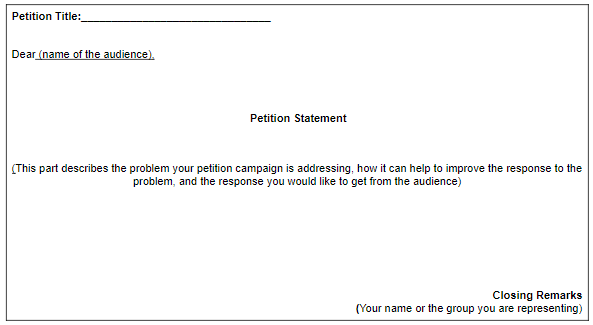
Step 3: Share
To share your work, click on the "Reply" button under this post and paste your work in the "Message" box. Make sure to reference others' intellectual property when necessary. All references should follow 7th Edition APA formatting. For further instructions, see the Himmelfarb Health Sciences Library resource: APA citation resource (N.B. references are excluded from word counts).
Step 4: Interact
To complete the activity, you will need to reply to at least two posts made by your peers in a respectful and professional manner. Be sure that your post engages your peers' ideas by including a reflection on their comments, sharing ideas of other potential difficulties and parties involved, or asking thought-provoking questions. If a peer comments on your posting, please reply. To post a reply, click "Reply" on a particular discussion, write your feedback and then click on "Post to Forum."
OPTIONAL Step 5: Interact (10 minutes)
If you would like to, you can reply to your peers' posts in a respectful and professional manner. Ensure that your post engages your peers' ideas by including a reflection on their comments, sharing ideas of other potential difficulties and parties involved, or asking thought-provoking questions. If a peer comments on your posting, please reply. To post a reply, click “Reply” on a particular discussion, write your feedback and then click on “Post to forum.”
-
Student Learning Outcomes:
Upon completion of this lesson, you will be able to:- Describe the different communication theories and principles.
- Analyze the importance of considering different communication theories and principles in public health communication.
- Assess how using different communication strategies can be more effective for specific audiences in a public health context.
-
Required Learning Resources and Activities
-
Students mustView
Read the content under Chapter 1 "Communication" from pages 1-9, and under the sub-headings "Theories of Communication," "A Model of Communication," "Objectives of Communications," "Elements of Communication Process," "Principles of Communication," and "Forms of Communication." (25 minutes)
Pramilaa R
-
Students mustView
Read the entire article. (17 minutes)
Thulane University, School of Public Heath and Tropical medicine - 2020
-
Students mustView
Read from the content under the heading "Purpose and background." on page 3 (2 minutes)
2017
-
Students mustView
Read the entire article. (15 minutes)
iMedPub Journals - 2017
-
Students mustViewStart discussions: 1
In this activity, you will assess the effectiveness of different vaccine communication strategies for specific audiences
Step 1: Review
Study the given scenario:
You are the health education and promotions officer in your locality. In the past months, there has been well-documented evidence of vaccine hesitancy across your locality which is often fuelled by online and offline misinformation surrounding the importance, safety, or effectiveness of COVID-19 vaccines.
In this regard, your lead officer assigned you to explore and conduct an assessment of the effectiveness of three existing vaccine communication campaigns, as seen below:
The assessment of these three campaigns will be helpful since you will re-model your vaccine campaign based on these data to increase vaccination statistics in your locality.
Step 2: Respond
Questions:After exploring the links for these existing vaccine communication strategies, complete an assessment of the effective communication in the table below, and answer follow-up questions.
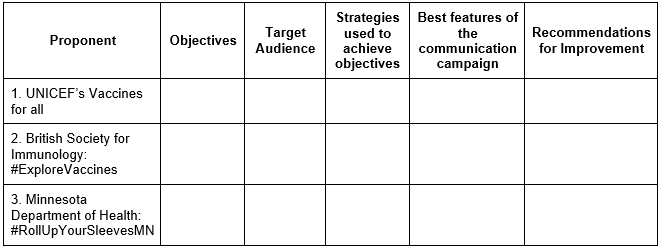
Why is the implementation of effective communication strategies especially significant during the COVID-19 pandemic? Cite specific instances where its relevance is observed.
How important are these communication principles/theories: accessibility, actionability, credibility, relevance, timeliness, and relatedness in countering misinformation about COVID-19 vaccines for specific audiences (kids, adults, older adults)?
Step 3: Self-Analysis and Enhancement
Before you submit, engage in an introspective self-analysis by systematically reviewing each component of your work. Reflect on what aspects of your work were executed well and what could be enhanced. Proceed to refine these elements in your work.
Step 4: Submit
To submit your work, click on the “Reply” button under this post and paste either the picture of your work or the shareable link of your work (if it is a google document) in the “Message” box. Make sure to reference others’ intellectual property when necessary. All references should follow 7th Edition APA formatting. For further instructions, see the Himmelfarb Health Sciences Library resource: APA citation resource (N.B. references are excluded from word counts).
OPTIONAL Step 5: Interact (10 minutes)
If you would like to, you can reply to your peers' posts in a respectful and professional manner. Ensure that your post engages your peers' ideas by including a reflection on their comments, sharing ideas of other potential difficulties and parties involved, or asking thought-provoking questions. If a peer comments on your posting, please reply. To post a reply, click “Reply” on a particular discussion, write your feedback and then click on “Post to forum.”
-
Quiz: Module 1
To access the quiz, click on the name of the quiz provided above. On the following screen, click the "Preview quiz now" button to respond to the questions.
Not available unless: The activity Course Registration is marked complete ...Not available unless:- The activity Course Registration is marked complete
- The activity Pre-Test is marked complete
-
 Competency covered in this module:
 - Describe the importance of cultural competence in communicating public health content.
- Apply legal and ethical principles to the use of information technology and resources in public health settings.
-
Student Learning Outcomes:
Upon completion of this lesson, you will be able to:- Summarize the definition and core principles of cultural competence.
- Exemplify how cultural competence can improve public health communications.
- Explain the strategies and processes for communicating effectively with culturally diverse audiences.
-
Required Learning Resources and Activities
-
Students mustView
Read pages 7-8 of the document. (5 minutes)
National Territory of Department of Education- Australia - 2014
-
Students mustView
Read the content under the headings "What is Cultural Competence?" and "What's the Difference? Cultural Competence, Awareness, and Sensitivity." (3 minutes)
National Prevention Information Network
Centers for Disease Control and Prevention - 2020 -
Students mustView
Read the content from the heading "Components of Intercultural Communication Competence" up to the heading "Key Takeaways." (11 minutes)
Minnesota Libraries - 2016
-
Students mustView
Read the entire sections of the "Introduction" and "Discussion." (8 minutes)
Journal of Primary Care & Community Health-SAGE - 2021
-
Students mustView
Read the entire document. (9 minutes)
National Association of State Mental Health Program Directors - 2012
-
Students mustView
Read the content under the heading "Introduction," and from the heading "Communicating COVID-19 health messages: challenges faced by CALD communities" to the end of the article. (11 minutes)
Public Health Research & Practice - 2021
-
Students mustViewStart discussions: 1
In this activity, you will review sample case studies in public health and exemplify how cultural competence can improve communications in these case studies.
Step 1: Review and Analyze
Review these five (5) case studies. Then, choose three (3) and analyze how cultural competence can improve public health communications in the selected case studies.
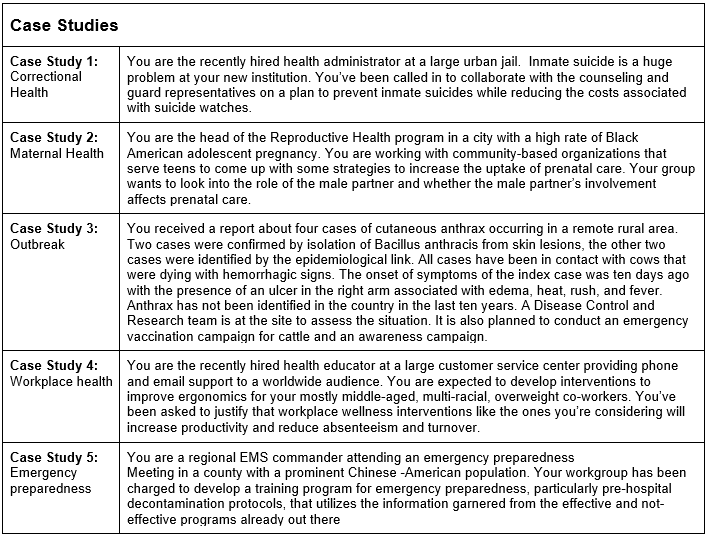
Step 2: Respond
After selecting three case studies, write a 600-900 word expository essay (200-300 words for each case study). In your essay, address the following questions:
- What are some of the issues reflected in each case study?
- How can cultural competence provide guidance in addressing this situation?
- As a public health practitioner, what can you do to increase your understanding of the patient's culture so that you can get the patient into care & treatment?
Step 3: Share
To share your work, click on the "Reply" button under this post and paste your work in the "Message" box. Make sure to reference others' intellectual property when necessary. All references should follow 7th Edition APA formatting. For further instructions, see the Himmelfarb Health Sciences Library resource: APA citation resource (N.B. references are excluded from word counts).
Step 4: Interact
To complete the activity, you will need to reply to at least two posts made by your peers in a respectful and professional manner. Be sure that your post engages your peers' ideas by including a reflection on their comments, sharing ideas of other potential difficulties and parties involved, or asking thought-provoking questions. If peer comments on your posting, please reply. To post a reply, click "Reply" on a particular discussion, write your feedback and then click on "Post to the forum."
OPTIONAL Step 5: Interact (10 minutes)
If you would like to, you can reply to your peers' posts in a respectful and professional manner. Ensure that your post engages your peers' ideas by including a reflection on their comments, sharing ideas of other potential difficulties and parties involved, or asking thought-provoking questions. If a peer comments on your posting, please reply. To post a reply, click “Reply” on a particular discussion, write your feedback and then click on “Post to forum.”
-
Student Learning Outcomes:
Upon completion of this lesson, you will be able to:- Provide examples of health informatics-related laws in the U.S.
- Justify how the ethical concerns regarding information technologies are relevant for public health communications.
- Examine the different types of ethical concerns for public health communication.
- Assess how the different ethical frameworks and precepts can be useful to address ethical issues when communicating public health information.
-
Students mustMark as done
Required Learning Resources and Activities
-
Students mustView
Read the entire page. (7 minutes)
USF Health Morsani Collage of Medicine - 2021
-
Students mustView
Read the entire article. (17 minutes)
NCBI - 2020
-
Students mustView
Read the entire document. (11 minutes)
CDC - 2015
-
Students mustView
Read the content under the headings "Summary," "Introduction: Why Are Ethical Considerations a Pivotal Part of Communication for Health Promotion Interventions?" and "Moral and Practical Reasons." (8 minutes)
Oxford University Press - 2017
-
Students mustView
Read the entire article. (8 minutes)
Americal Journal of Public Health - 2020
-
Students mustView
Read from the "Abstract" up until the heading "Translating ethical values into practice: Five examples of online platforms for health data sharing." (32 minutes)
BMC - 2017
-
Students mustView
Read ALL of the content under the following sections (required for the Peer Activity): "Types of Ethical Concerns Regarding Health Promotion Communication Interventions," "How to Identify and Consider Ethical Issues: Drawing on Ethical Frameworks and Precepts," "Ethical Approaches of Caring and Connectedness" and "Digital Media in Health Promotion: Issues of Privacy and Democracy." (69 minutes)
Oxford Research Encyclopedia - 2017
-
Students mustViewStart discussions: 1
In this activity, you will examine different types of ethical concerns for public health communication and assess how the ethical principles/ precepts can be useful to address ethical issues.
Step 1: Read and Examine
Read the following sections of this article: Ethical Issues in Health Promotion and Communication Interventions.
- Types of Ethical Concerns Regarding Health Promotion Communication Interventions
- How to Identify and Consider Ethical Issues: Drawing on Ethical Frameworks and Precepts
- Ethical Approaches of Caring and Connectedness
- Digital Media in Health Promotion: Issues of Privacy and Democracy
While reading these sections, examine the different types of ethical concerns highlighted in the articles, such as patient privacy and consent, patient safety, ethical dilemmas resulting from data availability and sharing, justice, equity, etc.
Step 2: Assess
After examining these ethical concerns, think of one prominent ethical issue in your research area. Then, analyze how the ethical principles, frameworks, and precepts discussed in the article are useful in addressing these ethical issues/concerns in public health communication.
Some Ethical Principles, Frameworks, and Precepts in Public Health Communication
- Principle of non-maleficence
- Principle of beneficence
- Principle of autonomy and privacy
- Principle of justice and equality
- Principle of impossibility
- Principle of integrity
Step 3: Respond
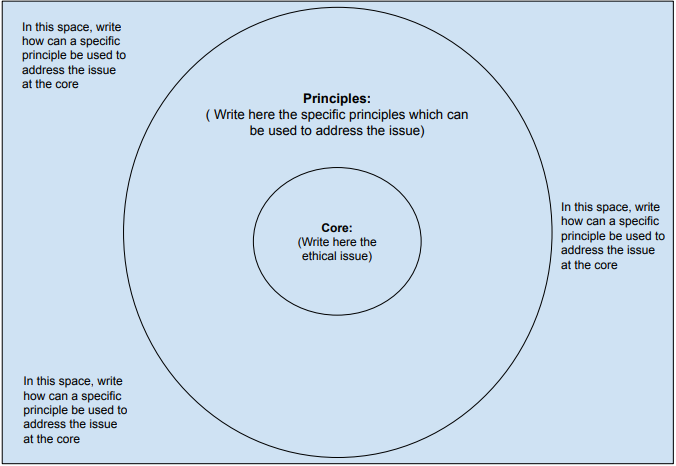
Assess how the ethical principles, frameworks, and precepts can be useful to address one prominent ethical issue in your research area by filling in this circle map with at least three (3) principles.
Step 3: Self-Analysis and Enhancement
Before you submit, engage in an introspective self-analysis by systematically reviewing each component of your work. Reflect on what aspects of your work were executed well and what could be enhanced. Proceed to refine these elements in your work.
Step 4: Submit
To submit your work, click on the “Reply” button under this post and paste either the picture of your work or the shareable link of your work (if it is a google document) in the “Message” box. Make sure to reference others’ intellectual property when necessary. All references should follow 7th Edition APA formatting. For further instructions, see the Himmelfarb Health Sciences Library resource: APA citation resource (N.B. references are excluded from word counts).
OPTIONAL Step 5: Interact (10 minutes)
If you would like to, you can reply to your peers' posts in a respectful and professional manner. Ensure that your post engages your peers' ideas by including a reflection on their comments, sharing ideas of other potential difficulties and parties involved, or asking thought-provoking questions. If a peer comments on your posting, please reply. To post a reply, click “Reply” on a particular discussion, write your feedback and then click on “Post to forum.”
-
Students mustViewReceive a gradeReceive a passing grade
To access the quiz, click on the name of the quiz provided above. On the following screen, click the "Preview quiz now" button to respond to the questions.
TO PASS THIS QUIZ, YOU MUST OBTAIN A SCORE OF 80%
-
Students mustMark as done
Additional Resources for Optional Learning
-
Students mustView
Read the entire article. (15 minutes)
Life Sciences, Society, and Policy - 2018
-

Competency covered in this module:
- Describe how the public health information infrastructure is used to collect, process, maintain, and disseminate data.
- Discuss the influences of social, organizational, and individual factors on the use of information technology by end-users.
-
Student Learning Outcomes:
Upon completion of this lesson, you will be able to:- Describe the key components of public health information infrastructure for data collection, management, and dissemination.
- Evaluate how the key components of public health information infrastructure can be strengthened for improved public healthcare services.
Click here to start this lesson-
Required Learning Resources and Activities
-
Students mustView
Read the entire page. (2 minutes)
United Nations Development Programme - 2021
-
Students mustView
Read the content under the headings "Introduction," "Results" and "Discussion." (20 minutes)
Sage Journals: Health Informatics Journal - 2019
-
Students mustView
Read the section "What are the main actions countries can take to strengthen their HIS?" (3 minutes)
WHO REGIONAL OFFICE FOR SOUTHEAST ASIA - 2017
-
Students mustView
Read the entire document. (10 minutes)
MEASURE Evaluation - USAID - 2017
-
Students mustView
Read the following sections:
- Plain language summary
- Background (up to the heading "Why is is important to do this review?")
- Results (from the heading "Interventions and comparisons" up to "RHIS performance"
- Discussion (up to the heading "Overall completeness and applicability of evidence") (33 minutes)Cochrane Library - 2020
-
Students mustViewStart discussions: 1
In this activity, you will examine common approaches to health information system development and evaluate how its key components can be strengthened for improved public healthcare services.
Step 1. Review
Review all the provided resources in Module 3, Lesson 1. Then, study the table below. After studying, choose two (2) entry approaches from the table and evaluate how key components of public health information systems can be strengthened to avoid such approach failure.
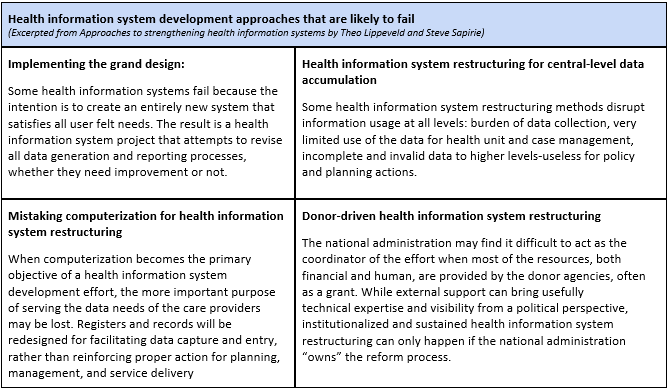
Step 2: Respond
To respond, write a 300-700 evaluation essay with the following inclusions:
- Two entry approaches from the table
- Strategic actions for strengthening key components of public health information system to avoid such approach failure
- A potential improvement in public healthcare service delivery from the strategic actions
Step 3: Share
To share your work, click on the "Reply" button under this post and paste your work in the "Message" box. Make sure to reference others' intellectual property when necessary. All references should follow 7th Edition APA formatting. For further instructions, see the Himmelfarb Health Sciences Library resource: APA citation resource (N.B. references are excluded from word counts).
Step 4: Interact
To complete the activity, you will need to reply to at least two posts made by your peers in a respectful and professional manner. Be sure that your post engages your peers' ideas by including a reflection on their comments, sharing ideas of other potential difficulties and parties involved, or asking thought-provoking questions. If a peer comments on your posting, please reply. To post a reply, click "Reply" on a particular discussion, write your feedback and then click on "Post to the Forum."
OPTIONAL Step 5: Interact (10 minutes)
If you would like to, you can reply to your peers' posts in a respectful and professional manner. Ensure that your post engages your peers' ideas by including a reflection on their comments, sharing ideas of other potential difficulties and parties involved, or asking thought-provoking questions. If a peer comments on your posting, please reply. To post a reply, click “Reply” on a particular discussion, write your feedback and then click on “Post to forum.”
-
Student Learning Outcomes:
Upon completion of this lesson, you will be able to:- Describe the common concepts and models of digital health literacy.
- Differentiate the concepts of health literacy and digital health literacy.
- Analyze the impact of social, organizational, and individual factors in the use of information technology by end-users.
- Illustrate how the ICT user experience can be enhanced to cater for different levels of digital health literacy to help address public health challenges and barriers for a stronger public health care delivery.
-
Students mustMark as done
Required Learning Resources and Activities
-
Students mustView
Read the content under the heading "The Situation" and the graphic "Digital Health Ecosystems." (4 minutes)
European Healthnet-European Commission - 2019
-
Students mustView
Read the content in the sections:
- Introduction
- Results
- Discussion (up to, and inclusive of, Table 3) (28 minutes)Knowledge Management and E-Learning - 2015
-
Students mustView
Read the Introduction. (11 minutes)
Journal of Medical Internet Research - 2018
-
Students mustView
Read the sections "Health Literacy and eHealth Literacy –Definition and Measurement." (4 minutes)
European Psychologist - 2019
-
Students mustView
Read the section "Taxonomy of Barriers to Electronic Medical Records." (33 minutes)
BMC Health Services Research - 2010
-
Students mustView
Read the content under the heading "III. Literature Review" on pages 40-42. (9 minutes)
International Journal of Advanced Computer Science and Applications - 2011
-
Students mustView
Read pages 77-85 "Implementation Considerations." (16 minutes)
WHO - 2019
-
Students mustViewStart discussions: 1
This activity will illustrate how ICT user experience and digital health literacy can be enhanced to help address a public health challenge by creating a tool.
Step 1 Review
Review all the provided resources for Module 3 Lesson 2, then study the list of priority public health challenges and concerns according to CDC’s prevention status reports. A piece of more detailed information is provided by CDC’s website: https://www.cdc.gov/psr/overview.html.

Step 2. Illustrate
Choose one (1) public health challenge/concern from the list. Then, create a tool that illustrates how ICT- user experience can be enhanced to cater to people with different levels of digital health literacy and address the selected public health challenge. Remember that the language used must be suitable for laypeople as the tool will serve as a digital health “prototype” for the selected public health concern. Your tool should have a maximum of 10 slides for a presentation, 500 words in a blog format, or 3-5 minutes in length for a video format. The following inclusions should be evident in your work:
- Strategies, techniques, methods for enhancing ICT to cater to different levels of digital health literacy in the selected public health challenge
- A simple prototype that demonstrates how an ICT or Digital health technology can address the public health challenge.
Step 3: Self-Analysis and Enhancement
Before you submit, engage in an introspective self-analysis by systematically reviewing each component of your work. Reflect on what aspects of your work were executed well and what could be enhanced. Proceed to refine these elements in your work.
Step 4: Submit
To submit your work, click on the “Reply” button under this post and paste either the picture of your work or the shareable link of your work (if it is a google document) in the “Message” box. Make sure to reference others’ intellectual property when necessary. All references should follow 7th Edition APA formatting. For further instructions, see the Himmelfarb Health Sciences Library resource: APA citation resource (N.B. references are excluded from word counts).
OPTIONAL Step 5: Interact (10 minutes)
If you would like to, you can reply to your peers' posts in a respectful and professional manner. Ensure that your post engages your peers' ideas by including a reflection on their comments, sharing ideas of other potential difficulties and parties involved, or asking thought-provoking questions. If a peer comments on your posting, please reply. To post a reply, click “Reply” on a particular discussion, write your feedback and then click on “Post to forum.”
-
Students mustViewReceive a gradeReceive a passing grade
To access the quiz, click on the name of the quiz provided above. On the following screen, click the "Preview quiz now" button to respond to the questions.
-
Students mustMark as done
Additional Resources for Optional Learning
-
Students mustView
Read the entire article. (55 minutes)
JMIR Publications - 2018
-
 Competency
covered in this module:
Competency
covered in this module: Interpret information for professional, non-professional, and community audiences. - Use current technology to communicate effectively.
- Use informatics methods and resources as strategic tools to promote public health.
- Use informatics and communication methods to advocate for community public health programs and policies.
-
Student Learning Outcomes:
Upon completion of this lesson, you will be able to:- Explore the strategies for interpreting information for professional, non-professional and community audiences in public health.
- Use the appropriate strategies to transfer and translate information for improved health outcomes.
Click here to start this lesson-
Required Learning Resources and Activities
-
Students mustView
Read the entire article. (24 minutes)
JBI Evidence Implementation - 2018
-
Students mustView
Read the entire article. (20 minutes)
BMJ journals - 2018
-
Students mustView
Read the content under the headings "Background" and "Discussion" up to the sub-section "Strengths and limitations." (15 minutes)
BMC Public Health - 2012
-
Students mustView
Read the entire document. (12 mins)
Alberta Health Services - 2019
-
Students mustViewStart discussions: 1
In this activity, you will write an expository essay that incorporates appropriate strategies to transfer and translate information for improved health outcomes.
Step 1. Review
Review the resources provided in Module 4 Lesson 1. Keep in mind the strategies that you have explored previously. Then, select one category from the four categories below.
Category 1: Health Promotion of preventable illness such as childhood obesity and diabetes
Category 2: Community involvement and engagement in health advocacy activities
Category 3: Improvement in the use of evidence in public health decision making in local government
Category 4: Combating misinformation, fear, and stigma in the wake of COVID-19
Category 5: Any specific public health communication topic related to your line of study or research
Step 2. Respond
To respond, write a 300-600 word expository writing on the selected category, incorporating appropriate strategies to transfer and translate information for improved health outcomes in the selected category. The expository must be able to include the ff:
- clear, concise, and defined thesis statement about the selected category
- clear and logical transitions between the introduction, body, and conclusion.
- Evidential support of the appropriate strategies to be used
- A conclusion that synthesizes the evidence provided
Step 3: Share
To share your work, click on the "Reply" button under this post and paste your work in the "Message" box. Make sure to reference others' intellectual property when necessary. All references should follow 7th Edition APA formatting. For further instructions, see the Himmelfarb Health Sciences Library resource: APA citation resource (N.B. references are excluded from word counts).
Step 4: Interact
To complete the activity, you will need to reply to at least two posts made by your peers in a respectful and professional manner. Be sure that your post engages your peers' ideas by including a reflection on their comments, sharing ideas of other potential difficulties and parties involved, or asking thought-provoking questions. If a peer comments on your posting, please reply. To post a reply, click "Reply" on a particular discussion, write your feedback and then click on "Post to the Forum."
OPTIONAL Step 5: Interact (10 minutes)
If you would like to, you can reply to your peers' posts in a respectful and professional manner. Ensure that your post engages your peers' ideas by including a reflection on their comments, sharing ideas of other potential difficulties and parties involved, or asking thought-provoking questions. If a peer comments on your posting, please reply. To post a reply, click “Reply” on a particular discussion, write your feedback and then click on “Post to forum.”
-
Student Learning Outcomes:
Upon completion of this lesson, you will be able to:- Examine the various technology trends and expectations to follow for effective communication.
- Provide examples of the application of current technologies for effective and creative communication.
- Discuss how visual design concepts (print or video) enable effective communication.
- Apply the ICT methods and visual design principles in advocating for public health programs and policies.
-
Students mustMark as done
Required Learning Resources and Activities
-
Students mustView
Read the entire page. (19 minutes)
OHIO university - 2020
-
Students mustView
Read the entire page. (6 minutes)
Canadian Health Information Management Association - 2021
-
Students mustView
Read the entire page. (5 minutes)
American University - 2019
-
Students mustView
Read the entire article. (14 minutes)
Journal of Public Health Management and Practice - 2020
-
Students mustView
Read the entire page and the infographic. (6 minutes)
World Health Organization - 2017
-
Students mustView
This website includes several examples of creative communication, the examples can be filtered by different types of media. Spend 4 minutes exploring examples of communication on each type of media. (25 minutes)
United Nations - 2021
-
Students mustView
Read the entire article. (8 minutes)
CONCORDIA UNIVERSITY - 2017
-
-
-
Students mustViewStart discussions: 1
In this activity, you will advocate a specific public health program and policy using ICT methods and visual design principles.
Step 1. Review
Review all the provided resources for Module 4 Lesson 2 and explore this National Association of County and City Health Officials (NACCHO) website. On that website, you will see an array of major programs and issues that NACCHO advocates. The information from the website will help you to solve the scenario below:
Scenario:
You are NACCHO’s health program, visual designer. As a visual designer/healthcare professional, your task is to effectively advocate a specific public health program to the public by applying recent ICT methods and visual design principles. NACCHO allowed you to select one of their public health programs to advocate.
Step 2: Select
Select any form of ICT method or visual design application to create your advocacy. It can be a simulation, interactive presentation, a vlog, a visual podcast, etc. as long as the chosen mode meets these criteria:( a maximum of 10 slides for an interactive presentation, 500 words in a blog format, or 3-5 minutes in length for a video format/ visual podcast. Your work should also emulate the following elements:
- Scale: use of relative size to signal importance
- Visual hierarchy: putting content/elements in order of importance
- Balance: satisfying arrangement or proportion of design elements.
- Contrast: noticeable difference between two objects to emphasize that they are distinct.
- Gestalt principles: simplify and organize complex images that consist of many elements,
Step 3: Self-Analysis and Enhancement
Before you submit, engage in an introspective self-analysis by systematically reviewing each component of your work. Reflect on what aspects of your work were executed well and what could be enhanced. Proceed to refine these elements in your work.
Step 4: Submit
To submit your work, click on the “Reply” button under this post and paste either the picture of your work or the shareable link of your work (if it is a google document) in the “Message” box. Make sure to reference others’ intellectual property when necessary. All references should follow 7th Edition APA formatting. For further instructions, see the Himmelfarb Health Sciences Library resource: APA citation resource (N.B. references are excluded from word counts).
OPTIONAL Step 5: Interact (10 minutes)
If you would like to, you can reply to your peers' posts in a respectful and professional manner. Ensure that your post engages your peers' ideas by including a reflection on their comments, sharing ideas of other potential difficulties and parties involved, or asking thought-provoking questions. If a peer comments on your posting, please reply. To post a reply, click “Reply” on a particular discussion, write your feedback and then click on “Post to forum.”
-
Students mustViewReceive a gradeReceive a passing grade
To access the quiz, click on the name of the quiz provided above. On the following screen, click the "Preview quiz now" button to respond to the questions.
-

Competency covered in this module:
Describe how societal, organizational, and individual factors influence and are influenced by public health communications. - Mobilize individuals and communities by using appropriate media, community resources, and social marketing techniques.
-
Click here to start this lesson
Student Learning Outcomes:
Upon completion of this lesson, you will be able to:- Explain how public health communications influence the behavior of societal, organizational, and individual entities.
- Examine the influence of societal, organizational, and individual factors on public health communications.
-
Required Learning Resources and Activities
-
Students mustViewRead Section 3 "How to promote behavior change: lessons from health communication research." (6 minutes)
National Center for Biotechnology Information, U.S. National Library of Medicine - 2020
-
Students mustView
Read from the beginning of the page up to the heading "Discussion." (19 minutes)
Institute of Medicine - 2015
-
Students mustViewRead the content from the beginning of the article up to the heading "Current Study" and under the heading "Discussion and Implications." (21 minutes)
HHS Public Access - 2014
-
Students mustViewRead the content under "Abstract," "Results" and "Discussion." (30 minutes)
BMC Public Health Journal - 2017 -
Students mustViewStart discussions: 1
In this activity, you will examine the influence of societal, organizational, and individual factors on public health communications through a critical review.
Step 1. Review
Review all the required readings for Module 5 Lesson 1. Keep in mind the societal, organizational, and individual factors in public health communications discussed in the required readings.
Step 2 . Research
Research for one public health communication-related case study/ example and examine the influence of societal, organizational, and individual factors on the selected case study/example.
Example: POLIO PUBLIC HEALTH COMMUNICATION STRATEGIES IN NORTHERN NIGERIA
Step 3. Write
Write a 250- 600 critical review of the case study/example, highlighting the influences of societal, organizational, and individual factors in public health and with the following inclusions.
- An introduction- the title and a brief explanation of the case study
- A main body (critique)- discusses and evaluates the strengths, weaknesses, and important features of the case study
- A conclusion- concludes the review with a restatement of the overall opinion of the case study
Step 3: Share
To share your work, click on the "Reply" button under this post and paste your work in the "Message" box. Make sure to reference others' intellectual property when necessary. All references should follow 7th Edition APA formatting. For further instructions, see the Himmelfarb Health Sciences Library resource: APA citation resource (N.B. references are excluded from word counts).
Step 4: Interact
To complete the activity, you will need to reply to at least two posts made by your peers in a respectful and professional manner. Be sure that your post engages your peers' ideas by including a reflection on their comments, sharing ideas of other potential difficulties and parties involved, or asking thought-provoking questions. If a peer comments on your posting, please reply. To post a reply, click "Reply" on a particular discussion, write your feedback and then click on "Post to the Forum."
OPTIONAL Step 5: Interact (10 minutes)
If you would like to, you can reply to your peers' posts in a respectful and professional manner. Ensure that your post engages your peers' ideas by including a reflection on their comments, sharing ideas of other potential difficulties and parties involved, or asking thought-provoking questions. If a peer comments on your posting, please reply. To post a reply, click “Reply” on a particular discussion, write your feedback and then click on “Post to forum.”
-
Student Learning Outcomes:
Upon completion of this lesson, you will be able to:- Recognise the features of community outreach and mobilization and mass media programmes.
- Give examples of social marketing techniques and how they can be applied in a public health context.
- Assess the strategies for mobilizing effective community outreach media programmes.
-
Students mustMark as done
Required Learning Resources and Activities
-
Students mustView
Read the entire page except for the "References" (13 minutes)
Advocates for Youth- CDC funded - 2014
-
Students mustView
Read the Abstract, Background, and Discussion. (7 minutes)
BMC Public Health Journal - 2020
-
Students mustView
Read the content under the headings "Context," "Overview of Health Communication Campaigns," and "Overview of Social Marketing Campaigns." (5 minutes)
Americal Journal of Preventive Medicine - 2014
-
Students mustView
Read the sections "Health Communication," "Examples of Health Communication interventions" and "Considerations for Implementation." (3 minutes)
Rural Health Information Hub - 2018
-
Students mustView
Read the entire document except for the "Resources." (7 minutes)
CDC - 2013
-
Students mustView
Read the content under the heading "Key strategies" on pages 5-8. (8 minutes)
The Journal of Applied Research on Children- US OFFICE of Adolescent Health - 2017
-
Students mustView
Read the content in the section "What are the key social marketing concepts and principles?" on pages 7-15. (25 minutes)
European Centre for Disease Prevention and Control - 2014
-
Students mustViewStart discussions: 1
In this activity, you will assess the strategies used for mobilizing a specific effective communication outreach media programme.
Step 1. Review and Select
Review all the required readings for Module 5 Lesson 2, especially the key strategies for community mobilization. After reviewing, select one (1) from the three (3) community outreach media programmes below:
Step 2. Assess
Study the selected community mobilization programme and assess how the 14 key strategies for community mobilization are implemented for the programme. The following are key points to consider:
- What are the key strategies implemented in community mobilization?
- To what extent or depth are these key strategies implemented in community mobilization?
- What are the common obstacles in mobilizing the community for the selected program>
- How are the implemented strategies helpful in paving success to community mobilization?
To show your assessment, create your own assessment tool/template. It can be a simulation, interactive presentation, a vlog, a visual podcast, etc. as long as the chosen mode meets these criteria:( a maximum of 10 slides for an interactive presentation, 500 words in a blog format, or 3-5 minutes in length for a video format/ visual podcast.
Step 3: Self-Analysis and Enhancement
Before you submit, engage in an introspective self-analysis by systematically reviewing each component of your work. Reflect on what aspects of your work were executed well and what could be enhanced. Proceed to refine these elements in your work.
Step 4: Submit
To submit your work, click on the “Reply” button under this post and paste either the picture of your work or the shareable link of your work (if it is a google document) in the “Message” box. Make sure to reference others’ intellectual property when necessary. All references should follow 7th Edition APA formatting. For further instructions, see the Himmelfarb Health Sciences Library resource: APA citation resource (N.B. references are excluded from word counts).
OPTIONAL Step 5: Interact (10 minutes)
If you would like to, you can reply to your peers' posts in a respectful and professional manner. Ensure that your post engages your peers' ideas by including a reflection on their comments, sharing ideas of other potential difficulties and parties involved, or asking thought-provoking questions. If a peer comments on your posting, please reply. To post a reply, click “Reply” on a particular discussion, write your feedback and then click on “Post to forum.”
-
Students mustViewReceive a gradeReceive a passing grade
To access the quiz, click on the name of the quiz provided above. On the following screen, click the "Preview quiz now" button to respond to the questions.
-
 Competency
covered in this module:
Competency
covered in this module: - Communicate effectively with individuals, families, groups, communities, and colleagues.
- Demonstrate effective written and oral skills for communicating with different audiences in the context of professional public health activities.
- Communicate audience-appropriate public health content, both in writing and through oral presentation.
- Apply theory and strategy-based communication principles across different settings and audiences.
- Select communication strategies for different audiences and sectors.
-
Student Learning Outcomes:
Upon completion of this lesson, you will be able to:- Understand the definition of effective communication.
- Differentiate the characteristics of effective communication against the barriers to effective communication.
-
Required Learning Resources and Activities
-
Students mustMark as done
Read the section "Communication is an Essential MCH Leadership Skill." (7 minutes)
National Center for Biotechnology Information - 2016
-
Students mustMark as done
Read the entire webpage. (2 minutes)
Open Learn create - 2011
-
Students mustMark as done
Read the content under the heading "Introduction" and "Principles of making effective communication in organization" (3 minutes)
Journal of Applied and Advanced Research-India - 2018
-
Students mustMark as done
Read the following sections:
- Principle: Accessible (page 4 up to "Identify Effective Channels" on page 5)
- Principle: Actionable (page 9 up to "Increase Awareness" on page 11)
- Principle: Credible and Trusted (page 17 up to "Coordinate with Partners" on page 20)
- Principle: Relevant (page 24 up to "Know the Audience" on page 5)
- Principle: Timely (page 30 up to "Communicate what who knows early" on page 31)
- Principle: Understandable (page 35) (24 minutes)WHO - 2017
-
Students mustMark as done
Read the content under the heading "Introduction" "Results" and "conclusions" (16 minutes)
Universidad del Zulia - 2019
-
Students mustViewStart discussions: 1
In this activity, you will differentiate between the characteristics of effective communication and its barriers by writing a case scenario for a specific public health topic or issue.
Step 1. Study
Study the provided learning resource for Module 6 Lesson 1, especially the resource on barriers and facilitators to effective communication. Then, access this website APHA to be acquainted with some common topics and issues in the realms of public health.
Step 2. Select
From APHA's list of common topics in public health, choose three topics. You will use these three topics in writing a specific case scenario for each.
Example: Category- Lead contamination
Step 3. Respond
After selecting, you will formulate a sample case scenario for each chosen topic/ issue (3 topics = 3 case scenarios). From the sample case scenario, you will differentiate what characteristics of effective communication should be demonstrated in solving the case scenario and the barriers to effective communication that may be encountered. The expected word count for each case scenario is 100-300 words ( Total: 300-900 words)
Example:
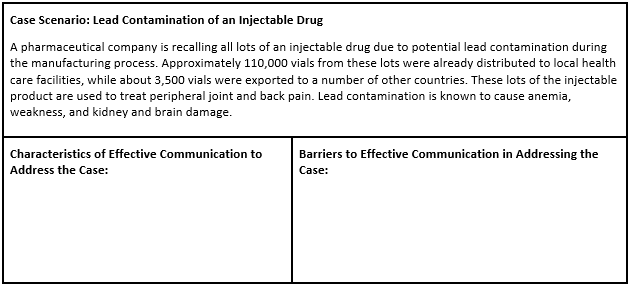
Step 3: Share
To share your work, click on the "Reply" button under this post and paste your work in the "Message" box. Make sure to reference others' intellectual property when necessary. All references should follow 7th Edition APA formatting. For further instructions, see the Himmelfarb Health Sciences Library resource: APA citation resource (N.B. references are excluded from word counts).
Step 4: Interact
To complete the activity, you will need to reply to at least two posts made by your peers in a respectful and professional manner. Be sure that your post engages your peers' ideas by including a reflection on their comments, sharing ideas of other potential difficulties and parties involved, or asking thought-provoking questions. If a peer comments on your posting, please reply. To post a reply, click "Reply" on a particular discussion, write your feedback and then click on "Post to the Forum."
OPTIONAL Step 5: Interact (10 minutes)
If you would like to, you can reply to your peers' posts in a respectful and professional manner. Ensure that your post engages your peers' ideas by including a reflection on their comments, sharing ideas of other potential difficulties and parties involved, or asking thought-provoking questions. If a peer comments on your posting, please reply. To post a reply, click “Reply” on a particular discussion, write your feedback and then click on “Post to forum.”
-
Student Learning Outcomes:
Upon completion of this lesson, you will be able to:- Differentiate written communication from oral communication.
- Practice written and oral communication skills (with attention to grammar, consistent style, clarity, brevity, objectivity, organization, and structure) in delivering professional public health content and activities.
-
Students mustMark as done
Required Learning Resources and Activities
-
Students mustView
Read the content from "Oral communication" to the end of the article on pages 30-32. (10 minutes)
Journal of Applied and Advanced Research-India - 2018
-
Students mustView
Read the entire page. (4 minutes)
Centre for Culture, Ethnicity & Health - 2020
-
Students mustView
Read the content under the heading "Barriers to Effective Verbal Communication" and "Strategies for Effective Verbal Communication." (4 minutes)
University of Waterloo
-
Students mustView
Read the content on the section "Presenting Information at Public Meetings" on pages 34 - 37 (6 minutes)
SAMHSA - 2019
-
Students mustViewStart discussions: 1
In this activity, you will communicate to the editor in response to a recent publication within the journal through a written and an audio letter.
Step 1. Review
Review all the previous readings for Module 6, as well as this guideline for writing a letter. After reviewing, recall a specific topic of interest in public health communication related to your area of research/expertise.
Step 2. Research and Study
Research for a journal article (dated 2010-2021) that is very much aligned with your point of interest. Study the journal article critically by keeping in mind the following salient points: strengths, weaknesses, and controversies in the article, ensuring the absence of misinterpretation.
Step 3. Respond
Write a 300-700 word letter to the editor of a journal publication about the selected journal article with the following inclusions
Purpose of the letter:
Is it to discuss a controversial aspect of the published journal article?
Is it to clarify a specific aspect of the article?
Is it to enrich the existing knowledge of the journal article with professional opinions or objective data?
Is it to share professional viewpoints
Introduction: beginning
Body (Key points, arguments, etc.)
Conclusion: a concise summary and end with suggestions or future recommendations
Step 3: Self-Analysis and Enhancement
Before you submit, engage in an introspective self-analysis by systematically reviewing each component of your work. Reflect on what aspects of your work were executed well and what could be enhanced. Proceed to refine these elements in your work.
Step 4: Submit
To submit your work, click on the “Reply” button under this post and paste either the picture of your work or the shareable link of your work (if it is a google document) in the “Message” box. Make sure to reference others’ intellectual property when necessary. All references should follow 7th Edition APA formatting. For further instructions, see the Himmelfarb Health Sciences Library resource: APA citation resource (N.B. references are excluded from word counts).
OPTIONAL Step 5: Interact (10 minutes)
If you would like to, you can reply to your peers' posts in a respectful and professional manner. Ensure that your post engages your peers' ideas by including a reflection on their comments, sharing ideas of other potential difficulties and parties involved, or asking thought-provoking questions. If a peer comments on your posting, please reply. To post a reply, click “Reply” on a particular discussion, write your feedback and then click on “Post to forum.”
Step 6 (Optional): Submit to your mentor or research advisor
If your mentor or research advisor is available, you may request a review consultation of your work in preparation for submission to your targeted journal. Then, if/when your work gets published, share the link with us, and we will share it on our blog!
-
Student Learning Outcomes:
Upon completion of this lesson, you will be able to:- Identify the best practices to adapt messages to audiences on communication campaigns.
- Analyze the different characteristics that should be considered when communicating audience-appropriate public content (i.e. literacy, technical expertise, cultural diversity, bias, jargon, etc.).
- Evaluate how existing public health communications campaigns adapted their messages for different audiences.
- Construct written/oral public health content that is audience-specific and appropriate based on both audience evaluation and strategy-based communication principles.
-
Students mustMark as done
Required Learning Resources and Activities
-
Students mustView
Read the entire page. (7 minutes)
Annenberg School of Communication and Journalism - 2011
-
Students mustView
Read the entire page. (24 minutes)
University of Minnesota - 2012
-
Students mustView
Read the entire page. (26 minutes)
University of Minnesota - 2012
-
Students mustView
Read the entire page. (16 minutes)
Seneca College - 2020
-
Students mustView
Read pages 24-29. (10 minutes)
WHO - 2017
-
Students mustViewStart discussions: 1
In this activity, you will evaluate an existing public health communication campaign and how it adapted its message to its audiences through a critical audio podcast.
Step 1. Review
Review all the previous readings for Module 6. After reviewing, access these featured public health communication campaigns in the Center for Disease Control and Prevention. Select one campaign of interest. This will help you solve the given scenario below.
Scenario
You are the Lead health communications officer of your region. For this month, you are invited to deliver a podcast episode in your region's health communication podcast channel evaluating one featured public health communication campaign of CDC for a possible re-modeling or adoption of the campaign into your locality.
Step 2. Analyze
Study the selected public health communication campaign and analyze the way it adapted its message to different audiences. Keep in mind the way the health campaign has customized/tailored its message to the different audiences and how it identified key supporting points, each with supporting facts, statistics, and examples, to accomplish the campaign's goal.
Step 3. Respond
Evaluate how the selected public health communications campaign adapted its messages for different audiences by recording an audio podcast that tackles the following focal points:
- Introduction of the campaign
- Relevance of the campaign's content to specific audiences
- Strong features of the campaign that encapsulates the interest and attention of specific audiences
- Strategies used in communicating risks effectively to achieve desired outcomes
- A concise summary that ends with suggestions or future recommendations
Step 4: Share
To share your work, click on the "Reply" button under this post and paste your work in the "Message" box. Make sure to reference others' intellectual property when necessary. All references should follow 7th Edition APA formatting. For further instructions, see the Himmelfarb Health Sciences Library resource: APA citation resource (N.B. references are excluded from word counts).
Step 5: Interact
To complete the activity, you will need to reply to at least two posts made by your peers in a respectful and professional manner. Be sure that your post engages your peers' ideas by including a reflection on their comments, sharing ideas of other potential difficulties and parties involved, or asking thought-provoking questions. If a peer comments on your posting, please reply. To post a reply, click "Reply" on a particular discussion, write your feedback and then click on "Post to the Forum."
OPTIONAL Step 6: Interact (10 minutes)
If you would like to, you can reply to your peers' posts in a respectful and professional manner. Ensure that your post engages your peers' ideas by including a reflection on their comments, sharing ideas of other potential difficulties and parties involved, or asking thought-provoking questions. If a peer comments on your posting, please reply. To post a reply, click “Reply” on a particular discussion, write your feedback and then click on “Post to forum.”
-
Students mustViewReceive a gradeReceive a passing grade
To access the quiz, click on the name of the quiz provided above. On the following screen, click the "Preview quiz now" button to respond to the questions.
-
-
Final Exam Quiz
To take the final exam, you must complete all quizzes and complete all the required activities. The final exam consists of 50 questions, and you will have 50 minutes to complete it. When the time is over, you will have two minutes to submit your attempt before it expires, and your progress is discarded. You will not be able to answer additional questions in the grace period.
To access the exam, click on the name of the exam provided above. On the following screen, click the Preview quiz now button to respond to the questions.
Not available unless: The activity Pre-Test is marked complete ...Not available unless:- The activity Pre-Test is marked complete
- The activity Course Registration is marked complete
- The activity Asynchronous Learning Activity 1: Assessing strategies and principles of effective vaccine communication (300 mins) is marked complete
- The activity Quiz: Module 1 is marked complete
- The activity Asynchronous Learning Activity 2: Assessing strategies and principles of effective public health communication (300 mins) is marked complete
- The activity Quiz: Module 2 is marked complete
- The activity Asynchronous Learning Activity 3: Addressing public health challenges and barriers through ICT and Digital Health Literacy (300mins) is marked complete
- The activity Quiz: Module 3 is marked complete
- The activity Asynchronous Learning Activity 4: Advocating public health programs and policies through the use of ICT methods and visual design principles. (300 mins) is marked complete
- The activity Quiz: Module 4 is marked complete
- The activity Asynchronous Learning Activity 5: Factors influencing public health communications (300 minutes) is marked complete
- The activity Quiz: Module 5 is marked complete
- The activity Asynchronous Learning Activity 6: Communicating to the editor for journal article review (300 mins) is marked complete
- The activity Quiz: Module 6 is marked complete
-
All of:
- The activity Discussion Forum 1. A petition to strengthen public health communications (300 mins) is marked complete
- The activity Discussion Forum 2. Case Studies in Cultural Competence (300 mins) is marked complete
- The activity Discussion Forum 3: Strengthening public health information infrastructure/system (300 mins) is marked complete
- The activity Discussion Forum 4: Utilizing appropriate strategies to transfer and to translate information for improved health outcomes (300 mins) is marked complete
- The activity Discussion Forum 5: Factors influencing public health communications (300 minutes) is marked complete
- The activity Discussion Forum 6: Barriers and facilitators of effective communication (300 minutes) is marked complete
-
-
 In this section, you can provide feedback about this course to help us make NextGenU.org better. Once evaluations are completed, you will be able to download your certificate of completion.
-
Course Evaluation QuestionnaireNot available unless: The activity Final Exam is marked complete
-
Self Evaluation QuestionnaireNot available unless: The activity Final Exam is marked complete
-
-
-
Students mustMark as done
-
Students mustMark as done
-
-