Global Health
You do not have permission to view discussions in this forum.
-
-
Students mustStudent must submit this questionnaire to complete it
-
Students mustViewReceive a grade
Show More-


Welcome to the Global Health course. This course is a comprehensive course designed to equip participants for professional practice within the global health field through the provision of knowledge and skills pertinent to addressing the issues and health implications surrounding global health from various perspectives. The purpose of this course is to educate and inform participants about the major determinants of health and disease from a global perspective and to prepare learners for professional practice in the field of global health.
The Global Health course is sponsored by the University of Incarnate Word (UIW). Like all NextGenU.org courses, it is competency-based; competencies were developed in collaboration with global health and public health subject matter experts, and taking into consideration the following competencies set and programs CUGH competencies and CEPH competencies. The course uses learning resources from accredited, world-class organizations such as the U.S. Centers for Disease Control and Prevention (CDC), the U.S. National Institutes of Health, and the World Health Organization.
The course was funded in part by the University of Incarnate Word (UIW) and created with Assistant Professor for Clinical and Applied Science Education TimMarie C. Williams, PhD, MCG. The course was designed by NextGenU.org team members including: Allison Da Santos, Ph.D.; Genikka Camille Gabral; B.ED, MSc,; Carolina Bustillos, MD, DiplEd.; Hugo Rojas, MD, MSc; Jamila Conliffe, MPH; Jean Pierre Musabyimana, MSc, MGHD; Jesse Ramkalawan, BSc; Leohrandra Graham, MSc; Margaret Niles, Ph.D; Mayra Ambrocio; Ph.D; Pablo Baldiviezo, MD, DiplEd; Samantha Anderson, MSc; and Stephanie Sankar, LLB, LEC.
For publications on NextGenU.org’s courses’ efficacy, see “A Novel Integration of Online and Flipped Classroom Instructional Models in Public Health Higher Education,” (2014), BMC Medical Education, “Building Public Health Capacity through Online Global Learning,” (2018), Open Praxis, or on NextGenU.org’s publication page. Subscribe to our newsletter to be notified of future updates, new courses, and to be part of our community.

There are 6 modules to complete:
- Module 1: Introduction to Global Health
- Module 2: Ethical and Professional Practice
- Module 3: Collaboration and Community Partnerships
- Module 4: Capacity Strengthening in Global Health
- Module 5: Social Awareness
- Module 6: Program Management and Evaluation
The completion time for this course is estimated at 190 hours, including 37 hours of learning resources, 72 hours allocated for study and assimilation, and 81 hours of participating in learning activities and quizzes. This course is equivalent to 4 credit hours.
The course requires completion of all learning activities. At the end of each module, there is a practice quiz of ten (10) multiple-choice questions. At the end of the course, after you’ve completed each lesson, quiz, and learning activity, you’ll have access to a final exam of fifty (50) multiple-choice questions, and a chance to evaluate this course. Upon completion of the training (6 modules), participants will complete a final exam with a passing score of 70% or higher. Participants may retake the exam until this grade is achieved. Once you’ve passed the final exam, you will be able to download a certificate of completion from NextGenU.org and our course’s co-sponsoring organizations. We keep all of your personal information confidential, never sell any of your information, and only use anonymized data for research purposes, and we are also happy to report your testing information and share your work with anyone (your school, employer, etc.) at your request.
Engaging with this Course:
You may browse this course for free to learn for your personal enrichment; there are no requirements. To register for this course, it is required that learners have obtained a college-level/bachelor's degree.
To PASS and obtain a certificate a learner must first register for a course and then successfully complete
- all the reading requirements,
- all quizzes and pass with 80% having unlimited attempts,
- all discussion forums,
- all peer activities,
- the final exam with a minimum of 80% and a maximum of 3 attempts, and
- the self and course evaluation forms.
To obtain credit:
- Complete all requirements listed above for the certificate, and
- Your learning institution or workplace should approve the partner-university-sponsored NextGenU.org course for educational credit, as they would for their learner taking a course anywhere.
NextGenU.org is happy to provide your institution with
- A link to and description of the course training, so they can see all its components, including the cosponsoring universities and other professional organization cosponsors;
- Your grade on the final exam;
- Your work products (e.g. case study activities), and any other required or optional shared materials that you produce and authorize to share with them;
- Your evaluations -- course, and self-assessments;
- A copy of your certificate of completion, with the co-sponsoring universities and other organizations listed.
To obtain a degree, NextGenU.org co-sponsors degree programs with institutional partners. To obtain a full degree co-sponsored with NextGenU.org, registrants must be enrolled in a degree program as a student of a NextGenU.org institutional partner. If you think that your institution might be interested in offering a degree with NextGenU.org contact us.
We hope that you will find this a rewarding learning experience, and we count on your assessment and feedback to help us improve this training for future students.
Here are the next steps to take the course for credit:
- Complete the registration form.
- Take the pre-test.
- Begin the course with Module 1. Introduction to Global Health. In each lesson, read the description, complete all required readings and any required activities, and take the corresponding quizzes.
-
Competencies covered in this module:
- Analyze the roles, relationships, and resources of the entities influencing global health.
-
Student Learning Outcomes:
Upon completion of this lesson, you will be able to:
- Summarize the different concepts and definitions of global health.
- Summarize 3 major global health initiatives in reducing the disparities in global health.
- Describe the major public health efforts to reduce disparities in global health (e.g., Sustainable Development Goals).
- Describe the major global causes of morbidity and mortality.
- Explain how the risk for disease varies with regions based on environmental factors, geographic, and cultural norms.
- Explain the impact of demographic and other major factors on patterns of morbidity, mortality, and disability in a defined population.
- Describe the different sources of data available for assessing the health status of populations (e.g., public health surveillance data, vital statistics, registries, surveys, electronic health records, and health plan claims data).
- Assess the health status of populations utilizing various sources.
-
Required Learning Resources and Activities
-
Students mustView
Read all the contents starting from section: Attributions of definitions until the Discussion section. (46 minutes)
BMJ Global Health - 2021
-
Students mustView
Read the entire article. (33 minutes)
Global Health Research and Policy - 2019
-
-
Students mustView
See the map about Global health initiatives at the bottom of the web page. Click on each icon on the countries to see the initiatives take on each of one. (10 minutes)
BMJ Global Health - 2021
-
Students mustView
Read the content under "Consultation Document " from page 3 to page 11. (36 minutes)
USAID/Global Health - 2010
-
Students mustView
Read the entire page; make sure to read the whole content by clicking on the button "read more" until the end of the reading. (66 minutes)
Pan American Health Organization - 2017
-
Students mustView
Read the content under "Transforming our world: the 2030 Agenda for Sustainable Development" until the heading "Sustainable Development Goals" with the list of goals on pages 3-14. (17 minutes)
United Nations - 2015
-
Students mustView
Read the entire document. (59 minutes)
WHO - 2011
-
Students mustView
Read entire document. (7 minutes)
EUPATI- European Patient's Academy - 2015
-
Students mustView
Read entire document. (45 minutes)
National Institute of Health - 2014
-
Students mustView
Read entire page. (35 minutes)
WHO-PAHO - 2021
-
Students mustView
Read the content under the heading "Types of data used to monitor and evaluation PHE programs" and Methods and data sources used in this guide from pages 24 -33. (23 minutes)
USAID-Measure Evaluation - 2018
-
Students mustView
Read the enitre page. (20 minutes)
CDC, National Academy of Medicine - 2016
-
Students mustViewStart discussions: 1
In this activity, you will assess health status data using measures and indicators for monitoring and evaluating population health.
Step 1. Study and Select [30 minutes]
Study the set of health status examples by accessing the links below. Select a specific group of the US population below:
- Health of American Indian or Alaska Native Population
- Health of Black or African American non-Hispanic Population
- Health of Hispanic or Latino Population
Step 2. Assess [45 minutes]
Assess the health status of the chosen population by using the following measures and indicators:
- Current health
- Estimate the burden of death on a population.
- Years of life lived with disability (YLD), an estimate of the burden of non-fatal diseases and disability on a population.
- Disability-adjusted life years (DALYs), a measure taking both mortality and disability into consideration.
- Sustainability of health
- Adherence to recommended behaviors related to fruit and vegetable consumption, physical activity, and adequate levels of sleep.
- Prevalence of major risk factors, such as obesity or high blood pressure, use of tobacco, alcohol, and other substances.
- Prevalence of other addictive disorders, such as gambling or gaming addictions.
- Quality of health, access to health insurance coverage.
- Satisfaction and well-being
- Emotional functioning, physical functioning.
- Career satisfaction, adequacy of financial resources.
- Social/interpersonal relations, community support.
- Meaning and purpose.
Read this resource for further information.
Step 3. Respond [180 minutes]
Respond by filling in this Summary Measures of Health and Well-Being. For the framework element of Sustainability of health, emphasize addiction-related assessments, such as substance use/abuse, gambling and gaming addiction, smoking, and alcoholism.
Step 4. Share [10 minutes]
To share your work, click on the “Add a new discussion topic” button under this post and paste your work into the “Message” box. Make sure to reference others’ intellectual property when necessary. All references should follow 7th Edition APA formatting. For further instructions, see the resource on the Himmelfarb Health Sciences Library: APA citation resource (N.B. references are excluded from word counts).
OPTIONAL Step 5: Interact (10 minutes)
If you would like to, you can reply to your peers' posts in a respectful and professional manner. Ensure that your post engages your peers' ideas by including a reflection on their comments, sharing ideas of other potential difficulties and parties involved, or asking thought-provoking questions. If a peer comments on your posting, please reply. To post a reply, click “Reply” on a particular discussion, write your feedback and then click on “Post to forum.”
-
Student Learning Outcomes:
Upon completion of this lesson, you will be able to:- Summarize different models or health systems for the provision of healthcare.
- Interpret the relationship between health models and systems with health care expenditure.
- Describe the term "globalization."
- Describe the impact of globalization on the availability and quality of health services.
- Interpret how global trends in healthcare influence the quality and availability of health services.
- Break down at least 3 specific examples of how travel and trade contribute to the spread of communicable and/or chronic diseases.
- Interpret what is meant by the "brain drain" of the global health workforce.
- Examine some of the trends and influences in the global movement and availability of health care workers.
-
Required Learning Resources and Activities
-
Students mustView
Read the entire article. (4 minutes)
Annals of Family Medicine - 2013
-
Students mustView
Read the entire page. (1 minute)
University of Columbia - 2021
-
Students mustView
Read the content under "2. Determinants of health care expenditures: A brief review of the literature" on pages 1-5. (18 minutes)
WHO - 2011
-
Students mustView
Watch the entire video. (4 minutes)
Council on Foreign Relations - 2019
-
Students mustView
Read the entire article. (41 minutes)
International Encyclopedia of the Social & Behavioral Sciences - 2015
-
Students mustView
Read the content under "Market Trends Are Increasingly Dynamic" to "State-Level Trends Are Increasingly Important." (8 minutes)
American Health and Drug Benefits - 2019
-
Students mustView
Read the entire page. (6 minutes)
American University of the Carribean - 2021
-
Students mustView
Read the content under the heading "Abstract" and "IV. Conclusions and Implications." (15 minutes)
HHS Public Access - 2014
-
Students mustView
Read the entire article. (32 minutes)
Elsevier Public Health Emergency Collection - 2018
-
Students mustView
Read the entire article. (55 minutes)
BMC Veterinary Research - 2019
-
Students mustView
Read the entire article. (22 minutes)
AMA Journal of Ethics - 2016
-
Students mustView
Read the content under "Determinants of Brain Drain" on pages 29-31. (12 minutes)
Net Journal of Business Management - 2015
-
Students mustView
Read the content under "Complex Patterns of Mobility: A blurring of 'source' and 'destination'" and "Focus Countries: Results – highlights." (7 minutes)
WHO - 2017
-
Students mustViewStart discussions: 1
In this activity, you will select two global health trends and interpret how they influence the quality and availability of health services.
Step 1. Review
Review the six global health trends as summarized by this learning resource: Global Health Trends. Then, select three (3) trends.
Step 2. Collect Examples
After selecting three trends, find real-life examples in specific regions of how these trends affect the quality and availability of health services, including some sources or pictures of these examples.
Step 3. Respond
Respond by writing a 400-600 word service availability and readiness assessment covering the following questions:
- Introduce your examples and pictures for each trend. Then, for each of them, explain:
- How does the trend impact health service quality, availability, and readiness?
- What challenges are faced by healthcare in relation to this trend?
- What are the probable long-term results if these trends continue to emerge?
- From your perspective, what are the main priorities to ensure these trends improve the quality and availability of health services.?
Step 4. Share
To share your work, click on the “Add a new discussion topic” button under this post and paste your work in the “Message” box. Make sure to reference others’ intellectual property when necessary. All references should follow 7th Edition APA formatting. For further instructions, see the resource on the Himmelfarb Health Sciences Library: APA citation resource (N.B. references are excluded from word counts).
OPTIONAL Step 5: Interact (10 minutes)
If you would like to, you can reply to your peers' posts in a respectful and professional manner. Ensure that your post engages your peers' ideas by including a reflection on their comments, sharing ideas of other potential difficulties and parties involved, or asking thought-provoking questions. If a peer comments on your posting, please reply. To post a reply, click “Reply” on a particular discussion, write your feedback and then click on “Post to forum.”
-
Student Learning Outcomes:
Upon completion of this lesson, you will be able to:- Identify the elements and principles of systems thinking that are already common in public health research.
- Describe the range of theories, methods, and tools associated with systems thinking.
- Interpret "systems thinking" and how it can be used across culture, economics, and health.
- Understand Sustainable Development Goals and their impact on global health.
- Examine with a systems thinking lens how cross-sectoral development contributes to global health.
-
Students mustMark as done
Required Learning Resources and Activities
-
Students mustView
Watch the entire video. (5 minutes)
The Australian Prevention and Psrtnership Center - 2021
-
Students mustView
Read the following sections of the article: Abstract; The relationship between KM and systems thinking; and What does systems-informed knowledge mobilization look like in practice? (25 minutes)
Health Research and Policy Systems - 2020
-
Students mustView
Read the entire article. (17 minutes)
Health Research and Policy Systems - 2014
-
Students mustView
Watch the entire video. (7 minutes)
WHO - 2010
-
Students mustView
Read the content under "Systems Thinking" on pages 39-43. (13 minutes)
WHO - 2009
-
Students mustView
Read the entire page. (7 minutes)
USC University of South Carolina - 2020
-
Students mustView
Read the entire page. (14 minutes)
Council on Foreign Relations - 2016
-
Students mustView
Read the entire page. (21 minutes)
PATH - 2013
-
Students mustViewStart discussions: 1
In this activity, you will propose a project centered in your locality that utilizes a systems thinking approach in understanding and addressing one local issue that spans across culture, economic, and health.
Step 1. Review
Review this case scenario.
You are tasked by the health department director of your locality to design a project to address an existing health issue in your community. For this project, the director wants you to use a systems thinking approach to address the issue according to these blocks:
- Leadership/governance
- Service delivery
- Human resources
- Information
- Financing
- Medical products and technologies
Step 2. Draft
Draft the project plan keeping in mind the following points:
- What is the name of the project?
- What is the health issue to be addressed by the project?
- Who are the stakeholders for this project?
- What are the interventions to address the issue and the 6 blocks mentioned above across the dimensions of culture, economic, and health?
- What are the potential challenges of this project?
- How does the project adapt to these challenges?
- How is systems thinking applied in all aspects of this project?
Step 3. Write
Write a 500-800 word project plan summary that covers the 6 blocks and 6 points discussed above. Write the name of your project as the title of the project plan summary.
Step 4. Share
To share your work, click on the “Add a new discussion topic” button under this post and paste your work in the “Message” box. Make sure to reference others’ intellectual property when necessary. All references should follow 7th Edition APA formatting. For further instructions, see the resource on the Himmelfarb Health Sciences Library: APA citation resource (N.B. references are excluded from word counts).
Step 5: Interact
Evaluate and categorize the work from one of your peers based on items A - E of this rubric. Provide a rationale for the grade you’ve provided, as well as comments or suggestions for improvement. To post a reply, click “Reply” on a particular discussion, write your feedback and then click on “Post to forum.” You can use the list below as an example:
Item A is .…. because…. My suggestions for improvement are….
Item B is .…. because…. My suggestions for improvement are….
Item C is .…. because…. My suggestions for improvement are….
Item D is .…. because…. My suggestions for improvement are….
Item E is .…. because…. My suggestions for improvement are….
-
Student Learning Outcomes:
Upon completion of this lesson, you will be able to:- Explain the term "cultural competence" and its influence on perceptions of health and disease.
-
Analyze the 5 major domains of social determinants of health and their relationship with "health inequity."
- Identify the major social and economic determinants of health and their impact on health access (universal health coverage) and quality of services.
- Analyze the impact of social determinants on life expectancy, major causes of morbidity, and mortality between and within countries.
- Understand the global trends in the adequacy of and access to potable water and sanitation and its relationship to individual and population health.
- Distinguish how the availability of adequate nutrition and air quality impact the risk for communicable and non-communicable diseases.
-
Students mustMark as done
Required Learning Resources and Activities
-
Students mustView
Read the content under "What is Cultural Competence?" (3 minutes)
CDC - 2021
-
Students mustView
Watch the entire video. (3 minutes)
University Behavioral Health Care - Rutgers Health - 2015
-
Students mustView
Read the content under "The cultural continuum." (3 minutes)
Caring for Kids New to Canada - 2021
-
Students mustView
Read the content under "Background" and "Results." (21 minutes)
BMC Public Health - 2017
-
Students mustView
Read the sections "What are the social 'determinants' of health?" and "What are health inequities or inequalities?" (2 minutes)
WHO - 2013
-
Students mustView
Read the entire page. (8 minutes)
Healthy People-Office of Disease Prevention and Health Promotion - 2020
-
Students mustView
Read all of the content under this section: Social Determinants of Health. (86 minutes)
National Academies Press - 2017
-
Students mustView
Read from page 1 to page 5. (24 minutes)
Health of Washington State Washington State Department of Health - 2014
-
Students mustView
Read the entire article. (25 minutes)
Institute for Research on Poverty University of Wisconsin-Madison - 2016
-
Students mustView
Read the entire page. (5 minutes)
Healthy People 2020-ODPHP - 2021
-
Students mustView
Read the entire document. (45 minutes)
National academy of MedIcine - 2019
-
Students mustView
Click twice on "read more" on the bottom of the reading and read the content under the heading "Conceptual Foundation of the Social Determinants of Health" and "Setting the Scene." (9 minutes)
PAHO WHO - 2021
-
Students mustView
Read the entire article. (17 minutes)
Issues Mental Health Nursing - 2013
-
Students mustView
Read the entire page. (2 minutes)
US Department of Health and Human Services CDC - 2012
-
Students mustView
Read the "abstract," "background," "discussion" and "conclusion." (14 minutes)
BMC Public Health - 2020
-
Students mustView
Read the "Abstract," "Introduction," and the content under "What Air Pollution Is and How It Causes Illness." (14 minutes)
CHEST Journal - 2018
-
Students mustViewStart discussions: 1
In this activity, you will record an audio commentary discussing the impacts of nutrition adequacy and air quality on the risk for communicable and non-communicable diseases.
Step 1. Review
Review the learning resources for this lesson before studying the case scenario below.
Case Scenario
You are invited to an environment-focused podcast to share your commentary about nutritional adequacy and air quality and their impact on the risk for communicable and non-communicable diseases. Before the podcasting event, you are requested to select a region where you will discuss how nutritional adequacy and air quality impact the region’s risk for communicable and non-communicable diseases. The regions are the following:
- Northern Africa
- Southern Asia
- Western Europe
- Caribbean
- Northern America
- Polynesia
Access these links for global and regional reports on nutritional profiles and air quality index:
Step 2. Prepare
Prepare your audio commentary focusing on the following points:
- What are nutritional adequacy and air quality?
- How are nutritional adequacy and air quality of a country/region measured?
- How do nutritional adequacy and air quality status determine the risk of communicable and non-communicable diseases for the chosen country/region?
- What communicable and non-communicable diseases are commonly associated with a lack of nutritional adequacy? With a lack of good air quality?
- What are the estimated long-term effects if these two issues are not addressed?
- How does the country/region respond to these two pressing issues?
- What are some recommendations that can be made to have a better nutritional adequacy profile and air quality status?
Step 3. Record
Record a 4-10 minute audio commentary covering all the points discussed in Step 2.
Step 4. Share
To share your work, click on the “Add a new discussion topic” button under this post and paste your work in the “Message” box. Make sure to reference others’ intellectual property when necessary. All references should follow 7th Edition APA formatting. For further instructions, see the resource on the Himmelfarb Health Sciences Library: APA citation resource (N.B. references are excluded from word counts).
Step 5: Interact
Evaluate and categorize the work from one of your peers based on items A - E of this rubric. Provide a rationale for the grade you’ve provided, as well as comments or suggestions for improvement. To post a reply, click “Reply” on a particular discussion, write your feedback and then click on “Post to forum.” You can use the list below as an example:
Item A is .…. because…. My suggestions for improvement are….
Item B is .…. because…. My suggestions for improvement are….
Item C is .…. because…. My suggestions for improvement are….
Item D is .…. because…. My suggestions for improvement are….
Item E is .…. because…. My suggestions for improvement are…. -
Quiz: Module 1
To access the quiz, click on the name of the quiz provided above. On the following screen, click the "Preview quiz now" button to respond to the questions.
Not available unless: The activity Course Registration is marked complete ...Not available unless:- The activity Course Registration is marked complete
- The activity Pre-Test is marked complete
-
Students mustMark as done
Additional Resources for Optional Learning
-
Students mustView
Read the entire document.
Int J Health Policy Manag - 2021
-
 Competencies covered in
this module:
Competencies covered in
this module:- Apply ethical approaches in global health research and practice.
- Display critical self-reflection, cultural humility, and ongoing learning in global health.
-
Student Learning Outcomes:
Upon completion of this lesson, you will be able to:- Identify the common ethical issues and challenges in diverse economic, political, and cultural contexts.
- Analyze the strategies and recommendations used to address the ethical issues and challenges in diverse economic, political, and cultural contexts.
- Implement strategies and recommendations to solve ethical issues in diverse economic, political and cultural contexts as well as vulnerable populations to address global health issues.
- Provide examples of different codes of ethics for clinical and public health environments.
- Examine local and international codes of ethics that are relevant to the healthcare working environment.
- Recognize examples of international standards and guidelines for the protection of human subjects established by key organizations.
- Describe the fundamental principles of some international standards for the protection of human subjects in diverse cultural settings.
- Assess how the fundamental principles of international standards can be applied in diverse cultural settings.
-
Required Learning Resources and Activities
-
Students mustView
Read the content under "Health ethics in practice: key issues and challenges", "Health ethics in practice: key strategies" on pages 14-24. (34 minutes)
WHO - 2015
-
Students mustView
Read Section 1: Introduction. (14 minutes)
American Public Health Association (APHA) - 2019
-
Students mustView
Read the entire document. (7 minutes)
WHO - 2019
-
Students mustView
Read the entire document. (9 minutes)
National Association for Healthcare Quality - 2021
-
Students mustView
Read the sections titled: "What are human rights?" "Defining HRPC and situating it in the legal landscape," "Balancing the rights to health and bodily integrity against other rights and interests," and "Conclusion." (15 minutes)
Public Health Reviews - 2017
-
Students mustView
Read the content under the Heading "Relevant General Principles" to the heading "Other Measures" on pages 11-25. (32 minutes)
Council of Europe - 2017
-
Students mustView
Read the entire page. (6 minutes)
UN Human Rights - 2021
-
Discussion Forum 3 - Ethical Issues and Codes of Ethics in Different Settings. (300 minutes)
In this activity, you will propose strategies on how to address some ethical issues in a case scenario based on the course readings and examine how local and international codes of ethics can be applied in the given case scenarios.
Step 1. Study
Study this table of ethical dilemmas and select two of them.
Step 2. Analyze
Analyze your two selected ethical dilemmas. Reflect on the following points:
- What is the impact of these ethical dilemmas on global health in terms of political, cultural, and economic contexts?
- What are some potential strategies that can be implemented to address these ethical dimensions in the contexts stated above?
- What are possible outcomes upon implementing these strategies and recommendations?
- How can the local and international codes of ethics be applied to address these ethical dilemmas?
Step 3. Respond
Write a 300-700 word proposal covering all the points introduced in Step 2 for the two selected ethical dilemmas. Make sure to support and reference your arguments with resources provided in the course.
Step 4. Share
To share your work, click on the “Add a new discussion topic” button under this post and paste your work in the “Message” box. Make sure to reference others’ intellectual property when necessary. All references should follow 7th Edition APA formatting. For further instructions, see the resource on the Himmelfarb Health Sciences Library: APA citation resource (N.B. references are excluded from word counts).
OPTIONAL Step 5: Interact (10 minutes)
If you would like to, you can reply to your peers' posts in a respectful and professional manner. Ensure that your post engages your peers' ideas by including a reflection on their comments, sharing ideas of other potential difficulties and parties involved, or asking thought-provoking questions. If a peer comments on your posting, please reply. To post a reply, click “Reply” on a particular discussion, write your feedback and then click on “Post to forum.”
Not available unless: The activity Quiz: Module 1 is complete and passed
-
Student Learning Outcomes:
Upon completion of this lesson, you will be able to:
- Describe the concept of integrity, regard, and respect for others in the context of professional practice.
- Describe the concept of cultural humility.
- Examine how integrity, regard, and respect for others impact their professional practice.
- Describe common barriers to health and healthcare in low-resource settings.
- Provide examples of barriers to health and healthcare in different types of communities.
- Reflect on how their own beliefs impact their perception of barriers to health and healthcare in different cultures.
- Explain the concepts of critical self-reflection and ongoing learning.
- Reflect on their limits of individual competence based on their skills, knowledge, and abilities.
- Exemplify how they would adapt their discipline-specific skills to respond to a health issue in a resource-constrained setting.
-
Required Learning Resources and Activities
-
Students mustView
Read the entire page. (5 minutes)
American Council of the Blind - 2020
-
Students mustView
Read the entire article. (30 minutes)
Pubmed - 2013
-
Students mustView
Read the content under results. (31 minutes)
Journal (BMJ) - 2021
-
Students mustView
Read the entire article. (19 minutes)
Caring for kids New Canada - 2021
-
Students mustView
Read the entire content. (2 minutes)
Rural Health Information Hub
-
Students mustView
Read under the headlines "Graduate employability.", "The reflective practitioner", "Reflection", "Teaching reflective skills", and "Reflecting “in” and “on” action", "Reflection as a development tool". (20 minutes)
Journal of Work-Applied Management - 2015
-
Students mustView
Read the entire article. (13 minutes)
International Journal of Surgery. Oncology - 2017
-
Students mustView
Watch the entire video. (78 minutes)
-
Peer Activity 3 - An Expository Essay on Individual Competence, Perception of Health Barriers, and Skill Adaptation (360 minutes) Forum
In this activity, you will choose a scenario that has a different culture/location than your own and reflect on your individual competence, perception of health barriers, and capacity to adapt your skills for resource-constrained settings.
Step 1. Study
Study these case scenarios and select one scenario that does not exist in your culture or location.
Step 2. Analyze
Analyze the selected scenario by reflecting on these points:
- What are your limits of individual competence to respond to the situation?
- Consider your strengths and weaknesses. Based on your current skill set, how could you provide the most contributions to respond to the situation?
- In the context of professional practice, how can integrity, regard and respect to others influence or impact your work in a selected cultural situation?
- How do your own beliefs impact your perception of barriers to health and healthcare about the selected culture/location? For example:
- Do you have any type of bias that drives you to attribute a health issue to cultural or individual factors and ignore structural causes?
- Did you have any pre-existing misconceptions that were clarified after learning more about the selected population?
- What are the similarities and differences about this situation between your own culture and the one you are studying for this activity?
Provide at least two specific examples/ideas of how you would adapt your current skills to make them more useful in addressing the case as a resource-constrained scenario. For example, if you are good at knowledge translation in big conferences, how would you adapt this skill for a small community?
Step 3. Respond
Write a 500-1000 word expository essay covering all the points introduced in Step 2 for the selected scenario.
Step 4. Share
To share your work, click on the “Add a new discussion topic” button under this post and paste your work in the “Message” box. Make sure to reference others’ intellectual property when necessary. All references should follow 7th Edition APA formatting. For further instructions, see the resource on the Himmelfarb Health Sciences Library: APA citation resource (N.B. references are excluded from word counts).
Step 5: Interact
Evaluate and categorize the work from one of your peers based on items A - E of this rubric. Provide a rationale for the grade you’ve provided, as well as comments or suggestions for improvement. To post a reply, click “Reply” on a particular discussion, write your feedback and then click on “Post to forum.” You can use the list below as an example:
Item A is .…. because…. My suggestions for improvement are….
Item B is .…. because…. My suggestions for improvement are….
Item C is .…. because…. My suggestions for improvement are….
Item D is .…. because…. My suggestions for improvement are….
Item E is .…. because…. My suggestions for improvement are….Not available unless: The activity Discussion Forum 3 - Ethical Issues and Codes of Ethics in ... ...Not available unless: The activity Discussion Forum 3 - Ethical Issues and Codes of Ethics in Different Settings. (300 minutes) is marked complete -
Quiz: Module 2
To access the quiz, click on the name of the quiz provided above. On the following screen, click the "Preview quiz now" button to respond to the questions.
TO PASS THIS QUIZ, YOU MUST OBTAIN A SCORE OF 80%
Not available unless: The activity Peer Activity 3 - An Expository Essay on Individual ... ...Not available unless: The activity Peer Activity 3 - An Expository Essay on Individual Competence, Perception of Health Barriers, and Skill Adaptation (360 minutes) is marked complete
-
 Competencies covered in this module:
- Design sustainable workforce development strategies for resource-limited settings.
- Design sustainable workforce development strategies for resource-limited settings.
-
Student Learning Outcomes:
Upon completion of this lesson, you will be able to:- Explain the meaning of the terms "constituencies," "community partnerships," and "interactive learning."
- Reflect on the strategies to promote interactive learning and their value to improve collaboration in resource-limited settings.
- Demonstrate the capacity to include representatives of different constituencies in community partnerships.
- Examine the concept of diplomacy.
- Describe strategies to build trust and engagement with community partners.
- Apply diplomacy and strategies to build trust with community partners in a case study.
-
Required Learning Resources and Activities
-
Students mustView
Watch the video. (6 minutes)
Center for Health Care strategies - 2021
-
Students mustView
Read the entire article. (25 minutes)
Journal of Medical Internet Research - 2019
-
Students mustView
Watch the entire video. (9 minutes)
Global Health Diplomacy- The State University of New York - 2021
-
Students mustView
Read the entire document.(10 minutes)
WHO - 2016
-
Students mustView
Watch the entire video. (82 minutes)
-
Students mustView
Watch the entire webinar. (60 minutes)
-
Peer Activity 4 - A Framework Proposal on Interactive Learning, Community Partnerships and Diplomacy (360 minutes) Forum
In this activity, you will select one case problem to analyze. Upon analysis and reflection, you will propose a framework on how to improve the collaboration to solve the selected case problem.
Step 1. Study
Study these three case problems and select one that matches your interest.
Step 2. Reflect
Reflect on the selected case problem based on the following points:
- How can interactive learning be used to improve collaboration and community participation in addressing the case problem?
- What groups and constituencies may be tapped to act as representatives in community partnerships and collaborations?
- What strategies may be utilized to encourage collaboration and community partnerships with these groups and constituencies?
- What strategies can be used to build trust with community partners in the selected case problem?
- How can diplomacy be applied to foster trust and solidarity with community partners in addressing the case problem?
Step 3. Propose
Propose a framework layout that will clearly present the strategies, interventions, and methods to promote the use of interactive learning in improving the collaboration to solve the selected case problem. Furthermore, the framework should cover all the points introduced in Step 2 and must be accompanied by a 200-600 word explanation. You may use any available tools such as https://www.canva.com/graphs/concept-maps/ and powerpoint.
Step 4. Share
To share your work, click on the “Add a new discussion topic” button under this post and paste your work in the “Message” box. Make sure to reference others’ intellectual property when necessary. All references should follow 7th Edition APA formatting. For further instructions, see the resource on the Himmelfarb Health Sciences Library: APA citation resource (N.B. references are excluded from word counts).
Step 5: Interact
Evaluate and categorize the work from one of your peers based on items A - E of this rubric. Provide a rationale for the grade you’ve provided, as well as comments or suggestions for improvement. To post a reply, click “Reply” on a particular discussion, write your feedback and then click on “Post to forum.” You can use the list below as an example:
Item A is .…. because…. My suggestions for improvement are….
Item B is .…. because…. My suggestions for improvement are….
Item C is .…. because…. My suggestions for improvement are….
Item D is .…. because…. My suggestions for improvement are….
Item E is .…. because…. My suggestions for improvement are….Not available unless: The activity Quiz: Module 2 is complete and passed
-
Student Learning Outcomes:
Upon completion of this lesson, you will be able to:- Recognize strategies to communicate with different audiences (i.e., community partners and global constituencies).
- Discuss strategies to communicate with diverse groups of stakeholders and communities in resource-limited settings.
- Describe the concept of collaborative leadership.
- Examine collaborative leadership practices and strategies.
- Discuss how collaborative leadership can help improve communications with diverse stakeholders in resource-limited settings.
-
Students mustMark as done
Required Learning Resources and Activities
-
Students mustView
Read the content under the heading "Working with Communities" and "Conclusion" on pages 12 to 19. (18 minutes)
CDC - 2014
-
Students mustView
Read pages 3-13. (29 minutes)
Oxford Leadership - 2016
-
Students mustView
Read from the section "Background" to "Conclusion." Note: Skip the Methods section. (35 minutes)
BMC Health Services Research - 2017
-
Peer Activity 5 - How Collaborative Leadership and Other Strategies Improve Communications in Resource-Limited Settings. (300 minutes) Forum
In this activity, you will be given a set of short case scenarios where collaboration and workforce development are necessary to solve a health issue in resource-limited settings.
Step 1. Study
Study these three hypothetical case scenarios below. Select one that matches your interest.
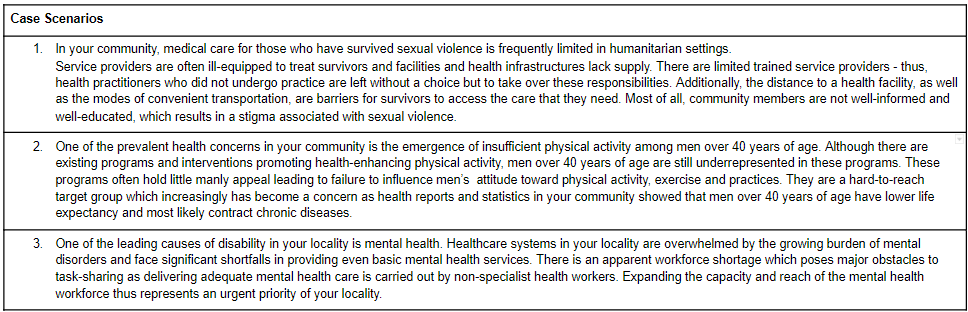
Step 2. Analyze
You have been assigned to coordinate a round table discussion with community partners and global constituencies to address your selected issue. This will be part of a collaboration and workforce development for resource-limited settings event that is being sponsored by global and regional health authorities. For this, you need to outline a strategy to communicate the available information and then to organize a discussion about potential strategies to address the problem.
Step 3. Respond
The partners have agreed to participate in the round table discussion for three hours. They also asked to be briefed about the health issue ahead of time to be prepared for discussing potential solutions during the event. Therefore, you need to:
- Prepare an agenda for the round table discussion: Keep collaborative leadership practices in mind when designing your agenda. You want to encourage stakeholders to take leading roles and provide their views and ideas to address the issue, but you also need to keep the discussion focused on collaboration and workforce development. The agenda should reflect your knowledge about communication and collaboration strategies.
- Plan the elaboration of information materials about the problem to be addressed: For this, your team will need a prepare a 300-650 word communication plan that discusses the following:
- Description of the type of materials to be used and specific communication strategies to be employed.
- Rationale that articulates the value of applying communication and collaborative leadership strategies (both new and existing) to improve collaboration and partnerships about the selected scenario.
- Implications not only to the target beneficiaries but also in the professional practice.
Note: Bear in mind that your diverse audience includes community partners with little health background and global constituencies with little base knowledge about the extent of the specific health issue in the community.
Step 4. Share
To share your work, click on the “Add a new discussion topic” button under this post and paste your work in the “Message” box. Make sure to reference others’ intellectual property when necessary. All references should follow 7th Edition APA formatting. For further instructions, see the resource on the Himmelfarb Health Sciences Library: APA citation resource (N.B. references are excluded from word counts).
Step 5: Interact
Evaluate and categorize the work from one of your peers based on items A - E of this rubric. Provide a rationale for the grade you’ve provided, as well as comments or suggestions for improvement. To post a reply, click “Reply” on a particular discussion, write your feedback and then click on “Post to forum.” You can use the list below as an example:
Item A is .…. because…. My suggestions for improvement are….
Item B is .…. because…. My suggestions for improvement are….
Item C is .…. because…. My suggestions for improvement are….
Item D is .…. because…. My suggestions for improvement are….
Item E is .…. because…. My suggestions for improvement are….Not available unless: The activity Peer Activity 4 - A Framework Proposal on Interactive ... ...Not available unless: The activity Peer Activity 4 - A Framework Proposal on Interactive Learning, Community Partnerships and Diplomacy (360 minutes) is marked complete -
Quiz: Module 3
To access the quiz, click on the name of the quiz provided above. On the following screen, click the "Preview quiz now" button to respond to the questions.
TO PASS THIS QUIZ, YOU MUST OBTAIN A SCORE OF 80%
Not available unless: The activity Peer Activity 5 - How Collaborative Leadership and Other ... ...Not available unless: The activity Peer Activity 5 - How Collaborative Leadership and Other Strategies Improve Communications in Resource-Limited Settings. (300 minutes) is marked complete
-

Competencies covered in this module:
- Design sustainable workforce development strategies for resource-limited settings.
-
Student Learning Outcomes:
Upon completion of this lesson, you will be able to:- Understand what capacity strengthening is.
- Describe strategies that can be used by organizations to engage hosts or partners to strengthen capacity.
- Discuss tools to assess a global health organization's operational capacity.
- Assess collaboration approaches between high and low-middle income countries (LMICs) in global health capacity strengthening such as human resources for health, material assets, organization of services, or the coordination of stakeholders.
-
Required Learning Resources and Activities
-
Students mustView
Read the content on page 1, except for the title "Challenges". (3 minutes)
intrac of civil society - 2021
-
-
Students mustView
Read the content under the heading "Abstract," "Background," and "Conclusion." (17 minutes)
Globalization and Health - 2019
-
Students mustView
Read the content under the heading "Abstract," "Background," and "Conclusion." (15 minutes)
International Journal of Health Policy and Medicine - 2018
-
Students mustView
Read the following content "Selecting a tool", and "Specific Situations for using the tools on pages 5-12. (27 minutes)
William and Flora Hewlett Foundation Informing Change - 2017
-
Students mustView
Read the entire page. (10 minutes)
The Lancet - 2018
-
Students mustView
Read the "Background" and "Discussion: Implication 3." (16 minutes)
BMC Health Services Research - 2020
-
Discussion Forum 4 - An Assessment of a GHO’s Operational Capacity (300 minutes)
In this activity, you will select a global health organization and discuss which tool is the most ideal to assess its operational capacity.
Step 1. Explore
Explore the NIH Fogarty International Center webpage. Among the listed Nongovernmental Organizations (NGOs) working in global health research, choose one and access the hyperlink that corresponds to it. Then, examine the website of the chosen organization by exploring tabs and other features that are associated with its operational capacity.
Step 2. Reflect
Reflect on how to assess the operational capacity of the selected organization by exploring these capacity assessment tools.
- CIP Operating Organizational Assessment Tool: review only the Operational Capacity table.
- M. Casey Org. Capacity Assessment Tool: review only the operational capacity assessment table ( page 28) and the operational capacity rubric (pp.20-24)
Step 3. Respond
Respond by writing a 300-600 word discussion piece that addresses the following:
- A brief description of your selected organization.
- Comparison between the two tools based on their characteristics and functionality to assess operational capacity.
- An explanation to support which between the tools is the most ideal to assess the operational capacity of the selected organization.
Step 4. Share
To share your work, click on the “Add a new discussion topic” button under this post and paste your complete discussion piece in the “Message” box. Make sure to reference others’ intellectual property when necessary. All references should follow 7th Edition APA formatting. For further instructions, see the resource on the Himmelfarb Health Sciences Library: APA citation resource (N.B. references are excluded from word counts).
OPTIONAL Step 5: Interact (10 minutes)
If you would like to, you can reply to your peers' posts in a respectful and professional manner. Ensure that your post engages your peers' ideas by including a reflection on their comments, sharing ideas of other potential difficulties and parties involved, or asking thought-provoking questions. If a peer comments on your posting, please reply. To post a reply, click “Reply” on a particular discussion, write your feedback and then click on “Post to forum.”
Not available unless: The activity Quiz: Module 3 is complete and passed -
Students mustMark as done
Additional Resources for Optional Learning
-
Students mustView
Read the entire tool. (41 minutes)
Advancing Partners & Communities - 2012
-
Student Learning Outcomes:
Upon completion of this lesson, you will be able to:- Examine the term "community assets."
- Recommend strategies that can be used for promoting community assets.
- Differentiate between an assets-based and a deficits-based approach to health promotion.
- Discuss at least 3 strategies for identifying and integrating community assets into programming to improve individual and population health.
- Examine at least 2 community-focused factors that can contribute to a public health program's sustainability.
- Analyze the key challenges of ownership for community health capacity strengthening in resource-limited settings.
- Discuss strategies to strengthen community capabilities in reducing health disparities for the improvement of community health.
-
Students mustMark as done
Required Learning Resources and Activities
-
Students mustView
Read the entire document. (2 minutes)
Healthy People 2020-US Department of Health and Human Services - 2010
-
Students mustView
Read the entire page. (3 minutes)
The University of Memphis - 2019
-
Students mustView
Read the content under "Introduction" and "Advantages of including CHWs in the health workforce " and "Cost-effectiveness of CHW programmes." (9 minutes)
WHO - 2016
-
Students mustView
Read the entire page. (19 minutes)
Health Affairs - 2016
-
Students mustView
Read the content in the sections "Abstract," "1. Introduction," "2. Community Based Programs Sustainability and Sustainability Factors," and "6. Discussion." (19 minutes)
Sustainability - 2018
-
Students mustView
Read pages 2-9 of the document. (23 minutes)
USAID - 2012
-
Students mustView
Read the content under Introduction, Discussion, and Summary. (30 minutes)
Journal - 2012
-
Students mustView
Watch the entire video. (5 minutes)
Scottish Community Development Center - 2010
-
Peer Activity 6 - Strengthening Capacity for Global Health. (360 minutes) Forum
In this activity, you will discuss strategies for integrating community assets to aid in strengthening the health workforce of resource-limited settings and reduce health disparities.
Step 1. Review
Review the learning resources for this module before studying the case scenario for this activity.
Step 2. Study
Study this case scenario.
Case Scenario
Step 3. ProposeYou are the lead health strategic officer of a rural community. The local authorities have set a goal to address the increasing rates of vaccine hesitancy within your community. Initial analysis has shown disparities in terms of health literacy among people of different ages, educational backgrounds, and internet access. As this is a small community, there is a limited number of trained health workers and the authorities have asked to make an effort on integrating community assets in the strategy. Therefore, you have been asked to propose strategies that could be used to achieve this goal.
Write a 400-700 words proposal where you:- Propose two different strategies to improve mental health literacy in the community. The proposed strategies should aim to involve community assets to achieve this goal.
- Provide a rationale for each strategy and explain their strengths and weaknesses.
- Explain additional measures that should be in place to ensure that the intervention also addresses gaps in terms of age, education, and internet access.
Step 4. Share
To share your work, click on the “Add a new discussion topic” button under this post and paste your operational assessment table, including the summary in the “Message” box. Make sure to reference others’ intellectual property when necessary. All references should follow 7th Edition APA formatting. For further instructions, see the resource on the Himmelfarb Health Sciences Library: APA citation resource (N.B. references are excluded from word counts).
Step 5: Interact
Evaluate and categorize the work from one of your peers based on items A - E of this rubric. Provide a rationale for the grade you’ve provided, as well as comments or suggestions for improvement. To post a reply, click “Reply” on a particular discussion, write your feedback and then click on “Post to forum.” You can use the list below as an example:
Item A is .…. because…. My suggestions for improvement are….
Item B is .…. because…. My suggestions for improvement are….
Item C is .…. because…. My suggestions for improvement are….
Item D is .…. because…. My suggestions for improvement are….
Item E is .…. because…. My suggestions for improvement are….Not available unless: The activity Discussion Forum 4 - An Assessment of a GHO’s Operational ... ...Not available unless: The activity Discussion Forum 4 - An Assessment of a GHO’s Operational Capacity (300 minutes) is marked complete -
Quiz: Module 4
To access the quiz, click on the name of the quiz provided above. On the following screen, click the "Preview quiz now" button to respond to the questions.
TO PASS THIS QUIZ, YOU MUST OBTAIN A SCORE OF 80%
Not available unless: The activity Peer Activity 6 - Strengthening Capacity for Global Health. ... ...Not available unless: The activity Peer Activity 6 - Strengthening Capacity for Global Health. (360 minutes) is marked complete
-

Competencies covered in this module:
- Propose sustainable and evidence-based multi-sectoral interventions, considering the social determinants of health specific to the local area.
-
Student Learning Outcomes:
Upon completion of this lesson, you will be able to:- Summarize the key characteristics of social justice and the human rights approaches to global health.
- Discuss the relationships among health, human rights, and global inequalities.
- Using the concepts of social justice and human rights, suggest at least 3 strategies that may be implemented to engage the marginalized and vulnerable populations in healthcare.
- Expound the concept of the global health care workforce crisis, including the factors that contribute to this crisis.
- Examine 3 strategies that can be used to address the global workforce crisis.
- Understand the Universal Declaration of Human Rights and its role in the health and well-being of the marginalized and vulnerable population.
- Using the example of substance use disorders, recommend strategies to engage marginalized and vulnerable populations in making decisions that affect their health and well-being.
- Apply interprofessional values and communication skills that exhibit respect for and awareness of the unique cultures, values, and expertise in global health.
-
Students mustMark as done
Required Learning Resources and Activities
-
Students mustView
Read the entire document. (11 minutes)
WHO - 2010
-
Students mustView
Read the content under "Conclusion and Recommendations" on pages 6-7 and "3.2 What are human rights?" on pages 26-27. (7 minutes)
WHO - 2016
-
Students mustView
Read the content under "Sexual and reproductive health and rights" on page 2, and "Introduction: denial of sexual and reproductive health and rights: a cause and consequence of gender inequality" on pages 9-12. (2 minutes)
International Planned Parenthood Federation - 2015
-
-
Students mustView
Read the content under the heading "Introduction," "Findings," "Discussion," and "Conclusion." (30 minutes)
Health Promotion International - 2017
-
Students mustView
Read the content under the chapter: Human rights and social justice:
separate causes (pgs. 47-52). (26 minutes)Amnesty International - 2015
-
Students mustView
Read the entire page. (2 minutes)
WHO - 2021
-
Students mustView
Read the content under the heading "Introduction" on pages 9-10 and "Findings" on pages 14-19. (15 minutes)
Consortium of Universities of Global Health - 2013
-
Students mustView
Read the entire page. (7 minutes)
World Economic Forum - 2019
-
Students mustView
Read the entire article. (10 minutes)
PLOS Medicine - 2013
-
Students mustView
Read the content on the sections "What is the right to health?", "How does the right to Health apply to specific groups?" on pages 3-21. (50 minutes)
Office of the United Nations High Commissioner for Human Rights - 2008
-
Discussion Forum 5 - Strategies for Engaging the Vulnerable Groups in Healthcare (300 minutes)
In this activity, you will identify a health issue or problem of a specific vulnerable population and suggest at least 3 strategies that may be implemented to engage the group in health care using the concepts of social justice and human rights.
Step 1. Review
Review the case scenario below.
You are the scriptwriter of an on-going documentary series about vulnerable populations in a particular locality. The theme of your next episode aims to show the challenges and issues faced by populations with substance use disorders in health care and how these resulted in their disengagement and apparent exclusion.
As this is a major documentary series, you are working in correspondence with the regional health program director of the locality that you are shooting. The regional health program director wants you first to draft an initial expository that details the realities mentioned above and some strategies that may be implemented to address the issue of disengagement and exclusion before working together to produce a script.
Step 2. Read and Analyze
Read the entirety of this article and reflect on the following:
- Why is this considered a marginalized and vulnerable population?
- What are the main barriers to involving this population in decision-making?
- What are the authors’ recommendations to address the problem?
Step 3. Write
Draft a 300-500 expository correspondence to the regional health program director that details the following:
- The target vulnerable group
- Their health issues and challenges
- Impact of these health issues and challenges to the group
- Strategies where principles of social justice and human rights can be applied to engage back the vulnerable populations.
- Advantages of using these strategies through examples.
- The impact of using the strategies not only to the vulnerable population but also to the global healthcare workforce.
Note: Your response should demonstrate values and communication skills that exhibit respect for and awareness of the unique cultures, values, of the target population along with your competence in global health.
Step 4. Share
To share your work, click on the “Add a new discussion topic” button under this post and paste your work in the “Message” box. Make sure to reference others’ intellectual property when necessary. All references should follow 7th Edition APA formatting. For further instructions, see the resource on the Himmelfarb Health Sciences Library: APA citation resource (N.B. references are excluded from word counts).
OPTIONAL Step 5: Interact (10 minutes)
If you would like to, you can reply to your peers' posts in a respectful and professional manner. Ensure that your post engages your peers' ideas by including a reflection on their comments, sharing ideas of other potential difficulties and parties involved, or asking thought-provoking questions. If a peer comments on your posting, please reply. To post a reply, click “Reply” on a particular discussion, write your feedback and then click on “Post to forum.”
Not available unless: The activity Quiz: Module 4 is complete and passed -
Students mustMark as done
Additional Resources for Optional Learning
-
Students mustView
Read the entire page. (14 minutes)
Audiovisual Library of International Law
-
Student Learning Outcomes:
Upon completion of this lesson, you will be able to:- Articulate how the WHO influences human rights in global health and development.
- Elaborate the roles and relationships of at least 3 entities that influence global health and development to address social injustice.
- Compare and contrast the characteristics, strengths, and limitations of the major global health organizations and institutions with regard to social justice.
- Understand the concept of multisectoral approach in global health.
- Discuss examples of a multisectoral intervention/initiative tackling a global health problem.
-
Students mustMark as done
Required Learning Resources and Activities
-
Students mustView
Read the entire article. (10 minutes)
Health and Human Right's Journal - 2020
-
Students mustView
Read the content under "The Global Health System: A Time of Transition." (9 minutes)
PLOS Medicine - 2010
-
Students mustView
Read the enire content. (8 minutes)
University at Albany State University of New York - 2021
-
Students mustView
Read the content under "Mapping of Global Health Actors" pgs. 6-10. (14 minutes)
Center on Global Health Security - 2015
-
Students mustView
Read the infographic. (15 minutes)
WHO - 2020
-
Students mustView
Read the content of "Introduction" on pages 1-4, and the following cases from "Case story summaries":
1. Andorra on pages 27-28.
2. Belgium on pages 32-33.
3. Cyprus on page 36.
4. Georgia on page 43.
5. Serbia on page 62. (30 minutes)WHO: Europe - 2018
-
Discussion Forum 6 - A Social Media Post on WHO’s Influences on Human Rights in Global Health Development (300 minutes)
In this activity, you will draft a social media post on this topic: How does WHO influence human rights in global health development?
Step 1. Review
Review this case scenario:
A part of WHO’s year-end plan is to present a series of social media posts that displays all their current accomplishments in global health development. This week, the topic of the posts will be centered on human rights and multisectorial interventions. As WHO’s regional social media advisor, you are tasked to draft the contents of the post before launching it this week.
Step 2. Draft
Draft the contents of the social media post that answers this question: How does WHO influence human rights in global health development?
Include the following in your draft:
- Strategies conducted by WHO to improve the Accessibility, Availability, Acceptability and Quality in regard to human rights and global health development
- Sample multisectorial interventions or initiatives in the field of global health and development which include but are not limited to the following:
- Health promotion and well-being of LGBTQI+
- Increased equitability of health systems for everyone
- Programs and policies on advancing gender, equity, and human rights
- Current role status of WHO in influencing human rights
Examples:
- https://www.instagram.com/p/COIaKIWDrLI/
- https://www.who.int/campaigns/world-health-day/2019/communications-materials/social-media-cards
Step 3. Respond
Respond by placing your completed draft in a 3-6 slide presentation. Each slide must not exceed 100 words of content. The text content must be accompanied by appropriate pictures and media.
Step 4. Share
To share your work, click on the “Add a new discussion topic” button under this post and paste your work in the “Message” box. Make sure to reference others’ intellectual property when necessary. All references should follow 7th Edition APA formatting. For further instructions, see the resource on the Himmelfarb Health Sciences Library: APA citation resource (N.B. references are excluded from word counts).
OPTIONAL Step 5: Interact (10 minutes)
If you would like to, you can reply to your peers' posts in a respectful and professional manner. Ensure that your post engages your peers' ideas by including a reflection on their comments, sharing ideas of other potential difficulties and parties involved, or asking thought-provoking questions. If a peer comments on your posting, please reply. To post a reply, click “Reply” on a particular discussion, write your feedback and then click on “Post to forum.”
Not available unless: The activity Discussion Forum 5 - Strategies for Engaging the Vulnerable ... ...Not available unless: The activity Discussion Forum 5 - Strategies for Engaging the Vulnerable Groups in Healthcare (300 minutes) is marked complete -
Quiz: Module 5
To access the quiz, click on the name of the quiz provided above. On the following screen, click the "Preview quiz now" button to respond to the questions.
TO PASS THIS QUIZ, YOU MUST OBTAIN A SCORE OF 80%
Not available unless: The activity Discussion Forum 6 - A Social Media Post on WHO’s Influences ... ...Not available unless: The activity Discussion Forum 6 - A Social Media Post on WHO’s Influences on Human Rights in Global Health Development (300 minutes) is marked complete
-
Competencies covered in this module:
- Apply monitoring and evaluation techniques to global health programs, policies, and outcomes.
-
Student Learning Outcomes:
Upon completion of this lesson, you will be able to:- Describe what is a community health needs assessments and its principles.
-
Explain the relevance of a community health needs assessment to a given community with a defined population.
- Describe the steps to assess the health needs of a defined community.
- Describe the steps to conduct a situational analysis.
- Apply situational analysis tools across a range of cultural, economic, and health environments.
-
Required Learning Resources and Activities
-
Students mustView
Read the content under the heading:
What Is a Community Health Assessment? (3 minutes)CDC - 2021
-
Students mustView
Read the content under the heading: Conduct a Needs Assessment. (3 minutes)
Rural Health Information Hub - 2017
-
Students mustView
Read the following sections of the article: Introduction, Discussion (11 minutes)
Health Research Center, School of Public Health, West Virginia University - 2020
-
Students mustView
Read the first four paragraphs of the paper. (5 minutes)
National Academy of Medicine - 2015
-
Students mustView
Read the entire page. (9 minutes)
National Institute for Children Health Quality - 2020
-
Students mustView
Read the entire content. (15 minutes)
Compass/ USAID - 2021
-
Students mustView
Read the entire page. (17 minutes)
GrassCollective organization - 2021
-
Peer Activity 7 - A Country-Specific SWOT Analysis (300 minutes) Forum
In this activity, you will select a health situation in a specific country and use situational analysis to gain a deeper understanding of the opportunities, challenges, and barriers to change the health situation.
Step 1. Explore
Explore this country profile health metric and evaluation website: https://www.healthdata.org/results/country-profiles. Select one country of interest in the dropdown menu under the heading COUNTRY PROFILES. Keep in mind that you will continue working with the same country in the next lesson.
Example: JAPAN- Nagasaki.
Step 2. Study
Study the health metric data of the chosen country. Focus on the following areas:
- Life expectancy, mortality, morbidity
- Causes of mortality, morbidity, and disability
- Risk factors
- More data (optional)
Step 3. Select and Assess
From the health data of the country, select one health issue, problem or behavior that spans across a range of cultural, economic, and health environments that you want to address. Then conduct a brief situational analysis. The situational analysis must answer the following questions:
- What is the current health situation here that demands an intervention? (Understand the broad context)
- What are potential challenges within the country?
- What is the country’s capacity to address this problem? Consider different cultural, economic, and health environments.
- What are the best ways to reach priority groups associated with the current health situation?
Step 4. Conduct
Conduct a situational analysis by presenting your findings using this framework:
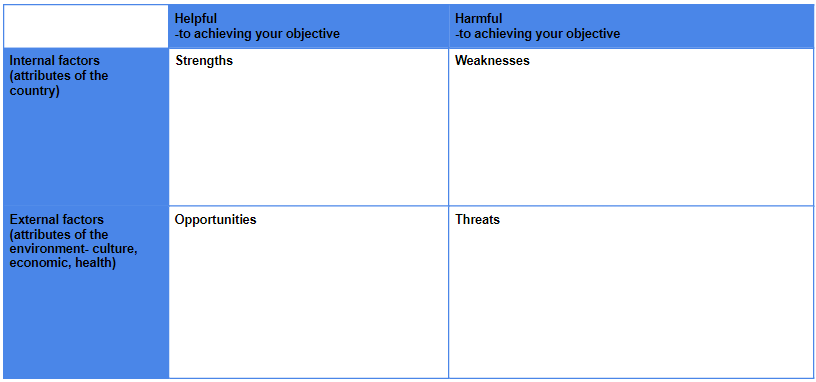
Step 4. Share
To share your work, click on the “Add a new discussion topic” button under this post and paste your operational assessment table, including the summary in the “Message” box. Make sure to reference others’ intellectual property when necessary. All references should follow 7th Edition APA formatting. For further instructions, see the resource on the Himmelfarb Health Sciences Library: APA citation resource (N.B. references are excluded from word counts).
Step 5: Interact
Evaluate and categorize the work from one of your peers based on items A - E of this rubric. Provide a rationale for the grade you’ve provided, as well as comments or suggestions for improvement. To post a reply, click “Reply” on a particular discussion, write your feedback and then click on “Post to forum.” You can use the list below as an example:
Item A is .…. because…. My suggestions for improvement are….
Item B is .…. because…. My suggestions for improvement are….
Item C is .…. because…. My suggestions for improvement are….
Item D is .…. because…. My suggestions for improvement are….
Item E is .…. because…. My suggestions for improvement are….Not available unless: The activity Quiz: Module 5 is complete and passed -
Additional Resources for Optional Learning
-
Students mustView
Read the content under the section SECTION 2: Plan for community needs assessment. (25 minutes)
CDC - 2013
-
Student Learning Outcomes:
Upon completion of this lesson, you will be able to:- Describe program management and its stages.
- Summarize key priorities and considerations when developing and implementing an evidence-based program.
-
Explain the concept, process, and purpose of the log frame development approach.
- Apply a log frame development approach for evidence-based program implementation and evaluation.
- Understand the key components, techniques and tools used when implementing a project.
- Analyze context-specific project management techniques and best practices throughout program planning based upon situation analysis.
- Describe strategies in monitoring and evaluating at all stages of the evidence-based program.
- Discuss how to apply tools for the monitoring and evaluation of an evidence-based program.
-
Students mustMark as done
Required Learning Resources and Activities
-
Students mustView
Read the entire page. (11 minutes)
Havard University
-
Students mustView
Read the entire document. (7 minutes)
Public health Ontario - 2021
-
Students mustView
Read the entire page. (7 minutes)
Center for family research & evaluation - 2020
-
-
Students mustView
Read the following contents of the document: Using the Logical Framework for Project Design pages 12-22. (25 minutes)
EU Integration Office - 2011
-
Students mustView
Read the entire page, including the content of the following hyperlink:
Gantt chart: Plan-do-check-act (PDCA) cycle. (12 minutes)American Society for Quality - 2021
-
Students mustView
Read the entire page and navigate on the tabs "Planner" and "How to" to explore tools for projects implementations. (10 minutes)
UNESCO for YOUTH - 2018
-
Students mustView
Read pages 4-7 of the document. (21 minutes)
European Coordination in Science and Technology - 2017
-
Students mustView
Read the entire page. (27 minutes)
Progect Management Institute
-
-
Peer Activity 8 - A Logical Framework Approach for Evidence-Based Program Implementation and Evaluation (360 minutes) Forum
In this activity, you will use your findings from Peer Activity 8’s situational analysis to draft a logical framework for evidence-based program implementation and evaluation.
Step 1. Review
Review the learning resources for this module, especially the ones focused on developing a log frame approach and monitoring and evaluation tools. Additionally, review the situational analysis product from Peer Activity 7. This will be used in this activity.
Step 2. Draft
Based on your situational analysis product, draft a logical framework for evidence-based program implementation and evaluation. The log frame should list your program activities, short-term outputs, medium-term outcomes, and long-term goals to address the problem selected in peer activity 7. The logframe must summarize the following:
- The program's hierarchy of objectives.
- Indicators to measure changes connected to an intervention
- Assumptions beyond the program’s direct control that are necessary to ensure the program’s success.
Step 3. Respond
Respond by placing your drafted log frame in the table below. The contents of this table should be within 300-700 words only.
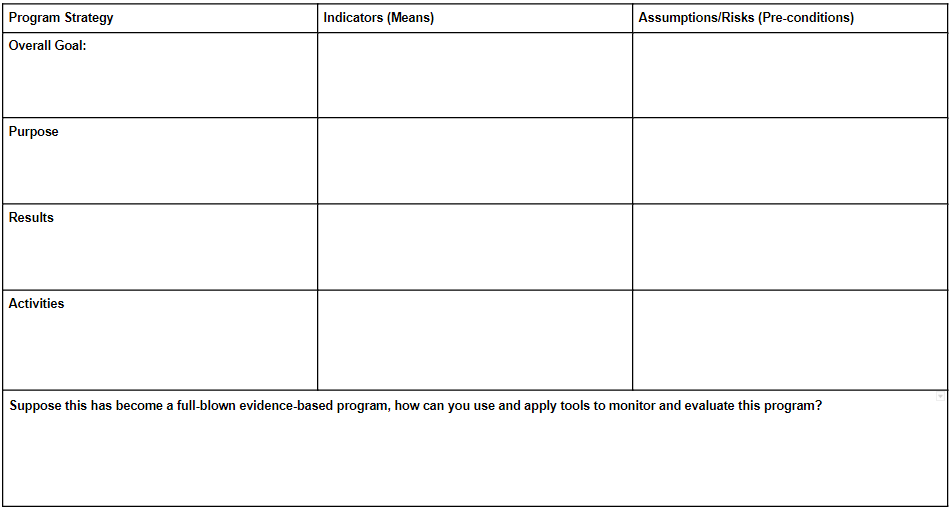
Step 4. Share
To share your work, click on the “Add a new discussion topic” button under this post and paste your operational assessment table, including the summary in the “Message” box. Make sure to reference others’ intellectual property when necessary. All references should follow 7th Edition APA formatting. For further instructions, see the resource on the Himmelfarb Health Sciences Library: APA citation resource (N.B. references are excluded from word counts).
Step 5: Interact
Evaluate and categorize the work from one of your peers based on items A - E of this rubric. Provide a rationale for the grade you’ve provided, as well as comments or suggestions for improvement. To post a reply, click “Reply” on a particular discussion, write your feedback and then click on “Post to forum.” You can use the list below as an example:
Item A is .…. because…. My suggestions for improvement are….
Item B is .…. because…. My suggestions for improvement are….
Item C is .…. because…. My suggestions for improvement are….
Item D is .…. because…. My suggestions for improvement are….
Item E is .…. because…. My suggestions for improvement are….Not available unless: The activity Peer Activity 7 - A Country-Specific SWOT Analysis (300 ... ...Not available unless: The activity Peer Activity 7 - A Country-Specific SWOT Analysis (300 minutes) is marked complete -
Quiz: Module 6
To access the quiz, click on the name of the quiz provided above. On the following screen, click the "Preview quiz now" button to respond to the questions.
TO PASS THIS QUIZ, YOU MUST OBTAIN A SCORE OF 80%
Not available unless: The activity Peer Activity 8 - A Logical Framework Approach for ... ...Not available unless: The activity Peer Activity 8 - A Logical Framework Approach for Evidence-Based Program Implementation and Evaluation (360 minutes) is marked complete
- Describe program management and its stages.
-
-
Final Exam Quiz
To take the final exam, you must complete all quizzes and complete all the required activities. The final exam consists of 50 questions, and you will have 100 minutes to complete it. When the time is over, you will have two minutes to submit your attempt before it expires, and your progress is discarded. You will not be able to answer additional questions in the grace period.
To access the exam, click on the name of the exam provided above. On the following screen, click the Preview quiz now button to respond to the questions.
Not available unless: All of: ...Not available unless:-
All of:
- The activity Course Registration is marked complete
- The activity Pre-Test is marked complete
- The activity Quiz: Module 1 is marked complete
- The activity Quiz: Module 2 is marked complete
- The activity Quiz: Module 3 is marked complete
- The activity Quiz: Module 4 is marked complete
- The activity Quiz: Module 5 is marked complete
- The activity Quiz: Module 6 is marked complete
-
All of:
- The activity Discussion Forum 1: Population Health Assessment (275 minutes) is marked complete
- The activity Discussion Forum 2 - Global Health Trends and Their Influence on Health Services (240 minutes) is marked complete
- The activity Peer Activity 1 - A Systems Thinking Approach to Project Design (240 minutes) is marked complete
- The activity Peer Activity 2 - Nutrition Adequacy and Air Quality and Risk for Diseases (300 minutes) is marked complete
- The activity Discussion Forum 3 - Ethical Issues and Codes of Ethics in Different Settings. (300 minutes) is marked complete
- The activity Peer Activity 3 - An Expository Essay on Individual Competence, Perception of Health Barriers, and Skill Adaptation (360 minutes) is marked complete
- The activity Peer Activity 4 - A Framework Proposal on Interactive Learning, Community Partnerships and Diplomacy (360 minutes) is marked complete
- The activity Peer Activity 5 - How Collaborative Leadership and Other Strategies Improve Communications in Resource-Limited Settings. (300 minutes) is marked complete
- The activity Discussion Forum 4 - An Assessment of a GHO’s Operational Capacity (300 minutes) is marked complete
- The activity Peer Activity 6 - Strengthening Capacity for Global Health. (360 minutes) is marked complete
- The activity Discussion Forum 5 - Strategies for Engaging the Vulnerable Groups in Healthcare (300 minutes) is marked complete
- The activity Discussion Forum 6 - A Social Media Post on WHO’s Influences on Human Rights in Global Health Development (300 minutes) is marked complete
- The activity Peer Activity 7 - A Country-Specific SWOT Analysis (300 minutes) is marked complete
- The activity Peer Activity 8 - A Logical Framework Approach for Evidence-Based Program Implementation and Evaluation (360 minutes) is marked complete
-
All of:
-
-
 In this section, you can provide feedback about this course to help us make NextGenU.org better. Once evaluations are completed, you will be able to download your certificate of completion.
-
Course Evaluation QuestionnaireNot available unless: The activity Final Exam is marked complete
-
Self Evaluation QuestionnaireNot available unless: The activity Final Exam is marked complete
-
-
-
Students mustMark as done
-
Students mustMark as done
-
-