

Section: Module 3: Lesson 2: Communication and partnerships | Global Health | NextGenU.org
-
Student Learning Outcomes:
Upon completion of this lesson, you will be able to:- Recognize strategies to communicate with different audiences (i.e., community partners and global constituencies).
- Discuss strategies to communicate with diverse groups of stakeholders and communities in resource-limited settings.
- Describe the concept of collaborative leadership.
- Examine collaborative leadership practices and strategies.
- Discuss how collaborative leadership can help improve communications with diverse stakeholders in resource-limited settings.
-
Students mustMark as done
Required Learning Resources and Activities
-
Students mustView
Read the content under the heading "Working with Communities" and "Conclusion" on pages 12 to 19. (18 minutes)
CDC - 2014
-
Students mustView
Read pages 3-13. (29 minutes)
Oxford Leadership - 2016
-
Students mustView
Read from the section "Background" to "Conclusion." Note: Skip the Methods section. (35 minutes)
BMC Health Services Research - 2017
-
Peer Activity 5 - How Collaborative Leadership and Other Strategies Improve Communications in Resource-Limited Settings. (300 minutes) Forum
In this activity, you will be given a set of short case scenarios where collaboration and workforce development are necessary to solve a health issue in resource-limited settings.
Step 1. Study
Study these three hypothetical case scenarios below. Select one that matches your interest.
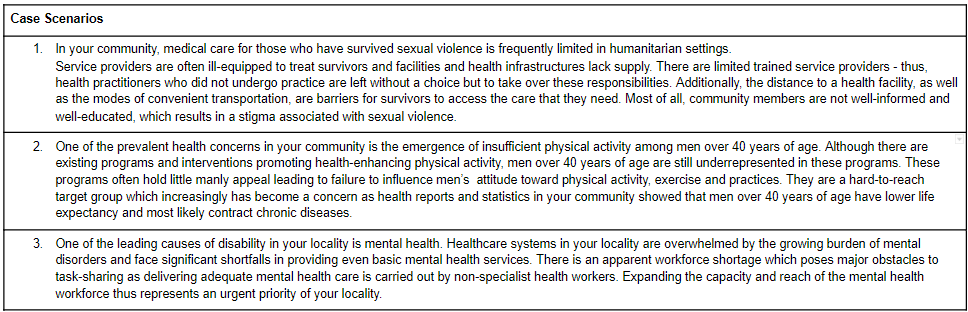
Step 2. Analyze
You have been assigned to coordinate a round table discussion with community partners and global constituencies to address your selected issue. This will be part of a collaboration and workforce development for resource-limited settings event that is being sponsored by global and regional health authorities. For this, you need to outline a strategy to communicate the available information and then to organize a discussion about potential strategies to address the problem.
Step 3. Respond
The partners have agreed to participate in the round table discussion for three hours. They also asked to be briefed about the health issue ahead of time to be prepared for discussing potential solutions during the event. Therefore, you need to:
- Prepare an agenda for the round table discussion: Keep collaborative leadership practices in mind when designing your agenda. You want to encourage stakeholders to take leading roles and provide their views and ideas to address the issue, but you also need to keep the discussion focused on collaboration and workforce development. The agenda should reflect your knowledge about communication and collaboration strategies.
- Plan the elaboration of information materials about the problem to be addressed: For this, your team will need a prepare a 300-650 word communication plan that discusses the following:
- Description of the type of materials to be used and specific communication strategies to be employed.
- Rationale that articulates the value of applying communication and collaborative leadership strategies (both new and existing) to improve collaboration and partnerships about the selected scenario.
- Implications not only to the target beneficiaries but also in the professional practice.
Note: Bear in mind that your diverse audience includes community partners with little health background and global constituencies with little base knowledge about the extent of the specific health issue in the community.
Step 4. Share
To share your work, click on the “Add a new discussion topic” button under this post and paste your work in the “Message” box. Make sure to reference others’ intellectual property when necessary. All references should follow 7th Edition APA formatting. For further instructions, see the resource on the Himmelfarb Health Sciences Library: APA citation resource (N.B. references are excluded from word counts).
Step 5: Interact
Evaluate and categorize the work from one of your peers based on items A - E of this rubric. Provide a rationale for the grade you’ve provided, as well as comments or suggestions for improvement. To post a reply, click “Reply” on a particular discussion, write your feedback and then click on “Post to forum.” You can use the list below as an example:
Item A is .…. because…. My suggestions for improvement are….
Item B is .…. because…. My suggestions for improvement are….
Item C is .…. because…. My suggestions for improvement are….
Item D is .…. because…. My suggestions for improvement are….
Item E is .…. because…. My suggestions for improvement are…. -
Quiz: Module 3
To access the quiz, click on the name of the quiz provided above. On the following screen, click the "Preview quiz now" button to respond to the questions.
TO PASS THIS QUIZ, YOU MUST OBTAIN A SCORE OF 80%