

Section: Module 6: Lesson 1: What is Effective Communication? | Public Health Communications | NextGenU.org
-
Student Learning Outcomes:
Upon completion of this lesson, you will be able to:- Understand the definition of effective communication.
- Differentiate the characteristics of effective communication against the barriers to effective communication.
-
Students mustMark as done
Read the section "Communication is an Essential MCH Leadership Skill." (7 minutes)
National Center for Biotechnology Information - 2016
-
Students mustMark as done
Read the entire webpage. (2 minutes)
Open Learn create - 2011
-
Students mustMark as done
Read the content under the heading "Introduction" and "Principles of making effective communication in organization" (3 minutes)
Journal of Applied and Advanced Research-India - 2018
-
Students mustMark as done
Read the following sections:
- Principle: Accessible (page 4 up to "Identify Effective Channels" on page 5)
- Principle: Actionable (page 9 up to "Increase Awareness" on page 11)
- Principle: Credible and Trusted (page 17 up to "Coordinate with Partners" on page 20)
- Principle: Relevant (page 24 up to "Know the Audience" on page 5)
- Principle: Timely (page 30 up to "Communicate what who knows early" on page 31)
- Principle: Understandable (page 35) (24 minutes)WHO - 2017
-
Students mustMark as done
Read the content under the heading "Introduction" "Results" and "conclusions" (16 minutes)
Universidad del Zulia - 2019
-
Students mustViewStart discussions: 1
In this activity, you will differentiate between the characteristics of effective communication and its barriers by writing a case scenario for a specific public health topic or issue.
Step 1. Study
Study the provided learning resource for Module 6 Lesson 1, especially the resource on barriers and facilitators to effective communication. Then, access this website APHA to be acquainted with some common topics and issues in the realms of public health.
Step 2. Select
From APHA's list of common topics in public health, choose three topics. You will use these three topics in writing a specific case scenario for each.
Example: Category- Lead contamination
Step 3. Respond
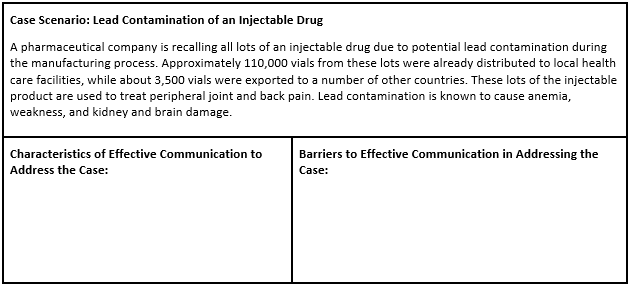
After selecting, you will formulate a sample case scenario for each chosen topic/ issue (3 topics = 3 case scenarios). From the sample case scenario, you will differentiate what characteristics of effective communication should be demonstrated in solving the case scenario and the barriers to effective communication that may be encountered. The expected word count for each case scenario is 100-300 words ( Total: 300-900 words)
Example:
Step 3: Share
To share your work, click on the "Reply" button under this post and paste your work in the "Message" box. Make sure to reference others' intellectual property when necessary. All references should follow 7th Edition APA formatting. For further instructions, see the Himmelfarb Health Sciences Library resource: APA citation resource (N.B. references are excluded from word counts).
Step 4: Interact
To complete the activity, you will need to reply to at least two posts made by your peers in a respectful and professional manner. Be sure that your post engages your peers' ideas by including a reflection on their comments, sharing ideas of other potential difficulties and parties involved, or asking thought-provoking questions. If a peer comments on your posting, please reply. To post a reply, click "Reply" on a particular discussion, write your feedback and then click on "Post to the Forum."
OPTIONAL Step 5: Interact (10 minutes)
If you would like to, you can reply to your peers' posts in a respectful and professional manner. Ensure that your post engages your peers' ideas by including a reflection on their comments, sharing ideas of other potential difficulties and parties involved, or asking thought-provoking questions. If a peer comments on your posting, please reply. To post a reply, click “Reply” on a particular discussion, write your feedback and then click on “Post to forum.”